
paper
🚨 EVERYONE WANTS LEADERS WHO ACT FAST. BUT WHO PAYS WHEN THEY ACT BEFORE THEY THINK?
When leaders move fast, who bears the consequences? ISI examines the limits of reversible decisions and introduces the Reversibility Test™.

Work examining the conditions required for sound judgment, accountability, and ethical decision-making under pressure.
paper
When leaders move fast, who bears the consequences? ISI examines the limits of reversible decisions and introduces the Reversibility Test™.

Dr Alwin Tan
KPIs are meant to measure progress toward purpose. But when targets acquire enough organisational power, the relationship can reverse: people begin serving the metric rather than the metric serving the purpose.

papers
Most organisations have two risk appetites: the one approved by the board and the one expressed through behaviour. The governance challenge is not what appetite leaders declare, but what appetite the system actually rewards.
paper
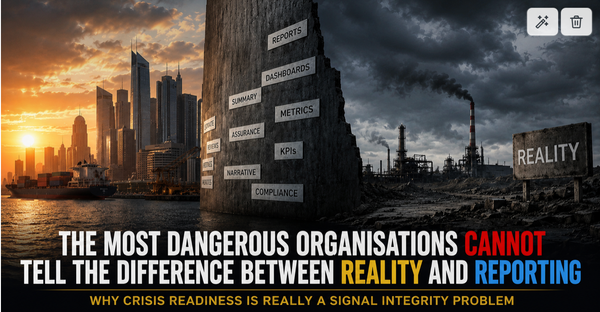
Most organisational crises are visible long before they become public. The real danger is not a lack of information, but the distortion of reality as it moves through the system. When reporting becomes disconnected from reality, governance failure becomes inevitable.

paper
The most dangerous leadership failures often occur when successful leaders continue using yesterday's leadership model to solve tomorrow's problems. A new ISI perspective on leadership fit, governance risk and adaptive capability.

paper
Growth does not merely increase scale. It changes the structure of the system. The very behaviours that helped organisations succeed can eventually become the conditions that destabilise them.

paper
Most organisations investigate catastrophe. Resilient organisations investigate almost-catastrophe. Near misses are not embarrassment or incompetence—they are organisational intelligence. Institutions rarely collapse without warning. More often, they stop listening before they stop functioning.
paper
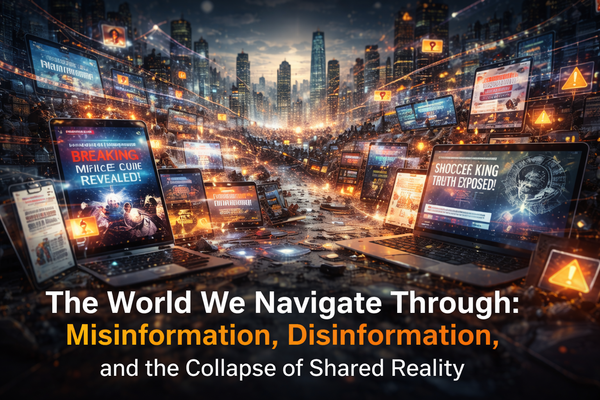
Misinformation and disinformation are not simply problems of false content. They are symptoms of a deeper erosion of shared reality. As digital systems amplify distortion and synthetic media blurs truth, information integrity is emerging as a critical governance challenge.
paper
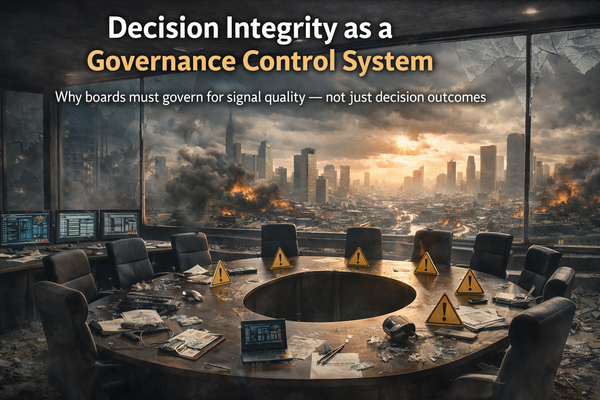
Governance failures rarely begin with a lack of information. They begin when boards receive distorted, filtered, delayed, or incomplete signals and mistake them for reality. Effective governance depends on signal quality, escalation integrity, and decision-making processes—not just compliance.

paper
This paper introduces the Failure Taxonomy — a structural model showing how harm accumulates in complex systems through drift, signal loss, and accountability inversion, without anyone intending it.

paper
Governance systems are designed for stability. Under sustained stress, visibility distorts, oversight becomes selectively blind, drift normalises, and outcomes become predictable.

paper
Dr Alwin Tan, GAICD, MBBS, FRACS, EMBA (University of Melbourne), AI in Healthcare (Harvard Medical School) Institute for Systems Integrity Introduction: the limits of individual explanations When adverse outcomes occur, organisations often focus first on individual actions. Questions such as who made the wrong decision or who failed to follow