🚨 EVERYONE WANTS LEADERS WHO ACT FAST. BUT WHO PAYS WHEN THEY ACT BEFORE THEY THINK?
When leaders move fast, who bears the consequences? ISI examines the limits of reversible decisions and introduces the Reversibility Test™.
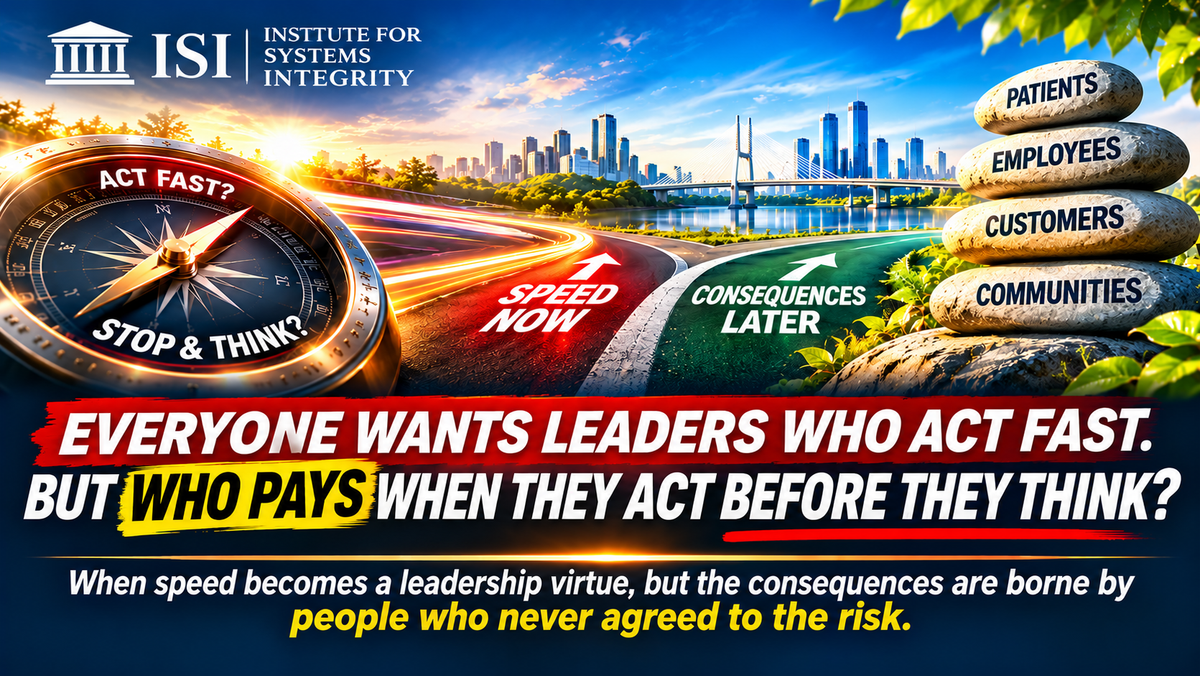
When speed becomes a leadership virtue,
but the consequences are borne by people who never agreed to the risk.
Dr Alwin Tan, GAICD, MBBS, FRACS, EMBA (Melbourne Business School)
Senior Surgeon | Governance Leader | HealthTech Co-founder | Founder of Institute for Systems Integrity (ISI) | Harvard Medical School — AI in Healthcare | University of Oxford — Sustainable Enterprise | Bastas Academy for Healthcare Leadership — Triple Scholar
THE DECISION TOOK FIVE MINUTES.
THE CONSEQUENCES COULD LAST A LIFETIME.
A hospital executive approves a new clinical system.
A bank pushes employees to meet ambitious targets.
An airline introduces changes to an aircraft's operating systems.
A government agency automates decisions affecting thousands of citizens.
A technology company releases an AI application before every risk is understood.
In each organisation, the language sounds familiar.
We need to move faster.
We cannot wait for perfect information.
Our competitors are already ahead.
We can fix the problems later.
Sometimes, those arguments are entirely reasonable.
But there is a question that rarely appears in the presentation.
🚨 WHO GETS TO DECIDE THAT THE RISK IS ACCEPTABLE — AND WHO MUST LIVE WITH THE CONSEQUENCES IF THEY ARE WRONG?
The executive can reverse a decision.
The company can withdraw a product.
The board can commission an investigation.
The government can amend a policy.
BUT CAN THE PATIENT REVERSE AN INJURY?
CAN THE EMPLOYEE RECOVER A DESTROYED CAREER?
CAN THE CUSTOMER RECLAIM AN OPPORTUNITY ALREADY LOST?
CAN THE FAMILY UNDO THE CONSEQUENCES OF A DECISION THAT SHOULD NEVER HAVE BEEN MADE THAT WAY?
This is not simply a question about speed.
It is about power, responsibility, risk and the limits of organisational correction.
1. AMAZON'S BIAS FOR ACTION:
A GOOD PRINCIPLE THAT DESERVES A HARDER QUESTION
Amazon's leadership principle Bias for Action encourages speed, calculated risk-taking and avoiding unnecessary analysis where decisions can be reversed (Amazon, n.d.).
Jeff Bezos expanded this idea through his distinction between one-way and two-way doors.
Some decisions are consequential and difficult to reverse.
Others can be tested, evaluated and changed.
In his 2016 shareholder letter, published in 2017, Bezos suggested that many business decisions could be made with around 70% of the information leaders would ideally like to possess, provided organisations can recognise and correct mistakes quickly (Bezos, 2017).
There is considerable wisdom in that approach.
Excessive bureaucracy can delay innovation.
Endless committees can prevent necessary action.
Fear of failure can become a greater obstacle than failure itself.
And organisations that wait for certainty may never act.
BUT THERE IS AN ASSUMPTION HIDDEN INSIDE THE WORD "REVERSIBLE".
Reversible for whom?
The CEO?
The board?
The company?
Or the person affected by the decision?
A DECISION CAN BE REVERSIBLE FOR THE ORGANISATION AND IRREVERSIBLE FOR THE PERSON WHO BEARS ITS CONSEQUENCES.
That distinction is central to responsible governance.
2. HEALTHCARE: THE HOSPITAL CAN REVERSE THE POLICY. THE PATIENT CANNOT REVERSE THE HARM.
Consider an illustrative hospital scenario.
Management introduces a new clinical workflow.
The implementation date has been announced.
Training is incomplete.
Nurses raise concerns about handovers.
Doctors identify potential risks.
The project team argues that delaying implementation would damage momentum.
The system goes live.
A patient is harmed after a breakdown in communication.
The hospital investigates.
The workflow is withdrawn.
Additional training is introduced.
From management's perspective, corrective action has been taken.
But the patient may still experience a bad outcome.
The family may still be grieving.
And the clinicians involved may carry the consequences long afterwards.
🚨 THE SYSTEM WAS REVERSED. THE HARM WAS NOT.
This scenario is illustrative, not a claim about a particular hospital.
The broader safety lesson is supported by established research.
Haynes et al. (2009) studied the introduction of the WHO Surgical Safety Checklist across eight hospitals.
Observed major complications declined from 11.0% to 7.0%, while mortality declined from 1.5% to 0.8%.
The before-and-after design does not prove that the checklist alone caused these improvements. Nevertheless, the findings demonstrate the potential value of structured safety processes.
In healthcare, a pause can be protective.
A checklist can prevent an avoidable error.
A second opinion can challenge an incorrect assumption.
But excessive delay can also harm patients.
A patient with uncontrolled bleeding cannot wait for another committee.
The governance distinction is therefore between necessary clinical urgency and organisationally manufactured urgency.
A PATIENT'S EMERGENCY IS URGENT.
AN EXECUTIVE'S PREFERRED LAUNCH DATE IS NOT AUTOMATICALLY AN EMERGENCY.
3. AVIATION: WHEN DESIGN ASSUMPTIONS MEET THE REALITY OF THE COCKPIT
The Boeing 737 MAX tragedies provide a documented example of why high-consequence technical decisions require effective oversight.
Lion Air Flight 610 crashed in October 2018.
Ethiopian Airlines Flight 302 crashed in March 2019.
A total of 346 people died.
Subsequent investigations examined the role of the Maneuvering Characteristics Augmentation System (MCAS), certification processes, training, communication and organisational oversight.
The US Department of Transportation Office of Inspector General identified limitations in Federal Aviation Administration certification guidance, incomplete understanding of MCAS safety assessments and communication weaknesses (US Department of Transportation OIG, 2021).
The Joint Authorities Technical Review also identified concerns about assumptions concerning flight crew responses and the integration of operational considerations into certification (JATR, 2019).
These findings should not be simplified into a claim that moving quickly was the sole cause of the accidents.
The failures were more complex.
But they expose a critical governance issue.
WHAT HAPPENS WHEN THE PEOPLE APPROVING A SYSTEM DO NOT FULLY UNDERSTAND HOW PEOPLE MUST RESPOND WHEN IT FAILS?
A manufacturer can modify software.
A regulator can revise certification requirements.
An airline can introduce additional training.
But the lives lost cannot be restored.
THE AIRCRAFT CAN RETURN TO SERVICE.
THE PEOPLE WHO DIED CANNOT RETURN HOME.
The lesson extends far beyond aviation.
Technical assurance must include the realities of human performance, especially when the consequences of failure are catastrophic.
4. BANKING: WHEN PERFORMANCE TARGETS BECOME MORE IMPORTANT THAN CUSTOMERS
In 2016, the US Consumer Financial Protection Bureau took enforcement action against Wells Fargo over widespread unauthorised account-opening practices.
According to the regulator, employees opened accounts without customers' knowledge or consent, influenced by sales targets and financial incentives.
The bank's analysis at that time identified more than two million potentially unauthorised accounts (CFPB, 2016).
This was not primarily a documented failure of rapid product deployment.
It was a failure involving incentives, conduct and oversight.
But it reveals another danger when organisational priorities become disconnected from the people exposed to their consequences.
The bank wanted stronger sales performance.
Employees faced pressure to deliver.
Customers carried the consequences of misconduct.
THE ORGANISATION REWARDED THE NUMBERS.
THE CUSTOMER CARRIED THE RISK.
Australia's Banking Royal Commission identified broader problems involving financial incentives, conflicts of interest, poor governance and failures to hold institutions accountable (Royal Commission into Misconduct in the Banking, Superannuation and Financial Services Industry, 2019).
These findings raise a challenge for every board.
Are executives being rewarded for decisions that create sustainable value?
Or for delivering results whose costs are transferred elsewhere?
A decision can look successful in a quarterly report while producing lasting consequences for customers.
WHEN THE REWARD FOR SUCCESS IS IMMEDIATE
BUT THE CONSEQUENCES OF FAILURE ARE DELAYED,
WHO REMAINS ACCOUNTABLE?
5. GOVERNMENT: ROBODEBT AND THE HUMAN COST OF ADMINISTRATIVE FAILURE
Australia does not need to look overseas for evidence of the consequences of failed organisational decision-making.
The Robodebt scheme began in 2015 and was discontinued in 2020.
It used automated processes in social security debt compliance, including income averaging that produced debts without an adequate lawful basis.
The Royal Commission's 2023 report documented serious failures in public administration, the treatment of affected individuals and the response to concerns about the scheme.
The Commission made 57 recommendations, including proposals concerning automated decision-making, review pathways, transparency and independent scrutiny (Royal Commission into the Robodebt Scheme, 2023).
The human consequences extended beyond administrative inconvenience.
People experienced financial distress, fear, shame and significant hardship.
The scheme was eventually stopped.
Debts were addressed through subsequent legal and administrative processes.
But that did not necessarily restore every affected person's wellbeing, opportunities or trust.
🚨 GOVERNMENT CAN WITHDRAW AN UNLAWFUL DECISION. CAN IT GIVE PEOPLE BACK THE YEARS THEY SPENT LIVING WITH ITS CONSEQUENCES?
Robodebt should not be characterised as a failure caused simply by speed.
The documented failures included legality, administration, institutional behaviour and accountability.
Its relevance to this paper is the danger of assuming that an organisation's ability to correct a decision means the consequences have been fully repaired.
It also demonstrates why effective challenge must remain possible even after senior leaders have committed to a policy.
6. TECHNOLOGY: THE SYSTEM CAN BE FIXED. THE DAMAGE MAY ALREADY BE DONE.
The UK Post Office Horizon scandal illustrates the long-term consequences of institutional reliance on flawed technology and the failure to respond appropriately to evidence challenging it.
Problems associated with the Horizon accounting system contributed to apparent financial shortfalls.
Subpostmasters faced allegations, financial demands, wrongful prosecutions and convictions.
The subsequent inquiry and government responses have examined failures extending across technology, investigation, institutional accountability and redress (UK Department for Business and Trade, 2025).
The central lesson is not that Horizon failed because leaders acted too quickly.
It is that an organisation's commitment to a system can outlast its willingness to question the system's reliability.
THE TECHNOLOGY WAS TREATED AS TRUSTWORTHY.
THE PEOPLE CHALLENGING IT WERE NOT.
Software can be corrected.
Convictions can be overturned.
Compensation can be provided.
But years of damaged reputation, financial hardship and personal suffering cannot necessarily be undone.
CORRECTING THE RECORD IS NOT THE SAME AS RESTORING THE PERSON.
For boards, this raises a question that should be asked long before a crisis emerges.
Who has the authority to challenge the system when its outputs conflict with credible human evidence?
And who has the power to reverse decisions made in reliance on those outputs?
7. AI: YOUR MODEL HAS A ROLLBACK BUTTON. DOES THE PERSON IT HARMED HAVE ONE?
Artificial intelligence makes this problem more urgent.
AI systems can be deployed rapidly and at considerable scale.
Models can be updated.
Outputs can be regenerated.
Applications can be disabled.
But their consequences may extend beyond the technology.
Consider three illustrative scenarios.
A hospital introduces an AI tool that makes an incorrect clinical recommendation.
A financial institution uses an automated model that unfairly excludes customers.
An employer adopts AI recruitment software that systematically disadvantages qualified applicants.
In each case, the organisation may be able to withdraw or modify the system.
But what happens to decisions already made?
🚨 YOU CAN TURN THE AI OFF.
CAN YOU UNDO WHAT IT HAS ALREADY DONE?
The NIST AI Risk Management Framework emphasises four functions: Govern, Map, Measure and Manage (NIST, 2023).
These functions support continuous attention to risk throughout the AI lifecycle.
The framework does not suggest that an organisation can eliminate every risk.
Rather, it recognises the need to understand, assess and manage risks in context.
For ISI, this leads to a critical distinction.
TECHNICAL REVERSIBILITY IS NOT HUMAN REVERSIBILITY.
Technical reversibility asks whether a system can be withdrawn, modified or restored.
Human reversibility asks whether the affected person can realistically recover their health, privacy, finances, employment, dignity or opportunity.
These are different questions.
And responsible governance must consider both.
8. THE OTHER SIDE: SOMETIMES WAITING IS THE MOST DANGEROUS DECISION
It would be a mistake to conclude that slower decisions are always safer.
They are not.
Consider an emergency physician treating a patient in cardiac arrest.
A cybersecurity team responding to an active attack.
An aviation crew dealing with an immediate threat.
A manufacturer deciding whether to recall a dangerous product.
In these circumstances, delaying action may increase harm.
Indeed, the 2017 WannaCry cyberattack on England's NHS provides a useful counterexample to excessive organisational delay.
The UK National Audit Office reported that the NHS had received warnings about cybersecurity vulnerabilities before the attack.
The attack subsequently caused widespread disruption, with more than 19,000 appointments estimated to have been cancelled (National Audit Office, 2017).
This case illustrates the costs of inadequate preparation and delayed risk reduction, rather than the dangers of moving too quickly.
INACTION IS STILL A DECISION.
AND SOMETIMES IT IS THE MOST DANGEROUS ONE.
Amazon's Bias for Action has genuine value.
It challenges unnecessary bureaucracy.
It encourages initiative.
It supports experimentation.
It recognises that organisations must sometimes act with incomplete information.
The governance challenge is not to eliminate speed.
It is to match decision speed to the likely consequences, available evidence and ability to detect and correct harm.
THE RIGHT QUESTION IS NOT "HOW FAST CAN WE MOVE?"
IT IS "HOW FAST CAN WE MOVE RESPONSIBLY?"
9. THE HIDDEN POWER IMBALANCE:
WHO GETS TO TAKE THE RISK?
Across these industries, a common problem emerges.
The people approving consequential decisions are not always the people exposed to their greatest risks.
A hospital executive approves a workflow.
The nurse implements it.
The patient experiences its consequences.
A bank sets performance targets.
Employees face pressure.
Customers experience misconduct.
A government agency adopts an administrative process.
Officials administer it.
Citizens bear the consequences of errors.
A technology company deploys AI.
Developers and executives control the system.
Users experience its outputs.
THE POWER TO MAKE A DECISION AND THE BURDEN OF LIVING WITH IT ARE OFTEN HELD BY DIFFERENT PEOPLE.
That separation is not automatically unethical.
Organisations necessarily delegate authority.
But where decision-makers are insulated from the consequences they impose, governance must ensure that affected people's interests are adequately represented.
Otherwise, the organisation may classify a decision as acceptable because its own losses are manageable.
While the losses experienced by others are not.
A RISK IS NOT SMALL SIMPLY BECAUSE THE PERSON APPROVING IT WILL NOT BE THE PERSON HARMED.
10. INTRODUCING THE ISI REVERSIBILITY TEST™
The Institute for Systems Integrity proposes the ISI Reversibility Test™ as a conceptual framework for examining consequential decisions before accelerating implementation.
It is intended to complement existing legal, regulatory, clinical and organisational risk-management requirements.
The test asks five questions.
R — REVERSIBILITY
Can the consequences genuinely be undone?
Not simply the software.
Not simply the policy.
Not simply the financial commitment.
Can affected people realistically recover their previous position?
Where full reversal is impossible, that limitation must be recognised.
E — EXPOSURE
Who bears the consequences if the decision is wrong?
The executive?
The employee?
The patient?
The customer?
The community?
And did those affected have any meaningful opportunity to raise concerns?
E — EVIDENCE
What minimum evidence is necessary to act responsibly?
What assumptions remain untested?
What independent expertise has been sought?
What evidence challenges the preferred decision?
What uncertainty is acceptable, and what uncertainty is not?
S — SAFEGUARDS
Which protections must remain in place regardless of urgency?
Clinical safety checks.
Regulatory requirements.
Independent validation.
Human oversight.
Escalation pathways.
Professional judgement.
Urgency must not become an automatic exemption from accountability.
C — CORRECTION
How quickly can harm be detected, stopped and remedied?
Who can pause implementation?
What signals trigger review?
Who investigates emerging problems?
What remedies are available?
And who remains responsible when the original decision-maker has moved on?
THE ISI REVERSIBILITY TEST™
REVERSIBILITY → EXPOSURE → EVIDENCE → SAFEGUARDS → CORRECTION
Its central proposition is:
THE FASTER AN ORGANISATION WANTS TO MOVE, THE MORE CLEARLY IT MUST UNDERSTAND WHAT CANNOT BE UNDONE.
The framework remains a proposed governance model requiring further testing and refinement.
11. A PRACTICAL TEST FOR BOARDS:
NOT EVERY DECISION NEEDS THE SAME SPEED
Boards should not approve every operational decision.
That would create unnecessary bureaucracy and blur the distinction between governance and management.
Instead, boards should ensure that organisations have proportionate decision-making processes.
Four situations require different responses.
LOW CONSEQUENCE, EASILY REVERSIBLE
Act quickly.
Use bounded experimentation.
Monitor outcomes.
Correct mistakes promptly.
HIGH CONSEQUENCE, EASILY REVERSED TECHNICALLY
Proceed with caution.
Limit exposure.
Validate assumptions.
Recognise that technical rollback may not reverse human harm.
LOW CONSEQUENCE, DIFFICULT TO REVERSE
Consider the long-term commitment.
Seek appropriate evidence.
Avoid unnecessary urgency.
HIGH CONSEQUENCE, DIFFICULT TO REVERSE
Require stronger assurance.
Identify affected stakeholders.
Protect critical safeguards.
Establish clear authority to stop or modify implementation.
There is one essential qualification.
If delaying action would itself cause serious harm, that risk must also be considered.
The objective is proportionate decision-making, not automatic delay.
12. TEN QUESTIONS EVERY BOARD SHOULD ASK
Before endorsing a consequential decision made under time pressure, directors should ask:
Why must this decision be made now?
What harm could result from delaying it?
Which consequences are genuinely reversible?
Who carries the greatest risk if we are wrong?
What evidence supports proceeding?
What evidence challenges management's preferred approach?
Which safeguards cannot be bypassed?
Who can stop implementation without fear of retaliation?
How will affected people obtain review and remedy?
Who remains accountable after the project is declared complete?
These questions should not become another administrative checklist completed without reflection.
They are intended to expose assumptions that conventional project reporting may overlook.
A GREEN DASHBOARD DOES NOT PROVE THAT THE CONSEQUENCES OF A DECISION ARE ACCEPTABLE.
Nor does successful implementation prove that the organisation has acted responsibly.
13. THE REAL LEADERSHIP TEST:
WHAT HAPPENS AFTER THE DECISION?
We admire leaders who act.
We celebrate executives who deliver.
We reward organisations that innovate.
And there are good reasons for doing so.
But speed is not a virtue in isolation.
A decision made quickly can be excellent.
A decision made slowly can be disastrous.
What matters is whether the organisation understood the risks, considered those affected, protected essential safeguards and remained accountable for the consequences.
That accountability must extend beyond project completion.
Beyond the next quarterly report.
Beyond the executive's tenure.
Beyond the announcement that the problem has been fixed.
Because the consequences may remain long after the decision-makers have moved on.
🚨 LEADERSHIP IS NOT JUST HAVING THE COURAGE TO MAKE A DECISION.
IT IS HAVING THE INTEGRITY TO REMAIN ACCOUNTABLE FOR WHAT HAPPENS NEXT.
Amazon's Bias for Action offers a valuable challenge to organisations trapped in unnecessary bureaucracy.
The Institute for Systems Integrity offers a complementary challenge.
Before calling a decision reversible, examine whether the people affected can genuinely recover from its consequences.
Before celebrating speed, understand who carries the risk.
Before rewarding the executive, examine the experience of those affected.
And before declaring a failure corrected, ask whether the people harmed have actually been restored.
SPEED IS NOT THE PROBLEM.
THE PROBLEM BEGINS WHEN LEADERS CAN REVERSE THEIR DECISIONS, BUT THE PEOPLE THEY HARM CANNOT REVERSE THE CONSEQUENCES.
So the final question for every board, CEO and executive team is this:
🚨 BEFORE YOU TELL YOUR PEOPLE TO MOVE FASTER, HAVE YOU ASKED WHO WILL PAY IF YOU ARE WRONG?
AND WILL YOU STILL BE THERE TO TAKE RESPONSIBILITY WHEN THEY DO?
References — Harvard style
Amazon (n.d.) Amazon leadership principles. Available at: https://www.aboutamazon.com/about-us/leadership-principles
Bezos, J. (2017) 2016 letter to shareholders. Amazon. Available at: https://www.aboutamazon.com/news/company-news/2016-letter-to-shareholders
Consumer Financial Protection Bureau (CFPB) (2016) Consumer Financial Protection Bureau fines Wells Fargo $100 million for widespread illegal practice of secretly opening unauthorized accounts. 8 September.
Haynes, A.B. et al. (2009) ‘A surgical safety checklist to reduce morbidity and mortality in a global population’, New England Journal of Medicine, 360(5), pp. 491–499
Joint Authorities Technical Review (JATR) (2019) Boeing 737 MAX flight control system: Observations, findings, and recommendations.
National Audit Office (2017) Investigation: WannaCry cyber attack and the NHS. London: National Audit Office.
National Institute of Standards and Technology (NIST) (2023) Artificial Intelligence Risk Management Framework (AI RMF 1.0). NIST AI 100-1. Gaithersburg, MD: NIST.
Royal Commission into Misconduct in the Banking, Superannuation and Financial Services Industry (2019) Final report. Canberra: Commonwealth of Australia.
Royal Commission into the Robodebt Scheme (2023) Report of the Royal Commission into the Robodebt Scheme. Canberra: Commonwealth of Australia.
UK Department for Business and Trade (2025) Post Office Horizon IT Inquiry.
US Department of Transportation, Office of Inspector General (2021) Weaknesses in FAA's certification and delegation processes hindered its oversight of the 737 MAX 8. Report AV2021020.
© 2026 Institute for Systems Integrity.
The ISI Reversibility Test™ is a proposed conceptual governance framework, not an independently validated assessment instrument. Illustrative scenarios are identified as such. Documented cases are discussed for their governance lessons and should not be interpreted as sharing a single cause. This publication is an independent examination of leadership principles and is not affiliated with or endorsed by Amazon.