The Institute for Systems Integrity (ISI)
examines how decisions fail under pressure — and what governance, design, and accountability are required to protect people, institutions, and public trust.
Current Publication :
Shock-Resilient Entrepreneurship: A Systems Integrity Playbook for Small Business in an Era of Global Disruption

In an era defined by geopolitical instability, energy volatility, and cascading economic shocks, small businesses are increasingly operating on the edge of uncertainty. Shock-Resilient Entrepreneurship reframes crisis not as an isolated event, but as a systemic stress test—one that exposes hidden dependencies, weak signals, and fragile decision structures. This ISI playbook brings together evidence, strategy, and systems thinking to help entrepreneurs move beyond reactive survival and instead build organizations that can absorb disruption, adapt with clarity, and sustain performance under pressure.
 Institute for Systems Integrity
AI Managers vs People Managers: Governance Lessons from Human and Machine Failure Modes
As artificial intelligence shifts from experimentation into operational reality, organisations are confronting a new governance challenge: they are no longer managing only people, but also autonomous systems with fundamentally different behaviours and risks. This article examines why managing humans and managing AI require distinct control systems—and what boards must now oversee to ensure safety, reliability, and accountability.
 Institute for Systems Integrity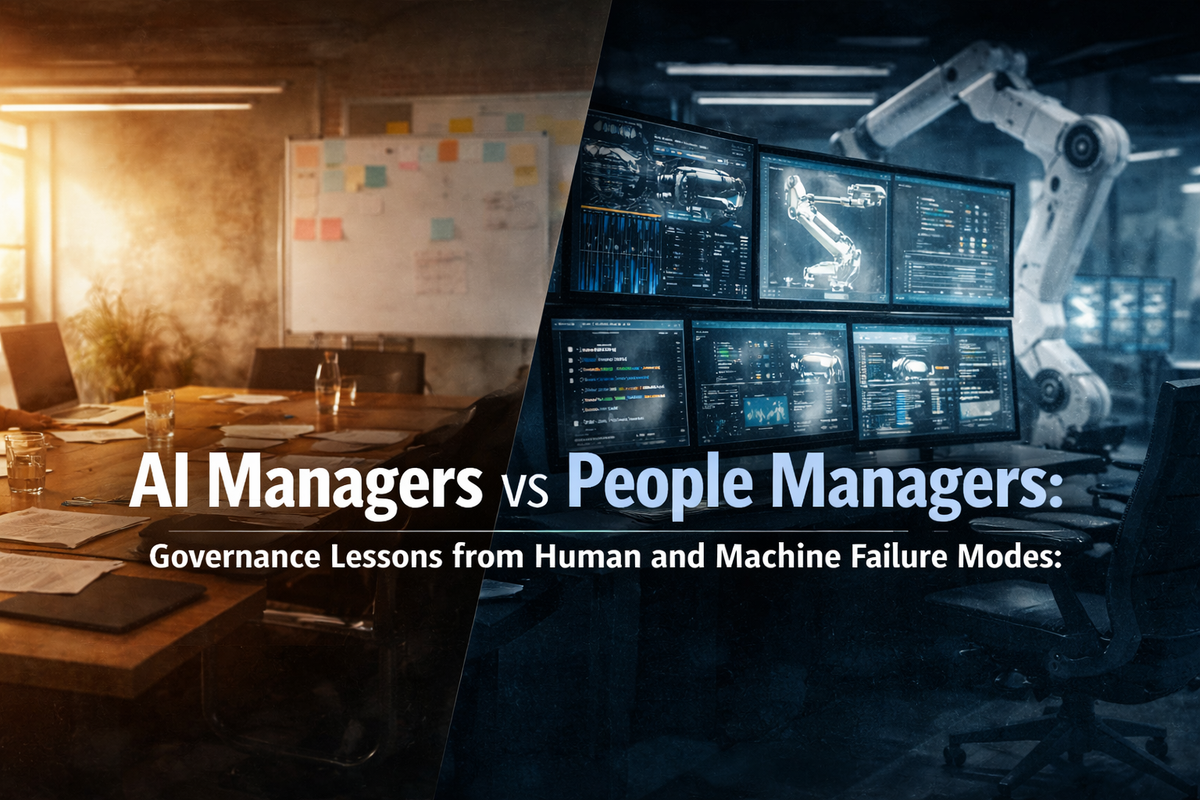
Tone at the Top, Drift in the System: Why ethical drift begins when leadership signals are inconsistent, tolerated, or ignored
Most organisations don’t fail because of a single unethical decision—they drift. Tone at the Top, Drift in the System examines how culture is shaped not by stated values, but by the signals leaders send through what they reward, ignore, and tolerate. Drawing on governance research and real-world patterns, this article explores how small inconsistencies accumulate into systemic risk, and why boards must look beyond frameworks to the behaviours that are quietly allowed to continue.
 Institute for Systems Integrity
🏛️ When AI Writes the Discharge Summary: A Governance, Duty, and Systems Integrity Challenge
As generative AI tools move rapidly into clinical workflows, their use in discharge summaries and medication instructions is often framed as a productivity gain. Emerging evidence, however, suggests a more complex reality. While AI can produce outputs that are complete, fluent, and consistent, safety-critical risks — including hallucinations, incorrect instructions, and uneven performance across patient groups — persist. This article reframes AI-generated discharge communication not as a documentation tool, but as a governance and systems integrity challenge requiring board-level oversight, clear accountability, and robust control design.
 Institute for Systems Integrity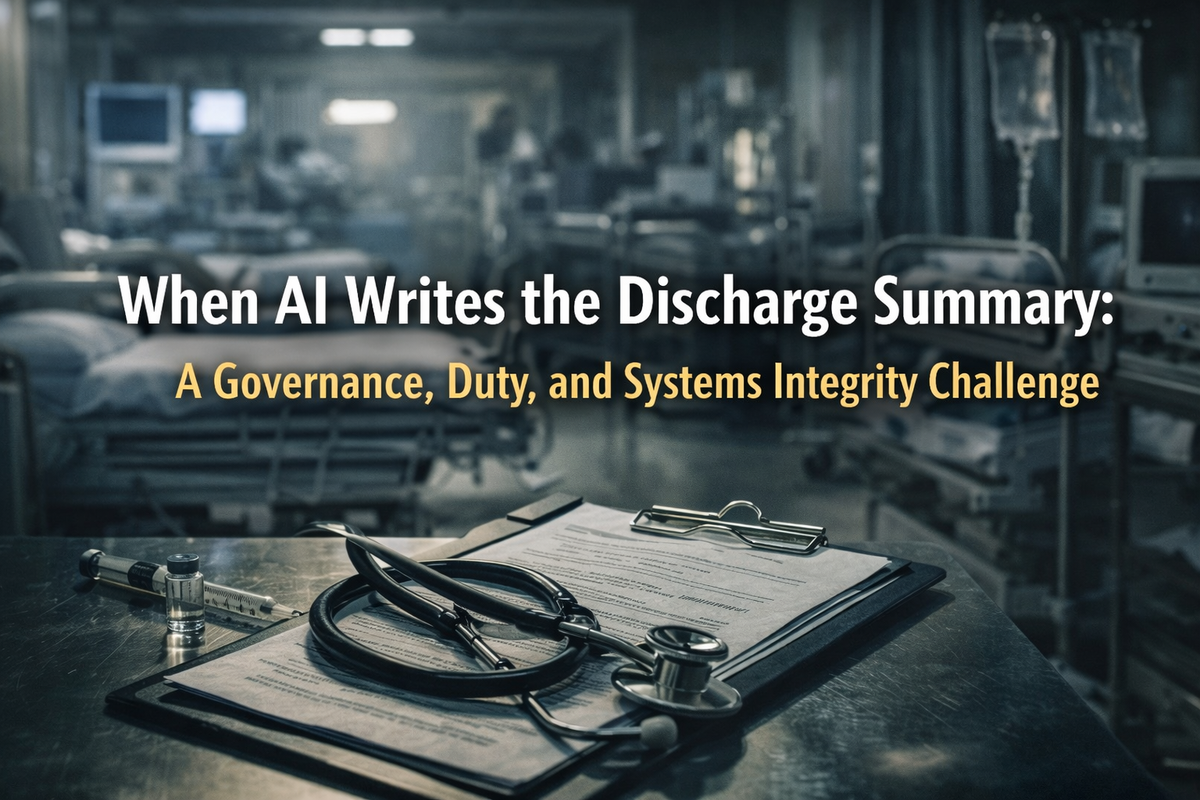
Adding Value Through Ethical Leadership: Why Board Behaviour Shapes System Integrity
Ethics is often discussed in governance as culture, values, or compliance. But within complex organisations, ethical leadership functions as something more structural. Board behaviour shapes decision environments, influences how risks are surfaced, and determines whether integrity is reinforced or gradually eroded. In this article, the Institute for Systems Integrity examines why ethical discipline at the board level is not symbolic governance, but a core mechanism through which systems remain credible, resilient, and effective.
 Institute for Systems Integrity
Carewashing: When “We Care” Becomes Organisational Self-Deception
Organisations increasingly speak the language of employee wellbeing. Leadership messaging emphasises that people matter, while wellbeing initiatives, resilience programs, and support services become more visible across workplaces. Yet many employees continue to experience chronic workload pressure, poorly managed organisational change, and inconsistent decision-making. This growing gap between organisational messaging and the lived experience of work is increasingly described as carewashing. This article examines how organisational expressions of care can unintentionally mask structural drivers of psychosocial risk and explores why genuine organisational care ultimately depends not on rhetoric, but on the design of work and the systems that protect people within it.
 Institute for Systems Integrity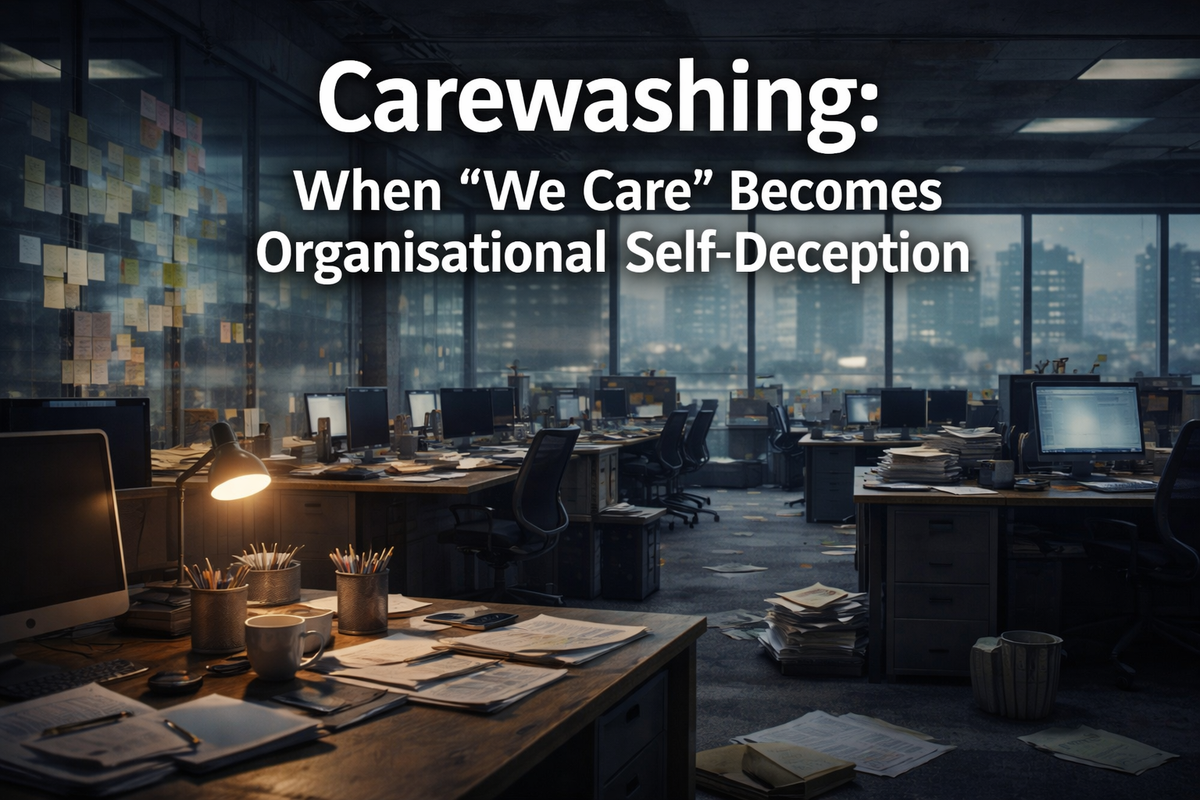
Water Governance in Healthcare Systems: A Planetary Boundary and Supply Chain Risk Analysis
Freshwater systems are a critical foundation of planetary stability, yet water governance rarely features in healthcare sustainability strategies. Healthcare depends heavily on reliable water for clinical care, sanitation, pharmaceuticals, and infrastructure, while global supply chains embed additional water risks. As climate change and over-extraction place increasing pressure on freshwater resources, healthcare systems face growing operational and systemic vulnerabilities. This paper examines water governance through the lens of planetary boundaries and supply chain risk, arguing that resilient health systems require stronger integration of freshwater risk into institutional governance.
 Institute for Systems Integrity
AI as a Systems Stress Test
Artificial intelligence is often discussed as a breakthrough technology capable of transforming healthcare and complex organisations. Yet as AI moves from experimentation to real-world deployment, a different reality is emerging. Rather than simply improving performance, AI frequently exposes deeper weaknesses in the systems it enters. In this paper, the Institute for Systems Integrity (ISI) examines why artificial intelligence often functions as a systems stress test—revealing hidden fragilities in data ecosystems, operational workflows, governance structures, and organisational readiness.
 Institute for Systems Integrity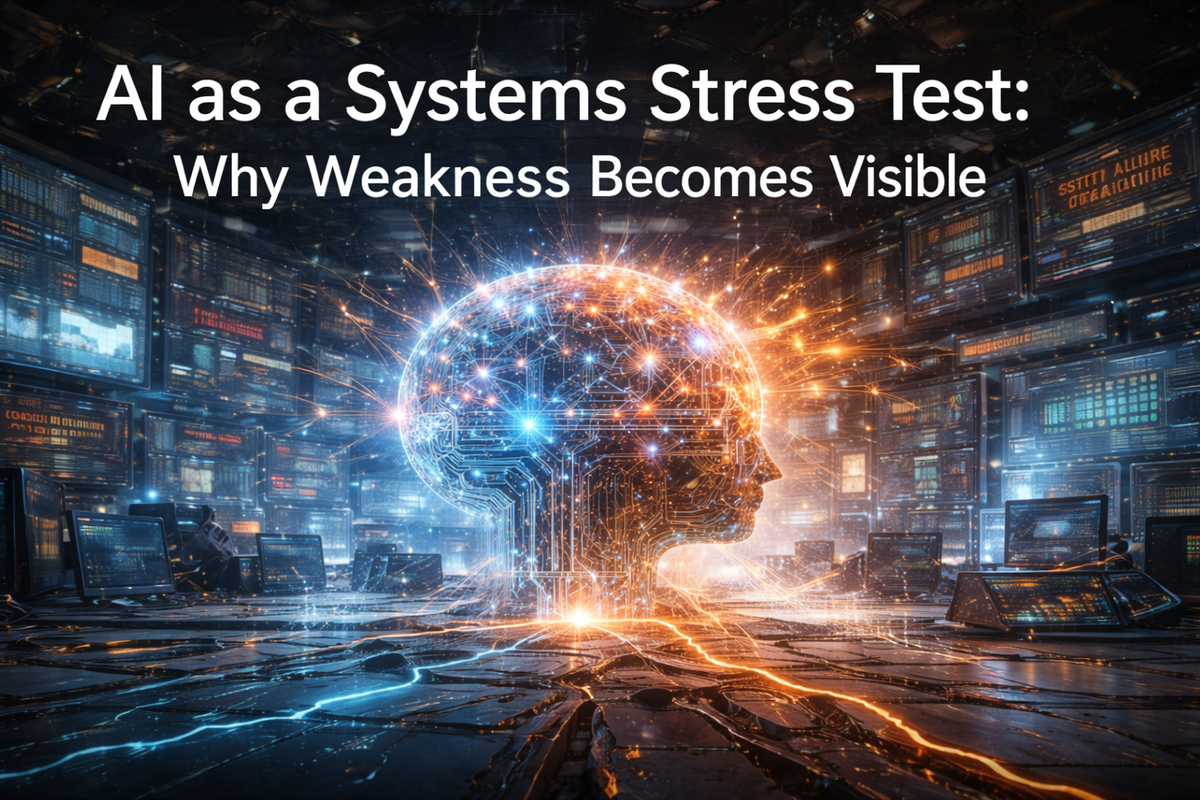
Low-Recoverability Plastics and the Governance Logic of Targeted Bans
Low-recoverability plastics represent a structural governance challenge rather than simply a waste-management issue. When products are designed with near-zero probability of recovery and high environmental leakage, downstream solutions such as recycling and clean-up become economically and operationally inadequate. In these cases, the core failure lies in product architecture and incentive design. Targeted bans, therefore, function not as symbolic environmental actions but as upstream governance instruments — correcting persistent design failures and preventing predictable harm before it enters circulation. From a systems integrity perspective, such measures reflect a transition from managing waste to managing risk at the level of design.
 Institute for Systems Integrity
Diversity as an Integrity Mechanism in Board Decision Systems
Diversity is commonly framed as representation. In complex governance environments shaped by AI disruption, sustainability transition, and systemic risk, it performs a far more critical function. In Diversity as an Integrity Mechanism in Board Decision Systems, ISI reframes diversity as a structural stabiliser within board architecture — strengthening weak-signal detection, ethical contestability, and decision resilience under stress. Perspective breadth is not symbolic. It is protective.
 Institute for Systems Integrity
Bed Block as a System Integrity Failure - Flow Breakdown at the Acute–Rehabilitation Boundary
Hospitals described as “full” are often signalling a deeper structural issue. This paper examines bed block not as a simple shortage of beds, but as a breakdown of flow integrity at the acute–rehabilitation boundary. Drawing on systems integrity frameworks and published health system evidence, it explores how capacity constraints, funding design, and fragmented accountability can combine under sustained stress to produce predictable congestion — even in well-intentioned systems.
 Institute for Systems Integrity
Featured Publication

Decision-Making Under System Stress
Foundation Article#1
 Institute for Systems Integrity
Why capable, ethical people make weaker decisions under pressure — and what integrity requires of the systems that govern them.
Most serious failures do not begin with bad decisions.
They begin with stressed systems.
This foundational paper examines how sustained pressure constrains time, attention, and information, producing predictable degradation in decision-making, even among highly capable professionals.
More Publication
Circularity Under Clinical Constraints: Why recycled material claims do not guarantee circular outcomes in healthcare
Healthcare increasingly adopts recycled-content materials in the name of sustainability. But recycled inputs do not guarantee circular outcomes. Clinical safety, contamination risks, regulation, and waste pathways often reshape what is truly recoverable. This paper examines the gap between circularity claims and system-level realities.
 Institute for Systems Integrity
Digital Transition Risk: Why Non-Tech Boards Inherit Tech-Grade Exposure
Digital transformation is often framed as an operational or technological upgrade. This paper examines a less discussed reality: how digital dependency fundamentally reshapes enterprise risk. As organisations adopt cloud systems, electronic records, vendor-managed infrastructure, and AI-enabled tools, boards inherit technology-grade exposure irrespective of industry classification.
 Institute for Systems Integrity
Mentoring as Infrastructure: Learning, Power, and Risk in Organisational Design
Mentoring is widely treated as goodwill.
In practice, it behaves like infrastructure.
When designed well, it accelerates learning and strengthens judgment. When left to intention alone, it can narrow thinking, create dependency, obscure power, and amplify risk. This paper reframes mentoring as a learning control system, outlining benefits, predictable failure modes, and the safeguards required to protect judgment, independence, and decision quality.
 Institute for Systems Integrity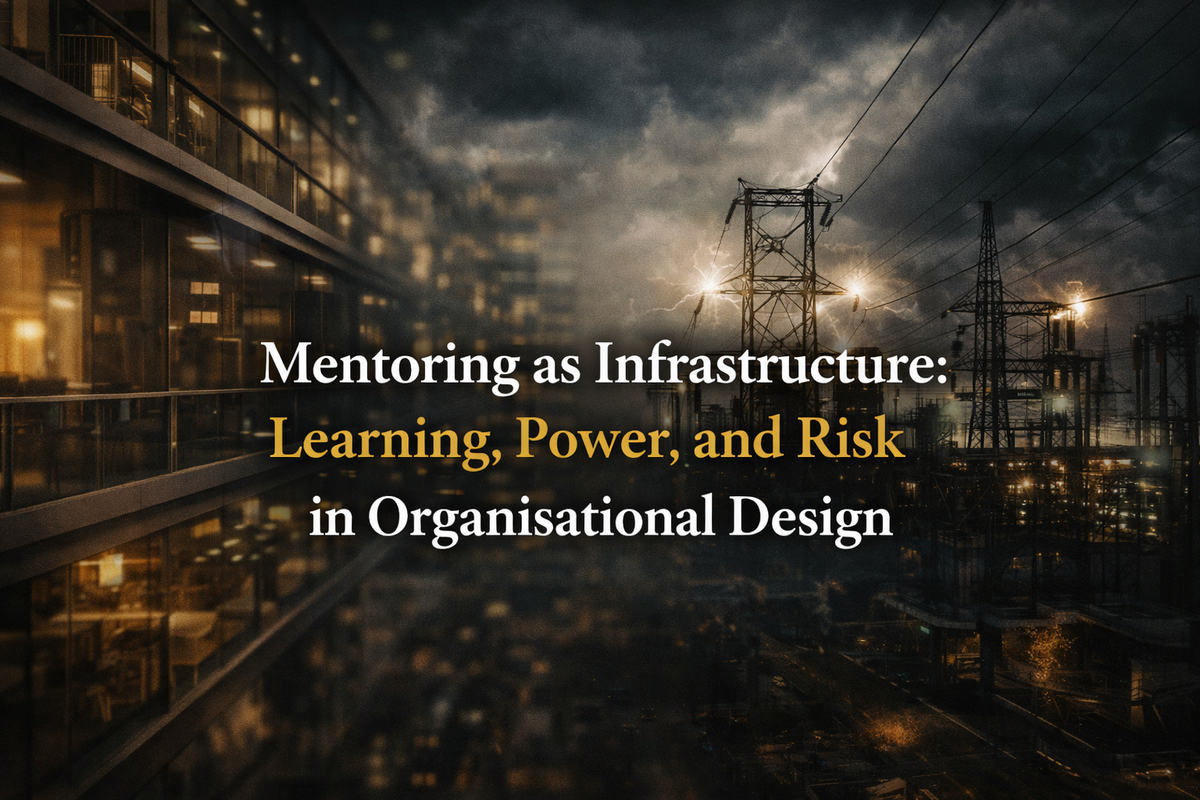
The Residual Risk Budget: Why “Net Zero” Still Requires Governance
Net zero is often described as a destination — emissions reduced, offsets applied, balance achieved. But this framing can obscure a critical governance reality. Even under credible net-zero pathways, residual emissions, residual harms, and residual uncertainties remain. They do not disappear; they are redistributed across systems, stakeholders, and time. This paper introduces the concept of the Residual Risk Budget — the remaining exposure that must be made visible, owned, and adaptively governed. Without this discipline, net zero risks become an accounting construct that masks ethical trade-offs and accelerates integrity drift.
 Institute for Systems Integrity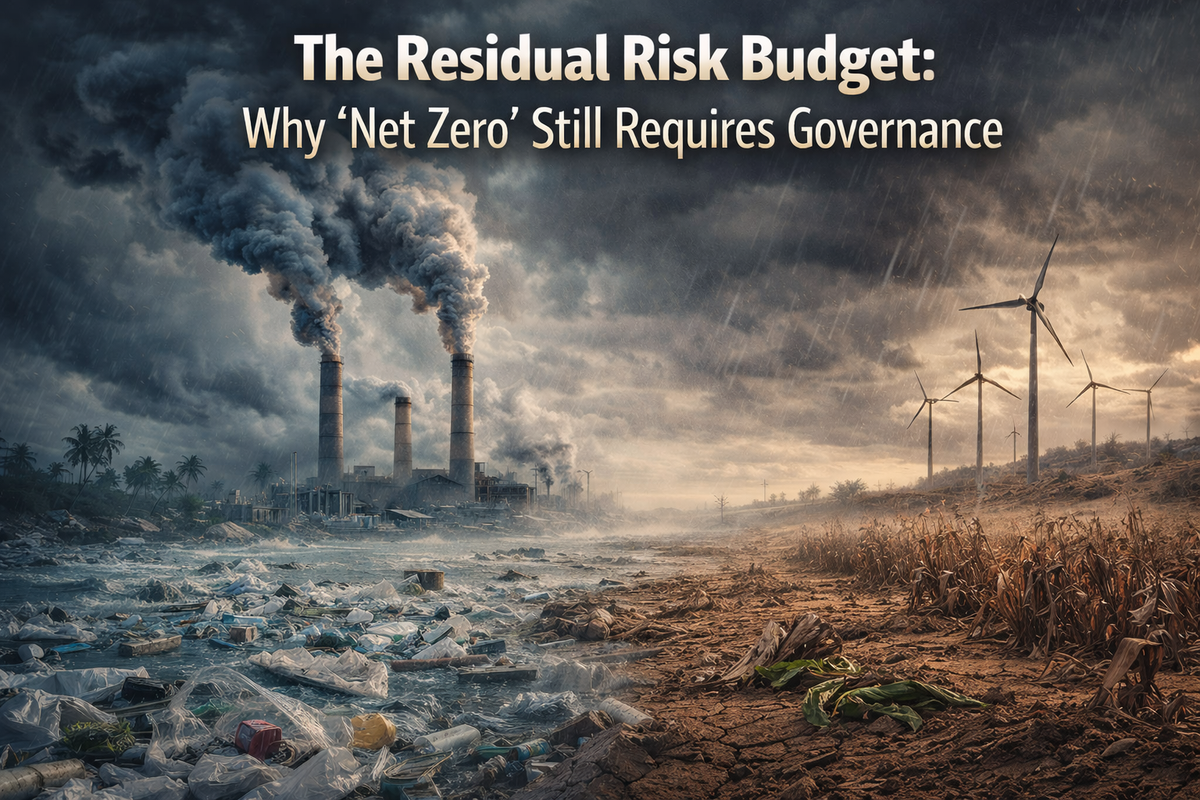
Beyond Legality: Why Boards Must Ask “Should We?”
In contemporary governance, legality is often treated as the primary decision threshold. Yet many organisational failures arise not from illegal actions, but from decisions that were lawful, compliant, and ultimately indefensible. This ISI paper examines the critical distinction between “Can we?” and “Should we?”, arguing that resilient boards must govern beyond permission alone and embed integrity as a core decision discipline.
 Institute for Systems Integrity
Governing Wicked Problems in Healthcare: An Integrity Architecture for AI, Sustainability, and Net Zero
Healthcare systems are entering a period of unprecedented complexity. Artificial intelligence, sustainability pressures, and net zero commitments are converging within institutions not originally designed to absorb this pace and scale of change. This paper argues that these challenges are best understood not as technical or compliance problems, but as wicked problems requiring a fundamentally different governance response.
 Institute for Systems Integrity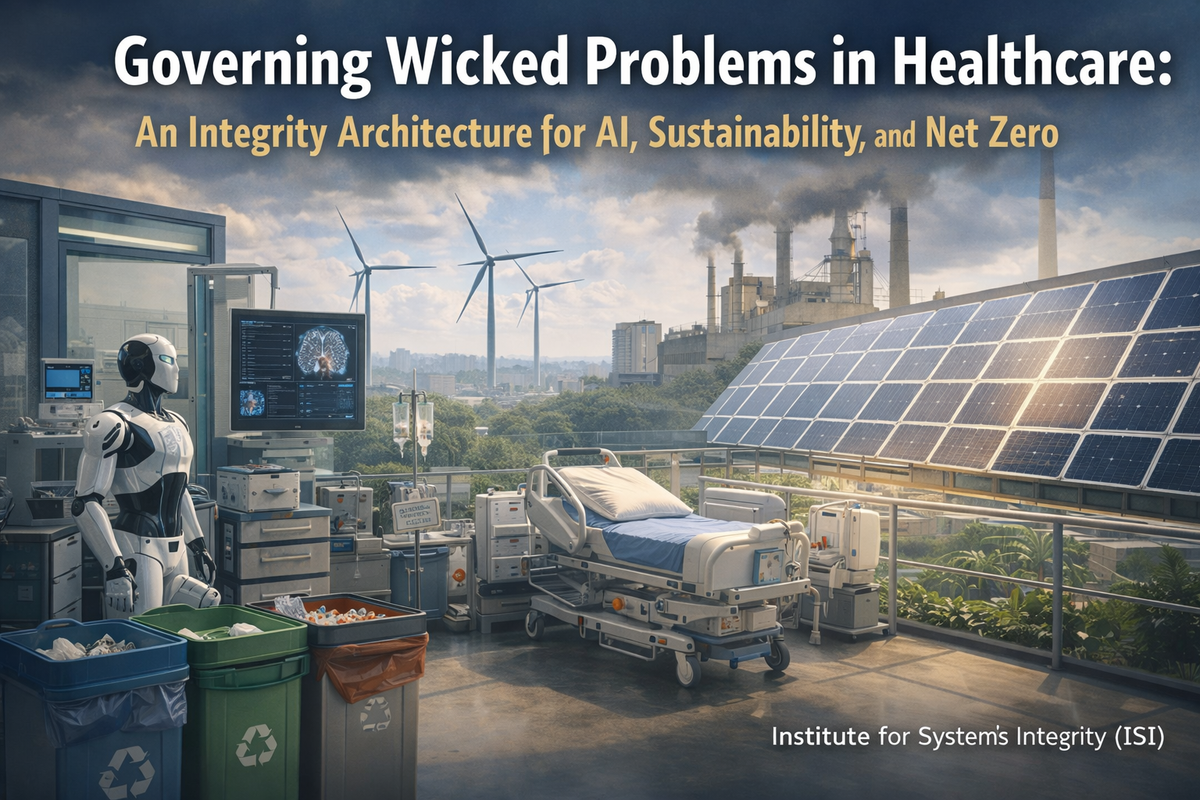
Governing AI in Healthcare: A Practical Integrity Architecture
This paper sets out why AI governance most often fails after deployment, not at approval. In real clinical environments, performance, safety, and accountability are shaped by workflow, staffing, training, and local judgment—not the model alone. This paper presents a practical integrity architecture for healthcare AI: designed to detect drift, preserve clinical judgment, and enable correction under operational pressure, before harm becomes visible to patients or boards.
 Institute for Systems Integrity
Beyond AI Compliance: Designing Integrity at Scale
This paper examines why most AI failures do not begin with flawed technology, but with governance systems that prioritise reassurance over judgment. As AI accelerates decision-making across complex organisations, traditional compliance frameworks struggle to detect drift, surface doubt, or correct harm before it becomes visible. This paper sets out a systems-level approach to AI governance—one that treats integrity as an architectural property, designed deliberately into authority, accountability, and the capacity to pause under pressure.
 Institute for Systems Integrity
The Systems Integrity Toolkit — Phase I
Why most integrity failures are not visible in time — and how systems allow harm to accumulate before anyone intervenes
Foundation Toolkit #1
This paper introduces the Systems Integrity Toolkit — Phase I, a governance architecture that consolidates ISI’s foundational research into a practical framework for identifying integrity risk before outcomes harden, showing how system stress, decision degradation, governance mediation, and failure dynamics interact long before harm becomes visible.
 Institute for Systems Integrity
Most systems don’t fail because they can’t see the problem.
They fail because they can’t change the things they’ve learned to protect.
As a companion to the Systems Integrity Toolkit — Phase I, this paper examines why integrity risks persist even after they become visible. It explores systemic refusal — the quiet protection of certain variables from change — and shows how governance under pressure can stabilise harm rather than correct it. Together, the Toolkit and this analysis describe a familiar condition in complex organisations: clarity without permission to change.
 Institute for Systems Integrity
The Failure Taxonomy: How Harm Emerges Without Malice - Why most disasters are not caused by bad people — but by predictable system drift
Foundation Article#4
This paper introduces the Failure Taxonomy — a structural model showing how harm accumulates in complex systems through drift, signal loss, and accountability inversion, without anyone intending it.
 Institute for Systems Integrity
Companion to Foundation Article#4
The ISI Pause Principle explains why governance fails when reaction replaces reflection. Under pressure, systems that remove space between signal and response degrade judgment, suppress warning signs, and invert accountability. Pause is not a leadership trait — it is a governance control condition.
 Institute for Systems Integrity
Integrity is a System Property. Why outcomes reflect design, not intent
Foundation Article#3
Integrity is often treated as a personal trait. This paper shows why it is better understood as a system property — shaped by how authority, accountability, and information are aligned under stress, and why outcomes reflect design rather than intent.
 Institute for Systems Integrity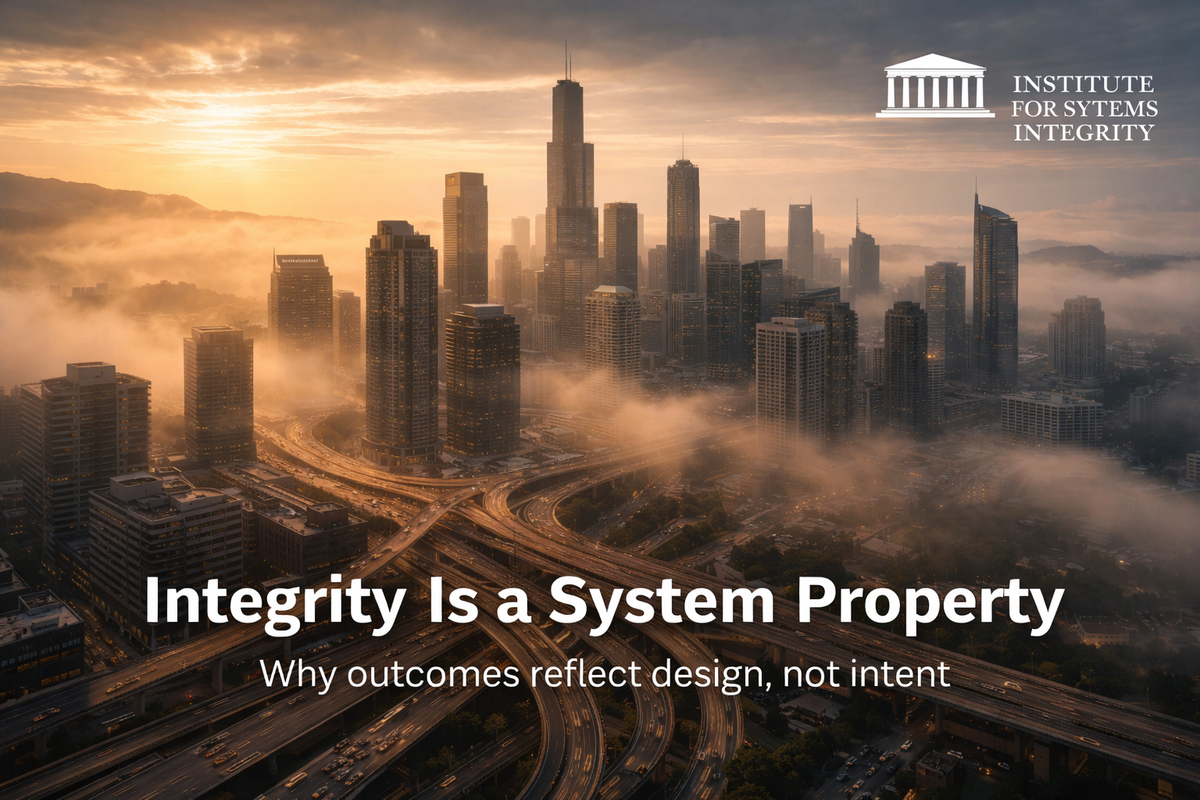
When the Constitution Becomes a Weapon
How governance drift turns compliance into a liability under system stress
Companion to Foundation Article#3
This paper examines how constitutions, delegations, and oversight structures can remain legally intact while drifting out of alignment with real decision-making, allowing compliance to persist even as governance control erodes.
 Institute for Systems Integrity
Why Oversight Fails Under Pressure
Foundation Article#2
How system stress distorts visibility, weakens governance, and produces predictable outcomes
Governance mechanisms designed for stable conditions often lose sensitivity under sustained stress.
Signals distort. Drift normalises. Oversight becomes selectively blind.
This paper examines why failures emerge quietly — and why outcomes are best understood as properties of system design, not individual intent.
 Institute for Systems Integrity
When Resilience Appears, Governance Has Already Failed. Why frontline heroics are a warning signal — not a success story
Companion to Foundation Article#2.
 Institute for Systems Integrity
Frameworks
 Institute for Systems Integrity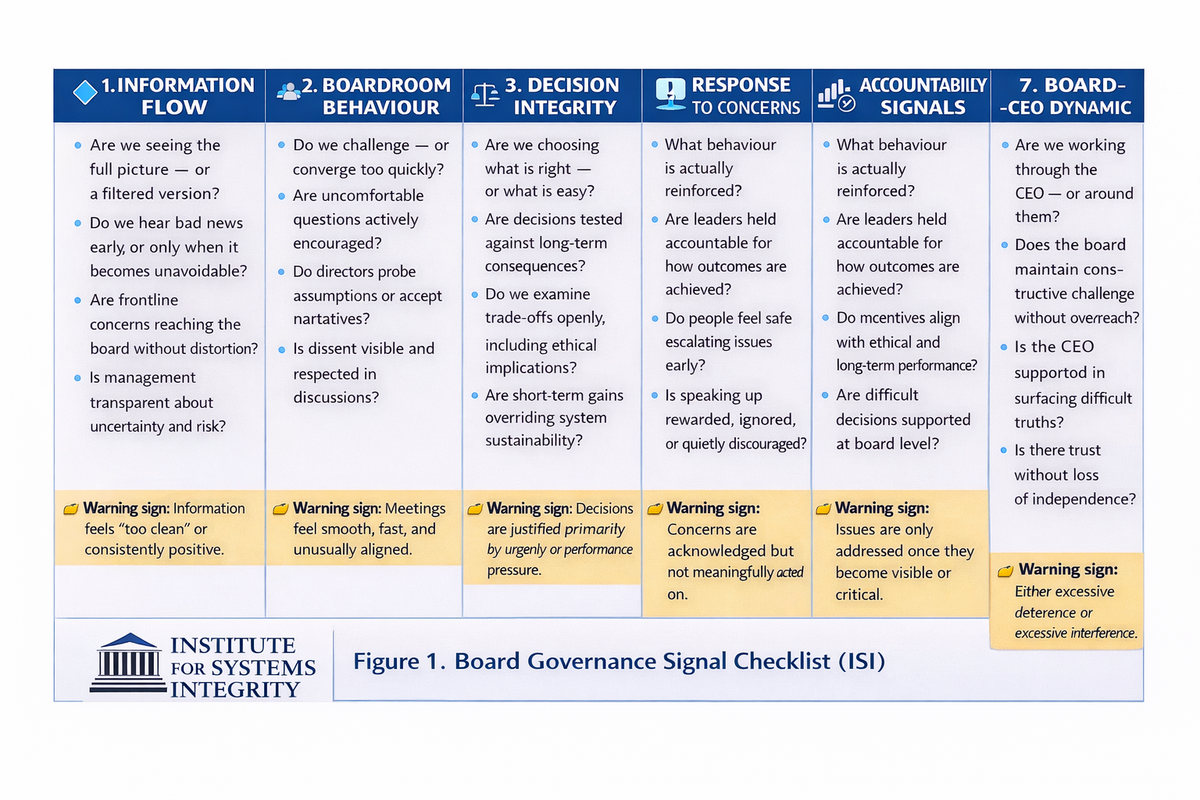
 Institute for Systems Integrity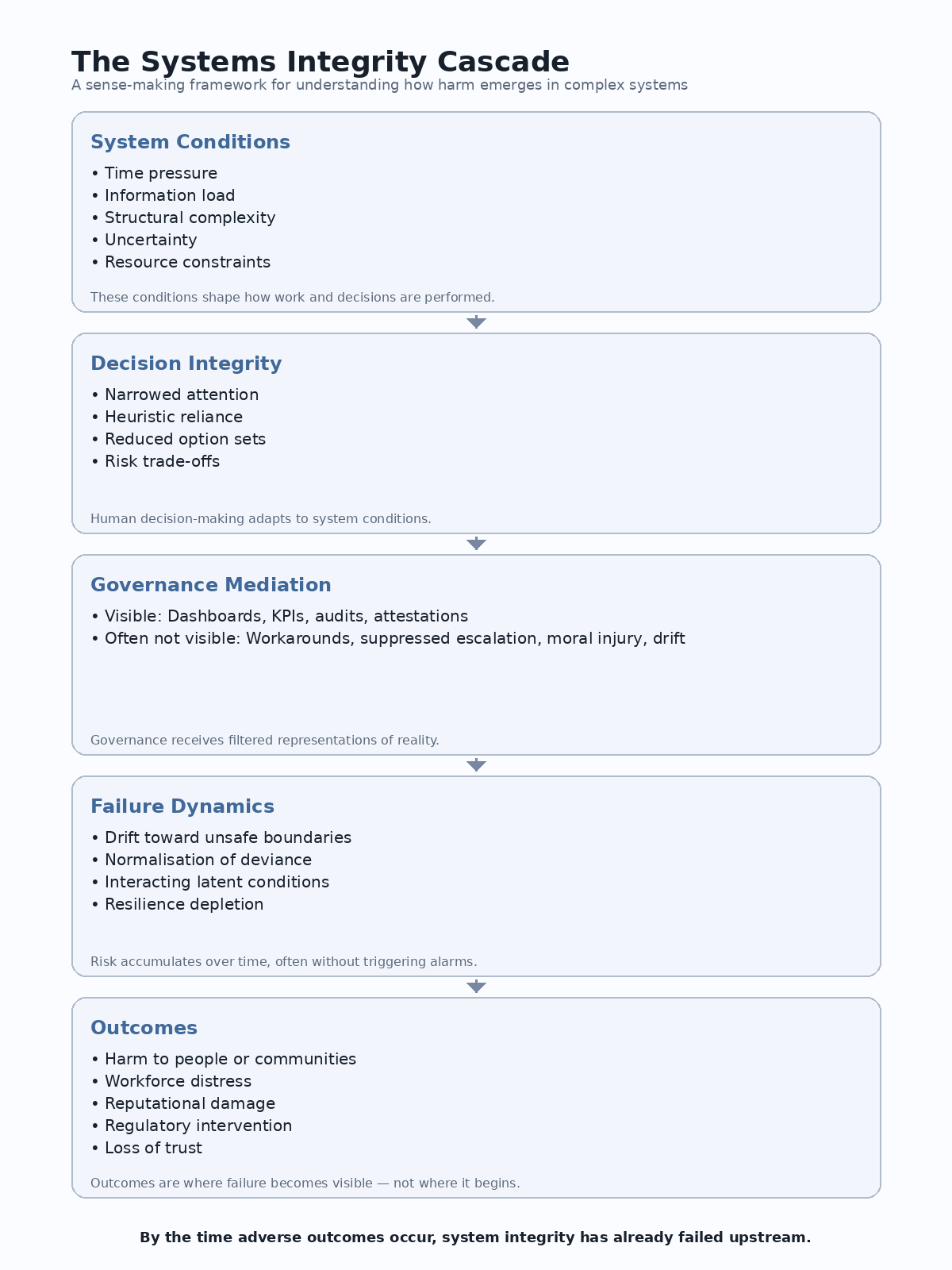
 Institute for Systems Integrity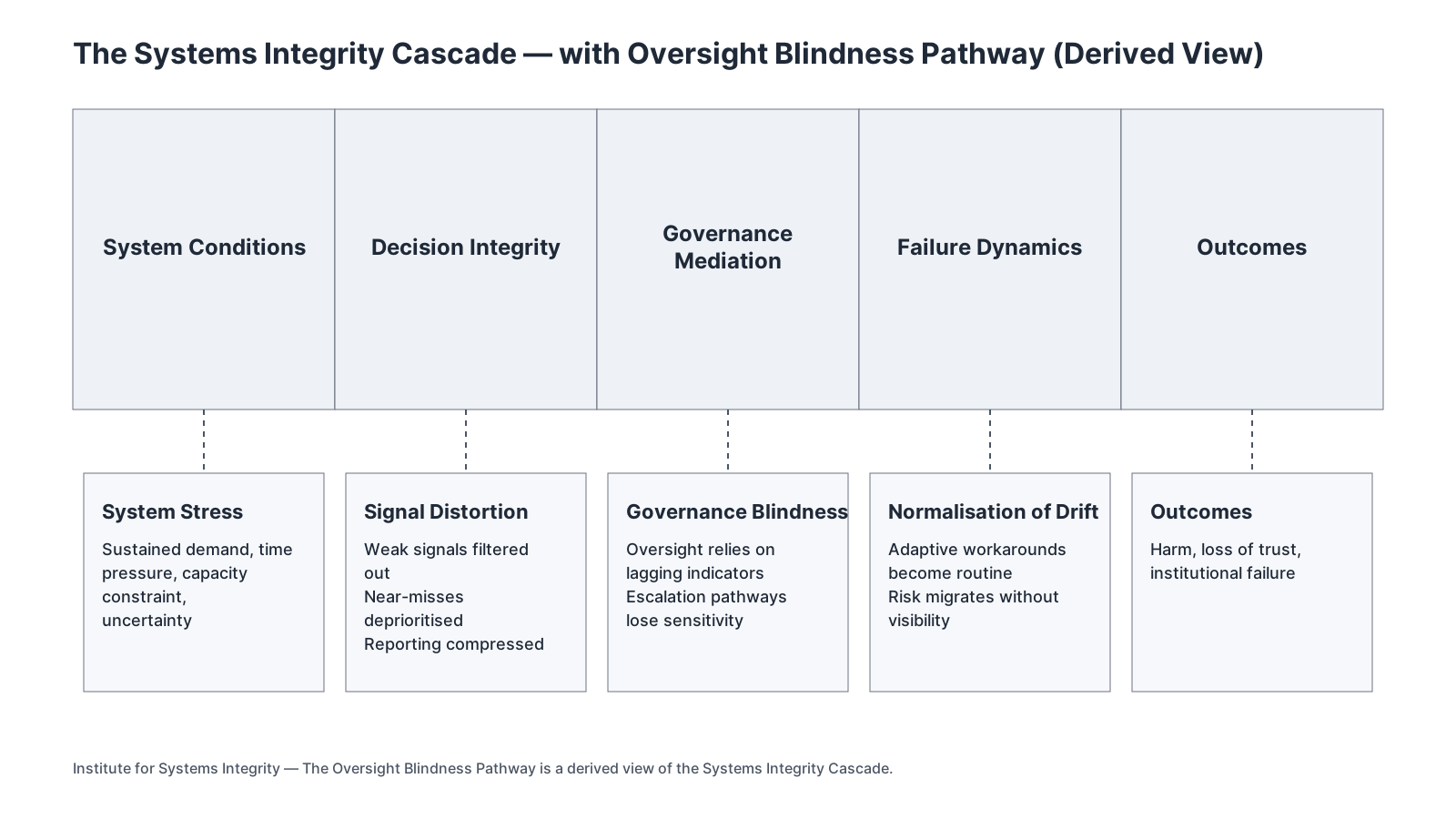
 Institute for Systems Integrity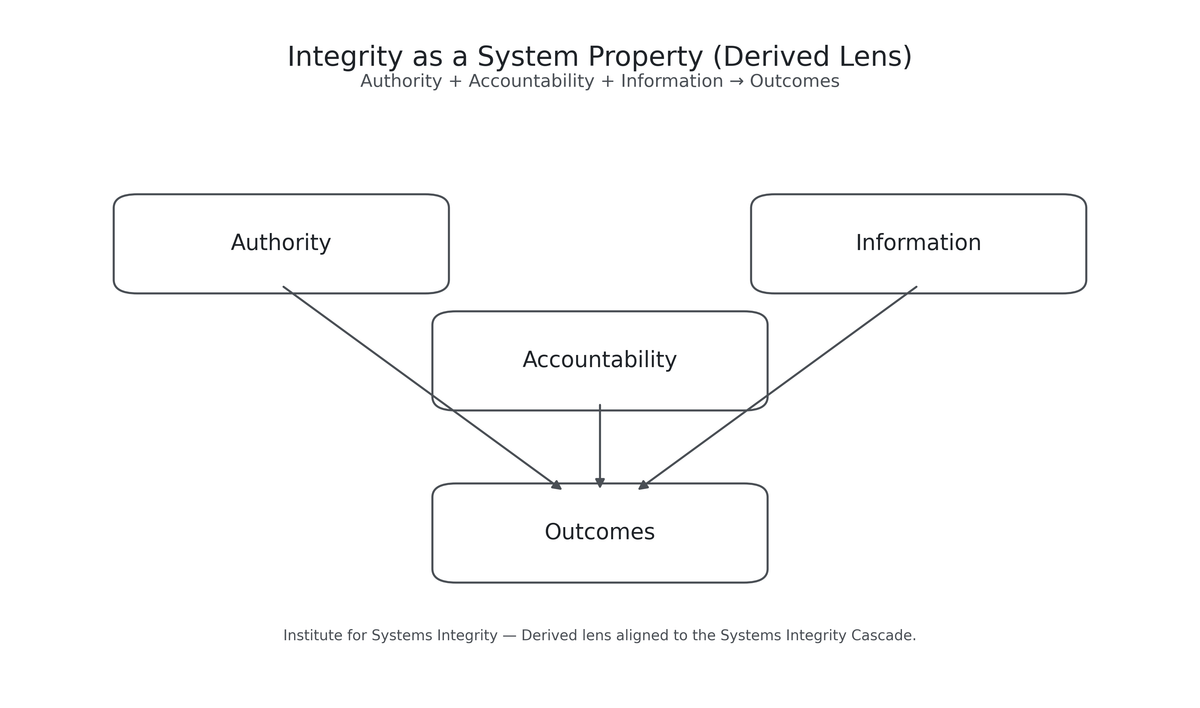
 Institute for Systems Integrity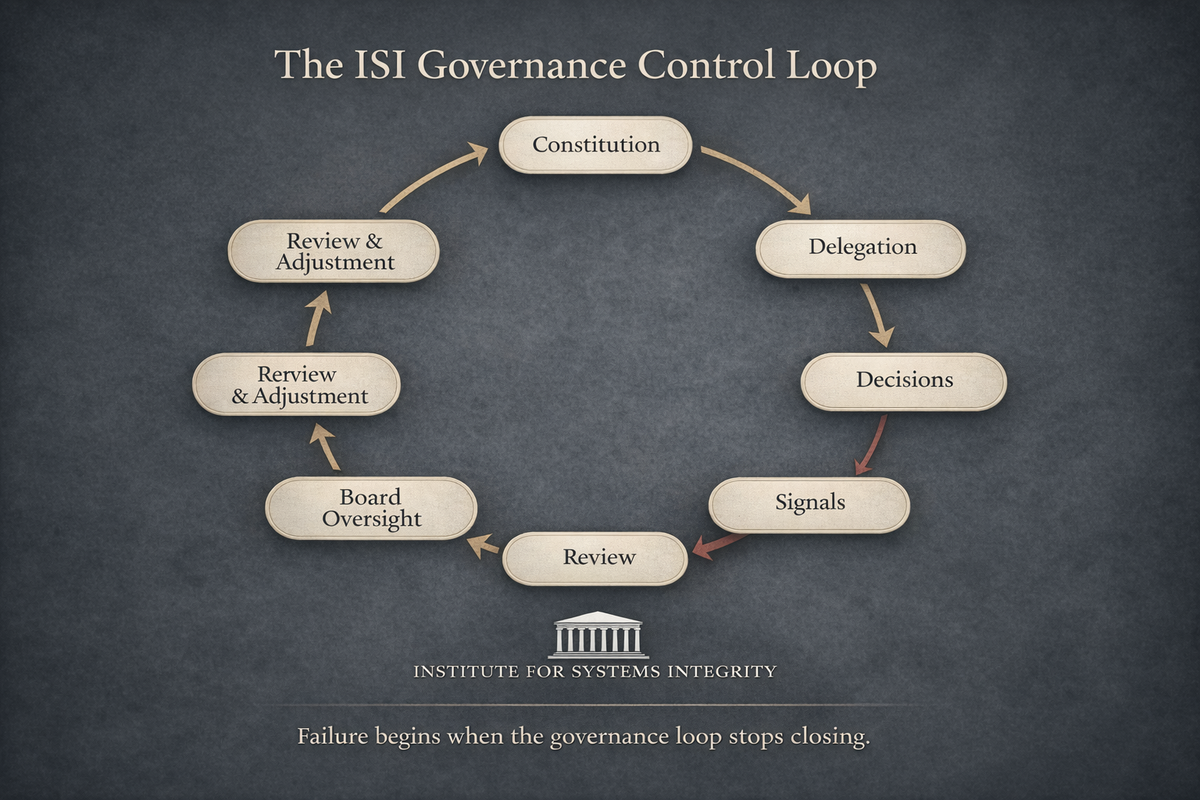
 Institute for Systems Integrity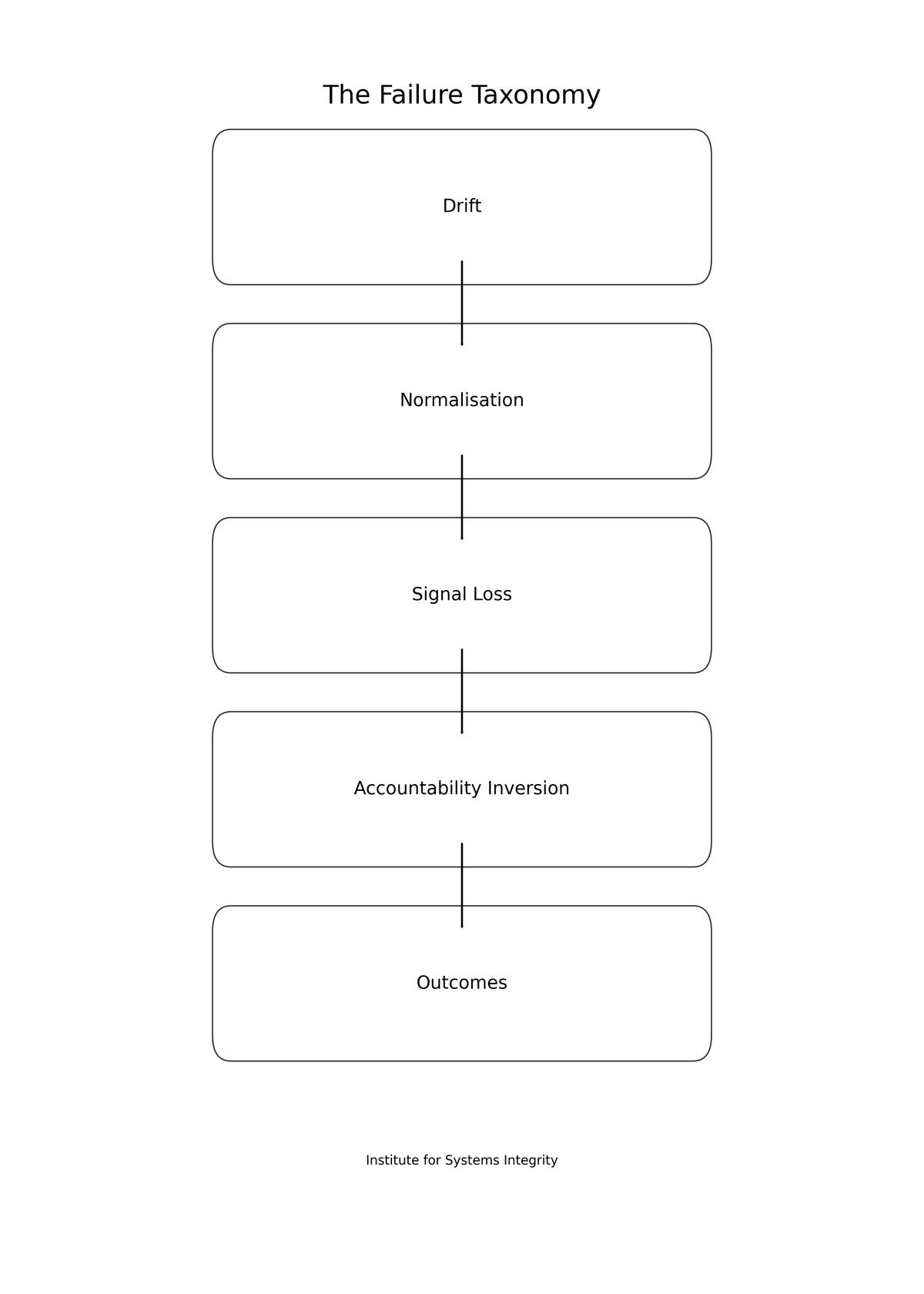
 Institute for Systems Integrity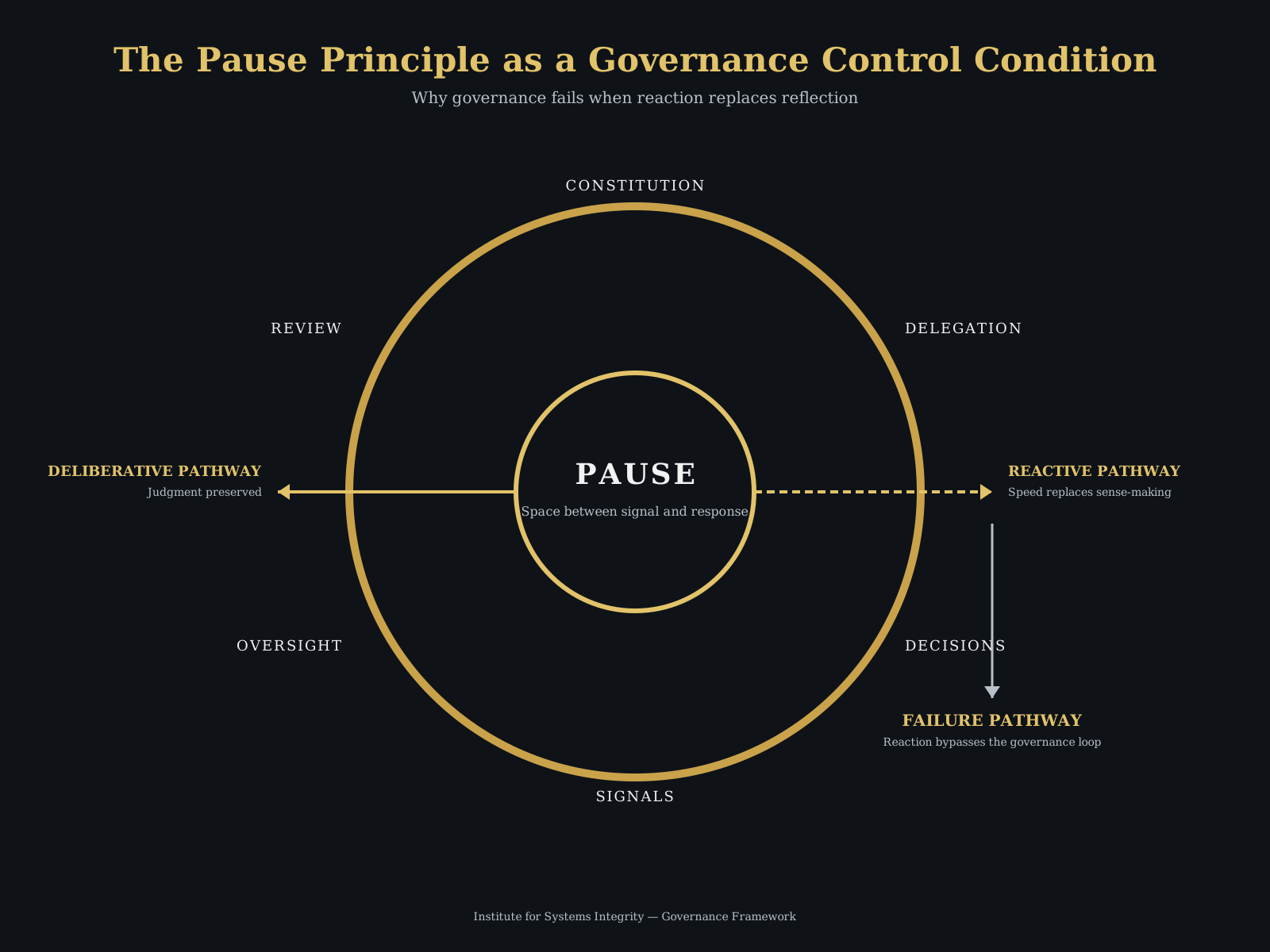
 Institute for Systems Integrity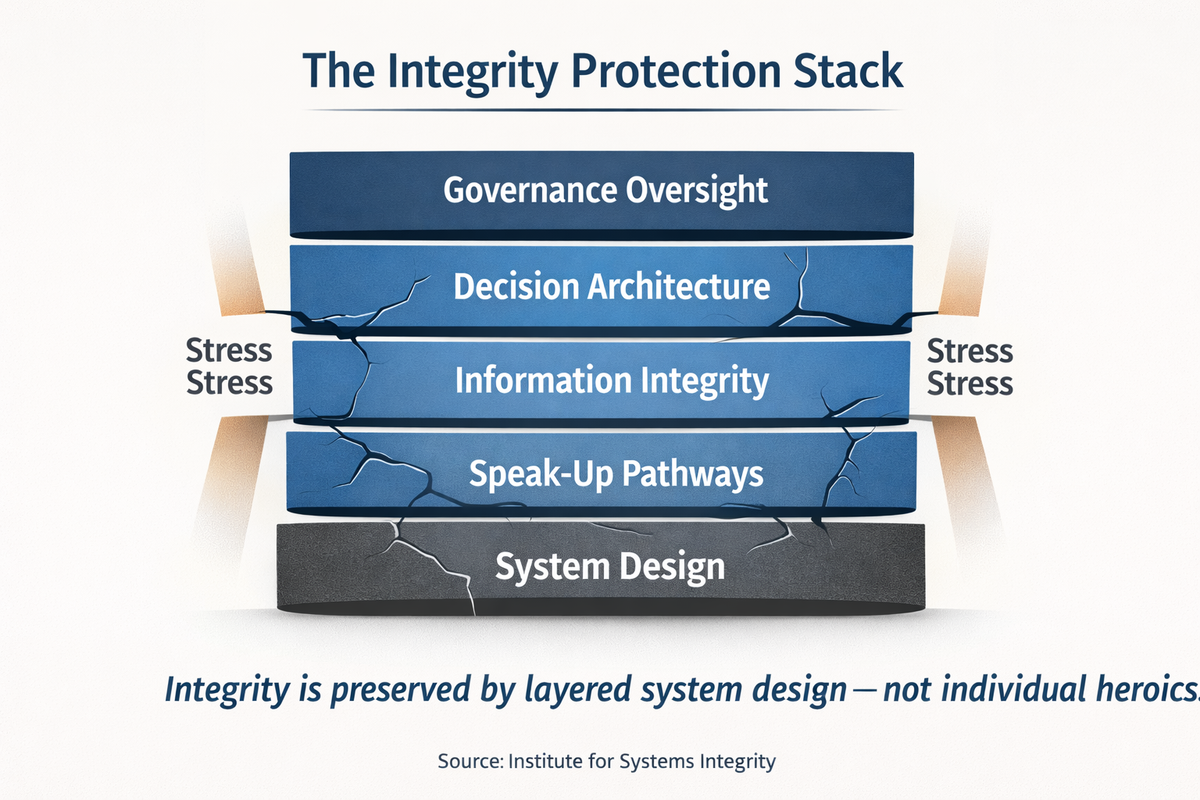
 Institute for Systems Integrity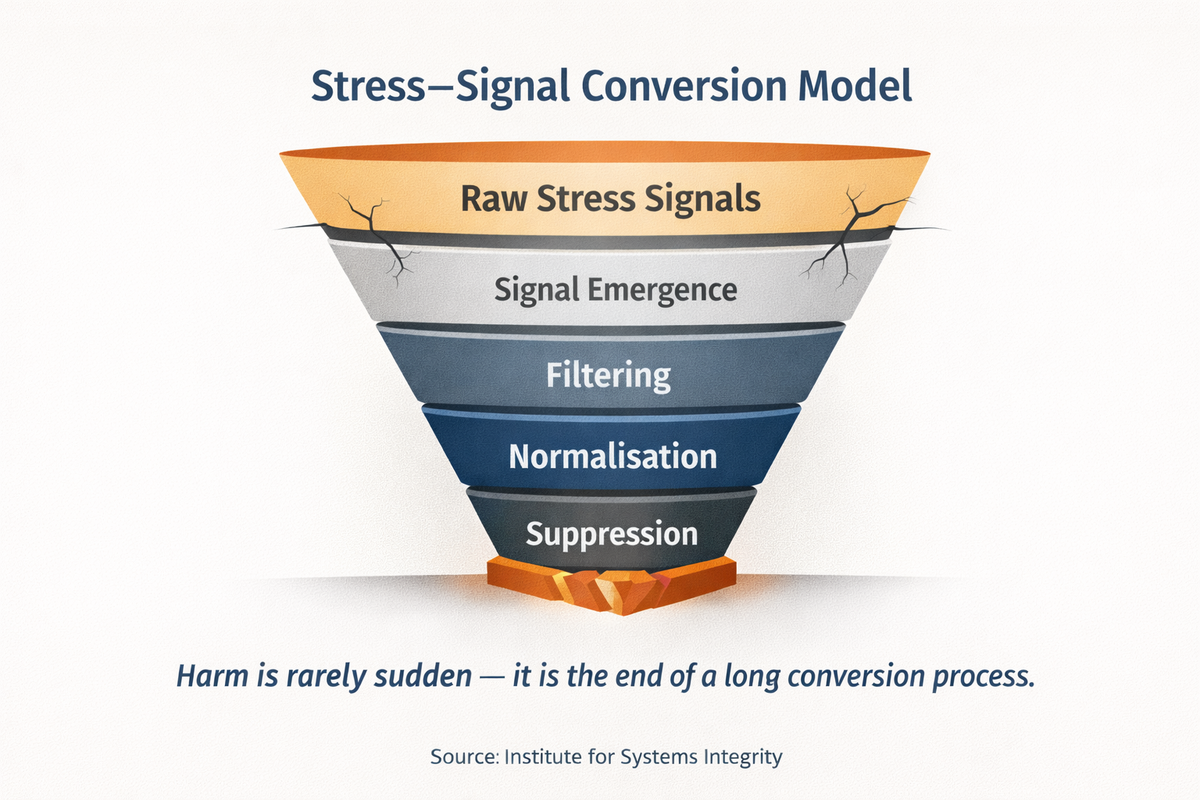
 Institute for Systems Integrity
About the Institute (ISI)

Institute for Systems Integrity (ISI)
The Institute for Systems Integrity is an independent research and analysis initiative examining how complex systems fail under stress — and how integrity erodes across institutions even in the absence of malice or incompetence.
The Institute focuses on decision-making, governance, leadership, and accountability within high-stakes environments, including healthcare, technology, cyber security, sustainability, and business management.
Its work is analytical rather than advisory, and is intended to support boards, executives, policymakers, clinicians, and researchers in understanding systemic risk, institutional drift, and delayed harm.
The Institute operates independently and does not provide consulting or commercial services.
The Institute publishes deliberately and in phases. Additional papers will be added to this series over time.

© 2026 Institute for Systems Integrity. All rights reserved.
Content may be quoted or referenced with attribution.
Commercial reproduction requires written permission.