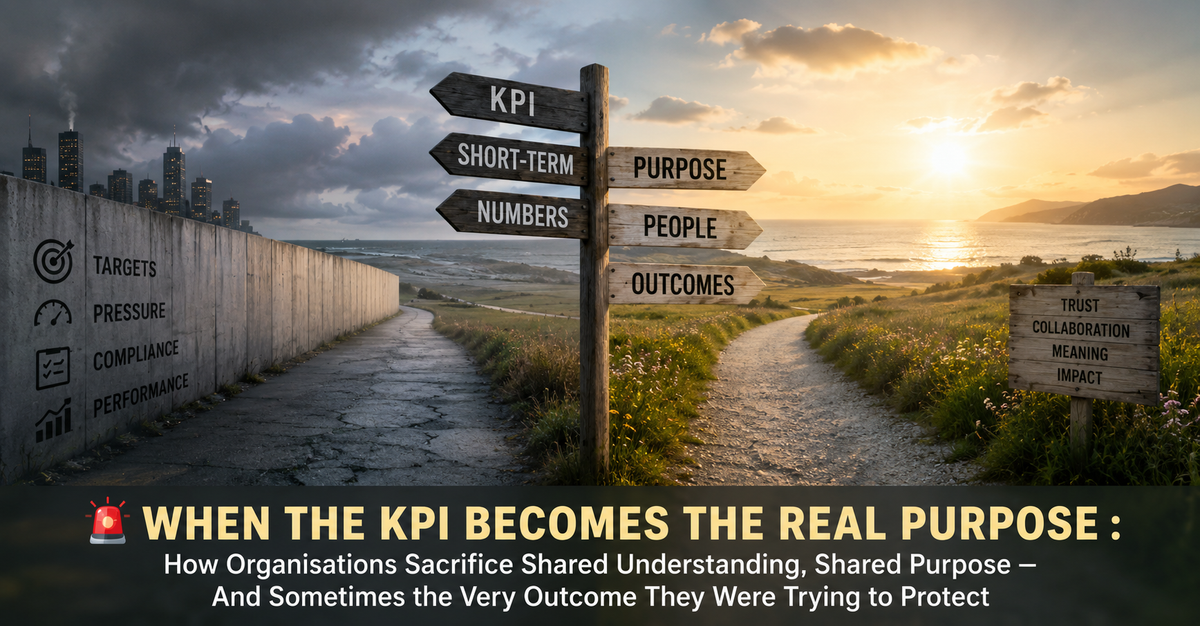
🚨 WHEN THE KPI BECOMES THE REAL PURPOSE : How Organisations Sacrifice Shared Understanding, Shared Purpose — And Sometimes the Very Outcome They Were Trying to Protect
KPIs are meant to measure progress toward purpose. But when targets acquire enough organisational power, the relationship can reverse: people begin serving the metric rather than the metric serving the purpose.
Dr Alwin Tan, GAICD, MBBS, FRACS, EMBA (Melbourne Business School)
Senior Surgeon | Governance Leader | HealthTech Co-founder | Founder of Institute for Systems Integrity (ISI) |Harvard Medical School — AI in Healthcare| University of Oxford — Sustainable Enterprise | Bastas Academy for Healthcare Leadership - Triple Scholar
INSTITUTE FOR SYSTEMS INTEGRITY
There is a point at which a KPI stops measuring the organisation.
And starts running it.
At first, the purpose is clear.
We want safer care.
Better outcomes.
Stronger service.
Higher quality.
Greater trust.
Then we create a metric to help us see whether we are getting there.
Then we create a target.
Then the target goes on the dashboard.
Then the dashboard goes to the executive.
Then the executive takes it to the board.
Then somebody’s reputation, budget, bonus, promotion or job begins to depend on it.
And somewhere in that chain, something changes.
THE KPI STOPS SERVING THE PURPOSE.
THE PURPOSE STARTS SERVING THE KPI.
We often talk about organisational alignment as if it is automatically a good thing.
It is not.
An organisation can be perfectly aligned around the wrong objective.
It can have:
clear strategy,
clear roles,
clear reporting,
clear targets,
clear accountabilities,
and excellent execution.
And still be heading in the wrong direction.
Because there are at least three different things we routinely confuse:
shared understanding;
shared purpose;
and
shared pressure.
They are not the same.
Shared understanding means people know what the organisation is trying to do.
Shared purpose means people understand and believe in why it matters.
Shared pressure means people know what number they cannot afford to miss.
And under enough pressure, shared pressure can overpower both of the others.
That is the part organisations rarely say out loud.
The mission may say:
“Patient first.”
The values may say:
“Safety before everything.”
The strategy may say:
“People are our greatest asset.”
But if the organisation repeatedly interrogates:
throughput,
length of stay,
utilisation,
revenue,
cost,
conversion,
waiting time,
and budget variance,
then employees receive another message.
A much more powerful one.
THIS IS WHAT ACTUALLY MATTERS.
Not because the leaders are lying.
Not because the values are fake.
Not because the KPI itself is wrong.
But because consequences reveal hierarchy.
And people learn hierarchy very quickly.
This creates what we might call the KPI Undercurrent.
The KPI Undercurrent is the persistent behavioural force created by what an organisation repeatedly measures, rewards, escalates and punishes beneath its stated purpose and values.
It is not written in the mission statement.
It does not appear in the values poster.
It does not need to be formally declared.
People feel it.
They learn it through meetings.
Through performance reviews.
Through who gets praised.
Through what gets escalated.
Through what gets funded.
Through what gets ignored.
Through what happens when the number turns red.
THE KPI UNDERCURRENT TELLS PEOPLE WHAT THE ORGANISATION WILL SACRIFICE — AND WHAT IT WILL NOT.
That is why it matters.
The problem is not measurement.
The problem is when the metric begins to become the organisational truth.
At the beginning, the sequence is reasonable:
Purpose → Objective → Measure.
But then:
Measure → Target.
Then:
Target → Consequence.
Then:
Consequence → Behaviour.
Then:
Behaviour → System adaptation.
Eventually:
System adaptation → new organisational reality.
And at that point, the metric is no longer merely describing performance.
It is shaping it.
THE KPI HAS BECOME PART OF THE OPERATING SYSTEM.
This is where the organisation can begin sacrificing both shared understanding and shared purpose.
Because once the target becomes dominant, people stop asking:
“What are we really trying to achieve?”
They start asking:
“What do I need to do to make this number move?”
That is a very different question.
And it changes how people interpret reality.
A patient is no longer simply a patient.
They may become:
a breach risk;
a length-of-stay problem;
a theatre utilisation slot;
a discharge target;
a funding category;
a denominator;
an exception;
a variance.
The language changes because the frame has changed.
And once the frame changes, behaviour follows.
The same thing happens outside healthcare.
A university may say its purpose is education.
Then academic success becomes publication volume.
Then publication volume becomes performance.
Eventually the institution can become brilliant at producing papers while teaching becomes the activity people fit around the metric.
A bank may say its purpose is customer service.
Then sales targets become the dominant signal.
Eventually employees understand that customer service matters — as long as it does not interfere with the number.
A public service agency may say its purpose is solving citizens’ problems.
Then case closure becomes the KPI.
Eventually the system becomes good at closing cases.
Whether the problem was actually solved becomes secondary.
A technology company may say it exists to improve people’s lives.
Then engagement becomes the metric.
Then engagement becomes the target.
Then the product is optimised for attention rather than value.
THIS IS HOW PURPOSE GETS DISPLACED WITHOUT EVER BEING FORMALLY ABANDONED.
Goodhart’s Law helps explain part of this.
When a measure becomes a target, it can become a poorer measure of the thing it was originally meant to represent.
But that is only half the problem.
The deeper governance failure occurs when the organisation begins to reorganise itself around the proxy.
Then the proxy does not simply distort measurement.
IT DISTORTS PURPOSE.
This is what we might call:
PURPOSE–METRIC INVERSION
A condition in which a metric originally created to represent progress toward purpose acquires enough behavioural, financial or reputational force that achieving the metric begins to supersede achieving the underlying purpose.
It begins with:
the metric serving the mission.
It ends with:
the mission being interpreted through the metric.
And eventually:
the metric becomes the mission.
This can destroy shared understanding as well.
That may sound counterintuitive.
Surely a KPI creates clarity.
Often it does.
But clarity about a target is not necessarily clarity about the system.
A strong KPI can narrow organisational attention so aggressively that people begin to see reality only through what is measurable.
What is counted becomes visible.
What is not counted becomes peripheral.
What is difficult to quantify becomes negotiable.
What is invisible to the dashboard can disappear from the organisational conversation altogether.
So the organisation may become more aligned around the metric while becoming less able to understand reality.
That is a serious integrity failure.
THE DASHBOARD GETS CLEARER WHILE THE SYSTEM GETS HARDER TO SEE.
And then shared purpose begins to fracture.
Not necessarily because people stop believing in the mission.
Most do not.
A clinician may still deeply believe in patient care.
A teacher may still care about students.
A public servant may still care about citizens.
A manager may still care about quality.
But they are operating in a system that repeatedly tells them something else has priority.
This creates an uncomfortable tension:
the purpose people believe in
versus
the behaviour the system rewards.
Under light pressure, people may preserve both.
Under sustained pressure, something usually gives.
And too often, the KPI wins.
Not because people suddenly become unethical.
Because the system has made the metric safer to obey than the purpose.
Steven Kerr described the organisational folly of rewarding A while hoping for B almost half a century ago.
We still do it.
We say:
collaborate,
but reward silo performance.
Innovate,
but punish failure.
Speak up,
but penalise disruption.
Put the patient first,
but interrogate throughput first.
Think long term,
but reward the quarter.
Protect quality,
but cut the capacity required to deliver it.
ORGANISATIONS ARE OFTEN VERY CLEAR ABOUT WHAT THEY WANT PEOPLE TO BELIEVE — AND EQUALLY CLEAR ABOUT WHAT THEY NEED PEOPLE TO DELIVER.
When those two diverge, employees learn quickly which one carries consequences.
This is why the KPI can become more powerful than shared purpose.
Purpose is often aspirational.
The KPI is immediate.
Purpose speaks in principles.
The KPI speaks in consequences.
Purpose says:
“Do the right thing.”
The KPI says:
“Hit 92% by Friday.”
Purpose invites judgement.
The KPI narrows judgement.
Purpose asks people to interpret complexity.
The KPI reduces complexity to a number.
And under pressure, numbers have an enormous advantage.
They are visible.
Comparable.
Escalatable.
Defensible.
Rewardable.
Punishable.
PURPOSE MAY GUIDE CONSCIENCE.
KPIs GOVERN CONSEQUENCE.
And organisations should never underestimate which one people will follow when those signals conflict.
Healthcare demonstrates the danger vividly.
Imagine an organisation with five excellent departments.
Emergency hits its waiting-time target.
Surgery maximises theatre utilisation.
The ward reduces length of stay.
Finance achieves budget.
Quality reduces reported incidents.
Every dashboard is green.
Every team understands its responsibilities.
Every manager is accountable.
Every executive can show improvement.
And yet the patient experiences:
fragmentation,
repetition,
poor handover,
premature discharge,
delay between services,
confusion about responsibility,
and nobody who owns the journey.
Every unit may be succeeding.
The system may still be failing.
That is what happens when local KPIs become stronger than shared purpose.
And this is where the idea of alignment becomes dangerous.
Because the problem is no longer that teams do not understand each other.
They may understand each other perfectly.
They simply have different things they must optimise.
That gives us a harder truth:
SHARED UNDERSTANDING CANNOT SAVE AN ORGANISATION WHEN ITS INCENTIVE ARCHITECTURE IS TEACHING A DIFFERENT PURPOSE.
We can hold more workshops.
Create better strategy decks.
Communicate the mission more clearly.
Run more town halls.
Repeat the values.
Improve the visualisation.
None of that will overcome a performance system that sends the opposite message every day.
YOU CANNOT COMMUNICATE YOUR WAY OUT OF AN INCENTIVE SYSTEM.
If leadership says one thing and the KPI system rewards another, the KPI system is likely to win.
Again.
And again.
And again.
Until the organisation eventually mistakes compliance with the metric for commitment to the mission.
This is why boards need to stop treating KPIs as neutral reporting objects.
Every KPI is an intervention.
Every target changes behaviour.
Every threshold creates incentives.
Every dashboard directs attention.
Every escalation tells the organisation what matters.
Every performance regime creates trade-offs.
Therefore the board should not simply ask:
“Are we hitting the KPI?”
It should ask:
“What is this KPI doing to the organisation?”
What behaviour is it encouraging?
What behaviour is it suppressing?
What activity is being neglected because it is not measured?
What reality is disappearing outside the dashboard?
What trade-offs are people making that we cannot see?
What does this target make rational?
And the most important test:
IF EVERYONE OPTIMISED THIS KPI PERFECTLY, WOULD THE ORGANISATION GET CLOSER TO ITS PURPOSE — OR FURTHER AWAY FROM IT?
If that question cannot be answered, the metric is not governed.
It is merely being obeyed.
None of this means we should abandon KPIs.
That would be naïve.
Organisations need targets.
Boards need visibility.
Executives need accountability.
Teams need feedback.
Resources need prioritisation.
Measurement is essential.
But precisely because measurement is powerful, it deserves more governance — not less.
Every material KPI should therefore be tested against at least five questions:
What underlying purpose does this measure serve?
How accurately does it represent that purpose?
What behaviour becomes rational when people are judged against it?
What important activity becomes less attractive because it is not measured?
What would tell us that the KPI is improving while the underlying system is getting worse?
That final question matters most.
Because systems rarely announce purpose drift.
They often continue reporting success.
The most dangerous organisation may not be the one with confusion.
Confusion is visible.
Misalignment creates friction.
Disagreement creates noise.
Those organisations know something is wrong.
The more dangerous organisation may be the one where everything looks aligned.
Everyone understands the target.
Everyone knows their role.
Everyone knows what the board expects.
Everyone knows what happens if the number is missed.
Everyone delivers.
And the dashboard stays green.
WHILE THE ORGANISATION QUIETLY SACRIFICES THE VERY PURPOSE THE KPI WAS CREATED TO PROTECT.
That is not performance excellence.
That is performance without integrity.
YOUR REAL PURPOSE IS NOT NECESSARILY WHAT YOUR MISSION STATEMENT SAYS.
YOUR REAL PURPOSE MAY BE WHAT YOUR KPI SYSTEM MAKES PEOPLE TOO AFRAID NOT TO OPTIMISE.
That is why shared understanding is not enough.
Shared purpose is not enough.
Even good intentions are not enough.
The performance architecture must reinforce them.
Because when the KPI becomes the undercurrent...
then the target becomes the language,
the target becomes the priority,
the target becomes the consequence,
and eventually—
THE KPI BECOMES THE REAL PURPOSE.
And by the time the organisation notices, it may already have sacrificed both the shared understanding and the shared purpose it thought it still had.
References
Bevan, G. and Hood, C. (2006) ‘What’s measured is what matters: targets and gaming in the English public health care system’, Public Administration, 84(3), pp. 517–538.
DeChurch, L.A. and Mesmer-Magnus, J.R. (2010) ‘The cognitive underpinnings of effective teamwork: a meta-analysis’, Journal of Applied Psychology, 95(1), pp. 32–53.
Ebrahim, A., Battilana, J. and Mair, J. (2014) ‘The governance of social enterprises: mission drift and accountability challenges in hybrid organizations’, Research in Organizational Behavior, 34, pp. 81–100.
Fishbach, A. and Woolley, K. (2022) ‘The structure of intrinsic motivation’, Annual Review of Organizational Psychology and Organizational Behavior, 9, pp. 339–363.
Jasinenko, A., Steuber, J. and Oliver, D. (2023) ‘Perceived organizational purpose: systematic literature review, construct definition, measurement and potential employee and organizational outcomes’, Journal of Management Studies, 60(6), pp. 1505–1547.
Kaplan, R.S. and Norton, D.P. (1992) ‘The balanced scorecard—measures that drive performance’, Harvard Business Review, 70(1), pp. 71–79.
Kerr, S. (1975) ‘On the folly of rewarding A, while hoping for B’, Academy of Management Journal, 18(4), pp. 769–783.
Lindenberg, S. and Foss, N.J. (2011) ‘Managing joint production motivation: the role of goal framing and governance mechanisms’, Academy of Management Review, 36(3), pp. 500–525.
Locke, E.A. and Latham, G.P. (2002) ‘Building a practically useful theory of goal setting and task motivation: a 35-year odyssey’, American Psychologist, 57(9), pp. 705–717.
Manheim, D. and Garrabrant, S. (2019) ‘Categorizing variants of Goodhart’s Law’, arXiv preprint, arXiv:1803.04585.
Schweitzer, M.E., Ordóñez, L. and Douma, B. (2004) ‘Goal setting as a motivator of unethical behavior’, Academy of Management Journal, 47(3), pp. 422–432.
van Ingen, R., Peters, P., De Ruiter, M. and Robben, H. (2021) ‘Exploring the meaning of organizational purpose at a new dawn: the development of a conceptual model through expert interviews’, Frontiers in Psychology, 12, 675543.