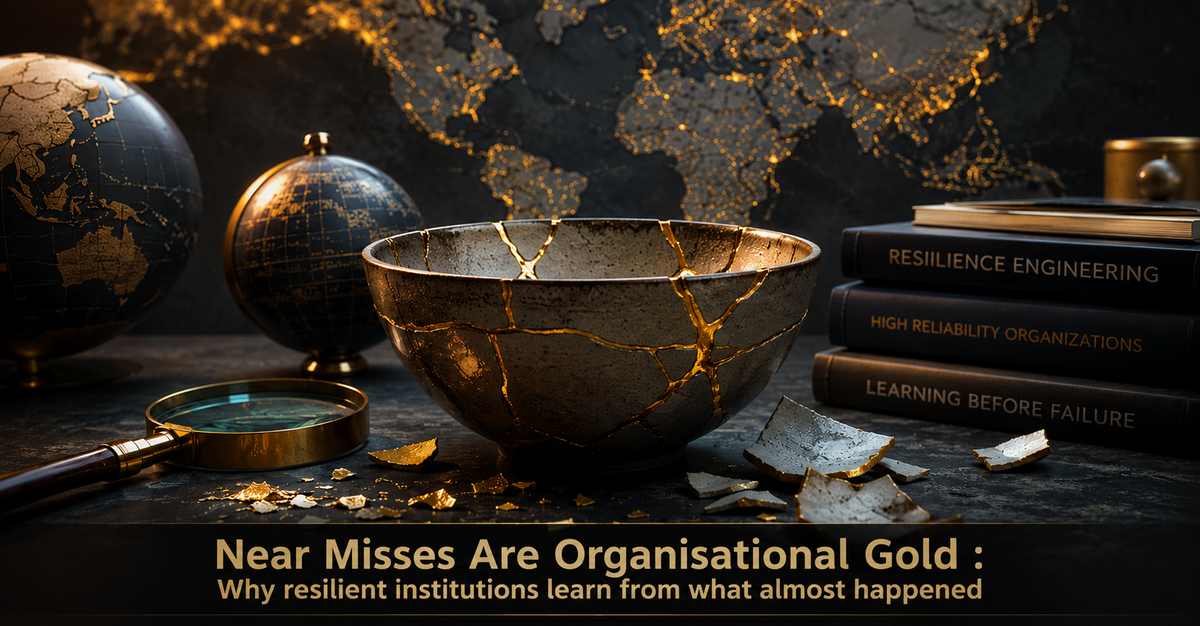
Near Misses Are Organisational Gold Why resilient institutions learn from what almost happened — not just what became catastrophic
Most organisations investigate catastrophe. Resilient organisations investigate almost-catastrophe. Near misses are not embarrassment or incompetence—they are organisational intelligence. Institutions rarely collapse without warning. More often, they stop listening before they stop functioning.
Dr Alwin Tan, GAICD, MBBS, FRACS, EMBA (Melbourne Business School)
Senior Surgeon | Governance Leader | HealthTech Co-founder |
Harvard Medical School — AI in Healthcare |
Australian Institute of Company Directors — GAICD graduate |
University of Oxford — Sustainable Enterprise
Institute for Systems Integrity (ISI)
Most organisations investigate catastrophe.
Resilient organisations investigate almost-catastrophe.
That difference may determine which institutions survive the next decade —
and which slowly drift into collapse while still believing they are safe.
Because the most dangerous organisational failures rarely begin with sudden disaster.
They begin quietly:
- a medication almost given incorrectly,
- a cyberattack almost successful,
- a clinician too exhausted to think clearly,
- a staff member afraid to escalate concern,
- a workaround quietly normalised,
- a dashboard that remains green while frontline conditions deteriorate.
These moments matter enormously.
Not because harm occurred.
But because the system revealed stress before catastrophe arrived.
And yet most institutions still misunderstand mistakes and near misses completely.
They treat them as:
- embarrassment,
- legal liability,
- reputational danger,
- or evidence of incompetence.
So organisations suppress the very signals that could save them.
Near Misses Are Not Failure — They Are Adaptive Intelligence
One of the most dangerous misconceptions in governance is the belief that safety equals absence of visible harm.
It does not.
Many fragile institutions appear “safe” right up until collapse.
Why?
Because harm is usually a lagging indicator.
Near misses, however, are different.
Near misses are:
- weak signals,
- system stress indicators,
- operational truth,
- adaptive diagnostics,
- and early warnings that resilience may already be degrading.
In complex systems:
catastrophe is rarely the first signal.
It is usually the first signal leadership could no longer ignore.
This distinction is critical.
Because resilient institutions do not merely react to disaster.
They actively study friction, deviation, and almost-failure before escalation occurs.
Most Institutions Punish the Signals They Need Most
Many organisations publicly claim they want transparency.
Operationally, they reward silence.
This is especially true under pressure.
When institutions become stressed, they often become psychologically intolerant of discomfort.
So:
- escalation becomes risky,
- reporting gets softened,
- frontline concerns get reframed as negativity,
- and near misses quietly disappear from formal learning systems.
The result is devastating.
The organisation loses visibility into emerging fragility.
And once weak signals disappear:
adaptive failure accelerates silently.
This is how institutions become dangerous while still appearing operationally successful.
Healthcare Has a Deeply Dysfunctional Relationship With Error
Healthcare remains one of the most psychologically complex environments for organisational learning.
Clinicians work inside cultures shaped by:
- perfectionism,
- hierarchy,
- fear of litigation,
- reputational pressure,
- professional identity,
- and chronic operational stress.
Under these conditions, mistakes are often experienced not merely as events —
but as personal moral failure.
That creates enormous adaptive risk.
Because when staff fear humiliation, punishment, or career damage:
- reporting decreases,
- near misses disappear,
- workarounds become hidden,
- and unsafe adaptations become normalised.
Over time, institutions stop learning honestly.
The organisation becomes progressively less capable of detecting its own deterioration.
And by the time patient harm becomes publicly visible:
the adaptive collapse has often been unfolding internally for years.
The Most Dangerous Organisations Often Still Have Green Dashboards
One of the greatest governance illusions is this:
Metrics can remain stable while resilience collapses underneath them.
Boards often receive:
- acceptable KPIs,
- reassuring summaries,
- compliance reports,
- and “within tolerance” indicators.
Meanwhile:
- staff exhaustion rises,
- escalation declines,
- fear increases,
- and near misses go unreported.
This creates a profound governance blind spot.
Because what matters most is often not:
what organisations are measuring.
But:
what the organisation no longer feels psychologically safe enough to reveal.
That is where systemic risk hides.
Psychological Safety Is Operational Infrastructure
Psychological safety is often discussed as a cultural or wellbeing issue.
This framing is dangerously inadequate.
Psychological safety is operational resilience infrastructure.
Because institutions only learn at the speed truth can safely travel.
When staff cannot:
- admit uncertainty,
- escalate concern,
- challenge assumptions,
- report near misses,
- or surface weak signals,
the organisation loses adaptive intelligence.
Fear therefore becomes more than a morale issue.
Fear becomes a governance destabiliser.
And institutions that suppress uncomfortable truth eventually lose the ability to self-correct safely.
Aviation Learned This Decades Ago. Healthcare Still Struggles.
High-reliability industries such as aviation and nuclear energy increasingly understand that near misses are strategic assets.
Pilots report small anomalies aggressively.
Minor deviations are analysed seriously.
Weak signals are treated as valuable information.
Why?
Because resilient systems understand:
learning before catastrophe is vastly cheaper than learning after catastrophe.
Healthcare, however, often continues to reward heroic adaptation rather than transparent system learning.
Exhausted clinicians compensate manually for failing processes.
Staff quietly absorb unsafe workload.
Workarounds become normalised.
And leadership frequently mistakes operational survival for resilience.
But survival is not the same as safety.
Sometimes organisations are merely consuming human goodwill faster than it can be replenished.
AI Will Make Near-Miss Governance Even More Critical
Artificial intelligence will intensify this challenge dramatically.
AI systems rarely fail only through obvious catastrophic breakdown.
More often they fail through:
- drift,
- edge-case instability,
- partial degradation,
- subtle bias accumulation,
- workflow distortion,
- and silent overreliance.
In other words:
through near misses.
The organisations safest in the AI era will not be those claiming perfect systems.
They will be those most capable of:
- detecting weak signals early,
- surfacing anomalies safely,
- adapting rapidly,
- and learning continuously before harm escalates.
AI governance therefore becomes inseparable from learning culture.
Because technology cannot compensate for institutions that suppress truth.
The Institutions That Survive Will Learn Before Harm Occurs
The future belongs to institutions capable of:
- hearing uncomfortable truth early,
- rewarding escalation rather than punishing it,
- studying almost-failure seriously,
- and treating mistakes as adaptive fuel rather than reputational contamination.
Because resilient systems are not systems that avoid all failure.
They are systems that:
- detect fragility early,
- metabolise reality honestly,
- and correct themselves before catastrophe emerges publicly.
That is the real purpose of governance.
Not image protection.
Not reassurance theatre.
Adaptive survival.
Board-Level Questions That Matter
Boards should increasingly ask:
- What near misses are we not hearing about?
- Where has escalation become psychologically unsafe?
- What weak signals are being filtered before reaching leadership?
- Are KPIs masking deteriorating adaptive capacity?
- Is fear slowing organisational learning?
- What workarounds have become normalised?
- Does this institution reward truth — or merely reward reassurance?
Because institutions rarely collapse without warning.
More often:
they stop listening before they stop functioning.
Conclusion
Near misses are not organisational embarrassment.
They are organisational intelligence.
And institutions that suppress weak signals eventually become blind to their own deterioration.
The organisations that survive the future will not be the ones pretending to be flawless.
They will be the ones capable of learning from what almost happened —
before almost becomes irreversible.
References (Harvard Style)
Dekker, S. 2011, Drift into Failure: From Hunting Broken Components to Understanding Complex Systems, Ashgate Publishing, Farnham.
Edmondson, A.C. 1999, ‘Psychological safety and learning behavior in work teams’, Administrative Science Quarterly, vol. 44, no. 2, pp. 350–383.
Hollnagel, E., Woods, D.D. and Leveson, N. 2006, Resilience Engineering: Concepts and Precepts, Ashgate Publishing, Aldershot.
Institute of Medicine 2000, To Err Is Human: Building a Safer Health System, National Academy Press, Washington, DC.
Reason, J. 1997, Managing the Risks of Organizational Accidents, Ashgate Publishing, Aldershot.
Schein, E.H. 2010, Organizational Culture and Leadership, 4th edn, Jossey-Bass, San Francisco.
Senge, P.M. 2006, The Fifth Discipline: The Art and Practice of the Learning Organization, revised edn, Doubleday, New York.
Turner, B.A. 1978, Man-Made Disasters, Wykeham Publications, London.
Vaughan, D. 1996, The Challenger Launch Decision: Risky Technology, Culture, and Deviance at NASA, University of Chicago Press, Chicago.
Weick, K.E. and Sutcliffe, K.M. 2015, Managing the Unexpected: Sustained Performance in a Complex World, 3rd edn, Wiley, Hoboken, NJ.