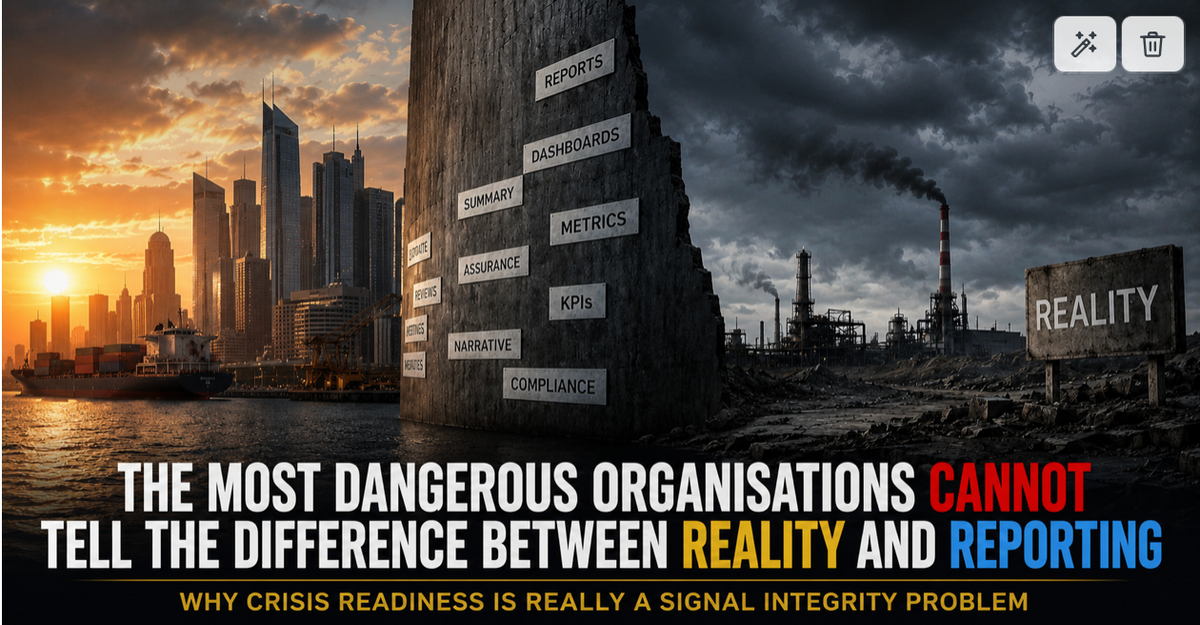
🚨 THE MOST DANGEROUS ORGANISATIONS CANNOT TELL THE DIFFERENCE BETWEEN REALITY AND REPORTING : Why Crisis Readiness Is Really A Signal Integrity Problem .
Most organisational crises are visible long before they become public. The real danger is not a lack of information, but the distortion of reality as it moves through the system. When reporting becomes disconnected from reality, governance failure becomes inevitable.
Dr Alwin Tan, GAICD, MBBS, FRACS, EMBA (Melbourne Business School)
Senior Surgeon | Governance Leader | HealthTech Co-founder |
Harvard Medical School — AI in Healthcare |
Australian Institute of Company Directors — GAICD graduate |
University of Oxford — Sustainable Enterprise
Most organisational crises are visible long before they become public.
The problem is not that nobody knew.
The problem is that reality never arrived intact.
Complaints were raised.
Concerns were documented.
Risks were escalated.
Data existed.
Warning signs accumulated.
Yet somehow leadership remained surprised.
That should concern every board, executive and governance professional.
Most organisations believe they are preparing for the next crisis.
They run simulations.
They develop response plans.
They conduct exercises.
They review risks.
They establish governance committees.
They monitor dashboards.
They receive assurance reports.
Everything appears responsible.
Everything appears controlled.
Everything appears ready.
Until it isn't.
Because crises rarely expose a lack of planning.
They expose a loss of connection to reality.
And that may be one of the most overlooked governance risks of our time.
The Assumption Hidden Inside Most Governance Systems
Most governance frameworks are built on a simple assumption.
That the information reaching decision-makers accurately reflects what is happening inside the organisation.
Often it does not.
Boards receive reports.
Executives receive summaries.
Committees receive dashboards.
Risk functions receive metrics.
Assurance functions provide reassurance.
Reality becomes translated into reporting.
And somewhere along that journey, something important can be lost.
Uncertainty is simplified.
Complexity is reduced.
Context disappears.
Bad news is softened.
Concerns become diluted.
The signal becomes weaker.
Yet the reporting becomes stronger.
This creates a dangerous illusion.
Leaders become increasingly informed while becoming progressively disconnected from reality.
The organisation appears to know more.
While understanding less.
The Reporting Reality Gap
At the Institute for Systems Integrity, we propose a concept that sits at the centre of many governance failures.
The Reporting Reality Gap
The difference between:
What is actually happening inside a system
and
What decision-makers believe is happening inside a system.
The larger the gap, the greater the governance risk.
This gap is rarely visible during periods of stability.
Targets are met.
Budgets are achieved.
Projects appear on track.
Customers remain satisfied.
Operations continue functioning.
The organisation appears healthy.
But appearances can be deceptive.
Reporting can remain positive long after reality has begun deteriorating.
And that is where danger begins.
Reality Debt: The Liability Nobody Reports
Most organisations understand financial debt.
Many understand technical debt.
Few understand what we call:
Reality Debt
Reality debt is the accumulated gap between organisational reality and organisational perception.
Every time:
- concerns are softened,
- warnings are delayed,
- bad news is filtered,
- risks are normalised,
- uncomfortable truths are ignored,
reality debt increases.
Like all debt, it compounds.
And eventually the organisation must repay it.
Often through:
- crisis,
- failure,
- regulatory intervention,
- reputational damage,
- workforce disengagement,
- or public loss of trust.
The longer reality debt accumulates, the more painful the eventual correction becomes.
Why Crises Expose What Reporting Conceals
Organisations often describe crises as unexpected.
In reality, many crises are preceded by months or years of signals.
Complaints.
Near misses.
Workarounds.
Staff concerns.
Customer frustrations.
Operational anomalies.
Emerging risks.
The signals exist.
The problem is rarely detection.
The problem is transmission.
Information does not travel intact.
By the time it reaches decision-makers, it has often been filtered through multiple layers of interpretation, incentives, hierarchy and organisational politics.
What begins as a warning can arrive as reassurance.
What begins as uncertainty can arrive as confidence.
What begins as a risk can arrive as a performance indicator.
The organisation remains informed.
But no longer connected to reality.
The Fatal Governance Myth
Many organisations assume more reporting creates better oversight.
This is not necessarily true.
Information volume and information quality are not the same thing.
A board can receive hundreds of pages of reporting and still be disconnected from what is actually happening.
A dashboard can be green while critical risks are emerging beneath the surface.
A compliance framework can be functioning while truth is struggling to travel.
A culture survey can report engagement while people no longer feel safe to speak openly.
Governance does not fail when information disappears.
Governance fails when information becomes distorted.
That distinction matters.
Because most governance systems are designed to collect information.
Far fewer are designed to preserve its integrity.
Why Signal Integrity Matters
Recent work on organisational resilience highlights the importance of adaptability, decentralised decision-making, communication and rapid learning during periods of disruption.
These capabilities matter.
But they all depend upon something deeper.
Signal Integrity
An organisation cannot adapt to risks it cannot see.
It cannot respond to concerns it cannot hear.
It cannot learn from mistakes that never reach decision-makers.
It cannot correct problems it does not understand.
Before resilience.
Before agility.
Before adaptability.
There must be visibility.
And visibility depends on preserving reality as information moves through the system.
The Hourglass Organisation Problem
Modern organisations face a growing challenge.
Technology is accelerating information flow.
AI is increasing reporting capacity.
Automation is reducing layers of coordination.
The organisation appears leaner.
Faster.
More efficient.
Yet something else may be happening.
Context disappears faster than ever.
Nuance is compressed.
Frontline signals become detached from frontline reality.
Leaders may see more data than at any point in history.
While understanding less about what is actually happening.
AI may solve information scarcity while simultaneously worsening meaning scarcity.
Organisations may soon drown in summaries while starving for understanding.
The organisation becomes increasingly efficient at moving information.
But progressively less effective at preserving meaning.
Healthcare Offers A Warning
Healthcare has repeatedly demonstrated this pattern.
Major failures rarely occur because nobody knew.
The complaints existed.
The incidents existed.
The near misses existed.
The concerns were raised.
The patients were speaking.
The staff were speaking.
The data was available.
The organisation was reporting.
Yet the signal never reached the people who could act.
This is why many failures are not compliance failures.
They are not capability failures.
They are not information failures.
They are signal integrity failures.
A Different View Of Crisis Readiness
Most organisations prepare for crises by strengthening response plans.
We believe they should begin by strengthening signal integrity.
A truly resilient organisation can:
- Detect emerging signals.
- Preserve uncomfortable truths.
- Interpret uncertainty honestly.
- Maintain decision integrity.
- Respond adaptively.
- Learn continuously.
Without signal integrity, the remaining steps become increasingly fragile.
Because decision quality can never exceed information quality.
And information quality can never exceed signal integrity.
The Governance Question Every Board Should Ask
Most boards ask:
"What risks are we monitoring?"
That remains important.
But it may not be the most important question.
The more important question may be:
"What realities are we not seeing?"
What concerns are being filtered?
What bad news is arriving late?
What assumptions are no longer being challenged?
What truths are becoming inconvenient?
What if the board's greatest risk is not what it knows?
What if it is what the reporting system has already taught the organisation to hide?
Because every major organisational failure begins with a gap between reality and perception.
And every governance system ultimately depends on its ability to close that gap.
Final Thought
Most organisations fear the next crisis.
They worry about disruption.
They worry about uncertainty.
They worry about volatility.
But the greatest danger is often much closer.
It is the gradual loss of connection between reality and decision-making.
The most dangerous organisations are not those facing a crisis.
They are those that can no longer distinguish reality from reporting.
Because when that happens, the crisis has already begun.
And by the time leadership sees it, reality debt may already be coming due.
Harvard References
Edmondson, A.C. (2019) The Fearless Organization: Creating Psychological Safety in the Workplace for Learning, Innovation, and Growth. Hoboken, NJ: Wiley.
Kahneman, D., Sibony, O. and Sunstein, C.R. (2021) Noise: A Flaw in Human Judgment. London: William Collins.
Senge, P.M. (2006) The Fifth Discipline: The Art and Practice of the Learning Organization. Revised edn. New York: Doubleday.
Taleb, N.N. (2012) Antifragile: Things That Gain from Disorder. New York: Random House.
Vaughan, D. (1996) The Challenger Launch Decision: Risky Technology, Culture and Deviance at NASA. Chicago: University of Chicago Press.
Weick, K.E. and Sutcliffe, K.M. (2015) Managing the Unexpected: Sustained Performance in a Complex World. 3rd edn. Hoboken, NJ: Wiley.
Financial Times (2025) ‘How Organisations Build Resilience in an Era of Continuous Disruption’, Financial Times, 2025.
Reason, J. (1997) Managing the Risks of Organisational Accidents. Aldershot: Ashgate.