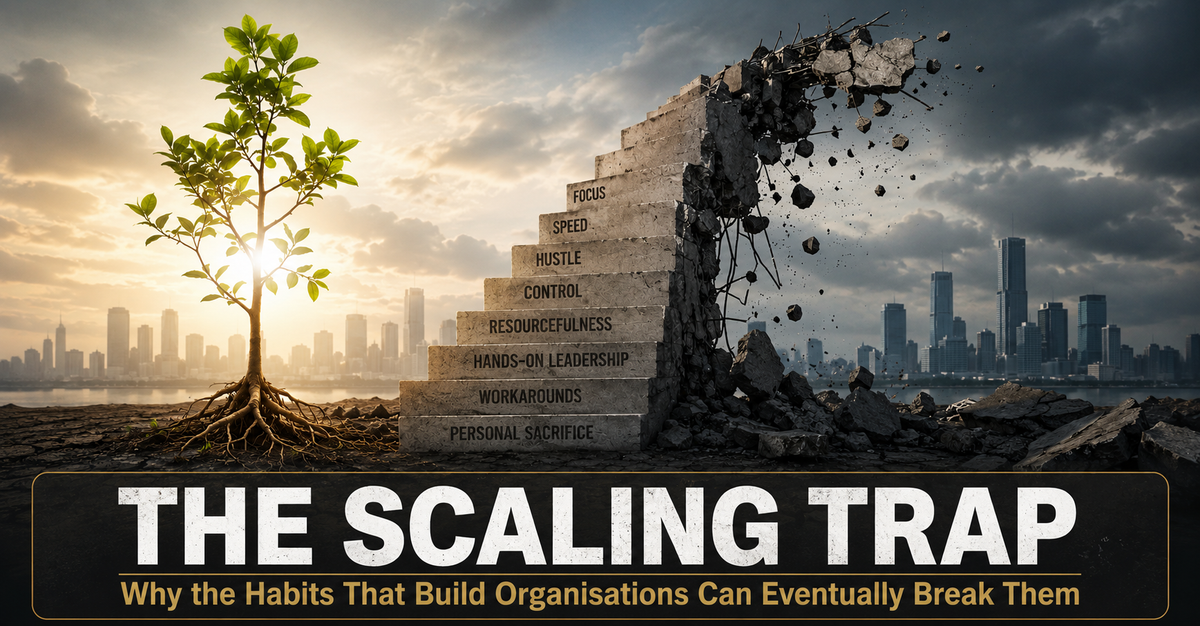
THE SCALING TRAP : Why the Habits That Build Organisations Can Eventually Break Them
Growth does not merely increase scale. It changes the structure of the system. The very behaviours that helped organisations succeed can eventually become the conditions that destabilise them.
Co-authored
Myles Kelly, EMBA (Melbourne Business School)
Founder | Director | CEO | Master of Entrepreneurship candidate (University of Melbourne)Faculty Advisor, Institute for Systems Integrity (ISI)
&
Dr Alwin Tan, GAICD, MBBS, FRACS, EMBA (Melbourne Business School)
Senior Surgeon | Governance Leader | HealthTech Co-founder |
Harvard Medical School — AI in Healthcare |
Australian Institute of Company Directors — GAICD graduate |
University of Oxford — Sustainable Enterprise
Institute for Systems Integrity (ISI)
🚨 THE MOST DANGEROUS PHASE OF GROWTH IS OFTEN THE MOMENT AN ORGANISATION APPEARS TO BE SUCCEEDING.
For decades, entrepreneurship has been celebrated through a familiar mythology.
Move fast.
Trust your instincts.
Outwork everyone.
Stay hands-on.
Push harder.
Never lose control.
In the early stages of an organisation, these behaviours often work extraordinarily well.
Founders survive because they compensate for limited resources through intensity, adaptability and sheer personal commitment.
They make decisions quickly.
Stay close to customers.
Solve problems in real time.
Carry institutional memory inside their own heads.
Bridge operational gaps through personal effort rather than formal systems.
In the beginning, these habits create energy.
They build momentum.
They help organisations survive.
But over time, many organisations discover something dangerous:
🚨 THE VERY BEHAVIOURS THAT HELPED THE ORGANISATION SUCCEED CAN BECOME THE FORCES THAT DESTABILISE IT AS COMPLEXITY GROWS.
This is the scaling trap.
And it may be one of the defining organisational risks of the modern era.
Heroic Habits Become Concentration Risk
Early-stage organisations depend on heroics.
The founder knows everything.
Approves everything.
Solves everything.
Remembers everything.
Absorbs stress personally.
Investors often reward this.
Teams admire it.
Customers value responsiveness.
It looks like leadership.
But as complexity grows, something changes.
The founder gradually becomes the point through which:
- judgement,
- approval,
- knowledge,
- relationships,
- culture, and
- crisis management
must continuously flow.
The organisation is no longer scaling capability.
🚨 IT IS SCALING DEPENDENCE.
What once represented entrepreneurial strength becomes concentration risk.
This is not leadership failure.
It is an evolutionary mismatch.
The operating model that solved Phase One becomes inadequate for Phase Two.
🚨 THE FOUNDER STOPS BEING A FORCE MULTIPLIER AND BECOMES A THROUGHPUT CONSTRAINT.
Scaling Changes the Structure of the System
Many organisations mistakenly assume growth simply means "more of the same."
More customers.
More staff.
More revenue.
More products.
🚨 BUT SCALE FUNDAMENTALLY ALTERS THE NATURE OF THE SYSTEM.
Complexity multiplies.
Communication pathways expand.
Decision loads increase.
Cyber exposure grows.
Regulatory obligations intensify.
Operational interdependencies deepen.
Cultural consistency becomes harder to maintain.
Weak signals become easier to miss.
Small organisations rely upon:
- proximity,
- shared memory,
- informal coordination,
- improvisation, and
- direct visibility.
Complex organisations require:
- translation,
- distributed authority,
- verification,
- signal integrity,
- adaptive learning, and
- coherent coordination under pressure.
Yet many organisations continue governing this new complexity using leadership structures designed for a much smaller system.
🚨 THIS IS WHERE SYSTEMIC DRIFT BEGINS.
Not because leaders stop caring.
But because organisational complexity begins to exceed the organisation's ability to maintain visibility, coherence and adaptive capacity.
Success Can Mask Deterioration
At this point, organisations enter a dangerous paradox.
Externally, they appear increasingly successful.
Revenue rises.
Hiring continues.
The brand strengthens.
The founder appears highly capable.
Internally, however:
communication slows,
decision bottlenecks emerge,
operational fatigue accumulates,
escalation weakens,
and critical knowledge remains dangerously concentrated.
🚨 THE BUSINESS APPEARS STRONGER WHILE BECOMING PROGRESSIVELY MORE FRAGILE.
Heroic organisations often look high-performing immediately before they fail.
The founder answers messages at midnight.
Approves every important decision.
Rescues operational breakdowns personally.
Maintains key customer relationships individually.
Holds culture together through force of personality.
From the outside, this appears admirable.
From a systems perspective, it often signals accumulating fragility.
🚨 SUCCESS CAN BECOME CAMOUFLAGE.
Signal Compression and Informational Distortion
One of the least discussed risks of organisational growth is the gradual deterioration of organisational sensing.
As organisations expand, staff begin adapting to hierarchy.
Bad news is softened.
Concerns are reframed.
Escalation slows.
Operational friction becomes normalised.
Weak signals disappear beneath momentum.
The organisation continues functioning.
But it gradually loses the ability to accurately perceive itself.
🚨 IT DEVELOPS INFORMATIONAL DISTORTION.
Founders become increasingly insulated from reality.
🚨 SCALING DOES NOT MERELY INCREASE WORKLOAD. IT CHANGES WHO GETS TO DEFINE REALITY.
This may be one of the defining risks separating resilient organisations from fragile ones.
Because systems rarely collapse without warning.
Signals almost always emerge first:
- missed follow-ups,
- unresolved tensions,
- customer frustration,
- financial leakage,
- staff withdrawal,
- decision fatigue,
- workarounds,
- cultural inconsistency,
- normalised deviance,
- accrued burnout.
The danger is that growth itself suppresses exactly these signals.
🚨 SUCCESS BECOMES A MASKING FORCE.
Momentum hides governance weakness.
Charisma obscures structural fragility.
Until pressure arrives.
AI Accelerates Appearance Faster Than Substance
Artificial intelligence is changing the economics of growth.
Organisations can now generate:
- strategy documents,
- investor presentations,
- marketing campaigns,
- forecasts,
- customer communications,
- software tools,
- operational workflows,
- policy documents,
at unprecedented speed.
But speed creates a dangerous illusion.
Output growth is not organisational maturity.
🚨 AI CAN MAKE ORGANISATIONS LOOK ADULT LONG BEFORE THEY HAVE LEARNED HOW TO GROW UP.
A company can look sophisticated long before its governance, culture, operational discipline and resilience are genuinely ready.
AI therefore amplifies one of the oldest dangers in entrepreneurship:
🚨 THE ABILITY TO SCALE APPEARANCE FASTER THAN SUBSTANCE.
This is a systems integrity problem.
The issue is not whether growth is occurring.
🚨 THE ISSUE IS WHETHER GOVERNANCE IS EVOLVING AS FAST AS COMPLEXITY.
Many organisations are discovering that it is not.
Integrity Debt and Verification Lag
Early shortcuts are often understandable.
"We'll fix it later."
"Documentation can wait."
"We know our customers."
"We'll formalise the process next quarter."
Each shortcut accumulates what might be called integrity debt.
🚨 INTEGRITY DEBT IS A HIDDEN OBLIGATION OWED TO REALITY.
As organisations scale, verification systems often fail to keep pace.
Growth outpaces understanding.
Expansion exceeds visibility.
Narratives become increasingly detached from operational truth.
Supply chains frequently expose these limits first.
Demand projections fail.
Margins narrow.
Defects emerge.
Timelines slip.
Quality deteriorates.
Warehouses reveal what presentations cannot.
🚨 REALITY ALWAYS RECONCILES THE BOOKS EVENTUALLY.
The narrative can adapt.
The invoice cannot.
The defect rate cannot.
The stock discrepancy cannot.
Leadership as System Design
The solution is not bureaucracy.
Many mature organisations fail for the opposite reason.
Too much hierarchy.
Too much process.
Too much inertia.
Too little adaptability.
The challenge is preserving entrepreneurial energy without depending on exhaustion, improvisation and constant intervention.
This requires a different conception of leadership.
🚨 NOT LEADERSHIP AS PERMANENT CONTROL. BUT LEADERSHIP AS SYSTEM DESIGN.
Leadership evolves:
From chief problem-solver
to architect of organisational capability.
From central decision-maker
to builder of decision environments.
From personal oversight
to system-level visibility.
From hero
to steward.
🚨 LEADERSHIP IS THE DESIGN OF HOW TRUTH MOVES THROUGH A SYSTEM UNDER PRESSURE.
The Systems Integrity Challenge
The scaling trap extends far beyond entrepreneurship.
Healthcare systems.
Universities.
Technology firms.
Government agencies.
Non-profits.
Professional partnerships.
Every institution now operates in environments shaped by:
- AI acceleration,
- digital dependency,
- cyber vulnerability,
- economic volatility,
- reputational amplification,
- workforce instability,
- rapidly shifting expectations.
Under these conditions, poorly governed complexity accumulates silently until thresholds are crossed suddenly.
🚨 MANY ORGANISATIONS ARE SCALING OPERATIONAL CAPABILITY FASTER THAN THEY ARE SCALING ORGANISATIONAL INTEGRITY.
Eventually, the gap becomes visible.
The Goal Is Not To Remain Indispensable
The strongest leaders ultimately recognise a difficult truth.
🚨 THE OBJECTIVE IS NOT TO REMAIN INDISPENSABLE FOREVER.
The objective is to build organisations capable of functioning clearly, coherently and adaptively even under pressure.
Because real scale is not measured by how much the founder can personally carry.
🚨 REAL SCALE OCCURS WHEN THE ORGANISATION NO LONGER DEPENDS ON HEROIC EFFORT TO REMAIN STABLE.
The great misconception of growth is that organisations fail because they lose the qualities that made them successful.
🚨 MORE OFTEN, THEY FAIL BECAUSE THEY CLING TO THOSE QUALITIES FOR TOO LONG.
Heroism becomes dependence.
Speed becomes distortion.
Confidence becomes insulation.
Growth becomes camouflage.
The challenge of modern leadership is therefore not simply building organisations that can expand.
It is building organisations capable of remaining truthful, adaptive and coherent as complexity accelerates around them.
Because resilience is not the absence of pressure.
🚨 RESILIENCE IS THE CAPACITY OF A SYSTEM TO PERCEIVE REALITY CLEARLY ENOUGH TO RESPOND BEFORE FRAGILITY BECOMES FAILURE.
And in the decade ahead:
🚨 RESILIENCE MAY PROVE TO BE THE MOST IMPORTANT COMPETITIVE ADVANTAGE OF ALL.
References
DeSantola, A. and Gulati, R. (2017) 'Scaling: Organizing and growth in entrepreneurial ventures', Academy of Management Annals, 11(2), pp. 640–668.
Reason, J. (1997) Managing the Risks of Organizational Accidents. Aldershot: Ashgate.
Turner, B.A. (1978) Man-Made Disasters. London: Wykeham Publications.
Vaughan, D. (1996) The Challenger Launch Decision: Risky Technology, Culture, and Deviance at NASA. Chicago: University of Chicago Press.
Dekker, S. (2011) Drift into Failure: From Hunting Broken Components to Understanding Complex Systems. Farnham: Ashgate.
Rochlin, G.I. (1999) 'Safe operation as a social construct', Ergonomics, 42(11), pp. 1549–1560.