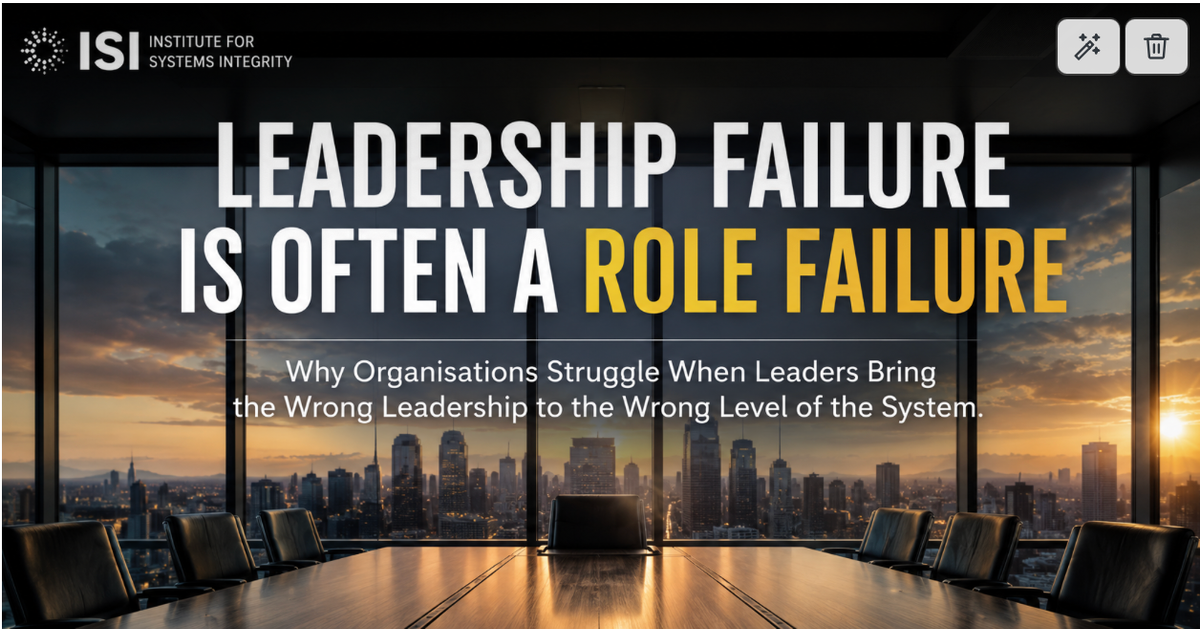
LEADERSHIP FAILURE IS OFTEN A ROLE FAILURE : Why Organisations Struggle When Leaders Bring the Wrong Leadership to the Wrong Level of the System
The most dangerous leadership failures often occur when successful leaders continue using yesterday's leadership model to solve tomorrow's problems. A new ISI perspective on leadership fit, governance risk and adaptive capability.
Dr Alwin Tan, GAICD, MBBS, FRACS, EMBA (Melbourne Business School)
Senior Surgeon | Governance Leader | HealthTech Co-founder |
Harvard Medical School — AI in Healthcare |
Australian Institute of Company Directors — GAICD graduate |
University of Oxford — Sustainable Enterprise
Institute for Systems Integrity (ISI)
Executive Summary
When organisations experience leadership failure, they usually look for the wrong cause.
They search for capability gaps.
Poor communication.
Weak decision-making.
Insufficient experience.
Inadequate training.
But many leadership failures are not capability failures at all.
They are role failures.
🚨 Leadership failure is frequently a role failure disguised as a people failure.
The individual may be highly capable.
Highly experienced.
Highly successful.
Yet still become a source of organisational risk.
Not because they lack leadership ability.
But because they are applying the wrong leadership model to the level of the system they now occupy.
As organisations become increasingly complex, leadership effectiveness is becoming less about competence alone and more about contextual fit.
The question boards should be asking is not:
"Do we have capable leaders?"
The question is:
🚨 Are our leaders practising the right form of leadership for the role they occupy?
Because in complex systems, capability without fit can become a governance liability.
The Leadership Myth
Most organisations continue to treat leadership as a transferable skill.
Communicate well.
Build relationships.
Influence others.
Manage conflict.
Drive performance.
Develop teams.
These capabilities matter.
But they encourage a dangerous assumption:
That leadership is fundamentally the same regardless of where it is practised.
It is not.
🚨 The same leadership behaviour that creates success at one level of an organisation can create failure at another.
The leadership required of a frontline nurse manager is fundamentally different from the leadership required of a hospital executive.
The leadership required of a CEO differs fundamentally from the leadership required of a board director.
Different levels of the system face different realities.
Different information.
Different risks.
Different accountabilities.
Different time horizons.
Different forms of uncertainty.
Yet organisations routinely promote individuals without recognising that the nature of leadership itself has changed.
As a result, organisations often mistake career success for leadership readiness.
Those are not the same thing.
The Governance Blind Spot Nobody Measures
Most organisations assess leadership capability.
Very few assess leadership fit.
This creates a governance blind spot.
A leader can possess exceptional technical expertise, operational experience and professional credibility while simultaneously being misaligned with the leadership demands of the role.
In fact, some of the greatest leadership risks emerge from highly successful people.
Because success often reinforces behaviours that no longer fit the environment.
🚨 Healthcare does not have a leadership shortage. It has a leadership fit problem.
The danger is not weak leadership.
The danger is misaligned leadership.
When leaders continue solving yesterday's problems using yesterday's leadership model, organisational learning begins to deteriorate.
Over time, the system becomes less adaptive, less responsive and less capable of seeing emerging risk.
This is what ISI describes as:
Leadership Fit Failure™
A condition in which leadership capability exists but leadership behaviour is no longer aligned with the role, complexity or decision environment of the system.
Every Level of the System Has a Different Leadership Task
One of the most important realities organisations fail to recognise is that leadership changes shape as responsibility increases.
The work is different.
The information is different.
The purpose is different.
The leadership model must therefore be different.
Frontline Leadership
Primary Function:
Signal Detection
Frontline leaders operate closest to operational reality.
They see:
- workload pressure
- patient experience
- workarounds
- process failures
- operational friction
- emerging safety concerns
Their value is proximity to truth.
They often see risks long before dashboards do.
Long before executive reports do.
Long before boards do.
🚨 Frontline leaders create value by seeing reality before the rest of the organisation does.
Their role is not to absorb systemic dysfunction.
Their role is to detect it.
Middle Leadership
Primary Function:
Signal Translation
Middle leadership may be one of the most strategically important and least understood levels in an organisation.
Middle leaders sit between strategy and operations.
Between executive intent and frontline reality.
Their role is translation.
Not filtration.
Translation.
They help organisations understand what is actually happening.
When functioning effectively, they strengthen learning.
When functioning poorly, they become distortion mechanisms.
🚨 The moment middle management begins protecting leadership from reality, organisational blindness begins.
Most catastrophic organisational failures are not caused by missing information.
They are caused by information that was softened, delayed, filtered or reframed before it reached decision-makers.
Executive Leadership
Primary Function:
Capability Design
Executives often inherit a dangerous temptation.
To remain experts.
To remain problem-solvers.
To remain operationally involved.
But executive leadership is not primarily about solving problems.
It is about building systems capable of solving problems.
Executives shape:
- incentives
- resources
- priorities
- workforce capability
- learning environments
- organisational resilience
🚨 Great executives solve fewer problems than they create capability to solve.
The shift from operator to architect is one of the most difficult leadership transitions in modern organisations.
Many never successfully make it.
Board Leadership
Primary Function:
Governing Conditions
Boards do not manage operations.
Boards govern the conditions within which organisational performance becomes possible.
Their role is stewardship.
Not execution.
Boards govern:
- organisational purpose
- strategic direction
- risk appetite
- accountability systems
- leadership expectations
- long-term sustainability
🚨 Boards should not govern activity. They should govern the conditions that shape activity.
When boards drift into management, governance weakens.
When boards focus exclusively on outcomes, they often miss the conditions producing those outcomes.
And that is where many governance failures begin.
Success Can Become a Liability
One of the least discussed risks in leadership is that success creates rigidity.
The surgeon promoted because of expertise continues relying on expertise.
The manager promoted because of operational control continues relying on control.
The executive promoted because of decisiveness continues relying on certainty.
The behaviours that once created success become increasingly difficult to abandon.
🚨 The leadership style that got you promoted may be the very thing preventing progress.
This is particularly dangerous in healthcare.
Because many contemporary healthcare challenges are not technical.
They are adaptive.
Burnout.
Workforce trust.
Culture.
Patient flow.
Digital transformation.
AI integration.
Psychological safety.
Workforce sustainability.
These challenges cannot be solved through authority alone.
They require learning.
Adaptation.
Experimentation.
And collective problem-solving.
The Complexity Challenge
Healthcare increasingly operates within environments characterised by:
- uncertainty
- emergence
- interdependence
- ambiguity
- delayed consequences
Traditional command-and-control leadership becomes progressively less effective under these conditions.
Complex systems do not respond predictably to authority.
They respond to adaptation.
🚨 The more complex the system becomes, the less leadership is about control and the more it becomes about adaptation.
This is why some of the most successful leaders struggle in periods of transformation.
The environment changes faster than the leadership model.
And eventually the gap becomes visible.
When Leadership Becomes a Governance Risk
Misaligned leadership produces remarkably predictable consequences.
Frontline leaders attempt to solve structural problems.
Middle managers become information filters.
Executives become operational firefighters.
Boards become pseudo-management teams.
The result is not simply inefficiency.
The result is organisational fragility.
🚨 Success creates rigidity. Rigidity creates governance risk.
Over time:
- signals weaken
- escalation slows
- learning deteriorates
- adaptability declines
- decision quality erodes
The organisation often remains operationally successful while becoming progressively less resilient.
That is one of the most dangerous conditions in governance.
Because fragility often hides behind performance.
Leadership as a System Capability
Traditional leadership models focus on individual characteristics.
ISI proposes a different perspective.
Leadership should be understood as a system capability.
The critical question is not:
"Is this person a good leader?"
The critical question is:
🚨 Is this person practising the right type of leadership for the position they occupy?
This changes everything.
Leadership becomes less about personality.
Less about charisma.
Less about heroics.
And more about system fit.
Organisational design.
Adaptive capacity.
And long-term resilience.
The ISI Position
Healthcare does not need more heroic leaders.
It needs more adaptive leaders.
Leaders capable of changing shape as the system around them changes.
Leaders capable of moving between:
- expertise and curiosity
- authority and learning
- certainty and experimentation
- control and adaptation
🚨 The most dangerous leaders are often the most successful ones.
Not because they lack capability.
But because they continue using yesterday's leadership model to solve tomorrow's problems.
Final Reflection
Most organisations ask:
"Do we have the right leaders?"
ISI suggests a more important question.
🚨 Are our leaders practising the right form of leadership for the level of the system they occupy?
Because in complex organisations:
🚨 Leadership failure is often not a people problem. It is a role-design problem.
And until organisations recognise that distinction, they will continue promoting capable people into positions where their greatest strengths eventually become their greatest limitations.
Ultimately:
🚨 Most organisations do not fail because they lack leaders. They fail because capable leaders continue solving the wrong problems at the wrong level of the system.
The future belongs to leaders who can adapt faster than the environments they govern.
🚨 The future belongs to leaders who can change shape faster than the system around them changes.
References
Charan, R., Drotter, S. and Noel, J. (2011) The Leadership Pipeline: How to Build the Leadership Powered Company. 2nd edn. San Francisco: Jossey-Bass.
Gronn, P. (2002) ‘Distributed Leadership as a Unit of Analysis’, The Leadership Quarterly, 13(4), pp. 423–451.
Heifetz, R.A. and Laurie, D.L. (2001) ‘The Work of Leadership’, Harvard Business Review, 79(11), pp. 131–141.
Heifetz, R.A. and Linsky, M. (2002) Leadership on the Line: Staying Alive Through the Dangers of Leading. Boston: Harvard Business School Press.
Heifetz, R.A., Grashow, A. and Linsky, M. (2009) The Practice of Adaptive Leadership: Tools and Tactics for Changing Your Organization and the World. Boston: Harvard Business Press.
Kaiser, R.B. (2011) ‘The leadership pipeline: Fad, fashion or empirical fact?’, The Psychologist-Manager Journal, 14(2), pp. 71–85.
Northouse, P.G. (2022) Leadership: Theory and Practice. 9th edn. Thousand Oaks, CA: Sage Publications.
Senge, P.M. (1990) The Fifth Discipline: The Art and Practice of the Learning Organization. New York: Doubleday.
Uhl-Bien, M., Marion, R. and McKelvey, B. (2007) ‘Complexity Leadership Theory: Shifting leadership from the industrial age to the knowledge era’, The Leadership Quarterly, 18(4), pp. 298–318.
West, M., Eckert, R., Collins, B. and Chowla, R. (2017) Caring to Change: How Compassionate Leadership Can Stimulate Innovation in Health Care. London: The King's Fund.