YOUR CEO CUT THE COST.... DID THE BOARD CHECK WHAT THE ORGANISATION LOST?
When CEOs cut costs through AI, outsourcing and offshoring, what capabilities disappear? ISI examines hidden risks, board oversight and accountability.
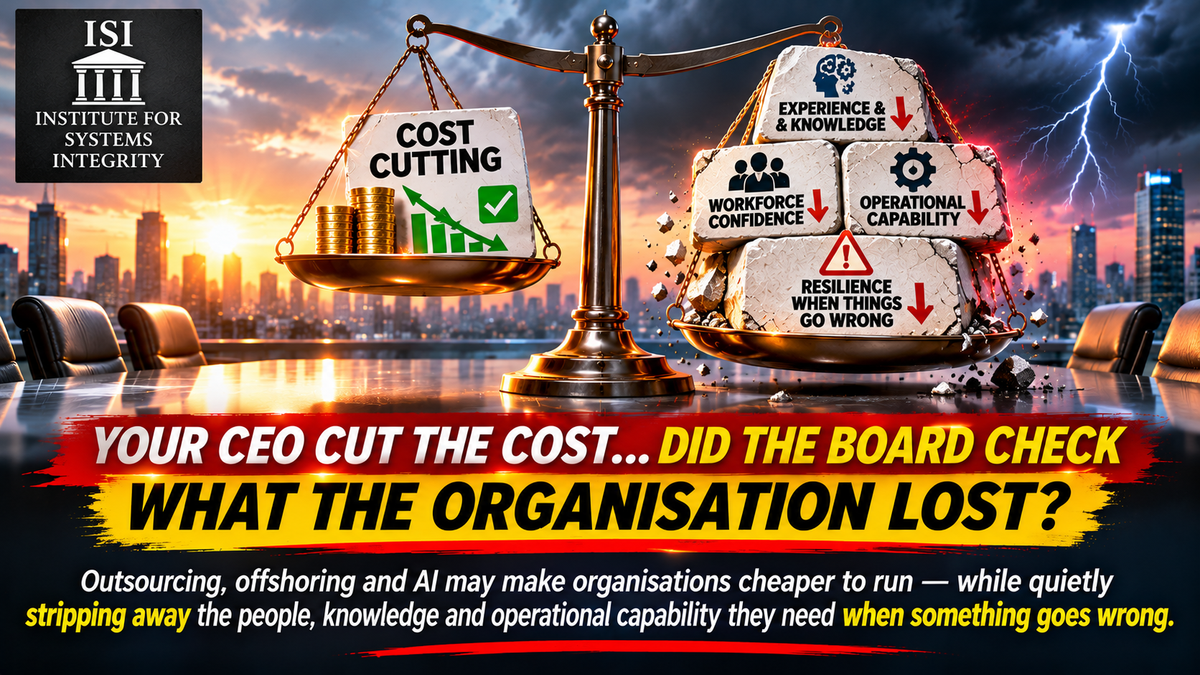
When outsourcing, offshoring and AI make organisations cheaper to run
but may weaken the knowledge, workforce confidence and operational capability they need when things go wrong.
Co Authors
Dr Alwin Tan, GAICD, MBBS, FRACS, EMBA (Melbourne Business School)
Senior Surgeon | Governance Leader | HealthTech Co-founder | Founder of Institute for Systems Integrity (ISI) | Harvard Medical School — AI in Healthcare | University of Oxford — Sustainable Enterprise | Bastas Academy for Healthcare Leadership — Triple Scholar
Nadra Gadeed BSc Psychology, MSc Forensic Psychology, MA Health Research
Founder and Strategic Advisor, Edify & Grow | Workforce Risk Advisor to Boards and C-Suite Leaders, Private Healthcare, GCC & Asia-Pacific | 20 Years in the NHS Across Strategic, Operational and Leadership Roles
INSTITUTE FOR SYSTEMS INTEGRITY
The CEO announces the savings.
The financial report confirms the improvement.
The board celebrates the transformation.
But five years later, a critical system fails.
Who still knows how to fix it?
The experienced engineers may have departed.
Critical knowledge may now sit with external providers, international teams or automated systems.
The organisation may depend on suppliers it cannot readily replace.
The contract says the organisation remains in control.
But does it still possess the practical capability to exercise that control?
And there is another question.
What happened to the people who remained?
Do they still understand the systems?
Do they trust the organisation?
Will they challenge a dangerous decision?
Will they speak up when something appears wrong?
This is not an argument against outsourcing, offshoring or artificial intelligence. Each can deliver genuine economic value, specialist expertise, innovation and stronger operational resilience.
It is an argument against measuring the financial benefits of transformation more precisely than the institutional capabilities that must survive it.
WHEN AN ORGANISATION REDUCES THE COST OF CRITICAL WORK,
WHO INDEPENDENTLY VERIFIES THAT IT HAS NOT ALSO REDUCED ITS ABILITY TO UNDERSTAND,
CONTROL,
RECOVER
AND REVERSE THAT WORK?
That is a question every board should be asking.
Executive summary
Organisations worldwide are restructuring critical operations to improve efficiency.
Banks are expanding international technology centres.
Hospitals depend on external providers for essential clinical services.
Airlines, telecommunications operators and energy companies rely on complex supplier networks.
Governments contract external organisations to deliver public services.
Artificial intelligence is accelerating this transformation.
The benefits can be substantial. International delivery and specialist providers can offer access to expertise, scalable operations, innovation and lower costs.
Yet these arrangements may also create dependencies that are difficult to identify, manage or reverse.
Research has documented additional costs associated with offshoring, including coordination, knowledge transfer and organisational complexity (Dibbern, Winkler and Heinzl, 2008; Larsen, Manning and Pedersen, 2013).
Regulators increasingly emphasise operational resilience, third-party dependencies, continuity planning and effective institutional oversight.
But there is another dimension that deserves equal attention: the workforce.
The people who understand critical systems,
recognise emerging problems,
challenge unsafe decisions
and coordinate recovery are themselves part of institutional resilience.
Research on organisational justice and psychological safety suggests that the treatment of employees and their confidence in speaking up can influence organisational behaviour (Brockner et al., 1987; Edmondson, 1999).
The Institute for Systems Integrity (ISI) therefore proposes two related conceptual frameworks:
Institutional Capability Erosion Paradox™
The possibility that financial efficiency improves while institutional knowledge, operational independence or recovery capability deteriorates.
Critical Capability Assurance Gap™
The potential difference between reported transformation benefits and independently verified evidence that critical organisational capabilities remain effective.
These are proposed governance concepts, not empirically validated measurement instruments.
The central recommendation is that boards require a critical capability assurance case alongside the conventional financial business case for material outsourcing, offshoring and AI-enabled restructuring.
A transformation should not be declared successful merely because it costs less.
It should be judged by whether it delivers better value while preserving the organisation's ability to fulfil its obligations under stress.
1. The global race to make organisations cheaper
Cost reduction has become a central feature of organisational transformation.
Executives face pressure to improve productivity, reduce operating expenses, adopt new technologies and maintain financial performance.
Outsourcing, offshoring and AI offer attractive opportunities.
A bank can establish an engineering centre in India.
A hospital can engage a specialist technology provider.
An airline can consolidate international support functions.
A government department can contract external expertise.
An organisation can automate work previously performed by employees.
Each decision may be commercially rational.
But the strategies are different.
Offshoring relocates work internationally, either through directly employed staff or external providers.
Outsourcing transfers responsibility for specified activities to another organisation.
AI automation uses technology to perform or support tasks previously undertaken by people.
An organisation may combine all three.
Each changes where work is performed,
where knowledge resides,
who makes decisions
and which capabilities the organisation depends upon.
The board must therefore understand not only what the organisation gains, but what it may become less capable of doing independently.
This includes the workforce.
A restructuring changes who holds institutional knowledge,
who remains responsible for managing risk
and who must respond when a system fails.
THE PRICE OF PERFORMING THE WORK IS NOT THE SAME AS THE COST OF RETAINING CONTROL OVER THE OUTCOME.
Nor is it necessarily the same as the cost of retaining the people who understand that outcome.
2. Banking: a global experiment in distributed technology capability
Modern banks depend on sophisticated technology for payments, deposits, lending, fraud prevention, cybersecurity, customer identity and financial-market operations.
Technology failures can affect millions of customers and, in severe circumstances, financial stability.
Major international banks have established substantial technology and operational capabilities across multiple countries.
These operations are not simply low-cost administrative facilities.
Many deliver sophisticated engineering, cybersecurity, cloud infrastructure, analytics and AI capabilities central to banking.
The benefits include access to specialist expertise, engineering scale, extended operational coverage and potentially lower costs.
But international delivery also changes where critical institutional knowledge resides.
A bank may directly employ its overseas engineers and retain legal ownership of its systems.
That does not automatically establish operational independence.
The board must understand which critical capabilities depend on particular locations, teams, individuals or infrastructure.
Can the bank maintain essential services if an important location becomes unavailable?
Can it independently investigate and reverse a dangerous system change?
Can it recover without relying entirely on the same provider or team affected by the disruption?
There is also a workforce challenge.
International technology centres compete for specialist engineering, cybersecurity and AI talent. Their long-term effectiveness depends on retaining experienced people, developing successors and preserving institutional knowledge.
A capability that exists today may not remain available five years from now without deliberate investment.
LEGAL OWNERSHIP OF A TECHNOLOGY OPERATION DOES NOT,
BY ITSELF,
PROVE THAT THE ORGANISATION CAN OPERATE INDEPENDENTLY.
3. Australia: the global transformation reaches domestic banking
Australia's major banks are participating in international technology and operational transformation.
NAB, ANZ, Commonwealth Bank, Westpac and Macquarie operate through differing combinations of domestic teams, international capabilities and external providers.
These arrangements vary in ownership, scale, function and dependence on third parties.
They should not be treated as interchangeable.
Nor should domestic redundancies occurring alongside international recruitment automatically be characterised as direct job replacement.
Restructuring may reflect automation, organisational consolidation, changing technical requirements or broader business strategy.
Nevertheless, legitimate governance questions remain.
What happens to domestic technical expertise?
How is knowledge of legacy banking systems preserved?
Who retains the authority and practical capability to challenge critical technology decisions?
How does the board independently establish that operational resilience has been maintained?
And how are the employees who remain affected by the transformation?
Brockner et al. (1987) found that employees remaining after layoffs could experience reduced organisational commitment when they identified with departing colleagues and perceived that those colleagues had been treated inadequately.
That finding does not establish that all restructuring damages employee commitment.
It does, however, demonstrate why the fairness and management of a transition matter.
Australia's APRA Prudential Standard CPS 230 requires regulated entities to manage operational risks, maintain critical operations through severe disruptions and manage risks arising from service providers. CPS 234 addresses information-security capabilities and controls (APRA, 2019; APRA, 2026).
These obligations reinforce a fundamental principle.
AN AUSTRALIAN BANK CAN GLOBALISE ITS TECHNOLOGY WORKFORCE.
IT CANNOT GLOBALISE AWAY ITS RESPONSIBILITY TO AUSTRALIAN CUSTOMERS AND THE FINANCIAL SYSTEM.
4. Europe: when an organisation cannot easily reverse its decision
European banking supervision has highlighted the challenges of substituting or reintegrating critical outsourced services.
The European Central Bank's 2025 analysis of outsourcing arrangements raises important questions about provider dependence, concentration and exit capability.
These findings concern external outsourcing arrangements, not all offshore employment or bank-owned international technology centres.
The distinction matters.
A bank may have a functioning outsourced service, satisfactory contractual reports and genuine financial savings.
But what happens when the bank wants to change providers?
What happens if a cyberattack, geopolitical disruption, commercial dispute or regulatory change threatens the arrangement?
Can the bank bring the service back inside its organisation?
Does it retain the technical knowledge required to operate independently?
Or has it gradually lost the practical ability to reverse a decision that was originally presented as reversible?
THE CONTRACT SAYS THE BANK IS IN CONTROL.
BUT CAN THE BANK STILL OPERATE WITHOUT THE CONTRACTOR?
This is the difference between contractual authority and operational capability.
A board may possess the legal right to terminate an arrangement without possessing the practical ability to restore the service.
ISI's concept of Reversal Architecture addresses precisely this problem.
An institution should establish not merely whether it can exit an arrangement legally, but whether it can do so operationally, within acceptable time, cost and disruption limits.
That may require alternative providers, retained expertise, portable data, accessible documentation and tested contingency arrangements.
It also requires people who retain the necessary skills.
An organisation may still employ individuals with the appropriate job titles while those individuals have lost practical experience of operating the systems concerned.
A DECISION IS NOT GENUINELY REVERSIBLE SIMPLY BECAUSE THE CONTRACT CONTAINS AN EXIT CLAUSE.
5. The hidden economics of making critical work cheaper
The business case for offshoring often begins with labour-cost differences.
But the cost of employment is not the same as the full cost of maintaining a reliable critical capability.
Dibbern, Winkler and Heinzl (2008), examining software projects offshored to Indian vendors by a German financial institution, identified additional client costs associated with requirements specification, knowledge transfer, control and coordination.
Larsen, Manning and Pedersen (2013) examined how organisational complexity, design and experience influence hidden offshoring costs.
These findings matter because critical systems contain more than software code.
They contain institutional knowledge.
A banking payments system may embody decades of regulatory changes, technical decisions and undocumented exceptions.
A hospital information system may contain complex relationships between clinical workflows, medications, diagnostics and patient records.
An electricity network may depend on specialised knowledge of equipment, maintenance history and operating conditions.
Some knowledge is documented.
Some exists in the experience of people who have developed, operated and repaired these systems over many years.
Other knowledge is behavioural.
It includes recognising an anomaly, questioning an assumption and speaking up before a problem becomes a failure.
Edmondson (1999) demonstrated the importance of psychological safety for learning behaviour in work teams.
Applying this research to restructuring suggests a legitimate concern: if employees feel insecure or unable to challenge decisions, an organisation may lose important opportunities to identify emerging risks.
That is a plausible governance implication, not proof that every restructuring reduces psychological safety.
When experienced employees depart, knowledge may be lost that cannot readily be reconstructed.
A CEO CAN CALCULATE THE SALARY THE ORGANISATION NO LONGER PAYS.
BUT HAS ANYONE CALCULATED THE VALUE OF THE KNOWLEDGE IT MAY NO LONGER POSSESS?
This does not mean knowledge must remain in one country.
An international team may preserve and develop it exceptionally well.
The requirement is that critical knowledge remains accessible, reliable, transferable and sufficient to maintain operations.
A responsible business case should therefore account for the full lifecycle costs of transformation, including coordination, knowledge transfer, assurance, retained technical leadership, workforce continuity, recovery and potential provider replacement.
A lower employment bill is not necessarily a lower total cost of ownership.
6. The strongest counterargument: global delivery can make organisations better
A credible governance argument must acknowledge the substantial benefits of international delivery.
Countries such as India have developed sophisticated technology and engineering workforces.
International capability centres can provide specialist expertise in software development, cybersecurity, cloud infrastructure, analytics and AI.
External providers may possess capabilities that an individual organisation could not economically develop internally.
Global delivery can improve scalability, innovation and continuity across time zones.
It can also strengthen resilience where operations are genuinely diversified across independent locations and infrastructure.
A mature international capability centre may outperform an expensive but poorly managed domestic department.
Equally, a poorly governed domestic provider may create greater risk than a well-managed international team.
The relevant distinction is not between Australian and Indian engineers.
It is not between domestic and international organisations.
THE NATIONALITY OF THE ENGINEER IS NOT THE GOVERNANCE ISSUE.
The issue is whether the organisation retains sufficient knowledge, authority, independent assurance and recovery capability.
A well-designed transformation can improve efficiency and resilience simultaneously.
It can also create stable careers, better training pathways and stronger knowledge retention.
The risk arises when the board assumes that financial success automatically establishes operational success.
7. Healthcare: when institutional dependency becomes a patient-safety problem
On 3 June 2024, Synnovis, a pathology provider serving NHS organisations in London, experienced a ransomware attack.
The attack disrupted pathology services, significantly reduced testing capacity and required extensive contingency arrangements.
NHS England subsequently reported delays affecting more than 11,000 outpatient and elective procedure appointments (NHS England, 2025).
The incident was a criminal cyberattack.
There is no basis for attributing it to offshoring.
Its relevance lies in the consequences of losing access to critical healthcare technology and services.
The questions for hospital boards are immediate.
Can clinicians access essential pathology results?
Can urgent investigations continue?
Are safe manual alternatives available?
Who understands the relationships between laboratory systems and clinical workflows?
Who has authority to coordinate recovery?
And how long can patient care safely continue without normal technology support?
There is also a workforce cost.
When services fail, retained clinical and administrative employees often manage the consequences.
They chase results, explain delays, coordinate alternative pathways and absorb additional work.
These costs may not appear in the original outsourcing business case.
Duffield et al. (2014) demonstrated that nurse turnover carries substantial financial costs, including temporary replacement and indirect costs.
Their findings do not establish that outsourcing caused nurse turnover. They do demonstrate why workforce retention should be considered when evaluating the full economic consequences of operational change.
A hospital may legitimately outsource pathology, imaging, cybersecurity or digital infrastructure.
But it must retain the ability to manage the consequences when those services become unavailable.
A HOSPITAL CAN OUTSOURCE THE TECHNOLOGY.
IT CANNOT OUTSOURCE ITS RESPONSIBILITY FOR PATIENT SAFETY.
This principle applies equally to clinical AI, outsourced administration, medical equipment maintenance and digital health platforms.
8. Aviation, telecommunications and energy: different industries, similar exposure
Critical dependencies take different forms across industries.
Airlines depend on technology for flight scheduling, reservations, operational coordination and maintenance planning.
Telecommunications operators depend on software providers, infrastructure vendors and specialist technical support.
Energy organisations depend on industrial control systems, maintenance expertise and operational technology.
International delivery and outsourcing can improve performance across these sectors.
But failures may have consequences beyond the organisation itself.
An airline disruption can affect thousands of passengers.
A telecommunications outage can interrupt business operations and emergency communications.
An energy-system failure can disrupt essential services.
The common question is whether the organisation retains the capability to respond when a critical dependency fails.
That capability depends partly on specialist employees who may be difficult to replace.
It also depends on understanding relationships between suppliers.
Several providers may appear independent while relying on the same cloud platform, telecommunications infrastructure or subcontractor.
CONTRACTUAL DIVERSIFICATION IS NOT NECESSARILY OPERATIONAL DIVERSIFICATION.
EFFICIENCY IS MEASURED WHEN THE SYSTEM WORKS. RESILIENCE IS REVEALED WHEN IT DOES NOT.
9. Government: when citizens cannot choose another provider
Government outsourcing raises an additional accountability challenge.
Citizens often cannot choose an alternative provider when an essential public service fails.
They may depend on government systems for social security, taxation, immigration, healthcare and licensing.
The British Post Office Horizon scandal illustrates the consequences of institutional failures to adequately challenge technology-generated information and respond to evidence of error.
It should not be characterised as an offshoring scandal.
Its relevance lies in technological dependence, institutional accountability and the capacity to correct harmful decisions.
When public services depend on external technology, the responsible institution must retain the ability to understand, investigate and challenge system outputs.
Who can identify an error?
Who can independently investigate it?
Who can reverse the decision?
And who can restore the position of people harmed by the failure?
These questions connect with ISI's work on Decision Custody and Administrative Closure ≠ Systemic Recovery™.
AN INSTITUTION DOES NOT DEMONSTRATE ACCOUNTABILITY MERELY BY SHOWING THAT ITS PROCESS WAS FOLLOWED.
IT MUST BE CAPABLE OF RECOGNISING WHEN THE PROCESS WAS WRONG — AND PUTTING THE CONSEQUENCES RIGHT.
10. AI: when automation changes what organisations understand
Artificial intelligence introduces another dimension.
Organisations increasingly use AI to support software development, testing, customer service, financial analysis, clinical administration and operational decisions.
These technologies can improve productivity, reduce repetitive work and enhance some processes.
They may also change how institutional knowledge is created, retained and exercised.
Consider an organisation that first transfers technology work to an international capability centre.
It subsequently automates part of that work using AI.
Both decisions may deliver genuine benefits.
But who understands the resulting system?
Who independently validates AI-generated code?
Who identifies when automated behaviour changes?
Who can suspend a critical AI-enabled process?
Who can restore the previous operating state?
And what happens when the organisation becomes dependent on a proprietary platform it cannot independently reproduce?
These questions connect with ISI's Validation Half-Life, AI Visibility Gap™ and Algorithmic Blast Radius™ frameworks.
AI does not necessarily erode institutional capability.
Properly designed systems may improve documentation, monitoring, knowledge retention and resilience.
But the people working alongside AI remain important.
They may recognise unusual outputs, inconsistencies or unexpected behaviour before formal monitoring detects a problem.
Whether they raise those concerns may depend on their confidence that they will be heard.
Kish-Gephart et al. (2009) examined fear and silence in organisations. Extending their findings to AI-enabled workplaces suggests that technical validation and employee voice should be treated as complementary safeguards.
That application remains a governance proposition requiring further empirical testing.
THE DANGER IS NOT THAT TECHNOLOGY BECOMES MORE CAPABLE.
IT IS THAT THE ORGANISATION MAY BECOME LESS CAPABLE OF UNDERSTANDING THE TECHNOLOGY ON WHICH IT DEPENDS.
11. The Institutional Capability Erosion Paradox™
ISI proposes the Institutional Capability Erosion Paradox™ to examine a potential contradiction in organisational transformation.
An organisation may become financially more efficient while becoming operationally less independent.
Operating costs decline.
Internal headcount may decrease.
Reliance on external expertise, technology platforms or automated systems may increase.
Financial performance may improve.
Yet the organisation's ability to independently understand, challenge, maintain or recover critical operations may deteriorate.
This deterioration may involve technical knowledge, workforce continuity, decision-making authority or the ability to challenge unsafe practices.
Changes in workforce confidence and retention could provide useful early warning signals.
However, whether those signals reliably precede technical deterioration requires empirical investigation.
The paradox is not that outsourcing necessarily causes capability loss.
It is that financial efficiency and institutional capability can move in opposite directions while conventional executive reporting measures one more precisely than the other.
Boards should therefore assess financial performance and retained institutional capability together.
Financial measures include operating expenditure, productivity, cost-to-income ratios and investment returns.
Capability measures include institutional knowledge, workforce continuity, decision authority, operational resilience, provider substitutability, recovery performance and independent technical assurance.
AN ORGANISATION CAN LOOK STRONGER ON ITS BALANCE SHEET WHILE BECOMING MORE DEPENDENT ON CAPABILITIES IT CANNOT EASILY REPLACE.
This remains a conceptual hypothesis, not an established universal consequence of cost reduction.
12. The Critical Capability Assurance Gap™
ISI proposes the Critical Capability Assurance Gap™ as a practical governance application of the Institutional Capability Erosion Paradox™.
It describes the potential mismatch between reported transformation benefits and independently verified evidence that essential organisational capabilities remain effective.
The framework comprises six dimensions.
01 — Economic integrity
Are the savings genuine after transition, coordination, assurance, retained oversight, workforce and lifecycle costs?
02 — Knowledge custody
Does the organisation retain access to the expertise, documentation and experienced people required to understand and maintain critical systems?
03 — Decision custody
Who possesses the authority and practical capability to challenge, suspend or reverse critical decisions? Do employees feel safe enough to raise concerns?
04 — Operational resilience
Can essential services continue within acceptable tolerances during severe disruptions, including the loss of critical staff or providers?
05 — Independent assurance
Are claims about efficiency, capability, workforce readiness, security and resilience independently tested?
06 — Reversal architecture
Can critical capabilities be replaced, relocated, restored or reintegrated within acceptable time, cost and service-disruption limits?
Knowledge custody and decision custody must be understood as practical capabilities, not merely documented responsibilities.
A procedure manual that nobody can confidently challenge or update does not demonstrate effective knowledge retention.
Likewise, a formal power to suspend a dangerous process is of limited value if employees do not feel able to raise the concern that would trigger its use.
The framework should complement established regulatory and risk-management arrangements.
It is not intended to replace existing standards or generate an unvalidated numerical risk score.
Its purpose is to require integrated evidence that the organisation can continue operating effectively after transformation.
EVERY DEPARTMENT MAY REPORT SUCCESS WHILE THE ORGANISATION AS A WHOLE BECOMES MORE FRAGILE.
13. The executive incentive problem:
who receives the benefit
and who inherits the risk?
Major restructuring decisions can deliver measurable financial benefits within relatively short reporting periods.
Operating expenditure declines.
Productivity targets improve.
Transformation milestones are achieved.
Executives may receive recognition for those results.
Yet the consequences of losing institutional knowledge, increasing provider dependence or weakening recovery capability may not emerge for years.
This creates a potential mismatch between the timing of executive rewards and the timing of institutional risk.
THE CEO WHO RECEIVES RECOGNITION FOR THE SAVINGS MAY NOT BE THE CEO WHO MUST MANAGE THE CONSEQUENCES.
This does not establish misconduct or improper incentives in any particular organisation.
It raises a governance question about the design of performance measures.
Kahneman and Lovallo (1993) examined how decision-makers can produce overly optimistic forecasts by focusing on the particulars of a proposed plan rather than broader evidence about comparable decisions.
A compelling business case is therefore not necessarily a realistic business case.
Fischhoff (1975) also demonstrated hindsight bias: once an outcome is known, people may judge it to have been more foreseeable than it actually was.
Both findings matter for boards.
Before approving transformation, directors should challenge assumptions and consider relevant external evidence.
After a failure, they should distinguish warning signs genuinely available at the time from conclusions that appear obvious only with hindsight.
The workforce dimension also matters.
Brockner et al. (1987) found that the treatment of departing colleagues could influence the organisational commitment of those who remained.
A board may therefore see satisfactory financial results and completed restructuring milestones while missing changes in the confidence and commitment of employees responsible for delivering the new operating model.
The governance question is whether executive performance measures adequately reflect the preservation of operational resilience, customer protection, technical capability and institutional knowledge.
And who remains accountable when consequences emerge after the executives responsible have departed?
14. The regulatory direction: accountability remains with the institution
International regulatory frameworks increasingly emphasise operational dependencies, continuity and institutional accountability.
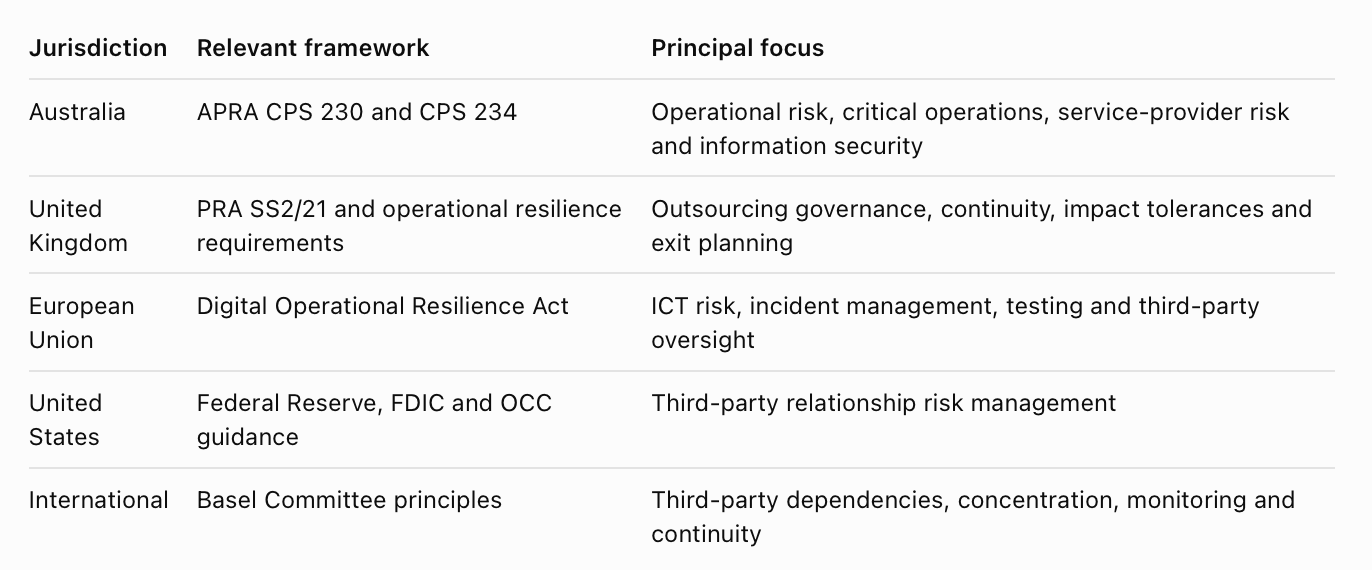
These frameworks differ in scope and legal application.
Third-party outsourcing requirements do not necessarily apply identically to directly employed offshore staff.
Nor would it be accurate to suggest that operational-risk regulation ignores people or internal capabilities.
The more precise concern is whether boards integrate workforce confidence, critical skill retention, succession and employee voice into their existing resilience assurance.
Formal compliance alone does not demonstrate that every critical capability has been preserved.
A contract may exist.
A risk register may be complete.
An audit report may be satisfactory.
But can the organisation continue delivering essential services when a critical dependency becomes unavailable?
RESPONSIBILITY FOR CRITICAL OPERATIONAL OUTCOMES DOES NOT DISAPPEAR BECAUSE THE WORK IS PERFORMED ELSEWHERE.
15. Eleven questions every board should ask before approving major cost reduction
1. What have we actually saved?
Have financial benefits been independently verified after transition, coordination, assurance and lifecycle costs?
2. What knowledge might we lose?
Which critical capabilities depend on experienced employees, and how will their expertise be preserved?
3. Who can stop the system?
Who possesses the authority and practical capability to suspend or reverse a dangerous technology change?
4. Can we operate without the provider?
Have we tested the loss of a major supplier, delivery centre or technology platform?
5. Are we genuinely diversified?
Do apparently independent providers share underlying infrastructure, subcontractors or geographic dependencies?
6. Who independently verifies management's claims?
Is assurance sufficiently independent of those responsible for delivering the savings?
7. What happens to our future capability?
Are we preserving expertise, training pathways, succession and technical leadership?
8. Has AI changed our exposure?
Can we understand, validate and reverse critical AI-enabled decisions and system changes?
9. Can we reverse the transformation?
What would it cost, and how long would it take, to restore an alternative operating model?
10. Who remains accountable after the CEO leaves?
How will the board monitor the long-term consequences of current decisions?
11. Are we measuring the workforce consequences?
Who monitors critical-skill attrition, employee confidence, willingness to speak up and the organisational effects of restructuring?
These questions should be addressed before approval, during implementation and throughout the life of the arrangement.
Assurance is not permanent.
People leave.
Providers change.
Software evolves.
Cyber threats develop.
AI systems are updated.
The capability that was adequately controlled yesterday may require renewed validation tomorrow.
16. A better model: two business cases, not one
ISI proposes that every material outsourcing, offshoring or AI-enabled restructuring affecting critical operations should be supported by two complementary business cases.
The first is the conventional financial business case.
It should establish expected savings, productivity gains, implementation costs, financial returns and commercial benefits.
The second is the critical capability assurance case.
It should demonstrate how the organisation will preserve knowledge, maintain decision authority, manage dependencies, retain essential workforce capability, independently verify performance and recover from severe disruption.
Both should be reviewed before approval.
Both should be monitored during implementation.
Both should be reassessed after the transformation is complete.
The critical capability assurance case should include evidence about the people responsible for operating and recovering the transformed system.
This could include critical-skill retention, succession coverage, workforce confidence, psychological safety, incident escalation and practical recovery exercises.
Such measures should be interpreted carefully, alongside operational and technical evidence.
A low employee turnover rate does not automatically demonstrate workforce confidence.
A positive engagement survey does not prove that staff can challenge a dangerous decision.
And the absence of reported concerns does not necessarily mean that concerns do not exist.
Where critical services cannot realistically be brought back in-house, boards should require credible alternatives, such as tested provider substitution, independent recovery capability or other continuity measures.
This is not an argument for retaining every function internally.
It is an argument for ensuring that the organisation remains capable of fulfilling its obligations, regardless of its delivery model.
A TRANSFORMATION SHOULD NOT BE CALLED SUCCESSFUL MERELY BECAUSE IT COSTS LESS.
IT SHOULD BE CALLED SUCCESSFUL WHEN IT DELIVERS BETTER VALUE WITHOUT SACRIFICING THE ORGANISATION'S ABILITY TO REMAIN IN CONTROL.
17. Conclusion: the organisation is cheaper.
But is it still in control?
The global movement towards outsourcing, offshoring and AI-enabled operations is not inherently a governance failure.
It can deliver genuine economic value, innovation, specialist expertise and improved services.
But it changes the structure of organisational dependence.
Work once performed internally may become distributed across countries, suppliers, platforms and automated systems.
Knowledge may move with that work.
Technical authority may become fragmented.
Recovery may depend on capabilities the organisation cannot readily replace.
And decisions that appeared reversible when first approved may become increasingly difficult to undo.
The consequences extend beyond financial performance.
In banking, they may affect essential financial services.
In healthcare, they may affect patient safety.
In aviation, they may affect operational reliability.
In telecommunications and energy, they may disrupt critical infrastructure.
In government, they may undermine public services and accountability.
The lesson is not that organisations should reject international delivery or technological progress.
It is that boards must govern the capabilities on which their institutions depend, regardless of where those capabilities reside.
The Institutional Capability Erosion Paradox™ challenges boards to recognise that financial efficiency and operational independence are not necessarily the same thing.
The Critical Capability Assurance Gap™ challenges them to demand independent evidence that essential capabilities remain effective after transformation.
Together, these concepts propose a more rigorous standard for evaluating organisational efficiency.
The real measure of a successful transformation is not simply what the organisation saves.
It is what the organisation remains capable of doing when things go wrong.
And capability is not retained only in contracts, systems and documentation.
It is retained in people who possess the knowledge, practical experience and confidence to recognise a problem, challenge a decision and help restore essential operations.
A CEO may cut costs.
A provider may deliver the service.
An AI system may automate the process.
But the board remains responsible for ensuring that the organisation can fulfil its obligations.
THE CEO CUT THE COST.
THE FINANCIAL REPORT SHOWED THE SAVINGS.
THE BOARD APPROVED THE TRANSFORMATION.
BUT WHO VERIFIED WHAT THE ORGANISATION LOST?
And if the institution can no longer independently understand, control, recover or reverse its critical operations, one final question becomes unavoidable:
DID THE ORGANISATION BECOME MORE EFFICIENT — OR DID IT SIMPLY BECOME CHEAPER TO RUN UNTIL SOMETHING WENT WRONG?
References
The following references are retained from the manuscript, with corrections and source links where verified. The remaining items should undergo a final bibliographic check before publication.
Australian Prudential Regulation Authority (APRA) (2019) Prudential Standard CPS 234: Information Security. Sydney: APRA. Available at: APRA prudential standards.
Australian Prudential Regulation Authority (APRA) (2026) Prudential Standard CPS 230: Operational Risk Management. Sydney: APRA. Available at: CPS 230.
Basel Committee on Banking Supervision (2025) Principles for the sound management of third-party risk. Basel: Bank for International Settlements.
Board of Governors of the Federal Reserve System, Federal Deposit Insurance Corporation and Office of the Comptroller of the Currency (2023) Interagency Guidance on Third-Party Relationships: Risk Management. Washington, DC.
Brockner, J., Grover, S., Reed, T.F., DeWitt, R.L. and O'Malley, M. (1987) 'Survivors' reactions to layoffs: We get by with a little help from our friends', Administrative Science Quarterly, 32(4), pp. 526–541. Available at: DOI.
Dibbern, J., Winkler, J. and Heinzl, A. (2008) 'Explaining variations in client extra costs between software projects offshored to India', MIS Quarterly, 32(2), pp. 333–366.
Duffield, C.M., Roche, M.A., Homer, C., Buchan, J. and Dimitrelis, S. (2014) 'A comparative review of nurse turnover rates and costs across countries', Journal of Advanced Nursing, 70(12), pp. 2703–2712. Available at: DOI.
Edmondson, A.C. (1999) 'Psychological safety and learning behavior in work teams', Administrative Science Quarterly, 44(2), pp. 350–383.
European Central Bank (ECB) (2025) 'Outsourcing trends in the banking sector', Supervision Newsletter, 19 February.
European Central Bank (ECB) (2025) 2024 Outsourcing Register: Annual Horizontal Analysis. Frankfurt: ECB.
European Parliament and Council of the European Union (2022) Regulation (EU) 2022/2554 on digital operational resilience for the financial sector. Official Journal of the European Union.
Fischhoff, B. (1975) 'Hindsight ≠ foresight: The effect of outcome knowledge on judgment under uncertainty', Journal of Experimental Psychology: Human Perception and Performance, 1(3), pp. 288–299.
Kahneman, D. and Lovallo, D. (1993) 'Timid choices and bold forecasts: A cognitive perspective on risk taking', Management Science, 39(1), pp. 17–31.
Kish-Gephart, J.J., Detert, J.R., Treviño, L.K. and Edmondson, A.C. (2009) 'Silenced by fear: The nature, sources, and consequences of fear at work', Research in Organizational Behavior, 29, pp. 163–193.
Larsen, M.M., Manning, S. and Pedersen, T. (2013) 'Uncovering the hidden costs of offshoring: The interplay of complexity, organizational design, and experience', Strategic Management Journal, 34(5), pp. 533–552.
NHS England (2025) Synnovis cyber incident. London: NHS England. Available at: NHS England incident report.
Prudential Regulation Authority (PRA) (2021) SS2/21: Outsourcing and third party risk management. London: Bank of England.
Synnovis (2024) Cyberattack Information Centre. London: Synnovis.
UK Post Office Horizon IT Inquiry (n.d.) About the Inquiry. UK Post Office Horizon IT Inquiry.