🚨 YOU HIRED THE BEST PEOPLE. SO WHY DID YOU BUILD A SYSTEM THAT MAKES THEM FAIL?
Organisations spend millions attracting exceptional talent, then undermine it through poor leadership, unsafe cultures and broken systems. ISI examines the Talent Enablement Gap™ and asks why boards keep questioning employees when the real problem may be the organisation itself.
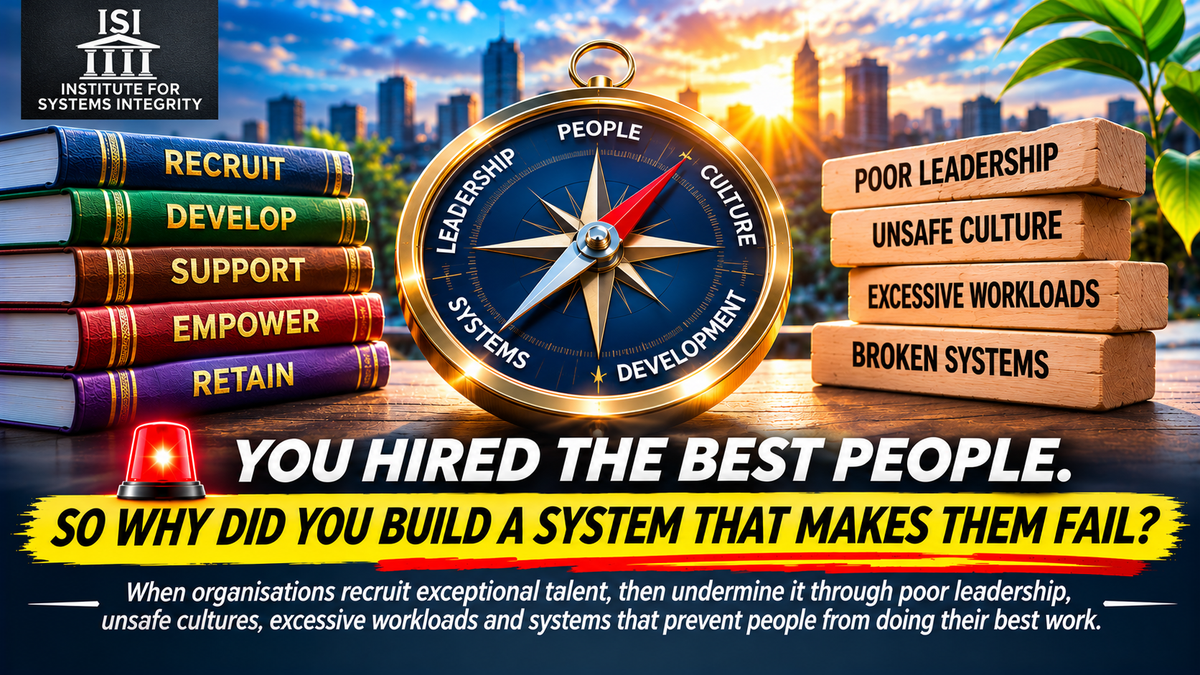
When organisations recruit exceptional talent, then undermine it through poor leadership, unsafe cultures, excessive workloads and systems that prevent people from doing their best work.
Dr Alwin Tan, GAICD, MBBS, FRACS, EMBA (Melbourne Business School)
Senior Surgeon | Governance Leader | HealthTech Co-founder | Founder of Institute for Systems Integrity (ISI) | Harvard Medical School — AI in Healthcare | University of Oxford — Sustainable Enterprise | Bastas Academy for Healthcare Leadership — Triple Scholar
INSTITUTE FOR SYSTEMS INTEGRITY
THE RECRUITMENT WAS A SUCCESS.
THE ORGANISATION WAS NOT.
A hospital recruits an outstanding surgeon.
A bank appoints an experienced risk manager.
An airline employs highly qualified engineers.
A government department attracts talented policy specialists.
A technology company recruits exceptional AI researchers.
An aged care provider employs dedicated, experienced nurses.
The recruitment announcements are impressive.
The qualifications are excellent.
The interviews were rigorous.
The remuneration packages are competitive.
Leadership congratulates itself.
WE HAVE HIRED THE BEST.
Then something strange happens.
The surgeon struggles to obtain the resources needed to deliver safe care.
The risk manager discovers that management does not welcome uncomfortable findings.
The engineer raises concerns about a product but cannot influence the launch decision.
The public servant identifies a serious policy problem but watches the warning disappear through layers of approval.
The AI researcher is told that commercial deadlines matter more than further validation.
The experienced nurse becomes exhausted by an unsustainable workload.
Eventually, some leave.
Others become silent.
Some stay but stop contributing ideas.
And when performance deteriorates, management asks:
What is wrong with our people?
🚨 WHAT IF THE ORGANISATION HIRED THE RIGHT PEOPLE
— BUT BUILT THE WRONG CONDITIONS FOR THEM TO SUCCEED?
This is the uncomfortable question at the heart of the Institute for Systems Integrity's examination of Amazon's leadership principle, Hire and Develop the Best.
Because recruitment excellence and organisational excellence are not the same thing.
And a workforce filled with talented people is not proof that those people are being allowed to perform at their best.
1. AMAZON'S PRINCIPLE: THE PART MANY ORGANISATIONS FORGET
Amazon's Hire and Develop the Best principle asks leaders to improve the quality of recruitment and promotion, recognise exceptional talent, support internal mobility, coach employees and develop future leaders (Amazon, n.d.).
It is a sound leadership ambition.
Strong organisations need capable people.
They need excellent judgement.
They need specialised expertise.
They need people who can innovate, challenge assumptions and solve difficult problems.
Poor recruitment can be expensive.
It can undermine performance, weaken organisational culture and create avoidable risks.
There is nothing wrong with expecting leaders to recruit carefully and develop their people.
But notice the full wording of Amazon's principle.
HIRE AND DEVELOP THE BEST.
Not simply hire the best.
The second half matters just as much as the first.
Yet many organisations invest enormous effort in selecting employees while paying far less attention to what happens after they arrive.
They recruit expertise.
Then limit professional discretion.
They recruit independent thinkers.
Then reward agreement.
They recruit experienced leaders.
Then bury them in administration.
They recruit people who care about quality.
Then measure them almost entirely by speed, volume or cost.
🚨 WHY SPEND SO MUCH MONEY RECRUITING TALENT IF YOUR MANAGEMENT SYSTEM PREVENTS THAT TALENT FROM BEING USED?
The challenge is not whether high recruitment standards are desirable.
They are.
The challenge is whether organisational conditions match the expectations placed on the people recruited.
2. WHAT THE RESEARCH TELLS US:
TALENT ALONE IS NOT ENOUGH
Research provides a substantial foundation for this argument.
Combs et al. (2006) examined 92 studies of high-performance work practices and organisational outcomes.
They found a positive overall association between these practices and performance, with an estimated correlation of approximately 0.20.
Importantly, combinations of complementary employment practices were more strongly associated with performance than isolated initiatives.
This does not prove that any particular recruitment practice causes superior organisational results.
But it suggests that the wider employment system matters.
Hiring talented people is one component.
How they are managed, supported, trained and enabled is another.
Edmondson's (1999) research into 51 work teams found that psychological safety was associated with learning behaviour.
In practical terms, teams need environments where people can ask questions, acknowledge uncertainty, discuss mistakes and raise concerns.
That does not mean removing accountability.
It means creating conditions in which problems can be identified before they become more serious.
West et al. (2016), in a systematic review and meta-analysis of interventions addressing physician burnout, found that both individual-focused and organisational interventions could reduce burnout.
The findings challenge the idea that professional wellbeing is solely an individual responsibility.
THE EVIDENCE POINTS TOWARDS A SIMPLE CONCLUSION.
EXCELLENT PEOPLE NEED EXCELLENT CONDITIONS TO CONSISTENTLY PRODUCE EXCELLENT RESULTS.
And when those conditions are missing, organisations should examine their own contribution before concluding that the workforce is the problem.
3. HEALTHCARE: YOU HIRED THE SURGEON.
DID YOU PROVIDE A SAFE SYSTEM?
Consider an illustrative hospital.
It recruits a highly experienced surgeon.
The surgeon has excellent qualifications.
Strong technical skills.
Years of clinical experience.
A commitment to patient safety.
But operating theatre staffing is inconsistent.
Experienced nurses are leaving.
Equipment availability is unreliable.
Clinical communication is fragmented.
Escalation pathways are unclear.
Management expects productivity to improve.
The surgeon is told to operate more efficiently.
But the surgeon cannot personally compensate for every weakness in the hospital.
A SURGEON CAN BRING EXPERTISE INTO THE OPERATING THEATRE.
THEY CANNOT BRING AN ENTIRE SAFE HEALTH SYSTEM IN THEIR BRIEFCASE.
The same applies to nurses.
An experienced nurse may recognise deterioration early.
But recognition is not enough if there are insufficient resources or inadequate support to respond.
A capable clinician may identify a safety concern.
But professional judgement has limited value if organisational systems discourage escalation.
Healthcare is delivered through interconnected teams, processes and resources.
Individual competence remains essential.
But it is not sufficient.
Research on physician burnout reinforces this point.
West et al. (2016) found that structural and organisational interventions, as well as individual approaches, can contribute to reducing burnout.
🚨 IF YOUR BEST CLINICIANS ARE EXHAUSTED,
LEAVING OR FALLING SILENT,
SHOULD THE BOARD BE ASKING WHETHER IT HAS A RECRUITMENT PROBLEM
— OR A MANAGEMENT PROBLEM?
This does not mean every staffing difficulty is caused by leadership failure.
Healthcare faces genuine workforce shortages, complex patient needs and financial constraints.
But those realities make good organisational design more important, not less.
4. BANKING: YOU HIRED THE RISK EXPERT.
THEN YOU IGNORED THE RISK.
Imagine a bank appointing an experienced risk executive.
The recruitment process emphasises independent judgement.
Regulatory knowledge.
Professional integrity.
The courage to challenge inappropriate conduct.
The executive identifies weaknesses in a profitable business activity.
The findings are uncomfortable.
They may delay growth.
They may require management to acknowledge past mistakes.
The executive raises the concerns.
But senior leaders respond defensively.
The warnings are described as excessive caution.
The executive is told to be more commercially minded.
Eventually, the concerns stop reaching senior management.
This is an illustrative scenario.
But the governance dilemma is real.
WHY HIRE AN INDEPENDENT RISK EXPERT IF THEIR INDEPENDENCE IS ONLY WELCOME WHEN IT SUPPORTS MANAGEMENT'S PREFERRED DECISION?
Australia's Banking Royal Commission documented significant failures involving conduct, incentives, governance and accountability (Royal Commission into Misconduct in the Banking, Superannuation and Financial Services Industry, 2019).
Its findings demonstrate why governance cannot depend solely on the existence of experienced professionals and formal oversight functions.
The effectiveness of those functions also depends on whether their advice is heard, challenged fairly and acted upon.
A bank may have highly qualified risk professionals.
But if its incentives discourage difficult conversations, those qualifications may offer less protection than the board assumes.
THE VALUE OF AN EXPERT IS NOT THE CERTIFICATE ON THE WALL.
IT IS THE JUDGEMENT THE ORGANISATION ALLOWS THEM TO EXERCISE.
5. AVIATION: THE ENGINEER WARNED YOU.
WHO HAD THE AUTHORITY TO LISTEN?
Aviation depends on highly trained people.
Pilots.
Engineers.
Maintenance specialists.
Safety investigators.
Regulators.
Their expertise is essential because errors can have catastrophic consequences.
But expertise must operate within systems that support communication, challenge and independent assessment.
Consider an illustrative aircraft manufacturer.
An engineering team identifies a potential safety issue.
The concern is technically complex.
Management faces commercial pressure.
The launch schedule has already been announced.
The engineers recommend further investigation.
Leadership asks whether the issue can be managed after delivery.
The central governance question is not whether the organisation recruited competent engineers.
It is whether their expertise had sufficient influence over the decision.
The Boeing 737 MAX accidents demonstrate the importance of examining technical design, certification, assumptions about pilot responses and communication between organisations.
The Joint Authorities Technical Review (2019) identified concerns involving certification processes, systems integration and assumptions about how flight crews would respond to failures.
The accidents were the result of complex failures and should not be attributed to a single employment or leadership practice.
Nevertheless, the governance lesson is significant.
🚨 IF YOUR SAFETY SPECIALISTS CANNOT CHANGE A DECISION, WHAT EXACTLY IS THE ORGANISATION PAYING THEM TO DO?
Employing experts does not automatically create effective oversight.
Their professional judgement must be integrated into the decisions that matter.
6. GOVERNMENT: THE PUBLIC SERVANT KNEW. THE SYSTEM DID NOT LISTEN.
Government departments employ highly capable people.
Lawyers.
Policy specialists.
Economists.
Investigators.
Administrators.
Technology experts.
Their responsibilities often affect millions of citizens.
But professional expertise can become less effective when organisational structures discourage challenge.
Australia's Robodebt Royal Commission examined serious failures in the design, implementation and administration of an unlawful social security debt scheme.
Its 2023 report documented failures involving public administration, legal concerns, institutional conduct and accountability (Royal Commission into the Robodebt Scheme, 2023).
Robodebt was not simply a failure of recruitment.
Nor can it be reduced to a claim that every warning was ignored in the same way.
But it provides a powerful example of why the existence of capable professionals does not guarantee that an institution will act appropriately.
The system must be capable of recognising and responding to uncomfortable evidence.
THE ORGANISATION MAY HAVE THE EXPERTISE IT NEEDS.
BUT DOES IT HAVE THE INTEGRITY TO ACT ON WHAT THAT EXPERTISE REVEALS?
This is a question every public-sector board, departmental executive and oversight body should consider.
7. TECHNOLOGY AND AI: YOU HIRED THE BEST ENGINEERS. THEN YOU MADE THE DEADLINE MORE IMPORTANT THAN THEIR JUDGEMENT.
Technology companies compete intensely for exceptional talent.
Software engineers.
Cybersecurity specialists.
Data scientists.
AI researchers.
Product designers.
They offer attractive remuneration and the opportunity to work on important innovations.
But technical capability does not exist independently of organisational priorities.
Consider an illustrative AI company.
Its researchers identify limitations in a model.
They recommend additional testing.
They explain that performance varies across different populations or situations.
The commercial team wants to launch.
Investors expect progress.
Competitors are moving quickly.
Management decides to proceed.
Problems emerge after deployment.
The company asks why the engineers failed to prevent them.
🚨 YOU HIRED PEOPLE TO IDENTIFY THE RISKS. THEN YOU BUILT A SYSTEM THAT MADE IT DIFFICULT FOR THEM TO STOP THE RISKS.
AI governance requires more than recruiting capable developers.
It requires clear responsibilities.
Appropriate testing.
Independent challenge.
Monitoring.
Human oversight.
And the authority to intervene when problems emerge.
The National Institute of Standards and Technology's AI Risk Management Framework identifies Govern, Map, Measure and Manage as core risk-management functions (NIST, 2023).
Those functions depend on organisational processes as well as technical expertise.
THE MOST ADVANCED AI TEAM IN THE WORLD CANNOT COMPENSATE FOR LEADERSHIP THAT REFUSES TO HEAR UNWELCOME EVIDENCE.
8. AGED CARE AND EDUCATION: WHEN DEDICATION BECOMES A SUBSTITUTE FOR RESOURCES
In aged care, organisations often recruit people because of their compassion, commitment and professional skill.
But compassion cannot replace adequate staffing.
Commitment cannot eliminate physical exhaustion.
And professional pride should not become an excuse for expecting employees to absorb unlimited workload.
The same challenge appears in education.
A school recruits excellent teachers.
A university attracts outstanding academics.
But administrative responsibilities increase.
Support services become stretched.
Professional development is reduced.
Staff spend more time navigating systems and less time doing the work they were recruited to perform.
These are illustrative situations.
They demonstrate a common risk.
ORGANISATIONS SOMETIMES TREAT EMPLOYEE DEDICATION AS A RESOURCE THAT CAN BE USED WITHOUT LIMIT.
The most committed people may compensate for poor systems longer than others.
They work late.
They solve problems quietly.
They help colleagues.
They protect students, patients and customers from organisational weaknesses.
Leadership sees that the work continues.
The dashboard remains green.
And the organisation concludes that the system is functioning.
But the system may be functioning only because people are continuously compensating for it.
🚨 WHEN YOUR BEST PEOPLE KEEP SAVING THE ORGANISATION FROM ITS OWN SYSTEMS, IS THAT EXCELLENCE — OR AN EARLY WARNING OF FAILURE?
9. THE OTHER SIDE: HIRING THE BEST AND DEMANDING PERFORMANCE ARE NOT WRONG
This paper must not be interpreted as an argument against high standards.
Organisations need accountability.
They need competent professionals.
They need effective performance management.
They must be able to address poor conduct, inadequate skills and persistent underperformance.
A healthy organisational culture does not mean that every employee is automatically right.
Nor does psychological safety mean freedom from scrutiny.
There are genuine differences in capability.
Some people are poorly suited to particular roles.
Some require further training.
Some fail to meet reasonable expectations.
Some engage in misconduct.
And some organisations simply cannot afford every resource employees would prefer.
GOOD GOVERNANCE DOES NOT REMOVE INDIVIDUAL ACCOUNTABILITY.
It ensures that accountability is fair, evidence-based and informed by organisational conditions.
A manager should be able to ask whether an employee has met reasonable expectations.
But the manager should also be prepared to ask:
Were those expectations achievable?
Was the employee properly trained?
Were the necessary resources available?
Was the workload reasonable?
Were concerns raised and addressed?
Did management create avoidable obstacles?
THE QUESTION IS NOT WHETHER EMPLOYEES SHOULD BE ACCOUNTABLE.
IT IS WHETHER MANAGEMENT SHOULD BE ACCOUNTABLE TOO.
10. THE DEVELOPMENT ILLUSION: TRAINING IS NOT THE SAME AS DEVELOPING PEOPLE
Organisations often describe their commitment to talent development through impressive programmes.
Leadership courses.
Mentoring schemes.
Professional development budgets.
Annual performance reviews.
Talent pipelines.
Succession plans.
These can be valuable.
But their existence does not prove that people are developing.
Consider an employee who completes an expensive leadership programme.
They return to work.
Their manager continues to make every important decision.
Their ideas are ignored.
They are given no opportunity to apply new skills.
Their responsibilities remain unchanged.
The organisation reports another successful development initiative.
But what has actually developed?
🚨 YOU PAID FOR THE LEADERSHIP COURSE.
DID YOU GIVE THE PERSON ANY OPPORTUNITY TO LEAD?
Real development requires more than training.
It requires feedback.
Coaching.
Appropriate responsibility.
Opportunities to practise.
Support when mistakes occur.
And pathways for progression.
The organisation must also be willing to recognise talent that does not resemble the people already occupying senior positions.
Otherwise, development programmes risk reinforcing existing hierarchies rather than expanding organisational capability.
11. THE TALENT PARADOX:
WHY YOUR BEST PEOPLE MAY BE THE FIRST TO LEAVE
When organisational conditions deteriorate, talented employees may have more opportunities to leave.
They may possess skills valued by other employers.
They may have professional networks.
They may recognise that their judgement is being undermined.
But not everyone can leave.
Some employees remain because of financial commitments.
Family responsibilities.
Limited employment opportunities.
Professional obligations.
Or a continuing commitment to the people they serve.
Others stay but disengage.
They stop suggesting improvements.
They avoid difficult conversations.
They do only what is formally required.
The organisation may interpret their silence as agreement.
BUT SILENCE IS NOT ALWAYS LOYALTY.
Sometimes it is resignation.
Sometimes it is exhaustion.
Sometimes it is a rational response to an environment where speaking up has repeatedly achieved nothing.
This creates a serious governance risk.
The organisation may lose the very people most capable of identifying problems and improving performance.
🚨 IF YOUR MOST CAPABLE PEOPLE ARE LEAVING, WHAT DOES THAT SAY ABOUT THE LEADERSHIP THEY ARE LEAVING BEHIND?
Not every resignation is evidence of poor management.
People leave for many legitimate reasons.
But patterns of unwanted turnover, disengagement and suppressed concerns deserve examination.
12. INTRODUCING THE ISI TALENT ENABLEMENT GAP
The Institute for Systems Integrity proposes the Talent Enablement Gap as a conceptual governance framework.
It describes the difference between the capability an organisation recruits and the capability its systems allow people to exercise.
The concept draws on established research into high-performance work practices, organisational culture, psychological safety, professional wellbeing and workforce development.
It is not an independently validated measurement instrument.
Its purpose is to help boards examine whether organisational conditions support or constrain the talent they have invested in.
The framework considers five dimensions.
1. RECRUITMENT — DID WE HIRE THE RIGHT CAPABILITY?
Are recruitment decisions based on relevant skills, judgement, integrity and potential?
Or are organisations relying too heavily on prestige, credentials, personal networks or similarity to existing leaders?
2. ENABLEMENT — HAVE WE PROVIDED THE CONDITIONS FOR SUCCESS?
Do employees have appropriate resources, staffing, systems, information and authority?
Are workloads sustainable?
Can professionals perform their responsibilities without unnecessary obstacles?
3. VOICE — CAN PEOPLE USE THEIR JUDGEMENT?
Can employees challenge decisions?
Can they raise safety concerns?
Can they question assumptions?
Can they disagree with senior leaders without unreasonable fear of retaliation?
4. DEVELOPMENT — ARE WE BUILDING FUTURE CAPABILITY?
Are employees receiving meaningful coaching?
Are they given opportunities to apply new skills?
Are talented people supported to progress?
Do managers have time and incentives to develop others?
5. ACCOUNTABILITY — DO WE EXAMINE THE PERSON AND THE SYSTEM?
When performance fails, does the organisation assess individual conduct and capability?
Does it also examine management decisions, resource constraints, culture and system design?
THE ISI TALENT ENABLEMENT GAP
RECRUIT → ENABLE → LISTEN → DEVELOP → ACCOUNT
The central proposition is straightforward.
AN ORGANISATION SHOULD NOT CLAIM TO VALUE TALENT WHILE IGNORING THE CONDITIONS THAT DETERMINE WHETHER THAT TALENT CAN SUCCEED.
13. TEN QUESTIONS EVERY BOARD SHOULD ASK
Before approving another expensive recruitment campaign, leadership development programme or workforce transformation, directors should ask:
1. WHY ARE OUR BEST PEOPLE LEAVING?
Do we understand the reasons behind unwanted turnover?
2. ARE WE RECRUITING PEOPLE INTO ROLES THAT ARE REALISTICALLY ACHIEVABLE?
Are expectations matched by resources and authority?
3. CAN OUR PROFESSIONALS EXERCISE INDEPENDENT JUDGEMENT?
Or are they rewarded primarily for agreeing with management?
4. WHAT HAPPENS TO PEOPLE WHO RAISE SERIOUS CONCERNS?
Are their concerns examined fairly, and are they protected from retaliation?
5. DO OUR MANAGERS DEVELOP PEOPLE — OR SIMPLY DEMAND RESULTS?
How is coaching recognised and assessed?
6. ARE WE CONFUSING QUALIFICATIONS WITH CAPABILITY?
Do recruitment and promotion processes assess relevant performance and judgement?
7. HOW MUCH OF OUR WORKFORCE'S TIME IS LOST TO POOR SYSTEMS?
Are talented employees spending their days compensating for avoidable organisational problems?
8. WHEN PERFORMANCE FAILS, DO WE INVESTIGATE THE WORKING CONDITIONS?
Or does accountability stop with the individual?
9. ARE WE DEVELOPING FUTURE LEADERS OR REPRODUCING THE EXISTING HIERARCHY?
Are opportunities fair, transparent and genuinely accessible?
10. WOULD OUR BEST PEOPLE RECOMMEND THIS ORGANISATION TO SOMEONE THEY RESPECT?
And if not, why not?
These questions are not intended to turn boards into operational managers.
They are intended to ensure that workforce strategy is assessed as a governance responsibility rather than merely an HR activity.
14. THE REAL TEST OF LEADERSHIP IS WHAT HAPPENS AFTER RECRUITMENT
It is easy to celebrate a prestigious appointment.
A respected surgeon.
A talented engineer.
An experienced executive.
An outstanding nurse.
A brilliant researcher.
A highly qualified risk specialist.
The announcement looks impressive.
The organisation's reputation improves.
The board feels reassured.
But the real test begins after the person arrives.
Are they supported?
Are they heard?
Are they trusted to exercise professional judgement?
Are they challenged fairly?
Are they given opportunities to develop?
And when they identify something wrong, does the organisation listen?
THE TRUE MEASURE OF A LEADER IS NOT SIMPLY THE QUALITY OF THE PEOPLE THEY RECRUIT.
IT IS WHAT THOSE PEOPLE ARE ABLE TO ACHIEVE UNDER THEIR LEADERSHIP.
Amazon's Hire and Develop the Best principle provides a valuable challenge to organisations that tolerate poor recruitment, weak coaching and inadequate succession planning.
The Institute for Systems Integrity offers a complementary challenge.
Before blaming employees for poor performance, examine the system in which they work.
Before recruiting another exceptional professional, ask why the last one left.
Before celebrating another leadership development programme, examine whether participants have been given the opportunity to lead.
And before assuming that a highly qualified workforce guarantees organisational excellence, ask whether those qualifications are being translated into meaningful authority, learning and results.
🚨 YOU HIRED THE BEST PEOPLE.
YOU GAVE THEM THE TITLE.
YOU PRAISED THEIR EXPERIENCE.
THEN YOU BUILT A SYSTEM THAT MADE IT DIFFICULT FOR THEM TO SUCCEED.
And when things went wrong, you questioned their performance.
Perhaps it is time to question the system.
BECAUSE WHEN EXCEPTIONAL PEOPLE KEEP FAILING, LEAVING OR FALLING SILENT,
THE PROBLEM MAY NO LONGER BE THE PEOPLE.
🚨 IT MAY BE THE LEADERSHIP THEY WORK UNDER.
References
Amazon (n.d.) Amazon leadership principles. Available at: https://www.aboutamazon.com/about-us/leadership-principlesAccessed: 11 November 2026).
Combs, J., Liu, Y., Hall, A. and Ketchen, D. (2006) ‘How much do high-performance work practices matter? A meta-analysis of their effects on organizational performance’, Personnel Psychology, 59(3), pp. 501–528.
Edmondson, A. (1999) ‘Psychological safety and learning behavior in work teams’, Administrative Science Quarterly, 44(2), pp. 350–383.
Joint Authorities Technical Review (JATR) (2019) Boeing 737 MAX flight control system: Observations, findings, and recommendations.
National Institute of Standards and Technology (NIST) (2023) Artificial Intelligence Risk Management Framework (AI RMF 1.0). Gaithersburg, MD: NIST.
Royal Commission into Misconduct in the Banking, Superannuation and Financial Services Industry (2019) Final report. Canberra: Commonwealth of Australia.
Royal Commission into the Robodebt Scheme (2023) Report of the Royal Commission into the Robodebt Scheme. Canberra: Commonwealth of Australia.
West, C.P., Dyrbye, L.N., Erwin, P.J. and Shanafelt, T.D. (2016) ‘Interventions to prevent and reduce physician burnout: A systematic review and meta-analysis’, The Lancet, 388(10057), pp. 2272–2281.S
© 2026 Institute for Systems Integrity.
The Talent Enablement Gap is a proposed conceptual governance framework, not an independently validated assessment instrument. Illustrative scenarios do not refer to specific unnamed organisations. Documented cases are presented for their governance lessons and are not attributed to a single cause. This publication is an independent examination of leadership principles and is not affiliated with or endorsed by Amazon.