🚨 WHEN POLICY IS CREATED ON THE SPOT, WHAT HAPPENS TO GOVERNANCE?....THE POLICY AUTHORITY TRAP™
An executive can win a policy dispute and still lose the confidence of the workforce. ISI examines how leadership behaviour, fairness and accountability determine whether authority earns lasting respect.
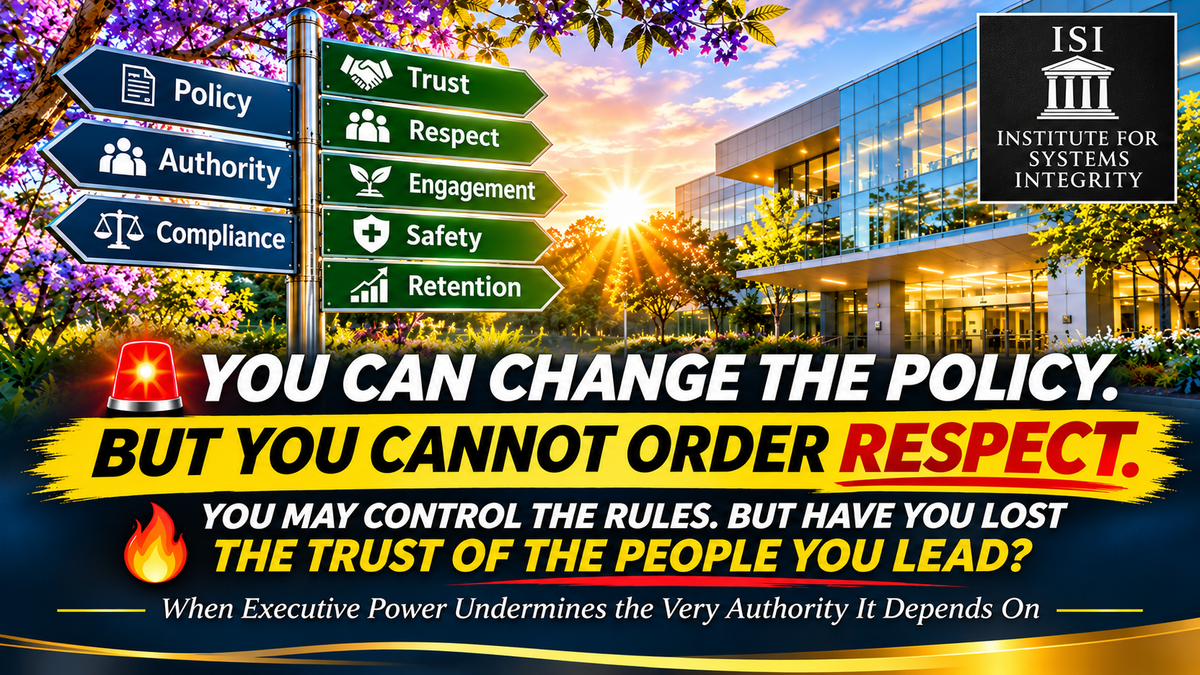
When an executive's title becomes the justification for a decision — and the organisation cannot demonstrate that the decision was properly authorised.
Dr Alwin Tan, GAICD, MBBS, FRACS, EMBA (Melbourne Business School)
Senior Surgeon | Governance Leader | HealthTech Co-founder | Founder of Institute for Systems Integrity (ISI) | Harvard Medical School — AI in Healthcare | University of Oxford — Sustainable Enterprise | Bastas Academy for Healthcare Leadership — Triple Scholar
INSTITUTE FOR SYSTEMS INTEGRITY
🔥 THE EXECUTIVE ANNOUNCED THE RULE.
HR UPHELD THE DECISION.
THE BOARD ACCEPTED THE EXPLANATION.
BUT WHO VERIFIED THE AUTHORITY BEHIND IT?
Imagine a hospital.
An experienced nurse requests a change to her employment arrangements.
The Director of Nursing refuses.
The employee asks why.
The response is simple:
"Hospital policy does not allow it."
The employee asks to see the policy.
When was it introduced?
Who approved it?
Was it communicated to staff?
Does it apply consistently?
And does it comply with the organisation's employment obligations?
The executive responds:
"I am the Director of Nursing. I have the authority to make that decision."
The employee challenges the decision.
HR upholds management's position.
The matter reaches the board.
The board refers it back to HR.
The decision remains unchanged.
Perhaps the refusal was lawful.
Perhaps genuine staffing constraints existed.
Perhaps the Director of Nursing had the necessary authority.
Perhaps HR reviewed the matter appropriately.
But imagine that nobody can demonstrate where the rule came from, who authorised it or whether it was properly applied.
🔥 WHEN DID AN EXECUTIVE'S TITLE BECOME SUFFICIENT PROOF THAT THEIR DECISION WAS LEGITIMATE?
This is not simply a disagreement about employment arrangements.
It raises a fundamental governance question:
Who protects the integrity of organisational rules when the people making those rules also influence how they are interpreted, challenged and reviewed?
We call this The Policy Authority Trap™.
This is a hypothetical scenario illustrating a potential governance failure. It is not a finding about any identifiable hospital, employee or executive.
1. AUTHORITY IS NOT THE SAME AS UNLIMITED DISCRETION.
Organisations need strong leaders.
A Director of Nursing must manage staffing and patient safety.
A CEO must make difficult financial and operational decisions.
A manager must allocate resources, resolve disputes and respond to changing circumstances.
Not every decision can wait for a committee.
Not every management instruction requires a new written policy.
And not every unpopular decision is unfair.
But authority has limits.
Those limits may arise from legislation, employment contracts, enterprise agreements, modern awards, board delegations and organisational governance requirements.
Under the Fair Work Act 2009 (Cth), the National Employment Standards establish minimum employment conditions. Section 55 restricts the extent to which modern awards and enterprise agreements may exclude those standards (Commonwealth of Australia, 2009).
Consultation obligations may also apply to major workplace changes or changes to regular rosters and ordinary hours, depending on the relevant industrial instrument and circumstances (Fair Work Ombudsman, n.d.-a).
Importantly, an employee requesting a different arrangement is not necessarily the same as an employer proposing to change a roster or employment conditions.
Consultation does not automatically give employees a veto over management decisions.
Nor does every request for a change in employment status trigger a statutory entitlement.
The applicable requirements must be established before judging the decision.
🔥 HAVING THE AUTHORITY TO MAKE A DECISION DOES NOT MEAN HAVING THE AUTHORITY TO IGNORE THE RULES GOVERNING THAT DECISION.
The question is not whether executives should exercise power.
They must.
The question is whether the organisation can demonstrate that power was exercised within legitimate boundaries.
2. THE POLICY AUTHORITY TRAP™
We propose an ISI governance concept.
THE POLICY AUTHORITY TRAP™
An organisational governance failure in which executive status, delegated discretion or managerial control is treated as sufficient validation of a policy decision, without adequate examination of its authorisation, process, consistency, fairness or consequences.
The trap may develop through five stages.
STAGE 1 — DECLARATION
An executive announces a rule, instruction or decision.
STAGE 2 — AUTHORITY CLAIM
The executive relies on their position or delegated responsibilities to justify it.
STAGE 3 — INSTITUTIONAL ACCEPTANCE
HR or another organisational function accepts the explanation without sufficiently examining the underlying authority.
STAGE 4 — CIRCULAR REVIEW
Challenges are returned to the same management hierarchy that made or supported the decision, without adequately managing potential conflicts.
STAGE 5 — ADMINISTRATIVE CLOSURE
The organisation records the matter as resolved even though material questions about the original decision may remain unanswered.
These stages describe a potential failure mechanism, not an established diagnostic test.
A disputed decision does not, by itself, demonstrate that the executive exceeded their authority.
🔥 THE DANGER IS NOT SIMPLY THAT AN EXECUTIVE CAN MAKE A BAD RULE. IT IS THAT THE ORGANISATION MAY LOSE THE ABILITY TO QUESTION HOW THE RULE WAS MADE.
3. WHEN POLICY IS CREATED ON THE SPOT, WHAT HAPPENS TO GOVERNANCE?
Imagine an executive announcing an immediate change to an established workplace arrangement.
An employee asks whether the change is permitted.
The executive responds that it falls within their management discretion.
That may be correct.
But what exactly has happened?
Was this an individual operational decision?
Was an existing policy being interpreted?
Was an exception being refused?
Or was a new organisational rule being introduced?
These are different exercises of authority.
An executive may be authorised to make an individual staffing decision without having authority to amend a hospital-wide policy.
A policy amendment may require approvals or consultation that an ordinary operational decision does not.
An urgent operational instruction may be legitimate without becoming a permanent organisational policy.
And an internal policy cannot simply override an applicable legal or industrial obligation.
🔥 IF MANAGEMENT CANNOT DISTINGUISH A POLICY FROM A PERSONAL DECISION, HOW CAN EMPLOYEES KNOW WHICH RULES ACTUALLY APPLY?
The governance safeguard is not endless paperwork.
It is clarity.
What was decided?
Under what authority?
When did it take effect?
Who was affected?
What requirements applied?
And how can the decision be reviewed?
Without those answers, policy can become difficult to distinguish from individual managerial preference.
4. WHEN THE RULES CHANGE DEPENDING ON WHO IS ASKING.
Two employees request similar employment arrangements.
One is approved.
The other is refused.
That does not automatically establish unfairness.
Their roles may differ.
Staffing requirements may differ.
Circumstances may have changed.
One arrangement may be operationally feasible while another is not.
Consistency does not require identical outcomes.
But it does require defensible criteria.
Research on organisational justice distinguishes fairness in outcomes, procedures, interpersonal treatment and information (Colquitt et al., 2001).
The research identifies associations between these dimensions and important organisational outcomes, including employee attitudes, commitment and trust.
It does not establish that every inconsistent decision is unlawful or harmful.
Nevertheless, organisations should be able to explain why different outcomes were justified.
WorkSafe Victoria's Compliance code: Psychological health identifies inconsistent policy application, inadequate transparency and unfair decision-making as examples relevant to poor organisational justice (WorkSafe Victoria, 2025).
🔥 A POLICY APPLIED DIFFERENTLY WITHOUT A DEFENSIBLE REASON IS NOT NECESSARILY FLEXIBILITY. IT MAY BE ARBITRARINESS.
The problem is not that management sometimes says no.
The problem is when the organisation cannot explain the basis on which it says yes to one person and no to another.
5. WHEN AN EMPLOYEE REQUESTS FLEXIBILITY, WHICH RULES ACTUALLY APPLY?
There is another distinction that executives and HR departments must understand.
Not every request to change employment arrangements is legally equivalent.
An employee might request:
- A change in roster.
- Reduced working hours.
- A change from permanent to casual employment.
- Different shifts to accommodate caring responsibilities.
- A temporary adjustment to existing arrangements.
Some requests may fall within the statutory flexible working arrangements framework under sections 65 and 65A of the Fair Work Act 2009.
Where the statutory provisions apply, eligible employees have specific rights and employers must follow the relevant response requirements.
These include consideration of the request, applicable discussion and response requirements, and restrictions on refusal (Fair Work Ombudsman, n.d.-b).
Other requests may depend on the employment contract, enterprise agreement, modern award, applicable law or ordinary management discretion.
A request to convert from permanent to casual employment does not automatically qualify as a statutory flexible working arrangement.
Equally, an executive's general staffing authority does not override an applicable statutory right.
The organisation must first identify which legal and contractual framework applies.
🔥 BEFORE AN EXECUTIVE SAYS “POLICY DOES NOT ALLOW IT”, HAS ANYONE CHECKED WHETHER THE LAW REQUIRES SOMETHING DIFFERENT?
This is not about guaranteeing approval.
It is about ensuring that the correct rules govern the decision.
6. WHEN HR UPHOLDS THE DECISION, WHO CHECKS THE AUTHORITY?
HR performs an essential organisational function.
It supports workforce management, employment compliance, dispute resolution and organisational capability.
But HR is not automatically independent of the executives it advises.
Its reporting relationships and responsibilities matter.
Imagine an employee questioning whether an executive had authority to introduce a new rule.
HR reviews the concern.
The executive explains that the decision was within their discretion.
HR accepts the explanation.
The matter is closed.
But did HR examine the actual delegation?
Did it check the applicable policy version?
Did it consider the employment obligations?
Did it assess whether the decision was consistent with previous practice?
Or did it simply accept the executive's interpretation?
🔥 HR CANNOT ESTABLISH THE LEGITIMACY OF A RULE SIMPLY BY ASKING THE PERSON WHO MADE IT WHETHER THEY WERE ENTITLED TO MAKE IT.
This is not an argument that HR professionals lack integrity.
Many perform their responsibilities with independence and professionalism.
But where a material conflict exists, independence should be supported by organisational design rather than depend entirely on individual courage.
A disputed policy decision should be capable of appropriate review by someone with the necessary authority, expertise and impartiality.
That may be HR.
It may be a different executive.
It may require legal advice.
And in some circumstances, it may warrant independent external review.
The response should match the seriousness of the concern.
7. THE BOARD REFERRED IT BACK TO HR. WAS THAT OVERSIGHT?
Boards should not investigate every employment disagreement.
Operational management belongs primarily to executives.
A board referring a routine employment matter to HR may be entirely appropriate.
But consider a different situation.
An employee is not simply disputing an outcome.
They are questioning whether an executive had authority to introduce the rule used to justify that outcome.
They also raise a material concern about whether the internal review process is sufficiently independent.
The board refers the matter back to HR.
HR supports management.
The board accepts the response.
But what assurance did the board obtain about the underlying governance issue?
🔥 THE EMPLOYEE ESCALATED THE QUESTION OF EXECUTIVE AUTHORITY TO THE BOARD. THE BOARD SENT IT BACK TO THE EXECUTIVE HIERARCHY. DID ACCOUNTABILITY EVER TRAVEL UPWARDS?
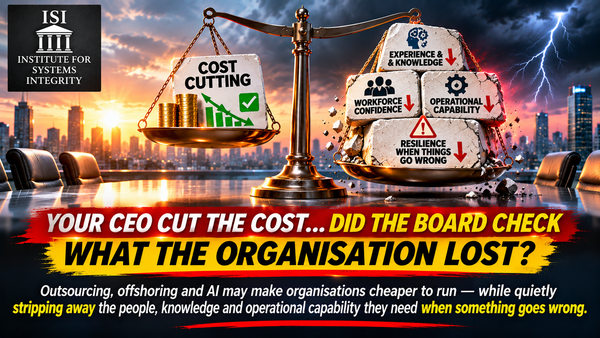
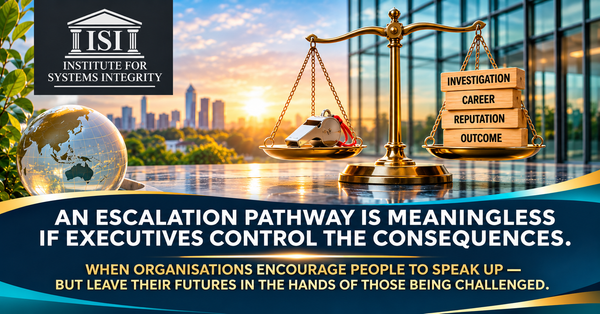
This connects with ISI's earlier work on accountability deflection and Consequence Control Risk™.
But the present question is more specific.
It concerns the legitimacy of the rule itself.
Boards do not need to substitute their judgement for management in every case.
However, where a concern raises material issues about executive authority, compliance or conflicts of interest, the board should ensure that an appropriate process exists to address those issues.
🔥 A BOARD DOES NOT DEMONSTRATE EFFECTIVE OVERSIGHT OF A MATERIAL GOVERNANCE CONCERN MERELY BY PROVING THAT IT FORWARDED THE COMPLAINT.
The relevant questions are whether the review was appropriate, conflicts were managed and sufficient assurance was obtained.
DELEGATION OF A TASK IS NOT PROOF THAT THE TASK WAS PERFORMED PROPERLY.
8. WHEN POLICY BECOMES A TOOL OF POWER.
Policies are intended to create consistency.
They clarify expectations.
Support compliance.
Protect legitimate interests.
And reduce arbitrary decision-making.
But policies can also be misused.
A rule may be introduced without appropriate approval.
An existing policy may be interpreted selectively.
An exception may be granted to one employee but denied to another without defensible reasons.
A policy may be invoked to justify a decision already made.
Or a new rule may be presented as though it had always existed.
These are possible failure mechanisms requiring evidence, not conclusions to be presumed.
The governance risk increases when the same executive hierarchy influences both the original decision and the subsequent challenge.
ISI's Consequence Control Risk™ framework identifies five relevant domains.
INFORMATION
Who controls the documents and explanations?
INVESTIGATION
Who decides how the concern is examined?
CAREER
Who influences the employee's future opportunities?
NARRATIVE
Who describes the dispute to the CEO or board?
RESOLUTION
Who has authority to reverse the decision?
Where several forms of control are concentrated within the same reporting structure, additional safeguards may be necessary.
🔥 A POLICY SHOULD CONTROL THE EXERCISE OF POWER. IT SHOULD NOT BECOME THE INSTRUMENT THAT MAKES POWER IMPOSSIBLE TO QUESTION.
9. THE POLICY INTEGRITY TEST™
We propose a practical ISI governance framework.
THE POLICY INTEGRITY TEST™
Eight questions should guide the proportionate review of materially disputed policy decisions.
1. SOURCE — WHAT IS THE RULE?
Can the organisation identify the actual policy, legal provision, contract term or operational authority being relied upon?
2. AUTHORITY — WHO APPROVED IT?
Was the decision-maker authorised to create, amend, interpret or apply the rule?
3. PROCESS — WERE THE REQUIRED STEPS FOLLOWED?
Were relevant approvals, consultation requirements and procedural safeguards observed?
4. TIMING — WHEN DID IT TAKE EFFECT?
Can the organisation establish when the rule was introduced, whether it was communicated and which version applied at the relevant time?
5. CONSISTENCY — WAS IT APPLIED FAIRLY?
Were comparable circumstances assessed using relevant and defensible criteria?
6. INDEPENDENCE — WHO CAN CHALLENGE IT?
Can a disputed decision receive impartial consideration, particularly where the original decision-maker has a material conflict of interest?
7. REMEDY — WHO CAN CORRECT IT?
If the decision was wrong, who has authority to reverse it and address the consequences?
8. EVIDENCE — WHAT DEMONSTRATES THE RULE WAS VALID?
Can the organisation produce reliable evidence of the applicable authority and process, such as a contemporaneous delegation, approved policy version, decision record or other relevant documentation?
Not every operational instruction requires formal documentation.
The level of evidence and review should reflect the significance and risk of the decision.
A minor operational instruction may need little formal scrutiny.
A decision affecting employment entitlements, professional standing, workplace safety or material organisational risk may require substantially more.
🔥 IF AN ORGANISATION CANNOT EXPLAIN WHERE A RULE CAME FROM, WHO APPROVED IT AND HOW IT CAN BE CHALLENGED, IT HAS A POLICY INTEGRITY PROBLEM.
10. WHEN POLICY FAILURES BECOME PSYCHOSOCIAL RISKS.
Poorly governed decisions may affect more than employee satisfaction.
Repeated inconsistency, unexplained changes, perceived favouritism and unfair treatment can contribute to psychosocial risk.
Victoria's Occupational Health and Safety (Psychological Health) Regulations 2025 commenced on 1 December 2025.
They require employers to identify psychosocial hazards, control associated risks so far as reasonably practicable and review controls in specified circumstances.
WorkSafe Victoria's compliance code identifies poor organisational justice as a psychosocial hazard, including unfair processes, inconsistent policy application and lack of transparency (WorkSafe Victoria, 2025).
This does not mean every disputed policy creates a psychosocial hazard.
Nor does every unfavourable employment decision constitute a breach of occupational health and safety law.
Whether particular conduct creates a risk requiring control, or amounts to a legal breach, depends on the circumstances and applicable duties.
But repeated or systemic unfairness can raise questions beyond ordinary employee dissatisfaction.
🔥 WHEN EMPLOYEES CANNOT TRUST HOW RULES ARE MADE OR APPLIED, THE PROBLEM MAY NO LONGER BE ONE DECISION. IT MAY BE THE SYSTEM OF DECISION-MAKING ITSELF.
That is why policy integrity belongs within organisational risk management.
11. THE COUNTERARGUMENT — EXECUTIVES MUST STILL BE ABLE TO LEAD.
There is a danger in taking this argument too far.
Hospitals and other complex organisations cannot function if every management decision becomes a formal governance inquiry.
Executives need discretion.
Policies cannot anticipate every circumstance.
Operational decisions sometimes need to be made quickly.
And employees do not automatically have a right to their preferred employment arrangement.
Overly rigid governance can create delay, administrative burden and uncertainty.
It can also undermine legitimate leadership.
The solution is not to remove discretion.
It is to make discretion accountable.
An executive should be able to explain why a decision was made, what authority supported it and what considerations were relevant.
A challenge should not automatically trigger an external investigation.
But a material question about authority, compliance or conflicts should not be dismissed simply because the executive is senior.
🔥 GOOD GOVERNANCE DOES NOT MEAN MANAGEMENT MUST ASK PERMISSION FOR EVERY DECISION. IT MEANS MANAGEMENT CAN EXPLAIN AND JUSTIFY THE DECISIONS IT MAKES.
That distinction protects both organisational effectiveness and fairness.
12. FIVE QUESTIONS EVERY BOARD SHOULD ASK.
Boards should seek proportionate assurance over the integrity of material policy decisions.
QUESTION 1 — DELEGATION
Do we know which executives can create, amend, suspend or override significant organisational policies?
QUESTION 2 — POLICY PROVENANCE
Can management identify which version of a policy applied when a disputed decision was made?
QUESTION 3 — COMPLIANCE
How do we ensure policy changes remain consistent with applicable legal, contractual and industrial obligations?
QUESTION 4 — INDEPENDENT CHALLENGE
What happens when an employee questions a policy created by an executive who also influences the review pathway?
QUESTION 5 — CORRECTION
If a policy decision is found to be improper, who has authority to reverse it and address the consequences?
The fifth question is critical.
An organisation may acknowledge that a decision was poorly handled.
It may apologise.
It may revise its policy.
But what happens to the person affected by the original decision?
🔥 CORRECTING THE RULEBOOK DOES NOT AUTOMATICALLY CORRECT THE DAMAGE CAUSED BY THE OLD RULE.
This connects policy integrity to ISI's broader work on reversal architecture and systemic recovery.
13. WHEN THE EXECUTIVE'S TITLE BECOMES THE FINAL ANSWER.
The real governance test is not whether an executive has power.
It is whether the organisation retains meaningful control over how that power is exercised.
A Director of Nursing may have legitimate authority to refuse a staffing request.
A CEO may properly endorse that decision.
HR may reasonably conclude that the decision complied with applicable obligations.
And a board may legitimately decide that no further intervention is necessary.
All of those outcomes can be appropriate.
But their legitimacy depends on more than seniority.
It depends on authority, process, relevant evidence, defensible reasoning and proportionate review.
🔥 THE QUESTION IS NOT WHETHER THE EXECUTIVE WAS SENIOR ENOUGH TO MAKE THE DECISION.
🔥 THE QUESTION IS WHETHER THE DECISION WAS MADE WITHIN THE AUTHORITY THE ORGANISATION HAD LEGITIMATELY GIVEN THEM.
An executive title is a position of responsibility.
It is not personal ownership of the organisation's rules.
CONCLUSION — WHO PROTECTS THE RULEBOOK FROM THE PEOPLE WHO CONTROL IT?
Organisations need decisive executives.
They need clear policies.
They need operational flexibility.
And they need boards that understand the difference between governance and management.
But the exercise of authority must remain open to appropriate scrutiny.
A Director of Nursing does not acquire unlimited policy-making power simply by holding that title.
A CEO does not make a disputed decision legitimate merely by endorsing it.
HR does not establish independent assurance merely by repeating management's explanation.
And a board does not demonstrate effective oversight of a material governance concern simply by referring it back to the hierarchy being questioned.
The issue is not whether an employee agrees with the outcome.
It is whether the organisation can demonstrate that the decision was properly authorised, lawfully made, fairly considered and capable of appropriate review.
Because policies should protect organisational integrity.
They should not simply protect the decisions of powerful people.
🔥 THE EXECUTIVE ANNOUNCED THE RULE.
🔥 HR UPHELD THE DECISION.
🔥 THE BOARD ACCEPTED THE EXPLANATION.
🔥 BUT WHO VERIFIED THE AUTHORITY BEHIND IT?
When an organisation cannot answer that question, authority risks becoming self-validating.
The executive's decision becomes the evidence of the executive's authority.
The policy becomes the justification for the decision.
And the internal review may become the mechanism through which the original position is preserved.
🔥 WHEN POWER BECOMES ITS OWN JUSTIFICATION, THE RULEBOOK NO LONGER RELIABLY CONTROLS THE PEOPLE WHO WRITE IT.
That is The Policy Authority Trap™.
And it is a governance risk every board should be capable of recognising before it becomes a crisis.
References — Harvard style
Colquitt, J.A., Conlon, D.E., Wesson, M.J., Porter, C.O.L.H. and Ng, K.Y. (2001) ‘Justice at the millennium: A meta-analytic review of 25 years of organizational justice research’, Journal of Applied Psychology, 86(3), pp. 425–445. Available at: https://doi.org/10.1037/0021-9010.86.3.425
Commonwealth of Australia (2009) Fair Work Act 2009 (Cth), particularly ss. 55, 65 and 65A. Available at: https://www.legislation.gov.au/C2009A00028/latest/text
Fair Work Ombudsman (n.d.-a) Consultation and cooperation in the workplace: Best practice guide. Available at: https://www.fairwork.gov.au/tools-and-resources/best-practice-guides/consultation-and-cooperation-in-the-workplace
Fair Work Ombudsman (n.d.-b) Flexible working arrangements. Available at: https://www.fairwork.gov.au/employment-conditions/flexibility-in-the-workplace/flexible-working-arrangements
WorkSafe Victoria (2025) Compliance code: Psychological health. Melbourne: WorkSafe Victoria. Available at: https://www.worksafe.vic.gov.au/compliance-code-psychological-health-how-use-compliance-code
WorkSafe Victoria (2025) Compliance code: Psychological health — Appendix C: Examples of psychosocial hazards and risk controls. Available at: https://www.worksafe.vic.gov.au/compliance-code-psychological-health-appendix-c-examples-psychosocial-hazards-and-risk-controls
© 2026 Institute for Systems Integrity (ISI). The Policy Authority Trap™ and Policy Integrity Test™ are proposed ISI governance concepts, not established legal doctrines or empirically validated assessment tools. The hypothetical examples are illustrative and do not constitute findings about identifiable individuals or organisations. This publication provides governance analysis and is not legal advice.