THE HARDEST PART OF BULLYING IS NOT ALWAYS WHAT SOMEONE DID TO YOU....IT IS DISCOVERING WHO STOOD BY AND WATCHED.
Workplace bullying hurts. But when trusted colleagues stay silent, the betrayal can cut deeper. Dr Alwin Tan explores fear, friendship and workplace trust.
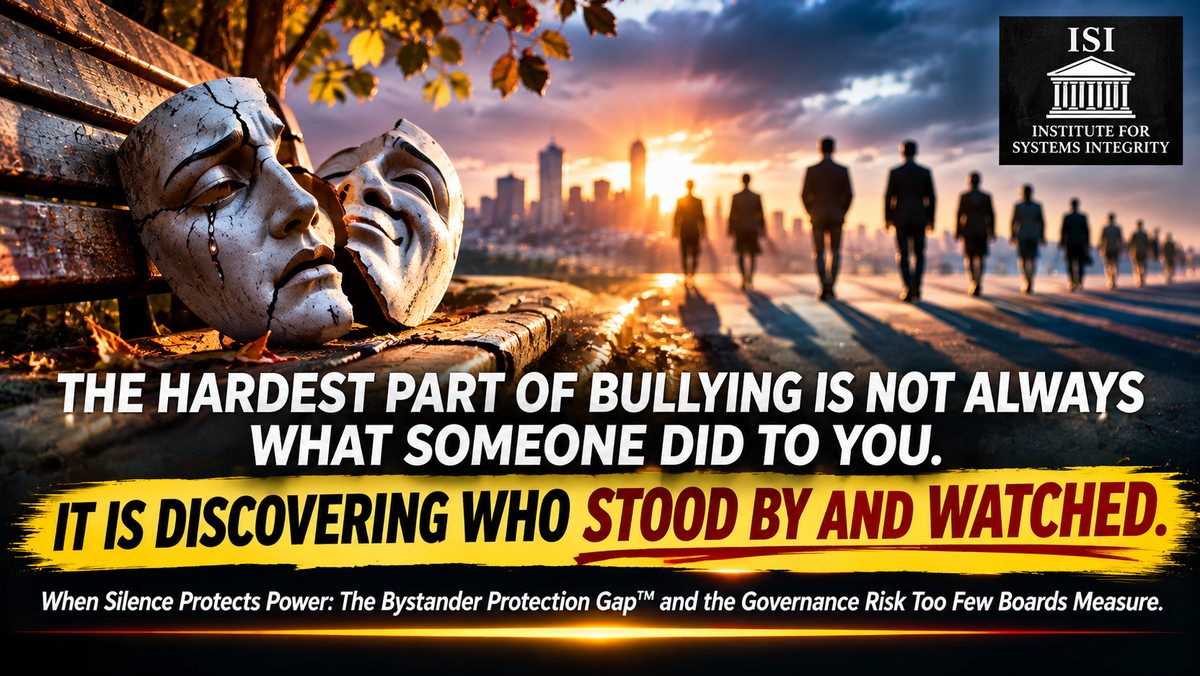
When Silence Protects Power: The Bystander Protection Gap™ and the Governance Risk Too Few Boards Measure
Dr Alwin Tan, GAICD, MBBS, FRACS, EMBA (Melbourne Business School)
Senior Surgeon | Governance Leader | HealthTech Co-founder | Founder of Institute for Systems Integrity (ISI) | Harvard Medical School — AI in Healthcare | University of Oxford — Sustainable Enterprise | Bastas Academy for Healthcare Leadership — Triple Scholar
INSTITUTE FOR SYSTEMS INTEGRITY
Executive Summary
THE BULLY MAY HAVE CAUSED THE INJURY.
BUT THE SILENCE AROUND THEM CAN MAKE THE INJURY MUCH HARDER TO HEAL.
A colleague witnesses someone being humiliated in a meeting.
Nobody intervenes.
Another employee notices that a respected colleague is suddenly excluded from important decisions.
Nobody asks why.
A manager hears that someone has raised concerns about a powerful executive.
The manager quietly advises them to be careful.
Eventually, the employee leaves.
The organisation records a resignation.
The complaint, if there was one, is closed.
The board receives a report confirming that appropriate procedures were followed.
EVERYTHING APPEARS TO HAVE BEEN MANAGED.
BUT WHAT HAPPENED TO THE PEOPLE WHO WATCHED?
Did they learn that bullying was unacceptable?
Or did they learn that protecting themselves required silence?
Workplace bullying is often understood as a problem between a perpetrator and a target.
Yet the organisational environment surrounding that relationship may determine whether harmful behaviour is challenged, reinforced or allowed to continue.
This paper examines the relationship between bystander behaviour, organisational power, psychological safety and governance accountability.
It introduces the Bystander Protection Gap™, a proposed ISI conceptual framework describing the mismatch between an organisation's expectation that employees will intervene and the protection actually available to those who do.
AN ORGANISATION CANNOT CREDIBLY DEMAND COURAGE FROM EMPLOYEES WHILE MAKING COURAGE A PERSONAL CAREER RISK.
This is not an argument that every silent witness is complicit. It is an argument that boards must understand why people remain silent, whether organisational conditions reinforce that silence, and what independent evidence demonstrates that speaking up is genuinely safe.
1. THE BETRAYAL THAT NOBODY RECORDS
Workplace bullying is frequently described as a conflict between two individuals.
That description can be dangerously incomplete.
There may be witnesses.
There may be managers who receive warnings.
There may be colleagues who privately express sympathy but publicly distance themselves.
There may be executives who are aware of credible concerns about a leader's behaviour yet fail to ensure those concerns are appropriately examined.
And there may be HR departments that focus on procedural closure without adequately examining whether the workplace has become safer.
THE PERSON WHO CAUSED THE HARM MAY BE ONE INDIVIDUAL. THE CONDITIONS THAT ALLOWED IT TO CONTINUE MAY INVOLVE AN ENTIRE ORGANISATION.
Paull, Omari and Standen (2012) identified 13 potential bystander roles in workplace bullying, challenging the simplistic division between perpetrators, targets and passive observers.
Bystanders may support those affected, reinforce harmful behaviour, intervene constructively or contribute indirectly to its continuation.
However, witnessing one difficult interaction does not necessarily mean that an employee knows bullying has occurred.
Workplace bullying generally involves repeated unreasonable behaviour and a risk to health and safety. Context, evidence and procedural fairness remain essential.
WHEN EMPLOYEES LEARN THAT INTERVENING MAY BE DANGEROUS, SILENCE CAN BECOME AN UNWRITTEN ORGANISATIONAL RULE.
An employee who remains silent because they fear losing their livelihood is not necessarily morally equivalent to an executive who knowingly suppresses credible evidence.
The first may be responding to an unsafe environment.
The second may be helping sustain it.
Governance must recognise that distinction.
2. TRIBALISM: WHEN LOYALTY BECOMES PROTECTION
ISI's earlier work on healthcare tribalism examined how professional identity, organisational hierarchy and internal loyalties may influence accountability.
Tribalism is not simply people forming friendships or supporting colleagues.
Healthy professional loyalty can strengthen teamwork, cooperation and patient care.
The problem begins when loyalty becomes more important than evidence.
Consider two hypothetical employees accused of comparable behaviour.
One belongs to an influential professional group and enjoys strong support from senior management.
The other is less connected and has previously questioned leadership decisions.
Would both be investigated with equal independence?
Would witnesses feel equally comfortable providing evidence?
Would the same standards apply?
IF THE EVIDENCE IS THE SAME
BUT THE OUTCOME DEPENDS ON WHO BELONGS TO THE INNER CIRCLE,
THE ORGANISATION HAS AN ACCOUNTABILITY PROBLEM.
This connects with ISI's Protection Gradient™ and Accountability Counterfactual™ concepts.
Tribalism may also influence bystanders.
A witness may be deciding not only whether harmful behaviour occurred, but whether challenging an influential colleague will make them the next outsider.
THE MOST DANGEROUS FEATURE OF WORKPLACE BULLYING MAY NOT BE ONE PERSON'S BEHAVIOUR.
IT MAY BE THE NETWORK THAT PROTECTS THAT BEHAVIOUR FROM SCRUTINY.
This is a proposed governance interpretation, not a claim that every cohesive group protects misconduct.
3. WHY GOOD PEOPLE SOMETIMES REMAIN SILENT
It is tempting to ask:
WHY DIDN'T SOMEBODY DO SOMETHING?
But that question may unfairly shift responsibility onto employees who themselves feel vulnerable.
Ng, Niven and Hoel (2020) proposed a dynamic sensemaking model examining how workplace bullying bystanders interpret events and decide whether to intervene.
Their theoretical model highlights the importance of social context, perceived risks, judgments and evolving interpretations.
A witness may remain silent because:
They are uncertain about the facts.
They fear retaliation or professional exclusion.
They believe reporting will achieve nothing.
They assume someone more senior will intervene.
They have seen others experience negative consequences after speaking up.
They have become accustomed to harmful behaviour.
These explanations are not interchangeable.
Some reflect uncertainty.
Some reflect fear.
Some reflect indifference.
Others may involve deliberate participation in wrongdoing.
WE MUST NOT CONFUSE FEAR WITH COMPLICITY.
BUT WE MUST NOT ALLOW FEAR TO BECOME AN EXCUSE FOR LEADERS WHO HAVE THE POWER TO ACT.
In healthcare, professional hierarchies, credentialing, training opportunities and career progression can create substantial dependencies.
A junior clinician may have limited practical power to challenge a senior specialist.
A nurse may fear the consequences of contradicting a manager responsible for rostering or promotion.
An administrator may doubt that concerns about a senior executive will receive independent scrutiny.
The governance question is not simply whether these employees were brave enough.
It is whether their organisation made safe intervention realistically possible.
4. WHEN THE PERSON WHO HURT YOU IS NOT THE PERSON WHO DISAPPOINTED YOU MOST
SOMETIMES THE DEEPEST DAMAGE IS NOT THE ORIGINAL ACT OF BULLYING.
IT IS DISCOVERING THAT PEOPLE YOU TRUSTED DID NOT FEEL ABLE TO STAND BESIDE YOU.
Consider an employee who has worked alongside colleagues for many years.
They have shared difficult shifts, celebrated achievements and supported one another through personal challenges.
Then a workplace conflict emerges.
The employee believes they are being bullied.
Colleagues who once offered friendship become distant.
Some stop calling.
Others avoid discussing what happened.
A few privately express sympathy but decline to provide evidence.
The employee may experience this withdrawal as abandonment, regardless of the witnesses' actual reasons.
This is where research on institutional betrayal provides a useful additional perspective.
Smith and Freyd (2014) examined institutional betrayal in the context of sexual assault, showing how institutional responses can contribute to harm when people depend on those institutions for safety and support.
The concept offers a potentially relevant lens for understanding workplace bullying, although findings from sexual assault research cannot simply be assumed to apply identically to every workplace complaint.
Likewise, moral injury literature examines distress associated with perceived violations of deeply held moral expectations. Its relevance to workplace bullying requires careful interpretation and should not be treated as a diagnosis.
The important distinction is between what witnesses intended and what the affected person experienced.
A colleague may have remained silent out of fear.
The affected employee may nevertheless experience that silence as betrayal.
Both realities can coexist.
THE SILENT WITNESS MAY BE TRYING TO SURVIVE.
THE PERSON LEFT ALONE MAY FEEL THEY HAVE BEEN ABANDONED.
A responsible organisation should not dismiss either experience.
It should examine why employees felt unable to support one another safely.
5. THE ORGANISATIONAL COST OF SILENCE
Workplace bullying can affect people who witness it, not only those directly targeted.
Nielsen et al. (2024), in a systematic review and meta-analysis, examined associations between witnessing workplace bullying and individual health and wellbeing outcomes.
The evidence indicates that witnesses may experience adverse consequences, although much of the research is observational and does not establish causation.
Potential organisational consequences include reduced willingness to challenge decisions, deterioration in trust, withdrawal from discussions and reluctance to raise concerns.
In healthcare, a culture that discourages speaking up about interpersonal harm may also warrant examination for its implications for clinical safety reporting.
That relationship should be investigated rather than assumed in every workplace.
A WORKPLACE WHERE PEOPLE FEAR CHALLENGING BULLYING MAY ALSO BE A WORKPLACE WHERE LEADERS RECEIVE AN INCOMPLETE PICTURE OF RISK.
For boards, silence is not automatically reassuring evidence.
It may mean employees have no concerns.
It may mean problems have been resolved.
Or it may mean employees no longer trust the reporting system.
A LOW COMPLAINT RATE CANNOT,
BY ITSELF, TELL A BOARD WHETHER EMPLOYEES FEEL SAFE
OR HAVE STOPPED TRUSTING THE REPORTING SYSTEM.
Independent evidence is needed.
6. INTRODUCING THE BYSTANDER PROTECTION GAP™
ISI proposes the Bystander Protection Gap™ as a conceptual framework for examining the distance between organisational expectations and practical protections.
Most organisations expect employees to report misconduct.
Many provide codes of conduct, reporting pathways, training and whistleblower policies.
But a policy is not the same as protection.
The gap emerges when employees are expected to act while the personal consequences remain uncertain or potentially severe.
The framework proposes six domains:
| Domain | Governance question |
|---|---|
| Recognition | Did witnesses understand what was occurring? |
| Exposure | What personal or professional risks did intervention create? |
| Protection | What safeguards were genuinely available? |
| Response | How did witnesses and leaders respond? |
| Consequences | What happened after concerns were raised? |
| Recovery | Were safety and trust restored? |
These domains have not been empirically validated as a diagnostic instrument.
They are proposed as structured questions for further research and governance assessment.
The framework does not assume that every witness should confront an alleged perpetrator.
Intervention may involve confidential reporting, privately supporting an affected colleague, documenting observations accurately, seeking advice or escalating concerns through an independent channel.
THE GOAL IS NOT TO TURN EVERY EMPLOYEE INTO A HERO.
THE GOAL IS TO BUILD AN ORGANISATION WHERE DOING THE RIGHT THING DOES NOT REQUIRE HEROISM.
7. WHEN THE ORGANISATION BECOMES THE SECOND SOURCE OF HARM
ISI's work on the Organisational Afterlife of Bullying™ considers what happens after the original conduct ends.
A perpetrator may leave.
A manager may be transferred.
A complaint may be closed.
Yet affected employees may continue to experience exclusion, damaged professional relationships, lost opportunities or diminished confidence in organisational processes.
Witnesses may also remain fearful.
Some may regret not intervening.
Others may believe that maintaining their position requires avoiding difficult truths.
THE BULLY LEFT.
BUT THE RULES OF SURVIVAL DID NOT CHANGE.
An organisation can remove the person responsible for bullying without necessarily changing the conditions that allowed it to continue.
This connects to ISI's Consequence Control Risk™ framework, developed with Nadra Gadeed.
Who controls the information?
Who controls the investigation?
Who influences careers?
Who determines the official narrative?
Who decides that the matter is closed?
If these powers are concentrated in people whose conduct or decisions are under scrutiny, conflicts of interest may undermine confidence in the process.
That does not prove an investigation is biased.
It establishes why independence and transparent safeguards matter.
WHEN THE PEOPLE BEING QUESTIONED ALSO CONTROL THE CONSEQUENCES OF QUESTIONING THEM,
SPEAKING UP CAN BECOME A TEST OF PERSONAL SURVIVAL.
8. THE COUNTERARGUMENT:
IS IT FAIR TO BLAME PEOPLE WHO REMAIN SILENT?
A provocative paper risks becoming unfair if it suggests that every person who witnesses possible bullying must intervene regardless of circumstances.
Five counterarguments deserve serious consideration.
First, witnesses may not know the full story.
A difficult conversation, disciplinary process or disagreement is not necessarily bullying.
Second, intervention can create additional harm.
Public confrontation may escalate a situation, expose a complainant's identity or compromise an investigation.
Third, witnesses may themselves be vulnerable.
Junior employees, contractors, trainees and workers dependent on senior colleagues may face substantial professional risks.
Fourth, allegations require procedural fairness.
A person accused of bullying must have an appropriate opportunity to respond. Witnesses should not be pressured to support a predetermined conclusion.
Fifth, organisations need legitimate management authority.
Reasonable performance management, constructive feedback, clinical supervision and lawful disciplinary processes must remain possible.
These are not minor qualifications.
They are essential to a credible governance framework.
Safe Work Australia's Model Code of Practice: Managing Psychosocial Hazards at Work recognises that workers may hesitate to report psychosocial hazards because of concerns about blame, retaliation or disadvantage.
Its legal status depends on adoption within the relevant jurisdiction.
THE SOLUTION TO SILENCE IS NOT TO PUNISH EVERYONE WHO FAILED TO SPEAK.
IT IS TO REMOVE UNNECESSARY RISKS, PROTECT FAIR PROCESS AND HOLD PEOPLE WITH DECISION-MAKING POWER ACCOUNTABLE FOR HOW THEY USE IT.
The Bystander Protection Gap™ must never become another instrument for judging employees who were themselves afraid.
9. THE BOARD'S BLIND SPOT:
MEASURING COMPLAINTS INSTEAD OF SAFETY
Many boards receive workplace culture information through dashboards.
Reports may include:
- Number of complaints received.
- Number of investigations completed.
- Average time to resolution.
- Mandatory training completion.
- Employee engagement results.
These indicators have value.
But they do not necessarily establish whether witnesses feel protected, whether employees trust the reporting process or whether retaliation has occurred.
A low complaint rate can reflect a healthy workplace.
It can also reflect fear.
A high complaint rate can indicate serious problems.
It can also indicate increased confidence in reporting.
IF THE BOARD CANNOT DISTINGUISH BETWEEN A SAFE WORKPLACE AND A SILENT WORKPLACE,
ITS CULTURE DASHBOARD MAY PROVIDE FALSE REASSURANCE.
This connects to ISI's wider work on independent assurance and the risks of executives assessing their own performance.
Boards need more than management statements that procedures were followed.
They need credible evidence that the procedures were fair, accessible and effective.
The ISI Bystander Assurance Questions™
We propose seven questions for boards and executive committees:
Who remains silent?
- Do employees believe raising concerns could damage their careers or relationships?
Who is protected?
- Are reporting protections equally effective for permanent employees, contractors, junior staff and people outside influential groups?
Who controls the investigation?
Are conflicts of interest identified and managed?
Who checks the consequences?
- Are potentially adverse employment, rostering or career decisions reviewed after a report?
Who supports witnesses?
- Can employees provide evidence without unnecessary exposure?
Who verifies recovery?
- Does the organisation assess whether affected teams have regained confidence and psychological safety?
Who challenges the board's information?
Is there independent assurance beyond management's own account?
These are proposed governance prompts, not a validated diagnostic instrument.
They should be applied with confidentiality, privacy safeguards, procedural fairness and careful interpretation of evidence.
A BOARD THAT ONLY ASKS WHETHER A COMPLAINT WAS CLOSED MAY NEVER DISCOVER WHETHER THE CULTURE THAT ENABLED THE HARM IS STILL OPERATING.
10. WHAT GENUINE LEADERSHIP LOOKS LIKE
A healthy organisation does not expect employees to intervene recklessly.
It provides practical options.
A colleague can privately support someone who appears distressed.
A witness can record what they personally observed without embellishment.
An employee can seek confidential advice.
A manager can intervene early when inappropriate conduct becomes apparent.
An independent investigator can test allegations fairly.
Senior leaders can protect people from retaliation without presuming the outcome of a complaint.
And a board can demand evidence that corrective action has addressed underlying risks.
This is not about creating a workplace where every disagreement becomes an investigation.
It is about building a workplace where concerns can be examined without fear and all parties receive fair treatment.
COURAGE IS AN INDIVIDUAL QUALITY.
PROTECTION IS AN ORGANISATIONAL RESPONSIBILITY.
If an employee supports a colleague despite substantial personal risk, that may demonstrate courage.
But if an organisation repeatedly depends on extraordinary individual courage to expose harmful conduct, its governance arrangements deserve scrutiny.
11. IMPLICATIONS BEYOND HEALTHCARE
Although ISI's earlier bullying work has examined healthcare extensively, the Bystander Protection Gap™ is not limited to hospitals.
In healthcare, professional hierarchies, credentialing, training positions and clinical authority may influence whether employees feel able to challenge misconduct.
In banking and financial services, reporting relationships, commercial incentives and career progression may affect decisions about escalating concerns.
In universities, academic supervision, research opportunities and institutional reputation can create dependencies.
In government and professional services, seniority, informal networks and organisational loyalty may influence perceived reporting risks.
These are potential mechanisms requiring context-specific assessment, not evidence that all organisations in these sectors behave alike.
The common governance question is:
DOES THE ORGANISATION PROTECT THE PERSON WHO RAISES A CONCERN AS SERIOUSLY AS IT PROTECTS THE AUTHORITY OF THE PERSON BEING QUESTIONED?
The answer cannot be established from policies alone.
It requires evidence of how the organisation behaves when speaking up becomes uncomfortable.
12. ACKNOWLEDGING THE CONTRIBUTIONS OF OUR COLLABORATORS
This paper builds on perspectives that have informed ISI's broader work.
Liza K. Collins brings attention to the physiological and psychological consequences of bullying. Her work helps explain why workplace harm may continue to affect people after the original behaviour ends.
Nadra Gadeed, through our collaboration on tribalism and Consequence Control Risk™, brings a focus on power, safeguarding, reporting consequences and independent oversight.
Associate Professor Nainaben Dhana's insights into gaslighting, micromanagement, workplace ghosting and carewashing highlight forms of organisational harm that may be overlooked when attention is limited to overt misconduct.
Vidoula Uckiah's governance and mediation perspective contributes to the wider discussion about fairness, accountability and rebuilding trust.
These acknowledgements recognise relevant contributions and perspectives. They do not imply that the individuals named have reviewed or endorsed this paper or its proposed framework.
13. CONCLUSION: THE SILENCE THAT SURVIVES THE BULLY
Return to the employee who spoke up.
The investigation is finished.
The complaint is closed.
The person responsible may have left.
But the colleagues who withdrew remain.
The manager who discouraged reporting may still hold authority.
The witnesses who feared retaliation may still believe that speaking up is dangerous.
And the board may have received a report stating that the matter was resolved.
AN ORGANISATION CAN REMOVE THE PERSON RESPONSIBLE FOR BULLYING WITHOUT NECESSARILY CHANGING THE CONDITIONS THAT ALLOWED IT TO CONTINUE.
That is the governance challenge.
Not every witness is responsible for what happened.
Not every silence is complicity.
Not every complaint is substantiated.
And not every difficult management decision is bullying.
But leaders cannot credibly claim that a workplace is safe merely because complaints are closed and employees have stopped raising concerns.
The real test is what happens when someone challenges power.
Are they heard?
Are they protected?
Is the evidence tested fairly?
Can mistakes be corrected?
And can the organisation demonstrate that people are safer afterwards?
THE HARDEST PART OF BULLYING MAY NOT BE DISCOVERING WHO HURT YOU.
IT MAY BE DISCOVERING THAT THE PEOPLE YOU TRUSTED DID NOT FEEL SAFE ENOUGH TO HELP.
And that leads to the question every board should confront:
IF YOUR EMPLOYEES MUST CHOOSE BETWEEN DOING THE RIGHT THING AND PROTECTING THEIR FUTURE,
WHAT KIND OF ORGANISATION HAVE YOU BUILT?
The Bystander Protection Gap™ is proposed as one way to begin answering that question.
Because ultimately:
AN ORGANISATION HAS FAILED WHEN DOING THE RIGHT THING REQUIRES MORE COURAGE THAN DOING NOTHING.
Harvard-Style References
Darley, J.M. and Latané, B. (1968) 'Bystander intervention in emergencies: Diffusion of responsibility', Journal of Personality and Social Psychology, 8(4), pp. 377–383.
Edmondson, A. (1999) 'Psychological safety and learning behavior in work teams', Administrative Science Quarterly, 44(2), pp. 350–383.
Morrison, E.W. (2014) 'Employee voice and silence', Annual Review of Organizational Psychology and Organizational Behavior, 1, pp. 173–197.
Ng, K., Niven, K. and Hoel, H. (2020) '“I could help, but…”: A dynamic sensemaking model of workplace bullying bystanders', Human Relations, 73(12), pp. 1718–1746.
Nielsen, M.B., Einarsen, S.V., Parveen, S. and Rosander, M. (2024) 'Witnessing workplace bullying—A systematic review and meta-analysis of individual health and well-being outcomes', Aggression and Violent Behavior, 75, 101908.
Paull, M., Omari, M. and Standen, P. (2012) 'When is a bystander not a bystander? A typology of the roles of bystanders in workplace bullying', Asia Pacific Journal of Human Resources, 50(3), pp. 351–366.
Safe Work Australia (2022) Model Code of Practice: Managing psychosocial hazards at work. Canberra: Safe Work Australia.
Smith, C.P. and Freyd, J.J. (2014) 'Institutional courage', American Psychologist, 69(6), pp. 575–587. Reference requires correction before publication: Smith and Freyd's relevant 2014 paper is Institutional courage? The institutional betrayal literature should be checked against the exact publisher record before citing this entry.
Vartia, M.A.-L. (2001) 'Consequences of workplace bullying with respect to the well-being of its targets and the observers of bullying', Scandinavian Journal of Work, Environment & Health, 27(1), pp. 63–69.
Publication note: The article is substantively revised, but the Smith and Freyd reference needs bibliographic verification before publication. The Bystander Protection Gap™ and Bystander Assurance Questions™ are proposed ISI concepts, not empirically validated instruments.