🚨 AN ESCALATION PATHWAY IS MEANINGLESS IF EXECUTIVES CONTROL THE CONSEQUENCES.
A reporting pathway cannot guarantee accountability when those being challenged retain power over investigations, careers and consequences. ISI introduces Consequence Control Risk™.
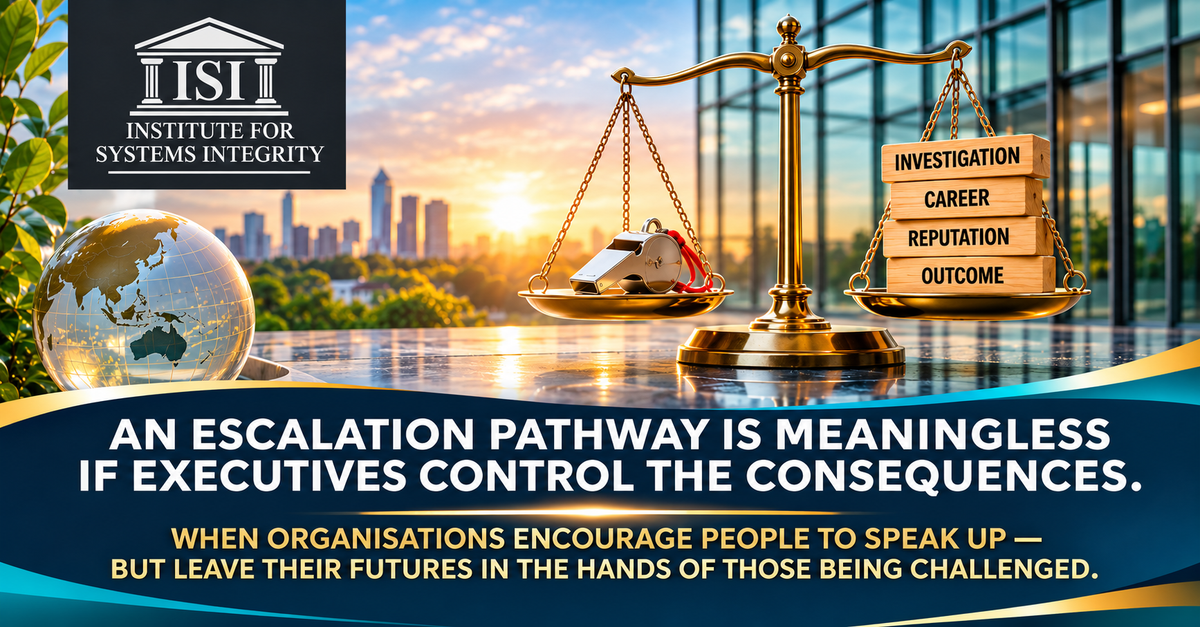
WHEN ORGANISATIONS ENCOURAGE PEOPLE TO SPEAK UP — BUT LEAVE THEIR FUTURES IN THE HANDS OF THOSE BEING CHALLENGED.
Co Authors
Dr Alwin Tan, GAICD, MBBS, FRACS, EMBA (Melbourne Business School)
Senior Surgeon | Governance Leader | HealthTech Co-founder | Founder of Institute for Systems Integrity (ISI) | Harvard Medical School — AI in Healthcare | University of Oxford — Sustainable Enterprise | Bastas Academy for Healthcare Leadership — Triple Scholar
Nadra Gadeed BSc Psychology, MSc Forensic Psychology, MA Health Research
Founder and Strategic Advisor, Edify & Grow | Workforce Risk Advisor to Boards and C-Suite Leaders, Private Healthcare, GCC & Asia-Pacific | 20 Years in the NHS Across Strategic, Operational and Leadership Roles
INSTITUTE FOR SYSTEMS INTEGRITY
THE QUESTION BOARDS ARE NOT ASKING
YOUR ORGANISATION HAS A WHISTLEBLOWER POLICY.
IT HAS AN ETHICS HOTLINE.
IT HAS AN ESCALATION PATHWAY.
IT MAY EVEN HAVE AN INDEPENDENT INVESTIGATOR AND A BOARD RISK COMMITTEE.
BUT WHO CONTROLS WHAT HAPPENS TO THE PERSON WHO SPEAKS UP?
That may be one of the most uncomfortable questions in modern corporate governance.
Across industries, organisations have become increasingly sophisticated at creating ways for employees to raise concerns. They publish policies, establish reporting channels, appoint investigators and assure their boards that appropriate procedures are in place.
Yet the existence of a reporting system tells us surprisingly little about what happens after someone uses it.
Consider a few situations.
A nurse reports repeated patient safety concerns. Her shifts are subsequently reduced.
An engineer warns that a project is unsafe. He is removed from the project.
A banker challenges a questionable lending practice. Her promotion is delayed.
A university researcher questions misconduct. Their funding opportunities disappear.
A public servant challenges a procurement decision. Their position is restructured.
A technology employee raises concerns about an AI system. They are excluded from future development.
These are illustrative scenarios, not findings about particular organisations. Each subsequent management decision may have a legitimate explanation.
But each raises the same fundamental question:
WHAT IF THE ORGANISATION ALLOWS YOU TO REPORT THE PROBLEM
— WHILE THE PEOPLE YOU ARE CHALLENGING STILL CONTROL YOUR FUTURE?
This is more than a human resources issue.
It is a potential failure of organisational integrity.
And it exposes a critical weakness in how boards understand accountability.
1. THE ILLUSION OF INDEPENDENT REPORTING
An organisation can have an impressive reporting system without having an independent accountability system.
The distinction becomes clear when we follow a complaint through the organisation.
Someone raises a serious concern.
A designated officer receives it.
Management determines its seriousness,
selects the investigator,
defines the scope
and considers the findings.
Eventually, the case is closed.
From an administrative perspective, the process may appear complete.
But who decided which evidence mattered?
Who determined what the board needed to know?
Who decided whether the underlying problem had been corrected?
And who continued to control the reporter's employment, contract, reputation and professional opportunities throughout the process?
If these powers remain concentrated among executives implicated in the original concern, the organisation may have created a reporting mechanism without adequately managing its conflicts of interest.
International guidance already recognises the importance of this distinction.
ISO 37002:2021 identifies trust, impartiality and protection as foundational principles of whistleblowing management systems. Its guidance covers receiving, assessing, addressing and concluding reports of wrongdoing (ISO, 2021).
Yet a fundamental governance question remains:
how can organisations ensure those principles continue to operate when the concern challenges people with substantial organisational power?
RECEIVING A COMPLAINT IS NOT THE SAME AS INVESTIGATING IT IMPARTIALLY.
INVESTIGATING A COMPLAINT IS NOT THE SAME AS PROTECTING THE REPORTER.
AND CLOSING A COMPLAINT IS NOT PROOF THAT THE UNDERLYING PROBLEM HAS BEEN CORRECTED.
An independent hotline is valuable.
But independence at the point of reporting is not enough if independence disappears when decisions about the person and the problem are made.
2. RETALIATION DOES NOT ALWAYS LOOK LIKE RETALIATION
One of the most difficult governance challenges is that adverse consequences may be explained using ordinary management language.
Operational requirements.
Performance concerns.
Budget constraints.
Restructuring.
Changed business priorities.
Loss of confidence.
Cultural fit.
Every one of these explanations may be legitimate.
Organisations must retain the ability to manage performance, allocate resources, change structures and make difficult decisions.
But the same explanations can also conceal improper retaliation.
The question is not whether an employee experienced an adverse outcome after raising a concern. Timing alone does not establish wrongdoing.
The question is whether the decision was genuinely independent, supported by evidence, consistent with comparable decisions and free from improper influence.
This is especially important when the executive responsible for the decision is also implicated in the concern.
Australian corporate whistleblower legislation recognises the seriousness of detrimental conduct. Part 9.4AAA of the Corporations Act 2001 provides protections for qualifying disclosures, including safeguards against certain forms of victimisation and avenues for compensation and other remedies (Commonwealth of Australia, 2001; ASIC, 2026).
These protections have eligibility requirements and do not apply automatically to every workplace complaint.
Other employment, discrimination, safety and public-interest disclosure laws may also be relevant, depending on the circumstances.
However, the existence of legal remedies does not eliminate the practical costs of pursuing them.
Someone may have enforceable rights and still experience financial strain, professional uncertainty, reputational harm and years of dispute.
Research by Miceli and Near (1989) examined whistleblowing and retaliation in US federal organisations. Their findings illustrated how encouraging reporting through legal reform did not necessarily eliminate retaliation experienced by identified whistleblowers.
The lesson remains relevant.
A PROTECTION THAT ONLY BECOMES EFFECTIVE AFTER SOMEONE HAS LOST THEIR CAREER IS AN INCOMPLETE FORM OF PREVENTION.
Good governance should seek to prevent improper consequences, not simply offer remedies after the damage has occurred.
3. WHEN SPEAKING UP BECOMES A CAREER CALCULATION
Organisational silence is often misunderstood.
When few complaints reach management, leaders may conclude that employees are satisfied.
But employees do not always remain silent because nothing is wrong.
Sometimes they remain silent because they have calculated the personal cost of speaking.
Amy Edmondson's research on psychological safety demonstrated the importance of an environment in which people feel able to take interpersonal risks, including raising concerns and acknowledging mistakes (Edmondson, 1999).
Detert and Edmondson (2011) subsequently examined the implicit beliefs employees develop about when speaking up is risky or inappropriate.
These beliefs can discourage people from raising concerns even when their intention is to help the organisation.
Morrison's reviews of employee voice and silence further explain how leadership behaviour, organisational relationships and expectations about responses can influence whether employees share important information (Morrison, 2014; 2023).
The implications for boards are significant.
An employee deciding whether to report a serious problem may ask:
Will my manager believe me?
Will the investigation be fair?
Will I be labelled difficult?
Will my colleagues support me?
Will this affect my promotion or next contract?
Will anything actually change?
And ultimately:
WILL I STILL HAVE A FUTURE HERE AFTER I TELL THE TRUTH?
Employees also observe what happens to others.
When a colleague raises a concern and becomes isolated, when another loses influence after challenging a decision, or when someone leaves following a prolonged complaint process, those events may influence how others assess the risks of speaking up.
The precise reasons for those outcomes may be disputed.
But their effect on organisational trust can still be significant.
FEAR CAN BECOME AN UNWRITTEN POLICY.
No executive needs to issue an instruction to remain silent.
The workforce may learn the lesson through experience.
And when employees decide that silence is safer than honesty, the board can begin receiving less information precisely when it needs more.
4. WHEN THE BOARD RECEIVES THE COMPLAINT — BUT NOT THE ORIGINAL CONCERN
Boards depend on management for information.
That is unavoidable in any complex organisation.
Executives possess operational knowledge, oversee reporting systems and translate day-to-day events into information suitable for board consideration.
But this creates a vulnerability when the concerns being reported involve those same executives.
A complaint may begin as:
Repeated patient safety warnings were ignored.
By the time it reaches the board, it may be described as:
An employee relations matter.
An allegation of financial misconduct may become:
A disagreement over commercial judgement.
A complaint about executive bullying may become:
A breakdown in working relationships.
Sometimes these descriptions are accurate.
Sometimes they omit the most important part of the original concern.
The board needs a way to distinguish between the two.
THE MOST DANGEROUS INFORMATION FAILURE MAY NOT BE A REPORT THAT NEVER REACHES THE BOARD.
IT MAY BE A REPORT THAT REACHES THE BOARD AFTER ITS MEANING HAS BEEN CHANGED.
This connects with ISI's proposed concept of Signal Lineage™.
Signal Lineage examines how an original concern is received, interpreted, classified, modified, escalated and eventually resolved.
The purpose is to establish whether the substance of a serious concern survives that journey.
Boards should be able to compare the original concern with the summaries, findings and recommendations presented to them, using appropriate confidentiality safeguards.
Otherwise, directors risk governing the management narrative rather than the underlying organisational reality.
5. THE EVIDENCE: SPEAKING UP IS NOT THE SAME AS FEELING SAFE
Healthcare provides an important example of the gap between formal reporting activity and workforce confidence.
In England, the National Guardian's Office reported that Freedom to Speak Up Guardians received 38,158 cases during 2024/25, an increase of 18.6% from the previous year.
Of those cases, 2.9% involved reported or perceived detriment associated with speaking up. Among organisations outside NHS trusts, the proportion was 4.6% (National Guardian's Office, 2025).
These figures describe cases brought to guardians. They do not establish the prevalence of retaliation across the entire healthcare workforce, nor do they mean that every reported instance of detriment was independently substantiated.
The 2025 NHS Staff Survey provides another perspective.
It found that:
- 71.10% of respondents would feel secure raising concerns about unsafe clinical practice.
- 55.49% were confident their organisation would address such concerns.
- 60.29% felt safe speaking up about anything concerning them.
- Only 47.59% were confident their organisation would address concerns raised under that broader speaking-up question (NHS England, 2026).
These are different survey questions and populations from the Guardian case data, so they should not be treated as directly comparable measures.
Nevertheless, they highlight a governance distinction: feeling able to raise a concern is not the same as believing the organisation will respond effectively.
The National Guardian's Office also reported that anonymous cases increased from 9.5% to 11.6% of cases between 2023/24 and 2024/25.
Anonymous reporting can provide a valuable option for workers. It may also indicate that some people remain reluctant to identify themselves.
For boards, the lesson is straightforward.
A low complaint count does not necessarily indicate a healthy culture.
A high closure rate does not necessarily indicate effective resolution.
And a reduction in recorded detriment does not, by itself, establish that all workers feel protected.
THE ABSENCE OF REPORTED PROBLEMS IS NOT PROOF OF THE ABSENCE OF PROBLEMS.
Boards need to examine not only the concerns that reach them, but also the conditions that may prevent concerns from being raised at all.
6. THE PROBLEM EXTENDS BEYOND FORMAL WHISTLEBLOWING
Whistleblower legislation is an essential part of accountability, but not every legitimate concern falls within its scope.
Employees and contractors may raise questions about unsafe workloads, bullying, discrimination, poor leadership, defective products, environmental risks, misleading performance reporting or unsafe AI deployment.
Different issues attract different legal obligations, protections and reporting procedures.
Yet the underlying governance challenge is often similar.
WHAT HAPPENS WHEN THE PERSON RAISING A LEGITIMATE CONCERN HAS LESS POWER THAN THE PERSON BEING CHALLENGED?
A hospital may have to examine a patient safety concern involving a senior clinician who influences credentialling or future appointments.
A university may need to investigate misconduct involving someone who controls research funding or academic progression.
A company may receive a complaint about an executive who influences promotion and remuneration.
A government agency may face concerns about senior decision-makers who also control the allocation of duties and professional opportunities.
A charity may receive allegations about the leadership team from staff who depend on those same leaders for continued employment.
None of these examples means the senior decision-maker is necessarily dishonest.
They demonstrate why governance cannot depend entirely on individual goodwill.
GOOD GOVERNANCE SHOULD NOT REQUIRE EVERY EXECUTIVE TO BE BRAVE, FAIR AND SELFLESS EVERY TIME THEIR AUTHORITY IS QUESTIONED.
It should provide safeguards for the occasions when competing interests threaten impartial decision-making.
7. ISI PROPOSES: CONSEQUENCE CONTROL RISK™
The Institute for Systems Integrity proposes Consequence Control Risk™ as a governance framework for examining whether those implicated in a serious concern retain disproportionate influence over what happens afterwards.
The framework identifies five areas in which concentrated authority can compromise an escalation system.
| Dimension | The question boards must ask |
|---|---|
| 1. Information control | Who can filter, reinterpret or withhold information from independent oversight? |
| 2. Investigation control | Who appoints the investigator, determines the scope and influences the evidence considered? |
| 3. Career and economic control | Who controls employment, contracts, promotion, funding, credentialling or professional opportunities? |
| 4. Narrative control | Who determines how the reporter, respondent and original concern are characterised? |
| 5. Resolution control | Who decides that the issue has been resolved and the underlying risk corrected? |
This is a proposed ISI conceptual framework, not an empirically validated risk score or established regulatory standard.
Its purpose is to identify where power remains concentrated after a concern is raised and where proportionate independent safeguards may be necessary.
The five dimensions are connected.
Information control can influence what the investigator sees.
Investigation control can influence the findings.
Narrative control can shape how those findings are understood.
Career and economic control can affect the reporter long after the investigation ends.
Resolution control can determine whether the organisation learns from the problem or merely closes the file.
Together, they can create a system in which the appearance of accountability exists without sufficient independence.
THE GREATER THE UNCHECKED CONTROL OF AN IMPLICATED DECISION-MAKER, THE GREATER THE NEED FOR INDEPENDENT SAFEGUARDS.
The objective is not to remove management authority.
It is to prevent material conflicts of interest from becoming the final authority over their own management.
8. CONSEQUENCE CONTROL IS ALSO A WORKFORCE RISK
Boards commonly monitor workforce risks through turnover, sickness absence, vacancies, agency expenditure and exit interviews.
These measures are important, but many are lagging indicators.
By the time a valued employee leaves, the underlying loss of trust may have been developing for months or years.
People do not necessarily resign the moment they stop trusting an organisation.
Some withdraw first.
They stop volunteering ideas, challenging decisions or raising concerns.
Others remain employed but become less willing to share information that leadership needs.
This creates a risk that conventional workforce dashboards may not capture.
Consequence Control Risk™ offers a way to examine potential warning signs earlier.
| Dimension | Possible workforce indicator |
|---|---|
| Information control | Differences between frontline feedback, survey findings, complaints and board reports |
| Investigation control | Independence of investigators and documented management of conflicts |
| Career and economic control | Subsequent employment, rostering, contract and progression decisions affecting reporters |
| Narrative control | Changes in the classification or description of serious concerns during escalation |
| Resolution control | Repeated complaints, recurring risks and evidence of corrective action after case closure |
These indicators should be interpreted carefully. None independently establishes retaliation, and their use must respect confidentiality, privacy, procedural fairness and applicable law.
They are proposed governance measures, not validated predictors of workforce outcomes.
However, they offer a more useful question than simply asking how many complaints were closed.
WHAT HAPPENED TO THE PEOPLE WHO RAISED THE CONCERNS — AND WHAT DID THE ORGANISATION LEARN?
This matters especially in smaller organisations.
In a private clinic, small business or community organisation, one individual may simultaneously act as owner, manager, investigator and decision-maker.
Such concentration of responsibility may be operationally unavoidable.
But it can also concentrate conflicts of interest.
In a small team, the perceived treatment of one person after raising a concern may shape whether others feel safe to speak up.
That makes independent oversight proportionately important, even when the organisation cannot sustain a large internal governance structure.
9. THE COUNTERARGUMENT: MANAGEMENT MUST STILL BE ABLE TO MANAGE
A credible framework must recognise the risks of excessive or poorly designed oversight.
Not every complaint is accurate.
Not every allegation can be substantiated.
Not every adverse employment decision constitutes retaliation.
Executives must be able to address poor performance, restructure operations, allocate resources and make difficult commercial decisions.
Independent investigations can be costly, slow and themselves vulnerable to poor judgement or bias.
Automatically removing management authority whenever an allegation is made could create opportunities for misuse and undermine procedural fairness.
These are legitimate concerns.
But they do not justify leaving material conflicts of interest unmanaged.
They justify designing proportionate safeguards.
Routine matters should ordinarily remain within appropriate operational processes.
More serious concerns — particularly those involving senior executives, suspected retaliation, significant safety risks or substantial conflicts of interest — may require independent assessment and direct access to appropriate board oversight.
Both the reporter and the respondent deserve fair treatment.
Both deserve an evidence-based process.
Both deserve protection from prejudgement and improper conduct.
PROTECTING THE RIGHT TO RAISE A CONCERN DOES NOT MEAN GUARANTEEING THAT THE CONCERN IS CORRECT.
It means ensuring that concerns can be examined fairly and that no person experiences improper consequences for making a protected or otherwise legitimate report.
Independence is not the removal of accountability.
It is one of the conditions that makes accountability credible.
10. FROM ESCALATION PATHWAYS TO INDEPENDENT CONSEQUENCE OVERSIGHT
ISI proposes that boards assess five practical safeguards within their existing governance arrangements.
First, independent access.
Serious concerns involving executive conflicts should have a credible route to an impartial decision-maker, appropriate board committee or suitably independent external authority.
Second, independent assessment.
Investigation arrangements should identify and manage conflicts of interest, preserve evidence and ensure procedural fairness.
Third, protection against detrimental treatment.
Significant adverse decisions affecting a person who has raised a serious concern should be capable of proportionate, independent scrutiny where retaliation risks are credible.
Fourth, direct board visibility.
Boards should have reliable access to material unresolved concerns, significant systemic risks and evidence of potential retaliation without compromising necessary confidentiality.
Fifth, verified resolution.
Administrative closure should not substitute for evidence that identified organisational risks have been addressed.
These safeguards do not require every complaint to become a board investigation.
They require organisations to recognise when the integrity of the reporting process itself may be at risk.
A useful starting point is for directors to ask:
Can serious concerns reach independent oversight without being filtered by executives who may have a conflict?
Who investigates allegations involving the CEO or executive team, and who reviews that investigator's independence?
Who scrutinises potentially adverse employment, contract or professional decisions after significant concerns are raised?
What evidence demonstrates that the underlying problem was corrected rather than merely administratively closed?
How would the board know if employees had stopped speaking up because they no longer trusted what would happen afterwards?
These questions should be supported by evidence, not simply management assurances.
Boards should examine original concerns where appropriate, investigation independence, patterns of adverse decisions, corrective actions and workforce confidence.
They should also look for recurring problems that have supposedly been resolved.
AN ORGANISATION SHOULD NEVER ALLOW A MATERIAL CONFLICT OF INTEREST TO BECOME THE FINAL AUTHORITY ON WHETHER THAT CONFLICT WAS PROPERLY MANAGED.
11. THE FINAL TEST OF INSTITUTIONAL INTEGRITY
Organisations spend considerable time telling people to speak up.
They teach courage.
They promote psychological safety.
They celebrate transparency.
They publish values statements.
They establish hotlines and escalation pathways.
And when a major organisational failure eventually emerges, leaders often ask:
Why didn't somebody say something earlier?
Perhaps the more revealing question is:
WHAT HAPPENED TO THE LAST PERSON WHO DID?
Were they heard?
Was their concern examined impartially?
Was the underlying problem corrected?
Were they treated fairly afterwards?
Could they continue their career without improper disadvantage?
Or did the organisation follow its procedure while leaving the individual to bear the consequences?
This is the deeper test of institutional integrity.
Not whether an organisation has a reporting policy.
Not whether an investigation was completed.
Not whether the board received a reassuring summary.
And not how many complaints were administratively closed.
The test is whether an organisation can examine its own power without allowing that power to compromise the process.
A REPORTING PATHWAY IS NOT THE SAME AS AN ACCOUNTABILITY PATHWAY.
And an accountability pathway cannot be considered sufficiently independent when the people being challenged retain unchecked control over the investigation, the narrative and the consequences.
Organisations do not become trustworthy simply by inviting people to speak up.
They become more trustworthy when they demonstrate that concerns will be examined fairly, conflicts will be managed independently, corrective actions will be verified and improper retaliation will not be tolerated.
Because the true measure of organisational integrity is not how comfortably people can praise leadership.
IT IS HOW SAFELY THEY CAN CHALLENGE IT.
🚨 THE QUESTION EVERY BOARD SHOULD ASK
IF SOMEONE IN OUR ORGANISATION RAISED A SERIOUS CONCERN ABOUT THE CEO TOMORROW,
WHO WOULD HAVE THE INDEPENDENT AUTHORITY TO INVESTIGATE IT,
PROTECT THE REPORTER
AND SCRUTINISE ANY SUBSEQUENT ADVERSE DECISION?
AND IF THE ANSWER IS EFFECTIVELY THE CEO OR THE EXECUTIVES BEING CHALLENGED
— WHAT EXACTLY ARE WE CALLING INDEPENDENT GOVERNANCE?
References
Australian Securities and Investments Commission (ASIC) (2026) Whistleblower rights and protections. Available at: https://www.asic.gov.au/about-asic/asic-investigations-and-enforcement/whistleblowing/whistleblower-rights-and-protections
Commonwealth of Australia (2001) Corporations Act 2001 (Cth), Part 9.4AAA.
Detert, J.R. and Edmondson, A.C. (2011) ‘Implicit voice theories: Taken-for-granted rules of self-censorship at work’, Academy of Management Journal, 54(3), pp. 461–488.
Edmondson, A. (1999) ‘Psychological safety and learning behavior in work teams’, Administrative Science Quarterly, 44(2), pp. 350–383.
International Organization for Standardization (ISO) (2021) ISO 37002:2021: Whistleblowing management systems — Guidelines. Geneva: ISO. Available at:
Miceli, M.P. and Near, J.P. (1989) ‘The incidence of wrongdoing, whistle-blowing, and retaliation: Results of a naturally occurring field experiment’, Employee Responsibilities and Rights Journal, 2(2), pp. 91–108.
Morrison, E.W. (2014) ‘Employee voice and silence’, Annual Review of Organizational Psychology and Organizational Behavior, 1, pp. 173–197.
Morrison, E.W. (2023) ‘Employee voice and silence: Taking stock a decade later’, Annual Review of Organizational Psychology and Organizational Behavior, 10, pp. 79–107.
National Guardian's Office (2025) Culture is a patient safety issue: A summary of speaking up to Freedom to Speak Up guardians, 1 April 2024–31 March 2025. London: National Guardian's Office. Available at:
NHS England (2026) 2025 NHS Staff Survey: National results briefing. Published 12 March 2026. Available at: