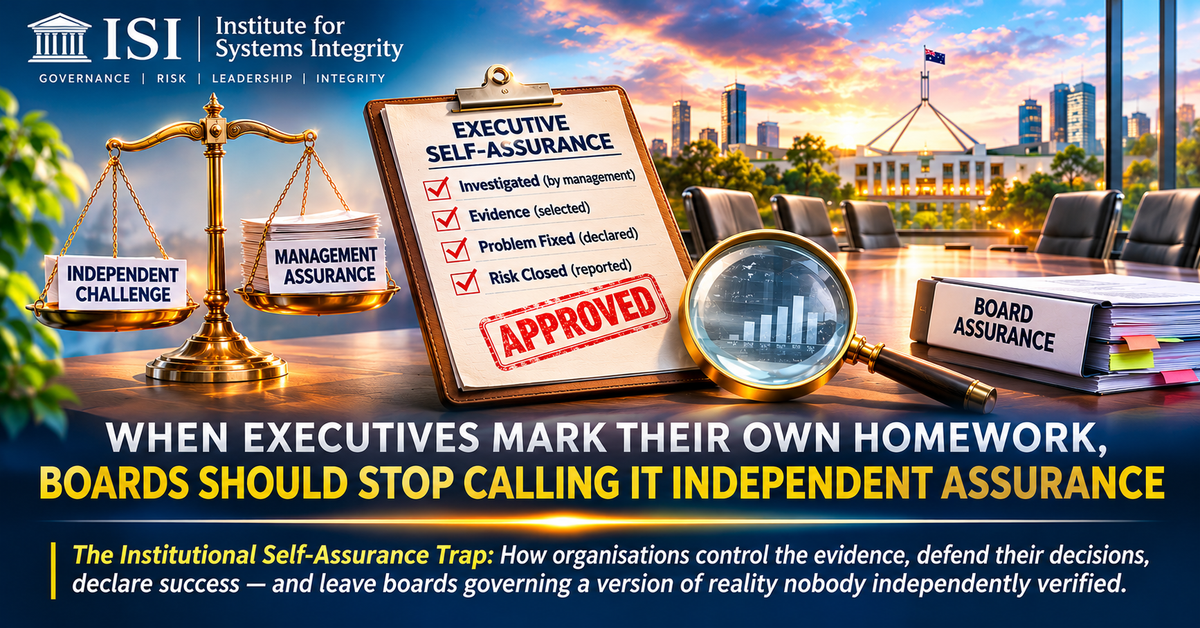
WHEN EXECUTIVES MARK THEIR OWN HOMEWORK, BOARDS SHOULD STOP CALLING IT INDEPENDENT ASSURANCE
Crown. AMP. PwC. Robodebt. The Star. Different scandals. One uncomfortable governance question: if management controls the investigation, evidence and conclusion, is the board exercising independent oversight — or approving the organisation's preferred version of reality?
Dr Alwin Tan, GAICD, MBBS, FRACS, EMBA (Melbourne Business School)
Senior Surgeon | Governance Leader | HealthTech Co-founder | Founder of Institute for Systems Integrity (ISI) | Harvard Medical School — AI in Healthcare | University of Oxford — Sustainable Enterprise | Bastas Academy for Healthcare Leadership — Triple Scholar
The Institutional Self-Assurance Trap:
How organisations control the evidence,
defend their decisions,
declare success — and leave boards governing a version of reality nobody independently verified.
An Institute for Systems Integrity (ISI) research and governance publication
EXECUTIVE SUMMARY
🚨 THE ORGANISATION INVESTIGATED ITSELF.
CLEARED ITSELF.
AND ASKED THE BOARD TO APPROVE THE RESULT.
The investigation was completed.
The recommendations were implemented.
The risk register was updated.
The dashboard turned green.
The board received assurance.
The matter was closed.
BUT WHO INDEPENDENTLY VERIFIED THAT THE PROBLEM WAS ACTUALLY FIXED?
Across Australia and internationally, major institutional failures have exposed a disturbing pattern.
Organisations can possess extensive governance frameworks, risk committees, compliance departments, professional advisers, internal reporting systems and formal approval processes while failing to recognise, escalate or correct serious problems.
Consider the evidence.
Crown Casino had governance and compliance structures. Royal commissions exposed serious failures in risk management, corporate culture and board oversight.
AMP continued charging some superannuation members fees for services they could no longer access. A Federal Court judgment exposed failures in internal controls and the investigation of repeated complaints.
PwC Australia advised organisations on governance and professional integrity while its own tax confidentiality scandal raised profound questions about ethics, conflicts of interest and accountability.
Robodebt operated through government administrative systems. Its unlawful income-averaging approach caused widespread harm before the scheme was dismantled.
The Star Entertainment Group operated within a heavily regulated industry. In October 2026, the Federal Court imposed a $260 million penalty for serious anti-money-laundering and counter-terrorism-financing breaches.
And internationally, the Boeing 737 MAX crashes, UK Post Office Horizon scandal, Mid Staffordshire failures and NASA Challenger disaster demonstrated different ways in which institutional confidence, inadequate challenge and defective decision-making can have devastating consequences.
These were not identical failures.
Some involved deliberate misconduct.
Others involved poor judgment,
inadequate oversight,
organisational silence,
flawed assumptions
or failures to respond to contradictory evidence.
But they expose a common governance vulnerability.
THE EXISTENCE OF ASSURANCE DOES NOT ESTABLISH THE RELIABILITY OF ASSURANCE.
And when management controls the problem, the investigation, the evidence, the interpretation and the declaration of success, accountability risks becoming a closed loop.
This paper proposes three Institute for Systems Integrity frameworks:
- The Institutional Self-Assurance Loop: How management reporting can repeatedly reinforce the organisation's preferred interpretation of reality.
- The Assurance Capture Model: Five mechanisms through which the independence and reliability of assurance may be compromised.
- The Assurance Independence Test: Seven questions boards should ask before accepting that material risks have been adequately addressed.
The central proposition is simple.
GOOD GOVERNANCE DOES NOT REQUIRE DIRECTORS TO DISTRUST MANAGEMENT.
IT REQUIRES A SYSTEM CAPABLE OF DISCOVERING WHEN MANAGEMENT IS WRONG.
1. THE GREEN DASHBOARD THAT HIDES A FAILING SYSTEM
Imagine a hospital.
Nurses repeatedly report unsafe staffing.
Patients experience delays.
Clinical staff raise concerns about workload, inadequate supervision and unsafe workarounds.
Management commissions a review.
A workforce action plan is developed.
Policies are updated.
Training is completed.
The risk committee receives a progress report.
Six months later, the board sees:
ACTION COMPLETED.
RISK MITIGATED.
STATUS: GREEN.
But on the ward, the underlying conditions remain.
Nurses are still working short.
Workarounds continue.
Staff have become reluctant to report concerns because previous complaints appeared to produce little meaningful change.
Management has evidence that corrective activities occurred.
It may not have evidence that those activities worked.
THE BOARD HAS VERIFIED THE PAPERWORK.
NOBODY HAS VERIFIED THE REALITY.
This hypothetical scenario illustrates a distinction that appears repeatedly in institutional failures.
POLICY IMPLEMENTED DOES NOT MEAN BEHAVIOUR CHANGED.
TRAINING COMPLETED DOES NOT MEAN CAPABILITY IMPROVED.
RECOMMENDATIONS CLOSED DO NOT MEAN RISKS ELIMINATED.
AND A GREEN DASHBOARD DOES NOT MEAN THE SYSTEM IS SAFE.
Mid Staffordshire: When patients experienced a different reality
The Mid Staffordshire NHS Foundation Trust Public Inquiry examined serious failures in patient care and the institutional systems responsible for recognising and responding to those failures.
The inquiry identified problems extending beyond individual clinical practice into organisational culture, management, oversight and regulation (Francis, 2013).
The significance of Mid Staffordshire was not simply that unacceptable care occurred.
It was that serious warning signals failed to produce sufficiently effective institutional responses.
The existence of formal governance structures did not ensure that patients' experiences were adequately understood or acted upon.
THE HOSPITAL HAD MANAGEMENT SYSTEMS.
PATIENTS HAD EXPERIENCES THOSE SYSTEMS FAILED TO ADEQUATELY REPRESENT.
This is a critical lesson for every board.
A hospital may measure staffing establishment while overlooking the actual workload experienced on a particular ward.
A financial institution may measure complaint closure while failing to establish whether customers received appropriate remedies.
A government agency may report completed investigations while affected citizens continue experiencing the same problems.
The board cannot judge organisational performance solely from the quality of management's reporting.
It must understand whether that reporting reflects the experiences of those most exposed to the risk.
ISI GOVERNANCE QUESTION:
If frontline reality contradicts the board dashboard,
which version does the organisation investigate
— and which version does it believe?
2. CROWN CASINO: WHEN THE RISK COMMITTEE EXISTS BUT COMMERCIAL POWER WINS
🚨 THE CASINO HAD RISK FRAMEWORKS. COMPLIANCE STRUCTURES. EXECUTIVES. AND A BOARD.
BUT WHO WAS EFFECTIVELY CHALLENGING THE DECISIONS THAT GENERATED THE PROFITS?
The Crown inquiries exposed serious failures involving money-laundering risks, regulatory compliance, corporate culture and board oversight.
The Bergin Inquiry found Crown unsuitable to hold its Sydney casino licence.
The Victorian Royal Commission subsequently found Crown Melbourne unsuitable to hold its casino licence, identifying extensive misconduct and governance failures (Bergin, 2021; Royal Commission into the Casino Operator and Licence, 2021).
The Victorian inquiry examined serious deficiencies involving governance, risk management, responsible gambling and compliance with legal obligations.
It also identified failures by Crown's board to ensure the organisation satisfied its regulatory responsibilities.
The important question is not whether Crown possessed governance structures.
It did.
The question is whether those structures exercised sufficient influence over the decisions creating the risks.
A risk committee can exist without effectively restraining commercial behaviour.
A compliance function can identify concerns without securing corrective action.
A board can receive extensive reporting while failing to understand the scale of problems developing beneath it.
THE PRESENCE OF A CONTROL IS NOT PROOF THAT THE CONTROL HAS POWER.
This is where the governance problem becomes uncomfortable.
What happens when the people responsible for generating revenue possess greater organisational influence than the people responsible for challenging the associated risks?
What happens when commercial success becomes the dominant measure of executive performance?
What happens when a risk function can report a problem but cannot compel meaningful change?
The lesson extends beyond casinos.
A hospital may face tension between theatre utilisation and patient safety.
A mining company may face tension between production targets and environmental protection.
A bank may face tension between revenue growth and customer outcomes.
A technology company may face tension between product deployment and safety testing.
These tensions are not automatically evidence of misconduct.
They are reasons why independent challenge must have genuine authority.
THE QUESTION IS NOT WHETHER THE ORGANISATION HAS A RISK MANAGEMENT FUNCTION.
IT IS WHETHER THAT FUNCTION CAN CHALLENGE THE PEOPLE GENERATING THE REVENUE — AND BE HEARD.
ISI GOVERNANCE QUESTION:
When risk management conflicts with commercial performance, who has the authority to stop the decision?
3. AMP SUPERANNUATION: WHEN THE ORGANISATION KNOWS ABOUT THE PROBLEM BUT THE SYSTEM KEEPS CHARGING
🚨 THE FEES KEPT COMING OUT.
THE SERVICE WAS NO LONGER AVAILABLE.
AND THE ORGANISATION FAILED TO STOP THE CHARGES.
In September 2022, the Federal Court ordered five companies within the AMP group to pay a combined $14.5 million in penalties for charging fees for services not provided to 1,452 superannuation members.
The members had continued paying fees for access to financial advice after leaving employers whose arrangements had provided that access.
ASIC stated that AMP was aware of the issue but had failed to take appropriate steps to prevent the charges continuing.
The Court also identified failures to investigate whether the problem was systemic, despite repeated complaints over an extended period (ASIC, 2022).
This is particularly significant for governance.
A problem may be known.
Complaints may exist.
Management may possess relevant information.
Yet the organisation may still fail to respond adequately.
KNOWING ABOUT A RISK IS NOT THE SAME AS MANAGING IT.
AND ACKNOWLEDGING A PROBLEM IS NOT THE SAME AS CORRECTING IT.
The Court's findings concerning organisational culture are important because they demonstrate that failures of escalation and systemic investigation can occur without establishing that every senior executive personally participated in the underlying conduct.
AMP subsequently acknowledged the judgment and reported that it had completed remediation of affected members.
That response matters.
Independent enforcement, acknowledgement and remediation are part of the accountability process.
But the broader governance question remains.
Why did repeated complaints not lead to sufficiently effective identification and correction of the systemic problem earlier?
For directors, the implications are direct.
When management reports that remediation is underway, boards should ask:
Has the conduct actually stopped?
How many customers remain affected?
Have the underlying systems changed?
Who independently tested the remedy?
And why did the organisation's original controls fail?
A REMEDIATION PROGRAMME SHOULD NOT BECOME A SUBSTITUTE FOR STOPPING THE HARM.
The AMP example is also relevant to healthcare.
A hospital may acknowledge repeated staffing ratio while continuing to operate the same unsafe process.
A company may recognise payroll errors while affected employees continue receiving incorrect payments.
An insurer may establish a claims remediation project while the underlying claims logic remains unchanged.
The fundamental governance question is the same.
DID THE ORGANISATION FIX THE CAUSE — OR SIMPLY CREATE A PROCESS FOR MANAGING THE CONSEQUENCES?
ISI GOVERNANCE QUESTION:
If repeated complaints do not trigger investigation of a systemic problem, what is the organisation's assurance system actually detecting?
4. PwC: WHEN THE PEOPLE SELLING ASSURANCE FACE THEIR OWN INTEGRITY CRISIS
🚨 THE FIRM ADVISED ORGANISATIONS ON GOVERNANCE, RISK AND COMPLIANCE.
THEN ITS OWN CONDUCT BECAME THE SUBJECT OF A MAJOR INTEGRITY SCANDAL.
The PwC Australia tax confidentiality scandal exposed serious questions concerning professional ethics, conflicts of interest, accountability and the protection of confidential government information.
A former PwC partner misused confidential tax policy information obtained through government consultations.
Parliamentary investigations examined the handling of that information, the conduct of individuals involved and the firm's institutional response.
The Senate's 2023 report was titled PwC: A Calculated Breach of Trust.
A subsequent report in 2024 carried the title PwC: The Cover Up Worsens the Crime.
The scandal prompted significant scrutiny, leadership changes and reviews of governance and culture.
But its implications extend beyond one professional services firm.
Organisations routinely engage external consultants to provide assurance.
Boards may assume that an internationally recognised advisory firm offers sufficient independence, expertise and credibility.
Yet professional reputation does not eliminate conflicts of interest.
An external appointment does not automatically establish independence.
A consultant may be constrained by the scope of an engagement.
The organisation commissioning a review may influence which questions are examined.
Commercial relationships may create perceived or actual conflicts.
And the board may receive a technically accurate report that does not address the most important underlying question.
THE QUESTION IS NOT WHETHER THE CONSULTANT HAS AN IMPRESSIVE NAME.
IT IS WHETHER THE CONSULTANT HAS THE INDEPENDENCE TO TELL THE BOARD SOMETHING MANAGEMENT DOES NOT WANT TO HEAR.
The PwC scandal raises a second-order governance problem.
Who scrutinises the people providing assurance?
Who manages their commercial conflicts?
Who examines the terms of reference?
Who determines whether material findings have been omitted?
And who can challenge the conclusions of the assurance provider?
This does not mean professional advisers are inherently compromised.
Independent professional advice is often essential.
It means independence must be demonstrated through governance arrangements, professional standards, conflict management and access to evidence.
IF THE ASSURANCE PROVIDER IS NOT ACCOUNTABLE, THE BOARD MAY SIMPLY BE OUTSOURCING ITS BLIND SPOTS.
ISI GOVERNANCE QUESTION:
Who assures the assurers — and can the board distinguish genuine independent challenge from externally branded reassurance?
5. ROBODEBT: WHEN THE GOVERNMENT'S COMPUTER SAYS YOU OWE MONEY
🚨 THE GOVERNMENT SAID PEOPLE OWED MONEY.
THE SYSTEM GENERATED THE ALLEGED DEBTS.
VULNERABLE AUSTRALIANS WERE EXPECTED TO CHALLENGE THE GOVERNMENT'S CALCULATIONS.
BUT WHO HAD VERIFIED THAT THE UNDERLYING METHOD WAS LAWFUL?
Australia's Robodebt scandal demonstrates how automated administration, flawed assumptions and inadequate institutional challenge can combine to cause widespread harm.
Between 2015 and 2019, the Australian Government operated an income compliance programme that used averaged income information from the Australian Taxation Office in calculating alleged social security overpayments.
Income averaging could not, by itself, reliably establish actual fortnightly earnings and entitlement.
Yet alleged debts were raised against large numbers of Australians.
Many recipients were required to locate historical employment records, dispute calculations and navigate difficult administrative processes.
The Royal Commission into the Robodebt Scheme, chaired by Catherine Holmes AC SC, delivered its report in July 2023.
It documented serious failures concerning the scheme's design, legality, implementation, continuation and public administration (Royal Commission into the Robodebt Scheme, 2023).
The scandal was not simply a computer malfunction.
It was a failure involving policy, law, people, administration and technology.
THE SYSTEM PRODUCED A NUMBER.
THE GOVERNMENT TREATED IT AS A DEBT.
THE CITIZEN WAS LEFT TO CHALLENGE THE ASSUMPTION.
The central governance problem was that institutional authority gave apparent legitimacy to a method that lacked the necessary legal foundation.
This is especially relevant to organisations adopting artificial intelligence.
Automation can improve speed, consistency and access to services.
But it can also reproduce a flawed assumption across thousands of cases before the organisation recognises the problem.
A HUMAN ERROR MAY AFFECT ONE DECISION.
AN AUTOMATED GOVERNANCE ERROR CAN AFFECT AN ENTIRE POPULATION.
The implications for boards are substantial.
Before approving automated decision-making, governing bodies should ask:
Who validated the underlying assumptions?
Who confirmed the legal basis?
Who tested the system against real-world cases?
Who monitors adverse outcomes?
Who can challenge its decisions?
And who has the authority to suspend it when evidence no longer supports its use?
Robodebt also raises a fundamental question about institutional power.
WHEN AN ORGANISATION MAKES AN ERROR,
WHY SHOULD THE COST OF CORRECTING IT FALL ON THE PERSON WITH THE LEAST POWER TO CHALLENGE IT?
ISI GOVERNANCE QUESTION:
If the organisation's automated system is wrong, does the governance system discover the error — or does it force the citizen, patient, customer or employee to prove it?
6. THE STAR ENTERTAINMENT GROUP: WHEN COMMERCIAL INCENTIVES OVERPOWER COMPLIANCE
🚨 THE COMPLIANCE OBLIGATIONS WERE CLEAR.
THE COMMERCIAL INCENTIVES WERE POWERFUL.
THE CONTROLS FAILED.
On 28 October 2026, the Federal Court ordered The Star Entertainment Group to pay $260 million following serious breaches of Australia's anti-money-laundering and counter-terrorism-financing laws.
AUSTRAC reported that The Star failed to maintain a compliant anti-money-laundering programme and failed to adequately identify, mitigate and manage risks associated with high-risk customers.
The regulator described serious failures involving customer due diligence, source-of-funds verification and transaction monitoring.
The Court's findings concerned conduct occurring over an extended period, with significant financial incentives associated with high-risk gambling activity (AUSTRAC, 2026).
This was not merely a paperwork problem.
It concerned whether the organisation's controls meaningfully restrained risky commercial conduct.
The Star had compliance obligations.
It operated in a highly regulated industry.
Yet serious failures persisted.
THE EXISTENCE OF COMPLIANCE REQUIREMENTS DID NOT PREVENT NON-COMPLIANCE.
The case is particularly relevant because the penalty was imposed in October 2026.
These are not merely historical governance lessons.
Serious failures of oversight and risk management continue to emerge in organisations operating under extensive regulatory supervision.
The Star case also raises a question about the relationship between revenue and risk.
What happens when activities generating substantial income also create serious legal, financial and reputational exposure?
Can the compliance function stop those activities?
Can risk managers challenge senior commercial executives?
Can the board identify when the organisation's business model has become dependent on unacceptable risk?
IF THE BUSINESS MAKES MONEY FROM THE RISK,
WHO HAS THE AUTHORITY TO SAY NO?
ISI GOVERNANCE QUESTION:
When the organisation profits from activities that create unacceptable risk,
can independent oversight genuinely restrain management?
7. OPTUS: WHEN OPERATIONAL RESILIENCE IS TESTED BY REAL-WORLD FAILURE
🚨 A RESILIENCE PLAN IS NOT PROOF OF RESILIENCE.
THE REAL TEST COMES WHEN THE SYSTEM FAILS.
The November 2023 Optus network outage disrupted telecommunications services across Australia.
Regulatory investigations subsequently identified serious failures affecting access to emergency calling services and required welfare checks.
The Australian Communications and Media Authority reported that 2,145 people were unable to access Triple Zero during the outage and that 369 required welfare checks were not completed.
Optus subsidiaries paid penalties totalling more than $12 million in relation to emergency call obligations (ACMA, 2024).
The case illustrates a different assurance problem.
An organisation may possess business continuity plans, technical resilience frameworks and incident response procedures.
But the existence of those arrangements does not establish that they will work under real operational stress.
The board needs to understand not merely whether the organisation has a resilience plan.
It needs evidence of whether the plan performs under credible failure conditions.
A POLICY CAN BE COMPLETE.
A TEST CAN BE RECORDED.
A RISK REGISTER CAN BE GREEN.
AND THE SYSTEM CAN STILL FAIL WHEN PEOPLE NEED IT MOST.
This lesson applies to hospitals, utilities, transport networks, banks, digital platforms and emergency services.
Operational resilience must be assessed through realistic testing, critical dependencies, recovery capability and the consequences experienced by users.
ISI GOVERNANCE QUESTION:
Are we assuring the existence of a resilience plan, or the actual ability of the organisation to protect people when the plan is tested?
8. WHEN THE COMPUTER IS BELIEVED AND THE HUMAN IS DISCREDITED
The UK Post Office Horizon scandal
For years, subpostmasters challenged apparent financial shortfalls associated with the Post Office's Horizon computer system.
Many experienced accusations, financial losses, reputational damage and criminal proceedings.
The scandal exposed profound failures in the treatment of evidence, institutional accountability and responses to those challenging the system's reliability.
Judicial proceedings and the Post Office Horizon IT Inquiry documented the devastating consequences of those failures.
THE COMPUTER WAS TREATED AS CREDIBLE.
THE PEOPLE CHALLENGING IT WERE TREATED AS THE PROBLEM.
The comparison with Robodebt is instructive.
In both cases, institutional confidence in a technology-supported process was insufficiently responsive to serious challenges from affected individuals.
However, the legal and operational circumstances differed.
Robodebt concerned unlawful welfare debt calculations based on income averaging.
Horizon concerned disputed accounting discrepancies, criminal prosecutions and failures involving the handling and disclosure of evidence.
The common governance lesson is not that all technology is unreliable.
It is that organisations must retain effective mechanisms for challenging technology-supported decisions.
WHEN THE SYSTEM'S OUTPUT BECOMES MORE TRUSTED THAN THE PEOPLE HARMED BY IT, ASSURANCE CAN BECOME AN INSTITUTIONAL BLIND SPOT.
For boards overseeing artificial intelligence, the implications are immediate.
A model can be validated and still perform poorly under changed conditions.
An automated decision can be technically consistent and still rely on an invalid assumption.
A system can meet internal performance targets while causing unacceptable harm.
TECHNOLOGY DOES NOT REMOVE ACCOUNTABILITY.
IT MAKES THE NEED FOR ACCOUNTABILITY MORE IMPORTANT.
ISI GOVERNANCE QUESTION:
Can people challenge the organisation's technology without being treated as the problem themselves?
9. WHEN CERTIFICATION BECOMES A SUBSTITUTE FOR SAFETY
Boeing 737 MAX
Two Boeing 737 MAX aircraft crashed in 2018 and 2019, killing 346 people.
A United States congressional investigation subsequently identified serious problems involving design assumptions, production pressures, communication, transparency and regulatory oversight (US House Committee on Transportation and Infrastructure, 2020).
The case demonstrates why formal certification cannot be treated as infallible evidence of operational safety.
Certification is essential.
But it must remain connected to reliable evidence, sufficient independence and the willingness to reconsider assumptions.
THE AIRCRAFT WAS CERTIFIED.
THE SAFETY ASSUMPTIONS WERE NOT SUFFICIENTLY CHALLENGED.
346 PEOPLE DIED.
The same principle applies to healthcare accreditation, financial compliance, AI certification and major infrastructure approvals.
A system can satisfy formal requirements while important risks remain inadequately understood.
The question is not simply whether certification occurred.
It is whether the underlying assumptions were robust, whether critical information was disclosed and whether the oversight process could challenge the organisation seeking approval.
ISI GOVERNANCE QUESTION:
What assumptions underpin our assurance,
and who has independently tested what happens if those assumptions are wrong?
10. WHEN LEGAL APPROVAL BECOMES A SUBSTITUTE FOR RESPONSIBLE GOVERNANCE
Rio Tinto and Juukan Gorge
In May 2020, Rio Tinto destroyed ancient Aboriginal rock shelters at Juukan Gorge in Western Australia.
The destruction occurred within an existing legal approval framework.
Subsequent parliamentary inquiries exposed serious deficiencies in cultural heritage protection, consultation and decision-making (Joint Standing Committee on Northern Australia, 2020; 2021).
THE ORGANISATION HAD AN APPROVAL.
THE CULTURAL HERITAGE WAS STILL DESTROYED.
The case illustrates the limits of treating legal permission as sufficient evidence of responsible governance.
An action can be legally permitted while remaining ethically, socially or strategically indefensible.
This matters for boards overseeing decisions involving Indigenous communities, environmental protection, vulnerable populations and long-term institutional trust.
Compliance asks whether the organisation has satisfied applicable requirements.
Integrity asks whether the organisation has adequately considered the consequences, affected stakeholders and legitimacy of its decision.
The questions overlap.
They are not identical.
LEGAL PERMISSION IS NOT AUTOMATICALLY SOCIAL LICENCE.
AND COMPLIANCE IS NOT THE SAME AS SOUND JUDGMENT.
ISI GOVERNANCE QUESTION:
Who has authority to challenge a decision that is legally permitted but inconsistent with the organisation's stated values and responsibilities?
11. WHEN ENGINEERS WARN, MANAGEMENT OVERRIDES AND DISASTER FOLLOWS
NASA Challenger
On 28 January 1986, the Space Shuttle Challenger broke apart shortly after launch, killing all seven crew members.
The subsequent Presidential Commission examined both the technical causes and the decision-making processes preceding the launch.
The investigation documented concerns involving the solid rocket booster joints and O-ring performance, including warnings associated with low temperatures.
The Commission found that the launch decision process was flawed and that important information had not adequately reached those responsible for the final decision (Presidential Commission, 1986).
ENGINEERS RAISED CONCERNS.
THE LAUNCH PROCEEDED.
THE FAILURE WAS NOT SIMPLY TECHNICAL.
It was also organisational.
Diane Vaughan's subsequent research examined how risky practices can become normalised within organisational decision-making (Vaughan, 1996).
Repeated exposure to a problem without immediate catastrophe can gradually reduce its perceived seriousness.
A near miss becomes evidence that the system can cope.
A workaround becomes accepted practice.
A warning becomes another entry on the risk register.
Until the system fails.
THE ABSENCE OF DISASTER IS NOT PROOF THAT THE RISK IS CONTROLLED.
SOMETIMES IT SIMPLY MEANS THE ORGANISATION HAS BEEN FORTUNATE.
ISI GOVERNANCE QUESTION:
Which warnings have we stopped treating seriously because nothing catastrophic has happened yet?
12. DIFFERENT INDUSTRIES. DIFFERENT FAILURES.
ONE RECURRING GOVERNANCE WEAKNESS.
These cases should not be collapsed into a single explanation.
Crown and The Star exposed serious failures in casino governance, risk management and regulatory compliance.
AMP demonstrated failures to prevent improper fee deductions and investigate repeated complaints.
PwC raised questions about professional ethics, confidentiality and the independence of advisers.
Robodebt exposed unlawful administrative decision-making and inadequate institutional challenge.
Optus demonstrated weaknesses in operational resilience and emergency service obligations.
Mid Staffordshire revealed failures in patient care and institutional oversight.
Horizon demonstrated the consequences of institutional confidence in disputed technology-supported evidence.
Boeing exposed weaknesses in design, certification and safety oversight.
Juukan Gorge demonstrated the inadequacy of relying on formal approval alone.
Challenger illustrated failures involving technical warnings and organisational decision-making.
They are not all examples of executives literally investigating themselves.
But together they demonstrate a broader vulnerability.
FORMAL GOVERNANCE STRUCTURES DO NOT GUARANTEE EFFECTIVE GOVERNANCE.
REPORTING DOES NOT GUARANTEE UNDERSTANDING.
COMPLIANCE DOES NOT GUARANTEE INTEGRITY.
AND ASSURANCE DOES NOT GUARANTEE THAT THE ASSURED CONCLUSION IS CORRECT.
The recurring challenge is whether an organisation's governance system is sufficiently independent, informed and open to contradiction.
13. THE SCIENCE OF ORGANISATIONAL SELF-DECEPTION
Why do these problems persist even in sophisticated organisations?
Academic research provides several explanations.
Information asymmetry
Those managing an organisation generally possess information that directors and external stakeholders cannot directly observe.
Agency theory highlights potential differences between managerial interests and the interests of those to whom managers are accountable (Jensen and Meckling, 1976).
This does not mean executives are inherently untrustworthy.
It explains why governance requires monitoring, accountability and informed challenge.
Organisational silence
Employees may withhold concerns when they believe speaking up will be ineffective, unwelcome or personally costly (Morrison and Milliken, 2000).
The organisation can then mistake silence for agreement.
Psychological safety
Research by Edmondson (1999) demonstrates the importance of interpersonal conditions that allow team members to discuss errors, acknowledge uncertainty and raise concerns.
Where employees fear the consequences of challenging authority, important operational information may remain hidden.
Institutional decoupling
Meyer and Rowan (1977) described how formal organisational structures can become disconnected from actual work practices.
A policy can exist without shaping behaviour.
A committee can meet without resolving the underlying problem.
A compliance programme can appear comprehensive while its practical effectiveness remains limited.
Normalisation of deviance
Vaughan (1996) showed how organisational practices can gradually redefine previously unacceptable risks as tolerable.
Together, these perspectives explain how governance systems can become increasingly confident while becoming progressively less capable of detecting their own weaknesses.
THE DANGER IS NOT ALWAYS THAT SOMEONE IS HIDING THE TRUTH.
IT MAY BE THAT THE ORGANISATION HAS BUILT A SYSTEM THAT NO LONGER KNOWS HOW TO RECOGNISE IT.
14. THE ISI ASSURANCE CAPTURE MODEL
The Institute for Systems Integrity proposes Assurance Capture as a conceptual framework for examining how assurance can lose independence or reliability.
Assurance Capture occurs when those responsible for managing an organisational risk exercise disproportionate influence over the scope, evidence, interpretation or communication of the assurance provided about that risk.
Five mechanisms warrant particular attention.
1. Scope capture
Management determines which questions may be investigated.
The inquiry becomes narrower than the original problem.
2. Evidence capture
Those being scrutinised control which information, records and witnesses are accessible.
Contradictory evidence may be excluded or overlooked.
3. Interpretation capture
Findings are framed around isolated incidents, individual behaviour or procedural compliance rather than underlying systemic causes.
4. Reporting capture
Material uncertainty, dissent or qualifications are lost as findings pass through management reporting channels.
The board receives a more reassuring narrative than the evidence justifies.
5. Closure capture
The organisational chain responsible for corrective action also determines whether that action was successful.
The matter is declared resolved without sufficiently testing the outcome.
THE ORGANISATION DEFINES THE PROBLEM.
THE ORGANISATION INVESTIGATES THE PROBLEM.
THE ORGANISATION MEASURES ITS OWN SUCCESS.
THE ORGANISATION DECLARES THE MATTER CLOSED.
AND THE BOARD APPROVES THE CONCLUSION.
This is the proposed Institutional Self-Assurance Loop.
It does not require deliberate deception.
It requires only that the same reporting hierarchy has excessive control over how organisational reality is constructed and presented.
Assurance Capture is proposed here as an ISI analytical construct, not an empirically validated model.
Further research would be needed to establish its prevalence, predictive validity and relationship to governance outcomes.
15. INDEPENDENT ASSURANCE: NECESSARY, BUT NOT INFALLIBLE
The Institute of Internal Auditors' updated Three Lines Model, issued in July 2026, emphasises the distinct responsibilities of governing bodies, management and internal audit.
It recognises the importance of coordinated assurance while reaffirming internal audit's independent role (IIA, 2026).
The distinction matters.
Management assurance is necessary.
Risk and compliance functions provide valuable oversight and challenge.
Independent internal audit offers objective assurance to the governing body.
External reviews can provide additional scrutiny where appropriate.
But independence is not achieved merely by appointing an external consultant.
A consultant may face restrictive terms of reference.
An internal auditor may have inadequate resources.
An external review may depend on information selected by management.
An assurance provider may lack the technical expertise necessary to challenge complex operational claims.
INDEPENDENCE IS NOT A LABEL ON A REPORT.
IT IS THE PRACTICAL ABILITY TO EXAMINE EVIDENCE, CHALLENGE ASSUMPTIONS AND COMMUNICATE FINDINGS WITHOUT INAPPROPRIATE INTERFERENCE.
There is also a legitimate counterargument.
Boards cannot independently investigate every management statement.
Excessive verification can create delay, cost, duplication and defensive behaviour.
It can undermine executive accountability and encourage directors to drift into operational management.
The solution is therefore not permanent suspicion.
It is proportionate, risk-based verification.
The UK Corporate Governance Code apply to financial years beginning on or after 1 January 2026, reflects increased attention to the effectiveness of material internal controls.
It does not require external assurance for every control. Boards must exercise judgment about the evidence and assurance needed (FRC, 2024; 2026).
GOOD GOVERNANCE DOES NOT REQUIRE DIRECTORS TO DISTRUST EVERYTHING.
IT REQUIRES THEM TO KNOW WHAT THEY CAN REASONABLY RELY UPON — AND WHAT MUST BE INDEPENDENTLY TESTED.
16. WHEN THE PEOPLE RESPONSIBLE FOR FAILURE ALSO CONTROL THE RESPONSE
Independent verification is only one part of accountability.
A further problem arises when executives responsible for disputed decisions retain substantial control over subsequent investigations and organisational responses.
This creates potential conflicts between organisational learning, personal accountability and institutional reputation.
A board must distinguish several questions.
Was the original decision reasonable based on the information available at the time?
Were relevant concerns properly considered?
Were conflicts of interest managed?
Was the investigation sufficiently independent?
Did corrective action address the actual causes?
Were those who raised concerns treated fairly?
And were findings followed by proportionate accountability?
These questions matter because an organisation can acknowledge a problem while avoiding meaningful examination of the decisions that allowed it to occur.
A new policy is issued.
Training is delivered.
A committee is established.
A consultant prepares a report.
The institution announces that lessons have been learned.
But the same incentives, reporting arrangements and decision-making authority remain unchanged.
THE ORGANISATION CHANGES THE PROCEDURE.
THE ORGANISATION PRESERVES THE POWER STRUCTURE.
AND THE SAME FAILURE BECOMES POSSIBLE AGAIN.
However, accountability must not be confused with automatic punishment.
Not every failed decision constitutes misconduct.
Not every executive responsible for an unsuccessful intervention acted negligently.
Fair investigation, due process and proportionality remain essential.
The objective is to establish what happened, why it happened and what must change.
Not to identify a convenient person to blame.
17. THE ISI ASSURANCE INDEPENDENCE TEST: SEVEN QUESTIONS FOR EVERY BOARD
The Institute for Systems Integrity proposes seven questions to help directors assess the credibility of assurance.
QUESTION 1 — WHO DEFINED THE PROBLEM?
Was the original concern investigated, or did management narrow the scope to something easier to resolve?
QUESTION 2 — WHO CONTROLLED THE EVIDENCE?
Could investigators access documents, data, witnesses and contradictory information without inappropriate interference?
QUESTION 3 — WHO WAS ALLOWED TO DISAGREE?
Were frontline workers, affected stakeholders and independent experts able to challenge the organisational narrative?
QUESTION 4 — WHO INTERPRETED THE FINDINGS?
Were competing explanations, unresolved uncertainties and limitations fairly presented?
QUESTION 5 — WHO MEASURED SUCCESS?
Was the intervention independently tested for effectiveness, or was completion of activities treated as proof of improvement?
QUESTION 6 — WHO REPORTED TO THE BOARD?
Could the assurance provider communicate material findings directly to the board or relevant committee?
QUESTION 7 — WHO CAN REOPEN THE MATTER?
If contradictory evidence emerges, can the organisation reconsider its conclusions without permission from those who previously declared success?
These questions are proposed as a practical governance framework, not a validated scoring system or substitute for applicable legal and professional requirements.
They should be applied proportionately to the level of risk.
IF THE SAME EXECUTIVE CHAIN CONTROLS ALL SEVEN ANSWERS, THE BOARD SHOULD QUESTION WHAT KIND OF ASSURANCE IT IS REALLY RECEIVING.
18. WHAT A BOARD SHOULD DO DIFFERENTLY ON MONDAY MORNING
Boards do not need another hundred-page governance framework to begin improving assurance.
They need to change the questions they ask.
When management reports that a risk has been mitigated, ask what outcome demonstrates that the risk has actually decreased.
When an investigation is completed, ask who determined its scope.
When recommendations are closed, ask whether their effectiveness was tested.
When staff concerns appear to have disappeared, ask whether reporting confidence has improved or deteriorated.
When a consultant provides assurance, ask whether the consultant had access to all relevant evidence.
When a dashboard is entirely green, ask which unresolved uncertainties remain outside the reporting framework.
When management reports that a serious problem was isolated, ask what evidence would contradict that conclusion.
And when a board receives repeated reassurance about the same unresolved risk, ask whether its assurance architecture has become part of the problem.
Boards should ensure that material concerns can reach appropriate independent oversight channels.
That may include direct internal audit access, protected whistleblowing processes, independent investigation protocols, periodic frontline engagement and appropriate board committee escalation.
The design will differ by organisation.
But the underlying principle remains constant.
THE BOARD MUST HAVE ACCESS TO INFORMATION THAT DOES NOT DEPEND ENTIRELY ON THE PEOPLE WHOSE DECISIONS ARE BEING EXAMINED.
Otherwise, directors risk governing an institution through a narrative controlled by the very hierarchy they are responsible for overseeing.
19. THE MOST DANGEROUS BOARD REPORT MAY BE THE ONE WHERE EVERYTHING IS GREEN
A green dashboard can represent genuine progress.
It can also represent incomplete measurement.
A completed investigation can establish important facts.
It can also leave critical questions unanswered.
A closed recommendation can demonstrate effective remediation.
It can also record administrative completion without meaningful change.
The problem is not the dashboard, investigation or recommendation itself.
The problem is assuming that its existence proves the conclusion.
A BOARD CAN RECEIVE ENORMOUS AMOUNTS OF ASSURANCE AND STILL KNOW SURPRISINGLY LITTLE ABOUT WHETHER THE ORGANISATION IS SAFE, ETHICAL OR EFFECTIVE.
This is why institutional integrity must be understood as a property of the governance system, not simply the personal virtue of individual leaders.
A resilient governance system must be capable of detecting mistakes, hearing dissent, testing assumptions, recognising conflicts and revising conclusions.
It must remain capable of discovering information that its leaders would prefer not to receive.
That is not disloyalty.
That is governance.
CONCLUSION — WHO IS PROTECTING THE BOARD FROM THE ORGANISATION'S OWN VERSION OF REALITY?
Crown had governance structures.
AMP had compliance obligations and customer complaints.
PwC possessed extensive professional expertise.
Robodebt operated through government administrative systems.
The Star operated within a heavily regulated industry.
Optus had telecommunications resilience obligations.
Mid Staffordshire had hospital governance arrangements.
Boeing had certification processes.
Rio Tinto had formal approvals.
The Post Office relied on a computer system whose reliability was seriously challenged.
NASA had technical expertise and launch decision procedures.
The failures were different.
The circumstances were different.
The responsibilities were different.
But each case demonstrates why organisational confidence must remain open to independent challenge.
THE PRESENCE OF GOVERNANCE IS NOT PROOF OF EFFECTIVE GOVERNANCE.
THE PRESENCE OF ASSURANCE IS NOT PROOF OF INDEPENDENT ASSURANCE.
AND THE ABSENCE OF REPORTED PROBLEMS IS NOT PROOF THAT PROBLEMS DO NOT EXIST.
Boards should trust competent management.
They should respect operational expertise.
They should avoid unnecessary interference.
But they must never allow trust to become a substitute for judgment.
Because when the same organisational hierarchy controls the problem, investigation, evidence, interpretation and declaration of success, accountability risks becoming a closed loop.
The board may then become the final signature on a conclusion it never adequately tested.
🚨 THE REAL DANGER IS NOT THAT EVERY EXECUTIVE IS DISHONEST.
IT IS THAT A GOVERNANCE SYSTEM CAN BECOME SO DEPENDENT ON MANAGEMENT'S VERSION OF REALITY THAT EVEN HONEST DIRECTORS LOSE THE ABILITY TO DISCOVER WHEN IT IS WRONG.
And that brings us to the question every board should ask before accepting the next reassuring report.
IF MANAGEMENT'S VERSION OF REALITY WERE WRONG,
WHAT IN OUR GOVERNANCE SYSTEM WOULD ALLOW US TO DISCOVER IT?
If the board cannot answer that question, it should be cautious about the assurance it believes it possesses.
Because the ultimate test of governance is not whether executives can explain why everything is under control.
IT IS WHETHER THE BOARD HAS THE INDEPENDENCE, EVIDENCE AND COURAGE TO DISCOVER WHEN IT IS NOT.
🚨 FINAL ISI CHALLENGE
WHEN EXECUTIVES MARK THEIR OWN HOMEWORK,
BOARDS SHOULD STOP CALLING IT INDEPENDENT ASSURANCE.
AND WHEN DIRECTORS ACCEPT THAT HOMEWORK WITHOUT SUFFICIENT CHALLENGE,
THEY SHOULD ASK WHETHER THEY ARE EXERCISING OVERSIGHT
— OR SIMPLY LEGITIMISING THE ORGANISATION'S PREFERRED VERSION OF THE TRUTH.
REFERENCES
Akerlof, G.A. (1970) ‘The market for “lemons”: Quality uncertainty and the market mechanism’, The Quarterly Journal of Economics, 84(3), pp. 488–500.
Australian Communications and Media Authority (ACMA) (2024) Optus pays $12 million penalty for Triple Zero outage. Canberra: ACMA. Available at:
Australian Securities and Investments Commission (ASIC) (2022) AMP companies admit liability and fined $14.5 million for fees for no service. Media Release 22-258MR.
Australian Transaction Reports and Analysis Centre (AUSTRAC) (2026) The Star ordered to pay $260 million for serious AML/CTF breaches. 28 October.
Bergin, P. (2021) Report of the Inquiry under section 143 of the Casino Control Act 1992 (NSW). Sydney: Independent Liquor & Gaming Authority.
Commonwealth of Australia (2023) Report of the Royal Commission into the Robodebt Scheme. Canberra: Commonwealth of Australia. Available at:
Edmondson, A. (1999) ‘Psychological safety and learning behavior in work teams’, Administrative Science Quarterly, 44(2), pp. 350–383.
Financial Reporting Council (FRC) (2024) UK Corporate Governance Code 2024. London: FRC.
Francis, R. (2013) Report of the Mid Staffordshire NHS Foundation Trust Public Inquiry. London: The Stationery Office.
Hayne, K.M. (2019) Final Report: Royal Commission into Misconduct in the Banking, Superannuation and Financial Services Industry. Canberra: Commonwealth of Australia.
Institute of Internal Auditors (IIA) (2026) Three Lines Model: Assurance and Advice in Support of Effective Governance. Statement of Position, 8 July.
Jensen, M.C. and Meckling, W.H. (1976) ‘Theory of the firm: Managerial behavior, agency costs and ownership structure’, Journal of Financial Economics, 3(4), pp. 305–360.
Joint Standing Committee on Northern Australia (2020) Never Again: Inquiry into the Destruction of 46,000 Year Old Caves at the Juukan Gorge in the Pilbara Region of Western Australia—Interim Report. Canberra: Parliament of Australia.
Joint Standing Committee on Northern Australia (2021) A Way Forward: Final Report into the Destruction of Indigenous Heritage Sites at Juukan Gorge. Canberra: Parliament of Australia.
Meyer, J.W. and Rowan, B. (1977) ‘Institutionalized organizations: Formal structure as myth and ceremony’, American Journal of Sociology, 83(2), pp. 340–363.
Morrison, E.W. and Milliken, F.J. (2000) ‘Organizational silence: A barrier to change and development in a pluralistic world’, Academy of Management Review, 25(4), pp. 706–725.
Post Office Horizon IT Inquiry (2025) Final Report, Volume 1. London: Post Office Horizon IT Inquiry. Available at:
Presidential Commission on the Space Shuttle Challenger Accident (1986) Report to the President. Washington, DC: US Government Printing Office. Available at:
Royal Commission into the Casino Operator and Licence (2021) Report. Melbourne: Victorian Government. Available at:
Senate Finance and Public Administration References Committee (2023) PwC: A Calculated Breach of Trust. Canberra: Parliament of Australia.
Senate Finance and Public Administration References Committee (2024) PwC: The Cover Up Worsens the Crime. Canberra: Parliament of Australia.
US Department of Justice (2017) Volkswagen AG Agrees to Plead Guilty and Pay $4.3 Billion in Criminal and Civil Penalties. Washington, DC: DOJ.
US House Committee on Transportation and Infrastructure (2020) The Design, Development & Certification of the Boeing 737 MAX. Washington, DC: US House of Representatives.
Vaughan, D. (1996) The Challenger Launch Decision: Risky Technology, Culture, and Deviance at NASA. Chicago: University of Chicago Press.
ABOUT THE INSTITUTE FOR SYSTEMS INTEGRITY
The Institute for Systems Integrity (ISI) examines how governance, leadership, risk, organisational culture and decision-making interact under institutional pressure.
Its work seeks to strengthen the ability of organisations and governing bodies to recognise emerging failures, challenge assumptions, protect independent judgment and maintain accountability.
Research contribution: This paper proposes the Institutional Self-Assurance Loop, the Assurance Capture Model and the seven-question Assurance Independence Test as conceptual governance tools. They are not empirically validated diagnostic instruments.
Research limitation: The documented cases illustrate different mechanisms of institutional failure. They should not be interpreted as establishing that every organisation or executive involved engaged in the same form of assurance capture.
Institute for Systems Integrity (ISI)
Systems Thinking | Governance | Risk | Leadership | Institutional Integrity