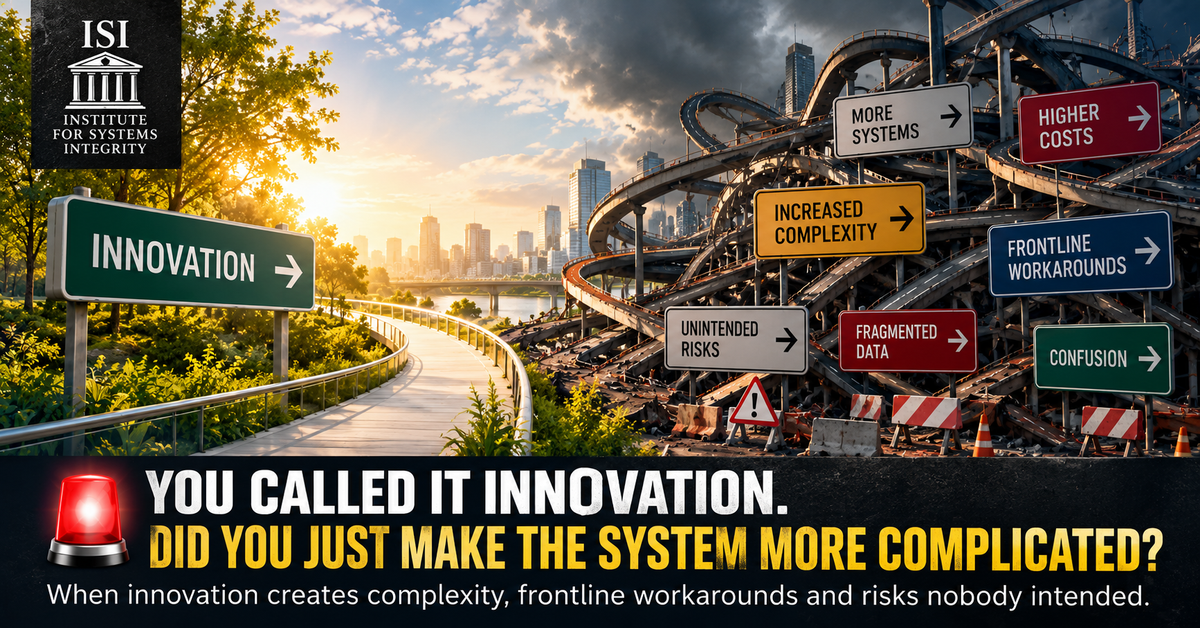
🚨 YOU CALLED IT INNOVATION. DID YOU JUST MAKE THE SYSTEM MORE COMPLICATED? When innovation creates complexity, frontline workarounds and risks nobody intended.
When innovation makes work harder, who carries the risk? ISI examines complexity transfer, frontline workarounds and the governance of genuine improvement.
Dr Alwin Tan, GAICD, MBBS, FRACS, EMBA (Melbourne Business School)
Senior Surgeon | Governance Leader | HealthTech Co-founder | Founder of the Institute for Systems Integrity (ISI) |Harvard Medical School — AI in Healthcare | University of Oxford — Sustainable Enterprise | Bastas Academy for Healthcare Leadership – Triple Scholar
INSTITUTE FOR SYSTEMS INTEGRITY
Amazon Leadership Principles Series — Principle Invent and Simplify
THE NEW SYSTEM WAS A SUCCESS....
SO WHY WAS EVERYONE WORKING HARDER?
The CEO announced the transformation.
The project was delivered.
The technology was installed.
The consultants presented their results.
The dashboard showed improved efficiency.
The board congratulated management.
THE INNOVATION WAS DECLARED A SUCCESS.
But on the frontline, something else was happening.
Employees were entering the same information twice.
Customers were struggling to navigate new processes.
Managers were creating spreadsheets to compensate for missing functionality.
Experienced staff were teaching colleagues how to work around the system.
And when something went wrong, nobody was quite sure which system, department or supplier owned the problem.
🚨 THE ORGANISATION HAD MODERNISED ITS TECHNOLOGY.
BUT HAD IT IMPROVED THE WORK?
This is an illustrative scenario, not an allegation about a particular organisation.
Yet the underlying problem is familiar across industries.
We introduce something new.
We celebrate the launch.
We measure adoption.
Then we move on.
But who measures the complexity left behind?
1. INVENT AND SIMPLIFY....TWO WORDS THAT MUST STAY TOGETHER.
Amazon's Leadership Principle, Invent and Simplify, challenges leaders to encourage invention, seek ideas from beyond their organisations and find ways to simplify.
It is a valuable principle.
Innovation has transformed healthcare, aviation, banking, manufacturing, logistics, communications, education and countless other fields.
Digital payments have removed friction from transactions.
Automation has improved consistency in industrial processes.
Modern diagnostic technologies have expanded clinical capabilities.
Digital services can make information and essential services more accessible.
AI can help employees complete some tasks more quickly and effectively.
Research supports these benefits.
Brynjolfsson, Li and Raymond (2025) found that AI assistance increased productivity by an average of 15% in a customer-support setting.
Noy and Zhang (2023) found substantial improvements in speed and rated quality for selected professional writing tasks.
These are meaningful results.
INNOVATION IS NOT THE ENEMY.
BUT INVENTION WITHOUT SIMPLIFICATION CAN BECOME ANOTHER FORM OF ORGANISATIONAL BURDEN.
A new technology is an input.
A better outcome is the objective.
And the two should never be confused.
2. COMPLEXITY DOES NOT DISAPPEAR. SOMETIMES WE JUST MOVE IT.
Imagine a bank introducing automated loan processing.
Applications become faster.
Staffing costs decline.
Management celebrates efficiency.
But customers whose circumstances do not fit the algorithm must navigate an increasingly complicated appeals process.
The complexity has not necessarily disappeared.
It may have moved from the bank to the customer.
Now consider a hospital.
An electronic record improves access to information and supports clinical communication.
But clinicians may spend more time documenting, responding to alerts and navigating multiple screens.
The technology may deliver important benefits while also introducing new burdens.
In government, digital services can reduce processing costs and improve access for many people.
But citizens who lack digital skills, language support or reliable internet access may face greater difficulty.
🔥 IF YOU MAKE YOUR ORGANISATION MORE EFFICIENT BY MAKING EVERYONE ELSE'S LIFE HARDER, HAVE YOU REALLY SIMPLIFIED ANYTHING?
We propose the ISI Complexity Transfer Gap™:
The difference between complexity removed from one part of a system and complexity imposed elsewhere as a consequence of the change.
This is a conceptual governance lens, not an empirically validated measure.
It asks leaders to examine where work, risk, cost and responsibility have moved.
Because what disappears from one dashboard may reappear in another person's working day.
3. THE FRONTLINE OFTEN KNOWS BEFORE THE BOARD DOES.
A new warehouse management system is launched.
Management sees improved stock visibility.
Workers discover that exception handling now takes longer.
A construction company introduces digital safety reporting.
Reports become easier to collect.
But supervisors struggle to distinguish serious hazards from administrative noise.
An airline introduces a new scheduling platform.
Routine operations become more efficient.
But during disruption, staff must coordinate several systems to recover the service.
A university introduces a centralised student platform.
Administration becomes more standardised.
But students with unusual circumstances struggle to find someone empowered to help.
A technology company deploys an AI assistant.
Routine questions are answered more quickly.
But employees spend additional time investigating incorrect or incomplete responses.
These are illustrative scenarios.
They reveal a common governance risk:
THE PEOPLE WHO APPROVE INNOVATION MAY NOT BE THE PEOPLE WHO EXPERIENCE ITS CONSEQUENCES.
And the people experiencing those consequences may have the least influence over the decision to continue, modify or abandon the system.
🚨 IF YOUR INNOVATION TEAM NEVER ASKS THE FRONTLINE WHAT BECAME HARDER, IT IS NOT MEASURING THE WHOLE RESULT.
4. AUTOMATION CAN MAKE THE HUMAN JOB MORE DIFFICULT.
This problem is not new.
In 1983, Lisanne Bainbridge described the ironies of automation.
Automation can remove routine human involvement while leaving people responsible for the most difficult situations — particularly when the automated system fails or encounters something unexpected.
Consider aviation.
An automated system may perform reliably under normal conditions.
But the human operator must still understand the system well enough to recognise and manage abnormal behaviour.
In manufacturing, an automated production line may reduce repetitive work.
Yet troubleshooting complex faults can require skills that are difficult to maintain when operators rarely perform the underlying tasks.
In healthcare, AI may support diagnosis or clinical decisions.
But clinicians must remain capable of identifying errors, questioning recommendations and exercising professional judgment.
In banking, automated fraud detection may reduce routine manual reviews.
But unusual cases still require careful human assessment.
🔥 AUTOMATION THAT REMOVES ROUTINE WORK BUT LEAVES HUMANS WITH ALL THE EXCEPTIONS HAS NOT NECESSARILY MADE THE HUMAN ROLE SIMPLER.
It may have made the role more demanding.
This does not mean automation should be rejected.
It means organisations must design for human capability, not merely technical performance.
Who monitors the system?
Who understands its limitations?
Who can intervene?
Who retains the necessary skills?
And what happens when the technology is unavailable?
5. MORE DATA DOES NOT AUTOMATICALLY MEAN BETTER DECISIONS.
Many innovations promise greater visibility.
More dashboards.
More alerts.
More reports.
More analytics.
More real-time monitoring.
More AI-generated summaries.
But information is only useful if people can understand it and act on it.
A mining company may collect thousands of equipment readings while struggling to identify the signals that matter most.
A hospital may generate more clinical alerts than staff can meaningfully review.
A financial institution may produce increasingly detailed risk reports without improving its ability to challenge assumptions.
A board may receive a sophisticated dashboard that makes performance look reassuring while obscuring emerging operational problems.
🚨 MORE INFORMATION IS NOT THE SAME AS MORE UNDERSTANDING.
And more reporting is not the same as better control.
The real test is whether innovation improves the quality, speed and reliability of decisions.
Not merely the volume of information available.
6. AI MAKES THE QUESTION MORE URGENT.
Generative AI creates extraordinary opportunities.
It can assist with drafting, coding, summarising, customer support, knowledge retrieval and many other tasks.
Research demonstrates meaningful productivity gains in particular settings.
But there is a difference between improving an individual task and improving an entire organisation.
Imagine an AI system that drafts a report in five minutes instead of fifty.
Excellent.
But what if three employees must now verify its accuracy?
What if the report creates additional questions?
What if errors are difficult to detect?
What if staff stop checking because the system appears reliable?
What if nobody knows who approved the model or who can suspend it?
🔥 SAVING 45 MINUTES ON DRAFTING IS NOT A PRODUCTIVITY GAIN IF THE ORGANISATION SPENDS TWO HOURS CORRECTING THE CONSEQUENCES.
That is a hypothetical example, not a measured average.
The opposite is also possible: well-designed AI may reduce total workload, improve quality and free employees for higher-value work.
The point is to measure the whole process.
The NIST AI Risk Management Framework emphasises governance, risk mapping, measurement and management throughout the AI lifecycle.
That is essential.
AN AI SYSTEM THAT WORKS IS NOT NECESSARILY AN AI SYSTEM THAT WORKS SAFELY WITHIN THE ORGANISATION.
Technical validation matters.
So do human oversight, operational integration, accountability and the ability to reverse a harmful deployment.
7. SIMPLIFICATION MUST NOT BECOME AN EXCUSE TO REMOVE SAFETY.
There is another danger.
In the pursuit of speed and simplicity, organisations may remove controls they do not fully understand.
A financial institution reduces verification steps.
A hospital removes a clinical check.
A construction project eliminates an approval.
An airline simplifies maintenance documentation.
A manufacturer reduces quality inspections.
Some controls may genuinely be redundant.
Others exist because previous failures revealed a need for protection.
🔥 THE MOST DANGEROUS COMPLEXITY TO REMOVE MAY BE THE COMPLEXITY YOU NEVER UNDERSTOOD.
Good simplification distinguishes unnecessary bureaucracy from essential safeguards.
It asks whether a control actually prevents harm.
Whether it can be redesigned.
Whether automation can improve its reliability.
And whether removing it creates a new risk.
SIMPLIFY THE PROCESS. NOT THE RESPONSIBILITY.
8. THE COST OF INNOVATION IS NOT JUST THE PURCHASE PRICE.
Boards routinely examine project budgets.
Capital expenditure.
Implementation milestones.
Expected savings.
Return on investment.
But the real cost of innovation may also include:
Training.
Temporary productivity losses.
Parallel systems.
Workarounds.
Additional verification.
Customer support.
Cybersecurity.
Data migration.
Technical debt.
Maintenance.
Vendor dependence.
Loss of organisational knowledge.
And the cost of recovering when something goes wrong.
Brynjolfsson, Rock and Syverson (2021) explain why the benefits of major technologies may take time to appear: organisations often need complementary investments in people, processes and business models.
That means a temporary increase in complexity does not automatically indicate failure.
Some transitions are difficult precisely because meaningful transformation is occurring.
But leaders must distinguish necessary transition costs from persistent structural problems.
🚨 THE QUESTION IS NOT WHETHER IMPLEMENTATION WAS DIFFICULT.
IT IS WHETHER THE ORGANISATION BECAME BETTER AFTER THE DIFFICULTY.
9. INNOVATION THEATRE IS NOT INNOVATION.
A new innovation laboratory.
A digital transformation strategy.
An AI steering committee.
A technology showcase.
A pilot programme.
A launch event.
A consultant's presentation.
None of these is inherently wrong.
But none proves that value has been created.
A pilot can succeed without being scalable.
A product can launch without being adopted meaningfully.
A system can be adopted because employees have no alternative.
A process can be automated without becoming more effective.
And a project can finish on time while creating years of additional work.
🔥 IMPLEMENTATION IS NOT IMPROVEMENT.
ADOPTION IS NOT BENEFIT.
AUTOMATION IS NOT SIMPLIFICATION.
INNOVATION IS NOT PROVEN BY THE FACT THAT SOMETHING NEW EXISTS.
The question must be what changed for the people, processes and outcomes that matter.
10. THE ISI COMPLEXITY TRANSFER TEST™
We propose five governance tests for any major innovation.
1. PURPOSE — WHAT PROBLEM ARE WE SOLVING?
Can leadership explain the problem without referring to the technology being purchased?
Is there evidence that the problem matters?
2. REMOVAL — WHAT HAS ACTUALLY BECOME SIMPLER?
Which tasks, delays, handovers, errors or unnecessary steps have been removed?
Have we measured them before and after implementation?
3. TRANSFER — WHERE DID THE COMPLEXITY GO?
Did work, cost, risk or responsibility move to customers, frontline staff, suppliers or another department?
Who now handles the exceptions?
4. CONTROL — WHAT NEW RISKS HAVE WE CREATED?
Can people detect failure?
Can they intervene?
Are essential safeguards preserved?
Who has authority to stop or reverse the change?
5. ASSURANCE — HOW DO WE KNOW IT IS BETTER?
Have we measured end-to-end outcomes rather than isolated task performance?
Have frontline staff and affected customers been heard?
Have benefits persisted beyond the initial launch?
PURPOSE → REMOVAL → TRANSFER → CONTROL → ASSURANCE
The ISI Complexity Transfer Test™ is a proposed conceptual governance framework, not a validated diagnostic instrument.
Its purpose is to challenge leaders to demonstrate that innovation has improved the system rather than merely moved its problems.
11. WHAT SHOULD THE BOARD DEMAND?
Before approving a major innovation, directors should ask:
SHOW US WHAT THE OLD SYSTEM DID BADLY.
SHOW US WHAT THE NEW SYSTEM WILL REMOVE.
SHOW US WHAT NEW WORK IT WILL CREATE.
SHOW US WHO WILL BEAR THAT WORK.
SHOW US WHICH SAFEGUARDS MAY CHANGE.
SHOW US WHO CAN STOP THE IMPLEMENTATION IF IT BECOMES UNSAFE.
SHOW US HOW WE WILL KNOW WHETHER THE PROMISED BENEFITS WERE REALISED.
Then, six or twelve months after implementation, return to the frontline.
Not only the project sponsor.
Not only the consultant.
Not only the executive dashboard.
Ask the people doing the work.
What became easier?
What became harder?
What are you now doing that the system was supposed to eliminate?
What workarounds have become normal?
What would you change?
IF THE BOARD NEVER RETURNS TO ASK THESE QUESTIONS, IT MAY HAVE APPROVED A PROJECT WITHOUT EVER ASSURING ITSELF OF THE OUTCOME.
12. THE BEST INNOVATION MAY BE THE THING YOU STOP DOING.
Not every improvement requires a new platform.
Sometimes innovation means removing an unnecessary approval.
Eliminating duplicate data entry.
Combining fragmented processes.
Redesigning a confusing form.
Giving employees authority to resolve problems.
Reducing alerts that nobody can act upon.
Retiring an obsolete system.
Or listening to the person who has been explaining the problem for years.
THE MOST VALUABLE INNOVATION MAY NOT BE SOMETHING NEW.
IT MAY BE THE COURAGE TO REMOVE SOMETHING THAT SHOULD NEVER HAVE BEEN THERE.
Amazon's Invent and Simplify principle offers an important challenge.
Invent.
Learn.
Look beyond your organisation.
Do not become trapped by existing methods.
But never forget the second obligation.
Simplify.
Not just for management.
Not just for the budget.
Not just for the dashboard.
For the people doing the work.
For the people receiving the service.
And for the organisation that must live with the consequences.
🚨 THE ISI BOARD QUESTION
SHOW US ONE MAJOR INNOVATION WE INTRODUCED IN THE LAST TWO YEARS.
NOW SHOW US WHAT BECAME SIMPLER FOR THE PEOPLE DOING THE WORK — NOT JUST FOR THE PEOPLE READING THE DASHBOARD.
And if the answer is that the new system is faster, cheaper and more sophisticated, ask one more question:
THEN WHY IS EVERYONE STILL WORKING SO HARD TO MAKE IT WORK?
REFERENCE
1. Amazon (n.d.) Amazon Leadership Principles. Available at: https://www.aboutamazon.com/about-us/leadership-principles (Accessed: 17 October 2026).
2. Bainbridge, L. (1983) ‘Ironies of automation’, Automatica, 19(6), pp. 775–779.
3. Brynjolfsson, E. and Hitt, L.M. (2000) ‘Beyond computation: Information technology, organizational transformation and business performance’, Journal of Economic Perspectives, 14(4), pp. 23–48.
4. Brynjolfsson, E., Rock, D. and Syverson, C. (2021) ‘The productivity J-curve: How intangibles complement general purpose technologies’, American Economic Journal: Macroeconomics, 13(1), pp. 333–372.
5. Brynjolfsson, E., Li, D. and Raymond, L.R. (2025) ‘Generative AI at work’, The Quarterly Journal of Economics, 140(2), pp. 889–942.
6. Herd, P. and Moynihan, D.P. (2018) Administrative Burden: Policymaking by Other Means. New York: Russell Sage Foundation.
7. Murad, M.H. et al. (2024) ‘Measuring documentation burden in healthcare’, Journal of General Internal Medicine, 39(14), pp. 2837–2848.
8. Noy, S. and Zhang, W. (2023) ‘Experimental evidence on the productivity effects of generative artificial intelligence’, Science, 381(6654), pp. 187–192.
9. National Institute of Standards and Technology (2023) Artificial Intelligence Risk Management Framework (AI RMF 1.0). Gaithersburg, MD: NIST.
10. Amabile, T.M. and Pratt, M.G. (2016) ‘The dynamic componential model of creativity and innovation in organizations: Making progress, making meaning’, Research in Organizational Behavior, 36, pp. 157–183.
Institute for Systems Integrity (ISI)
Amazon Leadership Principles Series — Principle : Invent and Simplify
The ISI Complexity Transfer Gap™ and Complexity Transfer Test™ are proposed conceptual governance tools. They are not empirically validated measures. The industry scenarios are illustrative unless otherwise identified.