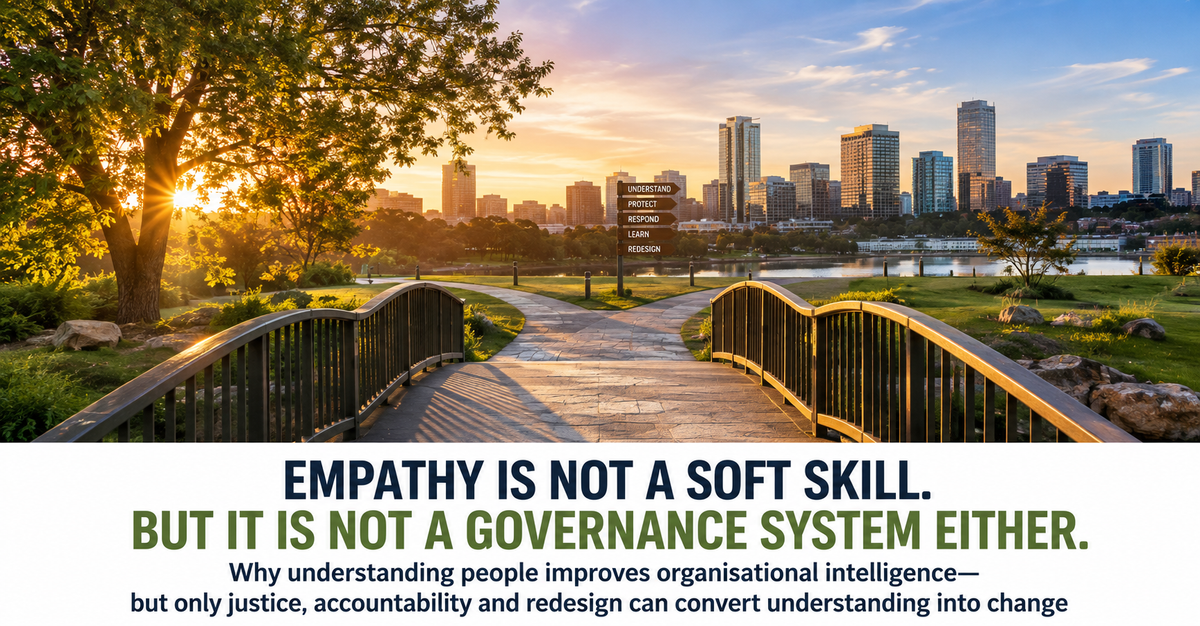
EMPATHY IS NOT A SOFT SKILL. BUT IT IS NOT A GOVERNANCE SYSTEM EITHER.: - Why understanding people improves organisational intelligence—but only justice, accountability and redesign can convert understanding into change
Empathy helps organisations understand people, but understanding alone does not create safer systems. The ISI rgues that empathy is an organisational sensing capability that must be matched by justice, accountability and system redesign to deliver meaningful, lasting change.
Dr Alwin Tan, GAICD, MBBS, FRACS, EMBA (Melbourne Business School)
Senior Surgeon | Governance Leader | HealthTech Co-founder | Founder of Institute for Systems Integrity (ISI) |Harvard Medical School — AI in Healthcare| University of Oxford — Sustainable Enterprise | Bastas Academy for Healthcare Leadership - Triple Scholar
Institute for Systems Integrity (ISI)
There is a familiar leadership story.
A high performer begins missing deadlines.
The manager could ask:
“Why isn’t this done?”
Instead, they ask:
“How can I support you?”
The employee reveals a serious family health issue.
The leader responds with flexibility.
Trust is strengthened.
The employee recovers.
The organisation retains a valued person.
It is a powerful story because it reveals something important:
Behaviour is often the visible output of an invisible reality.
The missed deadline was visible.
The family crisis was not.
The employee had the information.
The organisation did not.
Empathy helped the signal surface.
That matters.
But it is only the beginning.
Because the real governance question is not merely whether one manager asked a better question.
It is whether the organisation is capable of detecting human pressure, protecting disclosure, responding fairly, learning from the signal and changing the system when required.
Empathy can reveal reality.
It cannot govern reality on its own.
EMPATHY IS AN ORGANISATIONAL SENSING CAPABILITY
Empathy is often described as a human or interpersonal quality.
That is true.
But in organisational terms, empathy also performs an information function.
It helps leaders understand:
- what people are experiencing
- what pressures are emerging
- what context performance data may be missing
- what employees are afraid to disclose
- where formal reporting no longer reflects operational reality.
A leader who begins with accusation may receive compliance, silence or a defensible explanation.
A leader who begins with curiosity may receive the truth.
Research on workplace listening shows that high-quality listening is associated with trust, relationship quality, employee attitudes, knowledge exchange and leadership effectiveness
This makes empathy more than kindness.
Empathy is one mechanism through which hidden organisational information becomes visible.
In the language of systems integrity, it can improve signal integrity.
But there is an important distinction.
A signal may be detected and still fail to influence a decision.
An employee may disclose burnout.
A clinician may disclose unsafe workload.
A manager may disclose that targets are impossible.
A team may disclose that a process is harming people.
The organisation may listen.
It may express concern.
It may thank them for their honesty.
And then nothing may change.
Listening is not the same as learning.
Understanding is not the same as action.
Empathy is not the same as governance.
THE ORGANISATION LISTENED. NOTHING CHANGED.
Many organisations now speak fluently about empathy.
They promote wellbeing.
They celebrate vulnerability.
They train managers to listen.
They encourage employees to bring their whole selves to work.
They ask people how they feel.
Yet the structure remains unchanged.
The workload remains unsafe.
The incentives remain distorted.
The reporting pathway remains punitive.
The manager still lacks authority.
The employee still fears career consequences.
The team still absorbs the missing work.
This creates one of the most corrosive forms of organisational harm:
The organisation invites honesty without creating any capacity to respond to it.
That is not empathy.
It is information extraction.
It allows the organisation to appear caring while preserving the conditions that created the harm.
A wellbeing survey does not make an organisation well.
An open-door policy does not make it safe to speak.
A compassionate conversation does not neutralise an unsafe system.
An organisation can be emotionally articulate and structurally indifferent.
That distinction matters because performative empathy may produce deeper distrust than silence.
Being ignored by an organisation that never asked is damaging.
Being invited to disclose by an organisation that never intended to act may be worse.
AN EMPATHETIC LEADER CAN STILL PRESIDE OVER AN UNHEALTHY SYSTEM
Leadership matters.
Supportive managers can improve trust, engagement and perceived organisational support
Compassionate and relational leadership may also contribute to healthier workplace cultures and improved workforce outcomes, particularly in healthcare
But there is a limit to what individual leaders can carry.
A manager cannot solve chronic understaffing through active listening.
A team leader cannot eliminate structural discrimination through kindness.
A clinical director cannot repair unsafe workload through resilience conversations.
A supervisor cannot create psychological safety if senior executives retaliate against inconvenient truths.
Empathy can help a leader detect systemic harm.
It cannot compensate indefinitely for the system producing it.
This is where many organisations make a category error.
They identify a structural problem.
Then they prescribe an interpersonal solution.
Burnout becomes a wellbeing issue.
Silence becomes a communication issue.
Turnover becomes an engagement issue.
Moral distress becomes a resilience issue.
Underperformance becomes a motivation issue.
The system remains untouched.
The individual is coached.
The manager is trained.
The workload continues.
Job Demands–Resources theory demonstrates that employee wellbeing and engagement are shaped by the relationship between demands and the resources available to meet them
Supportive leadership is a resource.
It is not an unlimited substitute for safe staffing, autonomy, recovery, role clarity or fair work design.
A caring manager inside a harmful system may reduce the pain.
They may not be able to remove the cause.
EMPATHY WITHOUT JUSTICE CAN BECOME FAVOURITISM
Empathy is not automatically fair.
Human beings are often more empathetic toward people who are:
- familiar
- similar to them
- emotionally expressive
- visible
- personally likeable
- able to tell a compelling story.
This creates a serious governance problem.
One employee may receive flexibility because they disclosed a personal crisis eloquently.
Another may remain silent and receive none.
One leader may identify with a colleague whose experience resembles their own.
Another worker may be judged more harshly because their distress is expressed through withdrawal, irritability or reduced performance rather than visible vulnerability.
Empathy can illuminate individual circumstances.
But it can also create uneven treatment.
The person with the most compelling story is not always the person with the greatest need.
This is why empathy must be balanced by procedural fairness, consistency and equity.
A leader must consider:
- the needs of the individual
- the impact on colleagues
- the obligations of the organisation
- the interests of patients, customers or communities
- whether similar cases are treated consistently
- whether support is accessible to those least likely to ask.
Empathy helps leaders understand difference.
Justice helps them govern difference.
Empathy without justice risks becoming selective compassion.
EMPATHY WITHOUT ACCOUNTABILITY CAN BECOME AVOIDANCE
There is another uncomfortable truth.
Sometimes leaders use empathy to avoid difficult management.
They delay feedback.
They lower standards without explanation.
They redistribute work indefinitely.
They tolerate repeated failure because accountability feels unkind.
But empathy and accountability are not opposites.
A person can be experiencing genuine difficulty and still have responsibilities that must be addressed.
A team may care deeply about a colleague and still be harmed by carrying an unsustainable workload.
A clinician may need support while the organisation still has a duty to protect patients.
A leader may need to make an accommodation while also agreeing on:
- what work must still be completed
- what will be temporarily adjusted
- who will cover the gap
- how long the arrangement will last
- when the situation will be reviewed.
Empathy should improve the quality of accountability.
It should not remove accountability altogether.
A leader who asks only, “How can I support you?” may miss the second question:
“How do we support you while remaining fair to everyone else affected?”
That is not cold leadership.
It is responsible leadership.
Empathy without accountability can become indulgence.
Accountability without empathy can become institutional blindness.
Integrity requires both.
EMPATHY CAN BE USED TO MANIPULATE
Empathy is a capability.
It is not proof of moral intent.
A leader can understand another person’s emotions and use that understanding to support them.
They can also use it to manage, influence or control them.
An organisation may invite disclosure and then:
- document the employee as a risk
- use personal information against them
- placate them without acting
- encourage silence through reassurance
- frame compliance as psychological safety
- appear compassionate while protecting reputation.
The ethical test is not whether the leader sounded empathetic.
It is what happened to the information after it was disclosed.
Was the person protected?
Was confidentiality respected?
Was the concern investigated?
Was the workload changed?
Was retaliation prevented?
Did the system learn?
A leader can say all the right words and still govern badly.
Empathic language without ethical action is not leadership.
It is performance.
PSYCHOLOGICAL SAFETY IS NOT COMFORT
Empathy is often linked to psychological safety.
That link is real, but psychological safety is frequently misunderstood.
It does not mean:
- no difficult conversations
- no performance standards
- no disagreement
- no consequences
- no emotional discomfort.
Psychological safety concerns whether people believe they can take interpersonal risks—such as asking questions, admitting mistakes, challenging assumptions or raising concerns—without humiliation or retaliation
An empathetic response can make disclosure safer.
But psychological safety requires more than a warm conversation.
It requires credible evidence that the organisation will not punish truth.
People learn this not from policies, but from patterns.
They watch what happens to the last person who raised a concern.
They notice who is promoted.
They notice who is excluded.
They notice which truths are welcomed and which become career risks.
Psychological safety is not created by asking people to speak.
It is created by what the system does after they do.
FROM EMPATHY TO SYSTEMS INTEGRITY
The central failure in most empathy discussions is that they stop at the interpersonal moment.
A leader listens.
A person feels heard.
The conversation is praised.
But the organisation does not ask whether the disclosure reveals something larger.
Was this an isolated family crisis?
Or was the team already operating with no spare capacity?
Was this one employee afraid to speak?
Or has the culture trained everyone to conceal vulnerability?
Was this one missed deadline?
Or an early signal of workload failure?
Was flexibility granted fairly?
Or only because this employee had a trusted relationship with the manager?
The purpose of empathy should not be merely to make people feel better.
It should also help the organisation understand itself better.
ISI proposes the Empathy-to-Integrity Chain™:
NOTICE → UNDERSTAND → PROTECT → RESPOND → LEARN → REDESIGN
NOTICE
Detect changes in behaviour, performance or wellbeing without immediately assigning blame.
UNDERSTAND
Create enough safety and curiosity for the underlying context to become visible.
PROTECT
Safeguard dignity, confidentiality, procedural fairness and freedom from retaliation.
RESPOND
Take proportionate action that balances the individual, the team and those affected by the decision.
LEARN
Determine whether the case is isolated or evidence of a broader organisational pattern.
REDESIGN
Change workload, policy, authority, resourcing, incentives or culture where the system contributed to the harm.
Most organisations stop at UNDERSTAND.
Some reach RESPOND.
Very few reach REDESIGN.
That is the gap between interpersonal empathy and institutional integrity.
THE BOARDROOM QUESTION
Boards rarely receive a report titled:
“Our organisation is losing access to the truth because people do not feel safe enough to explain what is really happening.”
Instead, they receive:
- missed deadlines
- turnover data
- absenteeism
- grievances
- burnout metrics
- patient complaints
- safety incidents
- falling engagement.
These are often treated as separate operational problems.
But they may share a common cause.
The organisation may be failing to detect and respond to human pressure early enough.
Boards should therefore ask:
- Can people disclose difficulty without career harm?
- Do managers have authority to respond?
- Are accommodations applied fairly?
- Are patterns escalated beyond individual cases?
- Does employee experience alter workforce design?
- Are leaders rewarded for surfacing uncomfortable reality?
- What happens after people speak?
Empathy becomes a governance issue when access to reality depends upon it.
An organisation that cannot understand the lived experience of its people cannot reliably govern its risks.
THE STRONGER LEADERSHIP EQUATION
The debate should not be framed as:
Empathy or performance.
Compassion or accountability.
Humanity or success.
Those are false choices.
The real equation is:
Empathy helps leaders understand reality.
Compassion creates the motivation to respond.
Justice ensures the response is fair.
Accountability protects standards and stakeholders.
Governance converts recurring signals into system change.
Remove empathy and leaders may misunderstand the person.
Remove compassion and they may understand but fail to act.
Remove justice and their actions may become inconsistent.
Remove accountability and support may become unsustainable.
Remove governance and the same harm will recur.
THE FINAL TEST
The most empathetic organisation is not the one that uses the warmest language.
It is not the one with the best wellbeing campaign.
It is not the one that tells leaders to ask better questions.
It is the one in which honest answers are capable of changing decisions.
Empathy is not soft.
It is a critical organisational sensing capability.
But sensing without action is theatre.
Listening without protection is extraction.
Understanding without fairness is favouritism.
Compassion without accountability is incomplete.
And empathy without redesign leaves the system untouched.
The true measure of organisational empathy is not whether people feel heard.
It is whether what the organisation hears is allowed to change how the organisation works.
References
Bakker, A.B., Demerouti, E. and Sanz-Vergel, A. (2023) ‘Job Demands–Resources theory: Ten years later’, Annual Review of Organizational Psychology and Organizational Behavior, 10, pp. 25–53.
Bloom, P. (2016) Against Empathy: The Case for Rational Compassion. New York: Ecco.
Boamah, S.A., Laschinger, H.K.S., Wong, C. and Clarke, S. (2018) ‘Effect of transformational leadership on job satisfaction and patient safety outcomes’, Nursing Outlook, 66(2), pp. 180–189.
Cummings, G.G., Tate, K., Lee, S., Wong, C.A., Paananen, T., Micaroni, S.P.M. and Chatterjee, G.E. (2018) ‘Leadership styles and outcome patterns for the nursing workforce and work environment: A systematic review’, International Journal of Nursing Studies, 85, pp. 19–60.
Edmondson, A.C. and Bransby, D.P. (2023) ‘Psychological safety comes of age: Observed themes in an established literature’, Annual Review of Organizational Psychology and Organizational Behavior, 10, pp. 55–78.
Eisenberger, R., Rhoades Shanock, L. and Wen, X. (2020) ‘Perceived organizational support: Why caring about employees counts’, Annual Review of Organizational Psychology and Organizational Behavior, 7, pp. 101–124.
Joseph, D.L. and Newman, D.A. (2010) ‘Emotional intelligence: An integrative meta-analysis and cascading model’, Journal of Applied Psychology, 95(1), pp. 54–78.
Kluger, A.N. and Itzchakov, G. (2022) ‘The power of listening at work’, Annual Review of Organizational Psychology and Organizational Behavior, 9, pp. 121–146.
Morrison, E.W. (2023) ‘Employee voice and silence: Taking stock a decade later’, Annual Review of Organizational Psychology and Organizational Behavior, 10, pp. 79–107.
Östergård, K., Kuha, S. and Kanste, O. (2023) ‘Health-care leaders’ and professionals’ experiences and perceptions of compassionate leadership: A mixed-methods systematic review’, Leadership in Health Services, 36(4), pp. 594–615.
Zapf, D., Kern, M., Tschan, F., Holman, D. and Semmer, N.K. (2021) ‘Emotion work: A work psychology perspective’, Annual Review of Organizational Psychology and Organizational Behavior, 8, pp. 139–172.