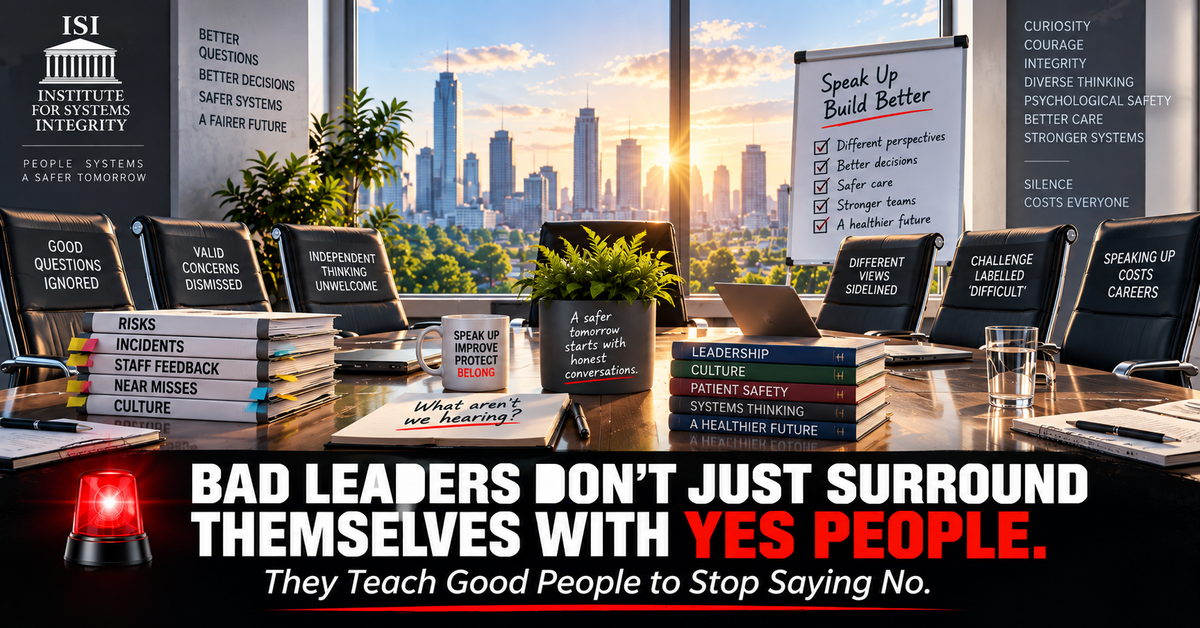
🚨 BAD LEADERS DON’T JUST SURROUND THEMSELVES WITH YES PEOPLE. They Teach Good People to Stop Saying No.
Bad leaders may not recruit yes people—they create them. ISI examines how power, silence and manufactured consensus can turn healthy challenge into compliance.
Dr Alwin Tan, GAICD, MBBS, FRACS, EMBA (Melbourne Business School)
Senior Surgeon | Governance Leader | HealthTech Co-founder | Founder of the Institute for Systems Integrity (ISI) |Harvard Medical School — AI in Healthcare | University of Oxford — Sustainable Enterprise | Bastas Academy for Healthcare Leadership – Triple Scholar
INSTITUTE FOR SYSTEMS INTEGRITY
They Teach Good People to Stop Saying No
The most dangerous word in a leadership meeting may be “yes.”
Not because agreement is bad.
But because leaders rarely know why they received it.
Did six intelligent people independently examine the evidence and reach the same conclusion?
Or did six intelligent people look around the room, calculate the consequences of disagreement, and work out what the most powerful person wanted to hear?
Those are not the same thing.
One is alignment.
The other is organisational silence wearing the clothes of consensus.
And organisations that cannot tell the difference have a governance problem.
THE “YES PERSON” IS TOO EASY TO BLAME
We have all heard the saying:
Bad leaders surround themselves with yes people.
There is truth in it.
But it places too much responsibility on the people saying yes—and not enough on the system that taught them what happens when they say no.
Organisational silence has long been recognised as a collective phenomenon in which important information about problems can be withheld from those with the authority to act (Morrison and Milliken, 2000).
Employees also develop implicit assumptions about when challenging authority is unsafe, inappropriate or career-limiting (Detert and Edmondson, 2011).
Which raises a harder possibility:
BAD LEADERS MAY NOT RECRUIT YES PEOPLE.
THEY MAY CREATE THEM.
The executive who once challenged becomes more careful.
The clinician who once questioned starts choosing their battles.
The manager who once brought bad news learns to bring solutions instead.
The board paper becomes cleaner.
The risk becomes smaller.
The language becomes softer.
The uncomfortable slide disappears.
Nobody has formally prohibited dissent.
Nobody needs to.
The organisation has learned.
THE COST OF SAYING NO
People are remarkably good at reading consequences.
Who gets promoted?
Who remains in the inner circle?
Who gets invited into the important meetings?
Whose disagreement is described as “constructive”?
And whose becomes:
“negative.”
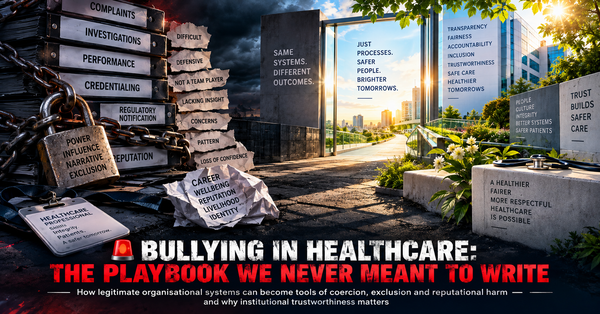
“difficult.”
“not aligned.”
“not commercial.”
“not collegial.”
“not a team player.”
Eventually employees stop asking:
“What does the evidence say?”
They start asking:
“What happens to me if I say this?”
That changes the entire information system.
And once the perceived personal cost of challenging authority exceeds the perceived cost of remaining silent, silence can become an understandable response rather than a character flaw.
Research on implicit voice theories shows how employees develop assumptions about the risks of speaking up—even when what they want to say could benefit the organisation (Detert and Edmondson, 2011).
So perhaps the real leadership test is not:
“Do I allow people to disagree with me?”
Almost every leader will say yes.
Ask instead:
WHAT HAPPENS TO PEOPLE WHO DO?
THE POWER PARADOX
Leadership creates another problem.
The more senior you become, the greater the consequences of your decisions.
But seniority also increases the possibility that information reaching you has already been interpreted, filtered or softened.
Front line.
↓
Manager.
↓
Executive.
↓
CEO.
↓
Board.
At every level, information can lose friction.
Uncertainty becomes confidence.
Concern becomes “an issue being managed.”
Repeated failures become “isolated incidents.”
Dissent becomes “stakeholder resistance.”
And bad news acquires a PowerPoint deck.
BY THE TIME THE TRUTH REACHES THE TOP, IT MAY NO LONGER LOOK LIKE THE TRUTH AT THE BOTTOM.
That is not simply a communication problem.
It is an information-governance problem.
MANUFACTURED CONSENSUS
Consensus looks reassuring.
Ten people around a table.
Ten nodding heads.
Decision approved.
Next agenda item.
But what exactly has the organisation established?
Perhaps ten people independently agree.
Perhaps eight disagree but believe the decision has already been made.
Perhaps three tried raising concerns previously.
Perhaps two know something the others don't.
Perhaps everyone knows what the CEO thinks.
The minutes may record:
“The Executive unanimously supported the proposal.”
But unanimity tells us almost nothing about the process that produced it.
CONSENSUS IS NOT EVIDENCE OF GOOD GOVERNANCE IF DISSENT WAS EXPENSIVE.
That is the danger of manufactured consensus.
The appearance of alignment can conceal the absence of genuine challenge.
THE MOST POWERFUL PERSON CHANGES THE ROOM
A leader walks into a meeting and says:
“I want everyone's honest opinion.”
Good start.
Then:
“Personally, I think Option A is clearly the way forward—but I'm interested in everyone's views.”
The meeting is no longer the same meeting.
Every subsequent contribution now occurs in the shadow of authority.
This matters because hierarchy is not suspended simply because the leader says:
“Please challenge me.”
People know who determines resources.
Opportunities.
Appointments.
Access.
Performance assessments.
Reputation.
Sometimes careers.
A leader's invitation to challenge therefore competes with the organisation's accumulated evidence about what challenging leadership actually costs.
Which leads to a simple leadership discipline:
THE MORE POWERFUL YOUR VOICE, THE LATER IT SHOULD ENTER THE ROOM.
Ask first.
Listen first.
Let people commit to their analysis before revealing yours.
Otherwise leaders risk asking for independent judgement after contaminating the independence of the judgement.
HEALTHCARE CANNOT AFFORD POLITE SILENCE
Now put this inside healthcare.
Consultant and registrar.
Doctor and nurse.
Executive and clinician.
Credentialing committee and practitioner.
Hospital CEO and employee.
Board and executive.
Regulator and regulated professional.
These are not relationships between people with equal institutional power.
Healthcare combines hierarchy, professional status and decisions capable of producing irreversible consequences.
Nembhard and Edmondson's study across 23 neonatal intensive-care units found leader inclusiveness predicted psychological safety and helped address the inhibiting effects associated with professional status differences (Nembhard and Edmondson, 2006).
A major systematic review covering 76 studies and more than 122,000 healthcare participants subsequently found a complex relationship between voice and silence and warned that speaking-up initiatives can achieve disappointing outcomes where organisational and professional cultures remain unsupportive (Lainidi et al., 2023).
That should make healthcare leaders uncomfortable.
Because hospitals can have:
Speak Up policies.
Incident-reporting systems.
Whistleblower procedures.
Open-door policies.
Culture surveys.
Psychological-safety training.
Anonymous reporting.
And still teach people that speaking is dangerous.
A SPEAK-UP POLICY DOES NOT CREATE A SPEAK-UP CULTURE.
People believe consequences more than posters.
THE LEADER MAY NEVER KNOW
Here lies perhaps the most dangerous part.
Eventually the leader may genuinely believe people agree with them.
Nobody objects anymore.
Meetings run smoothly.
Papers are approved.
Executives appear aligned.
Staff appear compliant.
Board meetings become reassuring.
And the leader concludes:
“My team trusts my judgement.”
Maybe.
But there is another possibility:
THEY HAVE STOPPED TELLING YOU WHEN YOUR JUDGEMENT IS WRONG.
That is how power can become informationally dangerous.
Not necessarily because powerful leaders become malicious.
But because the information environment around power can become progressively less reliable.
And the tragedy is that the leader may be the last person to realise it.
BUT LET'S NOT ROMANTICISE DISSENT
There is an equally lazy leadership slogan:
“Great leaders surround themselves with people who disagree with them.”
Not necessarily.
An organisation where everyone challenges everything is not psychologically safe.
It may simply be dysfunctional.
Constant opposition can produce paralysis.
Decision fatigue.
Political behaviour.
Personal conflict.
Endless reconsideration.
And blurred accountability.
Leadership requires decisions.
Teams eventually need to move.
So the objective is not maximum dissent.
It is:
MAXIMUM RELEVANT INFORMATION BEFORE COMMITMENT.
Followed by:
MAXIMUM CLARITY AFTER THE DECISION.
Healthy leadership is therefore neither:
YES, YES, YES.
Nor:
NO, NO, NO.
It is the ability to challenge hard before a decision and execute coherently after one.
THE ISI CHALLENGE–DECIDE–COMMIT MODEL
A mature decision system should deliberately separate five stages.
1. CHALLENGE
What might we be getting wrong?
Invite contrary evidence before positions harden.
2. TEST
What evidence would change our minds?
If the answer is “nothing”, this is no longer evidence-based decision-making.
3. DECIDE
Who actually owns the decision?
Psychological safety does not mean decision rights disappear.
4. COMMIT
What are we now going to do?
Challenge cannot become permanent organisational paralysis.
5. MONITOR
What would cause us to reopen the decision?
Good governance does not confuse commitment with stubbornness.
New evidence matters.
THE BOARD SHOULD WORRY ABOUT AGREEMENT TOO
Boards routinely interrogate disagreement.
Perhaps they should interrogate unanimity just as aggressively.
When every executive agrees:
Who argued the opposite case?
When a risk is rated low:
Who challenged the rating?
When management says staff support the strategy:
How do we know?
When a major investment is unanimously recommended:
What evidence would have stopped it?
When an assurance paper contains no significant concerns:
How many layers of management handled that information before it reached us?
And when nobody disagrees with the CEO:
IS THAT ALIGNMENT—OR INFORMATION?
Boards should not merely ask whether challenge is permitted.
They should examine whether their governance architecture produces meaningful challenge before consequential decisions are made.
TRY THIS AT YOUR NEXT EXECUTIVE MEETING
Don't ask:
“Does anyone disagree?”
The silence tells you almost nothing.
Instead ask each person for their view before giving yours.
Nominate someone to construct the strongest credible argument against the preferred option.
Ask:
“What would have to be true for this decision to be catastrophically wrong?”
Then:
“What information are we least comfortable showing the board?”
And finally:
“WHAT DOES EVERYONE IN THIS ORGANISATION KNOW THAT WE ARE NOT TALKING ABOUT IN THIS ROOM?”
Then stop talking.
The silence that follows may be more informative than another dashboard.
THE REAL TEST OF LEADERSHIP
Leadership is not demonstrated by how many people agree with you.
Nor by how confidently you dominate the room.
Nor by how quickly dissent disappears.
A powerful leader can make disagreement disappear very quickly.
That proves nothing.
The harder achievement is building an environment where intelligent people can tell you:
You may be wrong.
Where bad news travels upward without requiring courage bordering on self-harm.
Where disagreement is examined rather than personalised.
Where dissenters are neither automatically celebrated nor automatically punished.
Where decisions can be challenged fiercely and then implemented coherently.
And where leaders remain exposed to information capable of changing their minds.
Because eventually every powerful leader faces the same danger.
Not that people will oppose them.
But that people will stop.
BAD LEADERS DON'T JUST SURROUND THEMSELVES WITH YES PEOPLE.
THEY BUILD SYSTEMS IN WHICH SAYING “YES” BECOMES SAFER THAN TELLING THE TRUTH.
And by the time everyone around the table agrees—
the organisation may already have stopped thinking.
References
Detert, J.R. and Edmondson, A.C. (2011) ‘Implicit voice theories: Taken-for-granted rules of self-censorship at work’, Academy of Management Journal, 54(3), pp. 461–488. doi:10.5465/amj.2011.61967925.
Lainidi, O., Jendeby, M.K., Montgomery, A., Mouratidis, C., Paitaridou, K., Cook, C., Johnson, J. and Karakasidou, E. (2023) ‘An integrative systematic review of employee silence and voice in healthcare: what are we really measuring?’, Frontiers in Psychiatry, 14, 1111579. doi:10.3389/fpsyt.2023.1111579.
Morrison, E.W. and Milliken, F.J. (2000) ‘Organizational silence: A barrier to change and development in a pluralistic world’, Academy of Management Review, 25(4), pp. 706–725. doi:10.5465/amr.2000.3707697.
Nembhard, I.M. and Edmondson, A.C. (2006) ‘Making it safe: The effects of leader inclusiveness and professional status on psychological safety and improvement efforts in health care teams’, Journal of Organizational Behavior, 27(7), pp. 941–966. doi:10.1002/job.413.
See, K.E., Morrison, E.W., Rothman, N.B. and Soll, J.B. (2011) ‘The detrimental effects of power on confidence, advice taking, and accuracy’, Organizational Behavior and Human Decision Processes, 116(2), pp. 272–285. doi:10.1016/j.obhdp.2011.07.006.
Tost, L.P., Gino, F. and Larrick, R.P. (2012) ‘Power, competitiveness, and advice taking: Why the powerful don’t listen’, Organizational Behavior and Human Decision Processes, 117(1), pp. 53–65. doi:10.1016/j.obhdp.2011.10.001.