🚨 YOUR JOB WAS SAFE FOR NINE YEARS. THEN, JUST BEFORE LONG SERVICE LEAVE, EVERYTHING CHANGED.
Can policy changes and restructuring become workplace bullying? ISI examines long service leave, executive power, employee rights and board accountability.
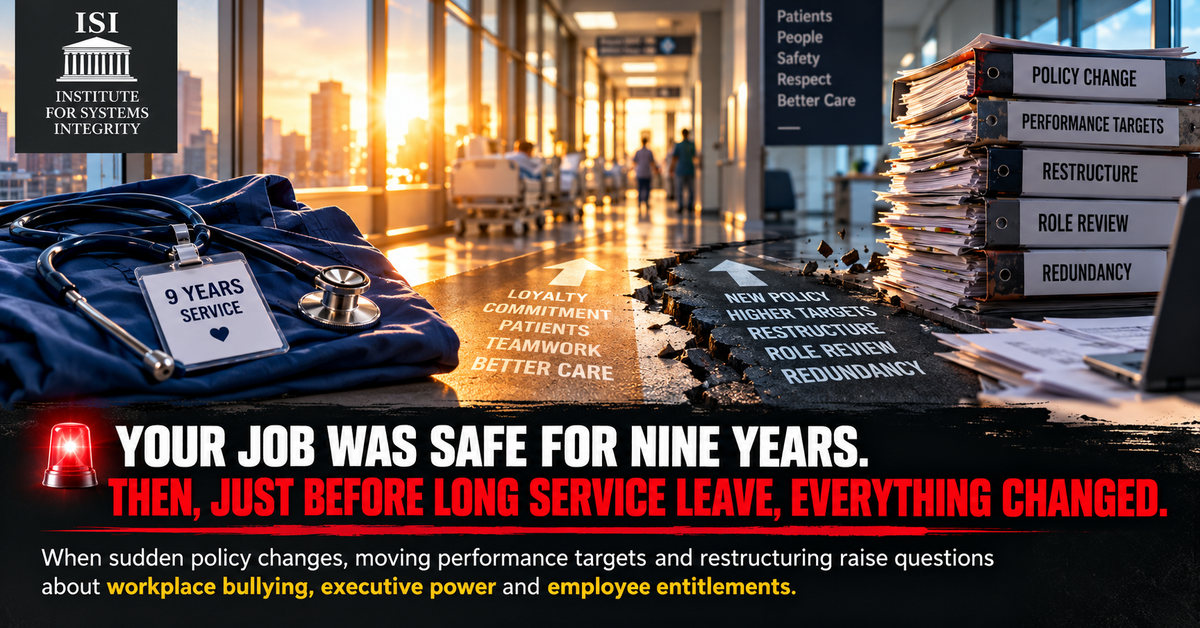
When sudden policy changes, moving performance targets and restructuring raise questions about workplace bullying, executive power and employee entitlements.
INSTITUTE FOR SYSTEMS INTEGRITY (ISI)
Dr Alwin Tan, GAICD, MBBS, FRACS, EMBA (Melbourne Business School)
Senior Surgeon | Governance Leader | HealthTech Co-founder | Founder of the Institute for Systems Integrity (ISI) |Harvard Medical School — AI in Healthcare | University of Oxford — Sustainable Enterprise | Bastas Academy for Healthcare Leadership – Triple Scholar
Workplace Bullying, Power and Organisational Accountability Series | Paper 4 | October 2026
NINE YEARS OF LOYALTY.
THEN THE RULES CHANGED.
Imagine a nurse who has worked at the same hospital for nine years.
Nine years of caring for patients.
Nine years of weekends, night shifts and public holidays.
Nine years of staying late when the ward was short-staffed.
Nine years of supporting colleagues, training new nurses and helping the hospital through difficult periods.
For years, the organisation described this employee as dependable.
Experienced.
Committed.
Valuable.
Then something changes.
A new executive arrives.
A policy that previously allowed flexibility is withdrawn.
Performance expectations change.
A request to move from permanent employment to casual work is refused.
A restructure is announced.
The employee's position is reviewed.
Perhaps it is declared redundant.
And all of this happens as the employee approaches an important service milestone.
Management explains that these are operational decisions.
Business requirements.
Workforce planning.
Financial sustainability.
Perhaps they are.
🚨 BUT WHAT IF THE TIMING IS NOT THE ONLY THING THAT DESERVES SCRUTINY?
What if the employee has performed the same duties successfully for years?
What if the new policy appeared only after the employee requested a change in employment arrangements?
What if similar employees were treated differently?
What if the position disappeared, but much of the work continued?
And what if the organisation claimed financial savings without examining what the employee lost?
🔥 WAS THIS A GENUINE BUSINESS DECISION — OR WAS A BUSINESS DECISION USED TO REMOVE THE EMPLOYEE?
This is a question that should concern every hospital board.
Not because every restructure is unlawful.
Not because every policy change is bullying.
And not because long service guarantees permanent employment.
But because legitimate management powers can be misused.
And when they are, the paperwork may look entirely ordinary.
1. BULLYING DOES NOT ALWAYS LOOK LIKE BULLYING
When we think about workplace bullying, we often imagine shouting.
Humiliation.
Threats.
Public criticism.
An aggressive manager.
A frightened employee.
But workplace harm can also emerge through a series of apparently routine management decisions.
A roster changes.
A performance target increases.
A flexible arrangement disappears.
A previously satisfactory employee receives an unexpectedly negative review.
A position is reclassified.
An employee is told their role is no longer required.
Each decision may have a legitimate explanation.
Yet their combined effect can be devastating.
🚨 WHAT IF THE MOST EFFECTIVE WAY TO PUSH SOMEONE OUT IS NEVER TO TELL THEM TO LEAVE?
Instead, make remaining increasingly difficult.
Change the conditions.
Remove the flexibility.
Question their performance.
Make resignation appear more attractive than staying.
Eventually, the employee leaves.
Management records a voluntary departure.
The board sees reduced workforce costs.
And the organisation may call it successful workforce management.
This is not simply an imagined organisational mechanism.
Quinn, Waheduzzaman and Djurkovic (2026), in qualitative research involving 21 senior Victorian public-sector managers, identified accounts of workplace bullying being used as a covert workforce downsizing strategy.
Their research connected bullying with organisational culture, management practices and accountability failures.
Importantly, the study does not establish that private hospitals routinely use these tactics, or that employees approaching long service leave are systematically targeted.
But it challenges an important assumption.
🔥 BULLYING IS NOT ALWAYS SOMETHING MANAGEMENT FAILS TO PREVENT.
IN SOME DOCUMENTED SETTINGS, IT HAS BEEN DESCRIBED AS A TOOL USED TO ACHIEVE MANAGEMENT OBJECTIVES.
That possibility deserves serious governance attention.
The question is not whether every difficult management decision constitutes bullying.
It is whether boards can recognise when apparently ordinary decisions form part of a repeated and unreasonable pattern.
2. WHEN EXECUTIVE AUTHORITY CHANGES THE RULES
Every organisation needs policies.
Hospitals must manage staffing, patient demand, financial pressures and changing clinical services.
Executives must be able to introduce new requirements, adjust performance standards and restructure departments.
These are legitimate management responsibilities.
But authority is not unlimited.
A policy should have a legitimate purpose.
Its introduction should be appropriately documented.
Affected employees should receive consultation where required.
Its application should be consistent and defensible.
And its consequences should be understood.
🚨 A POLICY DOES NOT BECOME FAIR SIMPLY BECAUSE AN EXECUTIVE APPROVED IT.
Consider a long-serving nurse who requests a change from permanent part-time to casual employment.
For years, similar arrangements may have been permitted.
But when this employee makes the request, management announces that such arrangements are no longer available.
The decision might reflect genuine staffing requirements.
A hospital may reasonably need certainty around workforce availability, continuity and rostering.
However, the timing and application of the policy may also warrant examination.
Was the policy under consideration before the request?
Was the change documented?
Were employees consulted where appropriate?
Was it applied consistently?
Were exceptions permitted?
Who approved them?
And was the employee given a meaningful explanation?
🔥 WHEN THE RULES CHANGE IMMEDIATELY AFTER SOMEONE EXERCISES A WORKPLACE RIGHT, THE BOARD SHOULD NOT SIMPLY ASK WHETHER MANAGEMENT HAD THE AUTHORITY TO CHANGE THEM.
IT SHOULD ASK WHY THE CHANGE OCCURRED, HOW IT WAS APPLIED AND WHETHER THE DECISION CAN WITHSTAND INDEPENDENT SCRUTINY.
This distinction matters legally.
Under the Fair Work Act 2009 (Cth), adverse action taken for a prohibited reason, including because an employee exercises certain workplace rights, may breach the general protections provisions (Part 3-1).
But timing alone does not prove unlawful adverse action.
The circumstances, decision-making evidence and applicable legal tests matter.
There is also an important distinction between legal compliance and good governance.
A DECISION MAY BE LAWFUL WITHOUT BEING WELL GOVERNED.
An organisation may satisfy a minimum legal obligation yet still damage employee trust through poor communication, inconsistent treatment or unnecessary harm.
Colquitt et al. (2001), in their meta-analysis of organisational justice research, demonstrated the importance of distributive, procedural, interpersonal and informational justice to workplace outcomes.
Employees do not assess decisions solely by whether they receive the outcome they wanted.
They also consider whether the process was consistent, transparent, respectful and supported by credible information.
🔥 EMPLOYEES MAY ACCEPT A DIFFICULT DECISION.
WHAT DESTROYS TRUST IS THE BELIEF THAT THE RULES WERE CHANGED TO PRODUCE A PREDETERMINED OUTCOME.
3. THE MOVING TARGET: WHEN PERFORMANCE MANAGEMENT BECOMES A QUESTION OF FAIRNESS
Performance management is necessary.
Hospitals must maintain clinical standards.
Employees must be accountable.
Underperformance must be addressed.
But what happens when performance expectations change repeatedly?
An employee meets one target.
Management introduces another.
The employee meets the new requirement.
The benchmark moves again.
Responsibilities increase without adequate resources.
Past achievements are discounted.
A previously satisfactory employee is suddenly described as unsuitable.
🚨 IF THE FINISHING LINE KEEPS MOVING,
IS THE ORGANISATION IMPROVING PERFORMANCE — OR MAKING SUCCESS IMPOSSIBLE?
Australian workplace law recognises an important distinction.
Under section 789FD of the Fair Work Act 2009, workplace bullying involves repeated unreasonable behaviour directed towards a worker or group of workers that creates a risk to health and safety.
Reasonable management action carried out in a reasonable manner is excluded from that definition.
Employers may legitimately establish performance standards, provide feedback and take disciplinary action.
However, repeated unreasonable management conduct that creates a health and safety risk may constitute workplace bullying (Fair Work Commission, n.d.).
Not every unreasonable decision meets the statutory definition.
And not every allegation establishes wrongdoing.
Nevertheless, the existence of a performance management process does not automatically establish that the process was reasonable.
Boards should be particularly concerned when:
Performance expectations change without a clear operational justification.
Employees are assessed against standards that were not communicated in advance.
Comparable employees are assessed differently without a defensible reason.
Performance concerns arise immediately after an employee makes a complaint or exercises a workplace right.
The employee is denied reasonable opportunities to respond or improve.
These circumstances are indicators for examination, not proof of misconduct.
🔥 PERFORMANCE MANAGEMENT SHOULD BE DESIGNED TO IMPROVE PERFORMANCE — NOT TO MANUFACTURE FAILURE.
And a board should be able to distinguish between the two.
4. SEVEN YEARS OR TEN YEARS? THE LONG SERVICE LEAVE QUESTION
This issue becomes particularly important in Australian healthcare.
Under Victoria's Long Service Leave Act 2018, employees covered by the Act generally become entitled to take accrued long service leave after seven years of continuous employment.
If their employment ends after seven years, accrued but unused long service leave is generally payable.
However, not every Victorian employee necessarily derives their entitlement from that Act.
Some employees may be covered by other applicable legislation, preserved pre-modern award provisions, enterprise agreements or other legally operative industrial arrangements.
These arrangements can be complex.
Some healthcare employees may encounter industrial instruments referring to ten years of service.
🚨 BUT DOES AN ENTERPRISE AGREEMENT THAT SAYS TEN YEARS AUTOMATICALLY OVERRIDE VICTORIA'S SEVEN-YEAR ENTITLEMENT?
NO. NOT AUTOMATICALLY.
The answer depends on the legal source of the employee's entitlement, the relevant instrument's terms and history, and the interaction between state and federal workplace law.
The Victorian Government's comprehensive guide explains that more favourable enterprise agreement provisions may apply, while less favourable provisions may be ineffective where the Victorian Act establishes the applicable minimum.
The Fair Work Ombudsman also recognises that preserved pre-modern award entitlements and certain transitional arrangements may affect which rules apply.
Consequently, a ten-year clause cannot simply be assumed to override the Victorian statutory minimum.
Equally, the existence of a ten-year provision does not, by itself, establish unlawfulness.
The correct legal entitlement must be determined.
This creates a serious governance responsibility.
Hospitals should know which long service leave provisions apply to each workforce group.
They should understand when leave becomes available.
They should know what accrues and what becomes payable on termination.
And they should ensure that employees receive accurate information.
🔥 AN EMPLOYEE'S ENTITLEMENT SHOULD BE DETERMINED BY THE LAW THAT APPLIES — NOT BY THE RULE THAT IS MOST CONVENIENT FOR THE EMPLOYER.
This is not merely an HR technicality.
It is a test of organisational integrity.
If a hospital cannot explain which long service leave rules apply to its own employees, how can its board be confident that employment liabilities and workforce decisions are being managed correctly?
5. WHO REALLY BENEFITS WHEN A LONG-SERVING EMPLOYEE LEAVES?
Imagine an employee approaching ten years of service.
They have accumulated experience, relationships and institutional knowledge.
Their salary may have increased through ordinary progression.
Their employment benefits may include accrued leave and other contractual entitlements.
A restructure removes their position.
The board receives a report showing projected payroll savings.
But what exactly has been saved?
Has the organisation reduced future salary expenditure?
Has it incurred redundancy costs?
Must accrued long service leave be paid?
Will replacement workers cost more?
Will agency staffing increase?
Will experienced staff need to train replacements?
Will continuity of patient care suffer?
🚨 A REDUCTION IN PAYROLL IS NOT NECESSARILY A REDUCTION IN ORGANISATIONAL COST.
There is also a critical legal and accounting distinction.
Where Victoria's Long Service Leave Act 2018 applies, dismissing an employee after nine years generally does not extinguish their accrued long service leave entitlement.
Unused leave is ordinarily payable on termination.
Therefore, it would be misleading to suggest that making a nine-year employee redundant automatically allows the hospital to retain the value of accrued long service leave.
It generally does not.
Under another lawfully applicable industrial arrangement, the position may differ and must be examined individually.
THE FINANCIAL INCENTIVE MUST BE PROVEN — NOT ASSUMED.
But that does not eliminate the governance concern.
An organisation may still have incentives to reduce future salary expenditure, change staffing arrangements, avoid particular unvested benefits or encourage departures without formal redundancy.
Those incentives should be transparent.
They should never justify unlawful adverse action or deliberate misuse of management processes.
🔥 WHEN AN EMPLOYEE LEAVES JUST BEFORE AN IMPORTANT SERVICE MILESTONE, THE BOARD SHOULD ASK TWO QUESTIONS.
WHAT DID THE EMPLOYEE ACTUALLY LOSE?
AND WHAT DID THE ORGANISATION ACTUALLY GAIN?
The answers may demonstrate a legitimate and necessary decision.
Or they may identify circumstances requiring independent investigation.
When restructuring becomes the explanation
Hospitals face genuine pressures.
Rising costs.
Workforce shortages.
Changing patient demand.
New technology.
Service redesign.
Financial sustainability.
Restructuring is sometimes necessary.
And long service does not guarantee permanent employment.
But a restructure should not become an unquestionable explanation for every employment decision.
Consider a position declared redundant.
The employee leaves.
Three months later, similar duties are performed by another person.
Perhaps the role has genuinely changed.
Perhaps responsibilities have been redistributed.
Perhaps the organisation has legitimately redesigned the service.
Or perhaps the decision warrants closer scrutiny.
🚨 IF THE POSITION WAS REDUNDANT, WHY DOES THE WORK STILL NEED TO BE DONE?
The continued performance of some duties does not, by itself, establish an unlawful redundancy.
Australian unfair dismissal law recognises genuine redundancy where the employer no longer requires the employee's job to be performed by anyone because of operational changes, subject to applicable consultation and redeployment requirements.
Section 389 of the Fair Work Act 2009 sets out the genuine redundancy test.
Separately, a dismissal may raise general protections concerns if it occurred for a prohibited reason.
These are distinct legal questions.
The board's responsibility is not to presume wrongdoing.
It is to ensure that management can substantiate its decisions.
6. THE EMPLOYEE WHO STOPS SPEAKING UP
Perhaps the most damaging consequence is not the employee who leaves.
It is the message received by everyone who remains.
A nurse watches a colleague request a change in working arrangements.
Then sees that colleague's flexibility withdrawn.
Another employee questions a new policy.
Their performance suddenly comes under closer scrutiny.
A third employee challenges a restructure.
Their position disappears.
Perhaps every decision is legitimate.
But if management cannot explain those decisions convincingly, other employees may draw their own conclusions.
They stop asking questions.
They stop challenging policy.
They stop requesting flexibility.
They stop raising concerns.
🚨 THE ORGANISATION MAY NOT HAVE REDUCED DISCONTENT.
IT MAY HAVE TAUGHT EMPLOYEES THAT SPEAKING UP IS DANGEROUS.
In healthcare, that matters beyond employment relations.
Experienced nurses carry institutional knowledge.
They recognise deterioration.
They identify unsafe processes.
They notice when something has changed.
When experienced staff leave under circumstances perceived as unfair, the organisation may lose more than labour.
It may lose trust, continuity and willingness to challenge unsafe practice.
🔥 THE COST OF A POORLY MANAGED RESTRUCTURE MAY NOT APPEAR ON THE PAYROLL REPORT.
IT MAY APPEAR LATER IN STAFF TURNOVER, SILENCE, LOST EXPERIENCE AND PATIENT SAFETY RISK.
These consequences should be assessed rather than presumed.
The psychological safety obligation
Safe Work Australia identifies poor organisational change management and poor organisational justice as psychosocial hazards.
Examples include inadequate consultation, unclear communication, inconsistent treatment and insufficient support during organisational change.
In Victoria, the Occupational Health and Safety (Psychological Health) Regulations 2025, which commenced on 1 December 2025, strengthen the regulatory framework for managing psychosocial risks.
Employers must identify psychosocial hazards, eliminate associated risks so far as reasonably practicable or otherwise reduce them so far as reasonably practicable, and review risk controls in prescribed circumstances.
These obligations matter when organisations restructure, change employment arrangements or introduce new management practices.
The issue is not confined to whether an individual manager breached an anti-bullying policy.
WORKPLACE SAFETY IS ALSO ABOUT HOW ORGANISATIONS DESIGN WORK, EXERCISE POWER AND MANAGE CHANGE.
The available research does not establish a national pattern of private hospitals deliberately removing employees to avoid long service leave.
Such a conclusion would require appropriate workforce, payroll and decision-making evidence.
But the absence of proof of a widespread practice is not a reason to ignore identifiable governance risks.
7. THE ARGUMENT EXECUTIVES DESERVE TO MAKE
A credible governance discussion must consider the other side.
Executives are responsible for keeping hospitals financially and operationally sustainable.
They cannot guarantee every employee the same position indefinitely.
They must sometimes introduce unpopular policies.
They must manage underperformance.
They must restructure services.
They must balance individual preferences against patient demand and workforce availability.
An employee's proximity to long service leave does not make every subsequent management decision suspicious.
And long service does not create immunity from legitimate performance management.
THE RIGHT TO FAIR TREATMENT IS NOT THE RIGHT TO A PERMANENTLY UNCHANGING JOB.
But responsible executives should welcome scrutiny of difficult decisions.
A genuine restructure should have a defensible rationale.
A fair policy should be consistently applied.
A performance decision should be supported by evidence.
An entitlement calculation should be legally correct.
And an investigation should be sufficiently independent to command confidence.
There are three separate questions worth asking.
WAS THE DECISION LAWFUL?
WAS THE DECISION FAIRLY MADE?
WHAT CONSEQUENCES DID THE DECISION CREATE?
These questions overlap, but they are not interchangeable.
A decision can meet minimum legal requirements yet still undermine trust through poor consultation or unnecessarily harmful implementation.
Equally, an unpopular decision may be lawful, fair and necessary.
🔥 GOOD MANAGEMENT SHOULD BE ABLE TO EXPLAIN ITS DECISIONS.
GOOD GOVERNANCE SHOULD BE ABLE TO VERIFY THEM.
That protects responsible executives as much as it protects employees.
8. THE ISI ENTITLEMENT-LINKED WORKFORCE DECISION REVIEW™
The Institute for Systems Integrity proposes the Entitlement-Linked Workforce Decision Review™ as a conceptual governance framework for examining significant workforce decisions involving long-serving employees.
Its purpose is to identify decisions that warrant closer scrutiny and to strengthen organisational accountability.
It is not a validated research instrument or a substitute for legal assessment.
1. TIMING INTEGRITY
When was the decision first proposed?
Did it follow a request for leave, a complaint, an exercise of workplace rights or an approaching service milestone?
Was the rationale documented before those events?
2. POLICY CONSISTENCY
Was the new policy applied consistently?
Were comparable employees treated differently?
Who approved exceptions?
Were the reasons documented?
3. PERFORMANCE FAIRNESS
Were targets reasonable and achievable?
Were employees given adequate support?
Did performance expectations change without explanation?
Were comparable employees assessed against equivalent standards?
4. ENTITLEMENT ACCURACY
Which legislation or industrial instrument applies?
What long service leave has accrued?
What becomes payable on termination?
Are employees receiving accurate information about their rights?
5. FINANCIAL TRANSPARENCY
What costs are genuinely saved?
What accrued liabilities remain payable?
What redundancy, recruitment and replacement costs arise?
Are claimed savings supported by a complete financial analysis?
6. INDEPENDENT OVERSIGHT
Who reviewed the decision?
Were conflicts of interest identified?
Did the affected employee have access to appropriate consultation and review?
Could the board examine the matter without relying exclusively on the executive responsible for the decision?
7. POST-DECISION CONSEQUENCE REVIEW
What happened after the decision?
Did employee retention improve or deteriorate?
Did workforce trust change?
Were complaints reduced because problems were resolved, or because employees became reluctant to report them?
Did the restructure increase dependence on agency staff?
Were psychosocial risks assessed and controlled?
Did clinical continuity, patient-safety reporting or escalation patterns change?
These questions should be examined through appropriate evidence, not assumptions.
🔥 THE PURPOSE OF THIS FRAMEWORK IS NOT TO PREVENT ORGANISATIONAL CHANGE.
IT IS TO ENSURE THAT ORGANISATIONAL CHANGE CANNOT BECOME A CONVENIENT HIDING PLACE FOR UNFAIRNESS.
The framework also shifts the focus beyond whether a decision was procedurally documented.
It asks whether the organisation can demonstrate that the decision was justified, consistently implemented and appropriately reviewed.
9. THE ORGANISATION'S TRUE TEST OF INTEGRITY
The easiest employee to praise is the one who never challenges management.
The easiest policy to defend is the one nobody questions.
The easiest restructure to celebrate is the one that produces immediate savings.
But organisational integrity is tested when interests conflict.
When a long-serving nurse asks for flexibility.
When an employee questions a new target.
When someone challenges the fairness of a policy.
When a restructure affects people approaching important employment milestones.
When management's preferred outcome is not necessarily the fairest outcome.
🔥 THE QUESTION IS NOT WHETHER AN EXECUTIVE CAN CHANGE THE RULES.
THE QUESTION IS WHETHER THE ORGANISATION CAN DEMONSTRATE THAT THE RULES WERE CHANGED FOR A LEGITIMATE REASON — AND APPLIED FAIRLY.
Healthcare organisations depend on the commitment of their people.
They ask nurses to work nights.
They ask clinicians to cover shortages.
They ask employees to remain flexible when the system is under pressure.
They celebrate loyalty.
They recognise years of service.
They describe their workforce as their greatest asset.
But those statements mean little if employees believe the rules can change when their entitlements become inconvenient.
LOYALTY CANNOT BE A ONE-WAY OBLIGATION.
And governance cannot stop at checking whether a policy exists.
It must examine what the policy does.
Who it affects.
Who benefits.
And whether the organisation has treated its people fairly.
THE FINAL BOARD QUESTION
Imagine a nurse who has given nine years to a hospital.
They have worked through difficult shifts.
Supported patients and families.
Trained colleagues.
Helped the organisation when it needed them most.
Then, as they approach an important employment milestone, their working arrangements change.
Management says the decision was necessary.
Perhaps it was.
But has anyone independently examined the evidence?
Has anyone checked the applicable legal entitlements?
Has anyone considered the cumulative effect of the decisions?
Or did the board simply accept that the process was followed?
🚨 A PROCESS CAN BE DOCUMENTED WITHOUT BEING FAIR.
A POLICY CAN BE CONSISTENTLY WRITTEN BUT SELECTIVELY APPLIED.
AND A RESTRUCTURE CAN PRODUCE SAVINGS WHILE CAUSING HARM THAT NEVER APPEARS IN THE FINANCIAL REPORT.
Organisations have every right to change.
They have every right to restructure.
They have every right to demand performance.
But they do not have the right to disguise unlawful or unfair treatment as operational necessity.
🔥 THE REAL TEST OF GOVERNANCE IS NOT WHETHER MANAGEMENT CAN EXPLAIN A DECISION.
IT IS WHETHER INDEPENDENT SCRUTINY CAN VERIFY THAT EXPLANATION.
And when the rules suddenly change for a long-serving employee approaching an important entitlement, every board should ask:
🚨 DID WE MAKE A NECESSARY BUSINESS DECISION — OR DID WE USE OUR POWER TO MAKE AN EMPLOYEE DISAPPEAR?
THAT IS THE DIFFERENCE BETWEEN COST REDUCTION AND ORGANISATIONAL INTEGRITY.
REFERENCES
Colquitt, J.A., Conlon, D.E., Wesson, M.J., Porter, C.O.L.H. and Ng, K.Y. (2001) ‘Justice at the millennium: A meta-analytic review of 25 years of organizational justice research’, Journal of Applied Psychology, 86(3), pp. 425–445. Available at: https://doi.org/10.1037/0021-9010.86.3.425.
Fair Work Act 2009 (Cth), particularly Parts 3-1 and 6-4B and section 389. Available at: https://www.legislation.gov.au/C2009A00028
Fair Work Commission (n.d.) About reasonable management action. Available at: https://www.fwc.gov.au/workplace-disputes/bullying/what-bullying-work/about-reasonable-management-action
Fair Work Commission (n.d.) What is a genuine redundancy? Available at: https://www.fwc.gov.au/what-genuine-redundancy .
Fair Work Ombudsman (n.d.) Long service leave fact sheet. Available at: https://www.fairwork.gov.au/tools-and-resources/fact-sheets/minimum-workplace-entitlements/long-service-leave
Long Service Leave Act 2018 (Vic). Available at: https://www.legislation.vic.gov.au
Occupational Health and Safety (Psychological Health) Regulations 2025 (Vic). Available at: https://www.legislation.vic.gov.au/in-force/statutory-rules/occupational-health-and-safety-psychological-health-regulations-2025
Quinn, S., Waheduzzaman, W. and Djurkovic, N. (2026) ‘Unmasking organizational factors contributing to bullying behaviors in public-sector workplaces: Insights from the Australian public sector’, International Journal of Public Sector Management, 39(3), pp. 349–365.
Safe Work Australia (n.d.) Poor organisational change management. Available at: https://www.safeworkaustralia.gov.au/safety-topic/managing-health-and-safety/mental-health/psychosocial-hazards/poor-organisational-change-management
Victoria State Government (n.d.) Comprehensive guide to the Victorian Long Service Leave Act 2018. Available at: https://www.vic.gov.au/comprehensive-guide-victorian-long-service-leave-act-2018/victorian-long-service-leave-act-2018
WorkSafe Victoria (2025) New regulations make psychological health a priority. Available at: https://www.worksafe.vic.gov.au/news/2025-12/new-regulations-make-psychological-health-priority
WorkSafe Victoria (n.d.) Psychological health regulations – Frequently asked questions. Available at: https://www.worksafe.vic.gov.au/psychological-health-regulations-frequently-asked-questions
© 2026 Institute for Systems Integrity. All rights reserved.
The Entitlement-Linked Workforce Decision Review™ is a proposed ISI conceptual governance framework and has not been empirically validated. This article examines systemic governance risks using hypothetical scenarios and published research. It does not allege misconduct by any particular hospital, executive or employer. Applicable employment entitlements, legal obligations and remedies depend on individual circumstances and relevant legislation and industrial instruments.