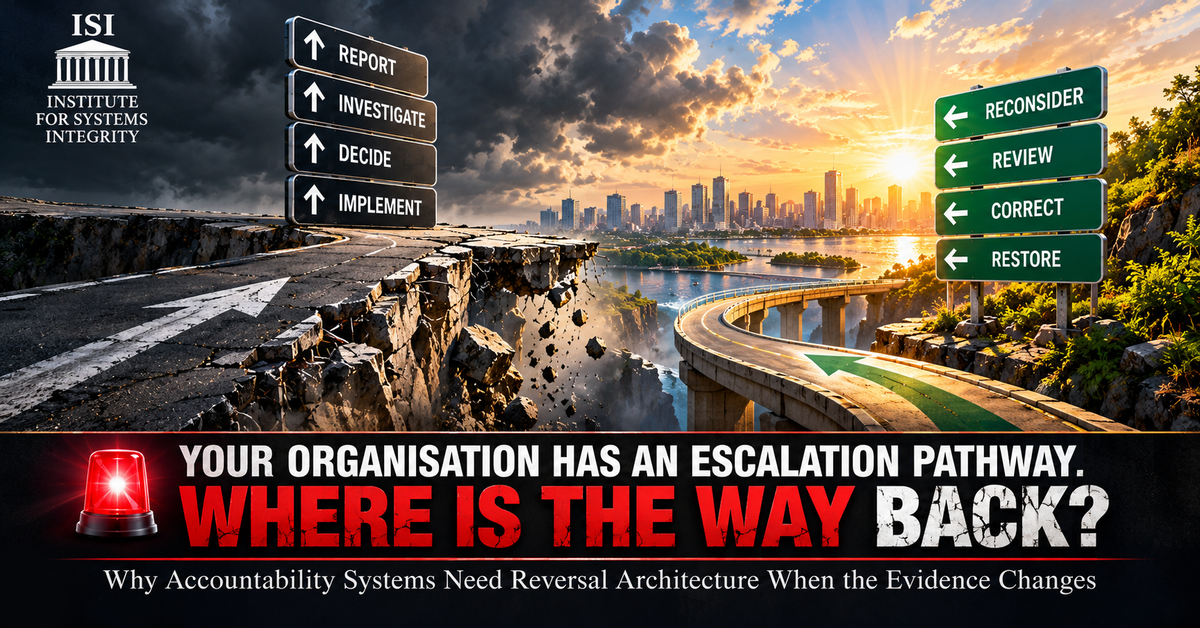
🚨 IF YOUR ORGANISATION GOT IT WRONG, WHO HAS THE POWER TO PUT IT RIGHT? We Know How to Escalate a Problem...But Do We Know How to Correct a Mistake?
Organisations know how to escalate concerns and make consequential decisions. But when material new evidence emerges, who can reopen the decision, correct the record and repair the harm?
Co Authors
Dr Alwin Tan, GAICD, MBBS, FRACS, EMBA (Melbourne Business School)
Senior Surgeon | Governance Leader | HealthTech Co-founder | Founder of Institute for Systems Integrity (ISI) | Harvard Medical School — AI in Healthcare | University of Oxford — Sustainable Enterprise | Bastas Academy for Healthcare Leadership — Triple Scholar
Nadra Gadeed BSc Psychology, MSc Forensic Psychology, MA Health Research
Founder and Strategic Advisor, Edify & Grow | Workforce Risk Advisor to Boards and C-Suite Leaders, Private Healthcare, GCC & Asia-Pacific | 20 Years in the NHS Across Strategic, Operational and Leadership Roles
INSTITUTE FOR SYSTEMS INTEGRITY
Imagine this.
A nurse raises a concern.
A doctor is investigated.
A manager makes a decision.
HR becomes involved.
A committee reviews the findings.
The board is briefed.
Someone is suspended. Someone loses their position. Someone's reputation changes.
Everyone says the proper process was followed.
The matter is closed.
THEN NEW EVIDENCE APPEARS.
A document was overlooked.
A witness changes an important part of their account.
Two apparently separate complaints turn out to have come from the same source.
Or something central to the original finding simply does not add up.
So you ask a reasonable question.
Can we look at this again?
And suddenly nobody seems quite sure who has the authority to do that.
🚨 WE KNOW WHO CAN START AN INVESTIGATION. BUT WHO CAN UNDO A WRONG DECISION?
That question should concern every board, every CEO and every professional who believes in fairness.
🚨 IN MEDICINE, CHANGING OUR MINDS IS PART OF DOING OUR JOB PROPERLY
I have spent more than two decades working as a surgeon.
And one thing medicine teaches you is that our first conclusion is not always our final conclusion.
A scan gets reviewed.
A pathology report is reconsidered.
A second opinion reveals something we missed.
A multidisciplinary team challenges the original treatment plan.
Sometimes we change our minds.
Not because we are incompetent.
Not because someone has failed.
But because new evidence changes what we know.
Imagine telling a patient:
"We have new information suggesting your diagnosis may be wrong.
But the original process was followed, so we are not going to reconsider it."
That would be absurd.
And potentially dangerous.
Yet in organisations, we sometimes treat an investigation finding as though changing it would somehow undermine the institution.
🚨 WHY IS IT ACCEPTABLE TO REVISE A CLINICAL DIAGNOSIS, BUT SO DIFFICULT TO REVISE AN ORGANISATIONAL JUDGEMENT?
The stakes may be different.
But the principle is the same.
WHEN THE EVIDENCE CHANGES, OUR WILLINGNESS TO RECONSIDER SHOULD CHANGE WITH IT.
🚨 THE MORE PEOPLE WHO APPROVE A DECISION, THE HARDER IT CAN BECOME TO QUESTION
Think about what happens after an investigation.
An investigator makes a finding.
HR accepts it.
Legal advises on it.
An executive approves the response.
A committee receives the report.
Perhaps the board is informed.
By this stage, many people have put their names, judgement or professional credibility behind the outcome.
Now imagine someone produces credible evidence that challenges it.
Who wants to be the person who says:
"Perhaps we got this wrong"?
That does not mean anyone is dishonest.
It does not mean the investigation was corrupt.
But human beings are human beings.
We can become attached to decisions we have already made.
Research on escalation of commitment helps explain why decision-makers may continue supporting an earlier course of action even when reasons to reconsider emerge (Staw, 1976; Brockner, 1992).
Research by Lord, Ross and Lepper (1979) also shows how prior beliefs can affect the way people evaluate supporting and contradictory evidence.
That study was not about workplace investigations. But it raises an important question about how we assess evidence once we have already committed to a conclusion.
ARE WE APPLYING THE SAME STANDARD TO THE EVIDENCE THAT CHALLENGES OUR DECISION AS WE APPLIED TO THE EVIDENCE THAT SUPPORTED IT?
Because sometimes:
🚨 THE HARDEST PERSON TO CONVINCE THAT A DECISION WAS WRONG IS THE PERSON WHO MADE IT.
That is why a fair organisation needs more than good intentions.
It needs a way to reconsider decisions without relying entirely on the people who made them.
🚨 “THE MATTER IS CLOSED.” BUT WHAT DOES THAT ACTUALLY MEAN?
Of course investigations must end.
People cannot be investigated forever.
Complainants deserve protection.
Witnesses should not be repeatedly dragged through the same process.
And someone who dislikes a finding should not be able to demand endless investigations until they get the answer they want.
FAIRNESS MUST WORK FOR EVERYONE.
But there is an enormous difference between:
"We have reached a conclusion based on the evidence available."
And:
"No matter what new evidence appears, we will never look at this again."
The first is reasonable.
The second is dangerous.
🚨 CLOSING A FILE SHOULD NOT MEAN CLOSING OUR MINDS.
If genuinely important new evidence emerges, someone should be authorised to assess it.
That does not mean the original decision must be overturned.
It may be confirmed.
It may be changed.
Or it may be reversed.
THE POINT IS NOT TO KEEP REOPENING CASES.
THE POINT IS TO MAKE SURE WE CAN CORRECT A SERIOUS ERROR WHEN THERE IS A PROPER REASON TO DO SO.
🚨 A CORRECTED REPORT DOES NOT NECESSARILY REPAIR A DAMAGED CAREER
This is the part I think organisations too easily overlook.
Imagine a clinician who has been suspended.
Or a nurse whose professional reputation has been damaged.
Or an employee who has lost a promotion because of an investigation finding.
Months later, new evidence leads the organisation to change that finding.
The record is amended.
A letter is issued.
The organisation says the matter has been resolved.
But has it?
What happened to the person's reputation?
What happened to their confidence?
Their professional relationships?
Their opportunities?
Their trust in the organisation?
Did they leave?
And if they did, was that departure ever examined?
🚨 YOU CAN CORRECT THE PAPERWORK WITHOUT CORRECTING WHAT HAPPENED TO THE PERSON.
A colleague who is reinstated or cleared does not necessarily return to the same level of trust or engagement.
Some people never return.
Some choose not to.
And some damage cannot be fully undone.
That is why correcting a finding is only part of the job.
Organisations also need to consider whether the consequences of the original decision should be corrected, and what appropriate remedies are possible.
This must be done fairly, lawfully and with regard to everyone affected, including complainants and witnesses.
A REVERSED DECISION IS NOT AUTOMATICALLY A REPAIRED INJUSTICE.
🚨 THIS IS NOT ABOUT PROTECTING PEOPLE FROM ACCOUNTABILITY
I want to be absolutely clear about something.
A strong reconsideration process must never become a tool for powerful people to intimidate complainants.
It must never be used to punish whistleblowers.
It must never allow someone to exhaust witnesses through repeated challenges.
And it must never assume that every allegation was false simply because an investigation is questioned.
Genuine concerns must be heard.
Serious misconduct must be investigated.
Unsafe practice must be addressed.
And findings supported by reliable evidence should stand.
BUT ACCOUNTABILITY MUST INCLUDE THE POSSIBILITY THAT THE ORGANISATION ITSELF HAS MADE A MISTAKE.
Otherwise, we have created a system that can hold individuals accountable but struggles to hold its own decisions accountable.
🚨 IF THE ORGANISATION DEMANDS ACCOUNTABILITY FROM EVERYONE ELSE, WHY SHOULD ITS OWN DECISIONS BE BEYOND RECONSIDERATION?
That is the question.
🚨 SO WHAT SHOULD A BOARD ACTUALLY DO?
Boards should not become workplace investigators.
They should not interview witnesses or overturn findings because someone influential is unhappy.
But they should know whether their organisation has a clear, fair and independent way of reconsidering important decisions when material new evidence emerges.
I would ask every board five straightforward questions.
1. What would make us reconsider a serious decision?
Is there a clear threshold for genuinely important new evidence?
2. Who has the authority to act?
Does the person have to approach the same people who made the original decision?
3. How do we protect everyone involved?
Including complainants, witnesses and respondents.
4. If a decision changes, who corrects the consequences?
Not just the report, but the records, notifications and actions that followed.
5. How do we know the correction actually happened?
Who checks? Who learns? Who makes sure the same weakness does not recur?
These are not complicated questions.
But I suspect some organisations would struggle to answer them clearly.
The Institute for Systems Integrity has proposed the idea of Institutional Reversibility™: building the ability to reconsider and, where justified, correct high-consequence decisions into the organisation's systems from the beginning.
It is a proposed governance concept, not a substitute for existing appeal rights or legal obligations.
And its central idea is simple.
🚨 DON'T WAIT UNTIL YOU HAVE MADE A SERIOUS MISTAKE TO WORK OUT HOW TO CORRECT ONE.
🚨 THE REAL TEST OF LEADERSHIP IS NOT WHETHER YOU ALWAYS GET IT RIGHT
As clinicians, we are taught to review our decisions.
To listen to colleagues.
To question assumptions.
To reconsider when new evidence appears.
We do not always get it right.
Nobody does.
Research by Edmondson (1996) reminds us that the ability to detect and learn from errors depends partly on the conditions in which teams work.
For me, that is just as relevant to boardrooms as it is to operating theatres.
A board can have excellent policies.
A CEO can have impeccable procedures.
An investigator can complete every required step.
And the conclusion can still deserve reconsideration.
GOOD PEOPLE CAN FOLLOW A GOOD PROCESS AND STILL REACH A CONCLUSION THAT LATER EVIDENCE CALLS INTO QUESTION.
What matters is what happens next.
Do we examine the new evidence?
Or defend the old decision?
Do we ask what has changed?
Or remind everyone that the process was followed?
Do we protect the institution's reputation?
Or protect the integrity of its decisions?
🚨 THE REAL TEST IS NOT WHETHER AN ORGANISATION CAN DEFEND ITS DECISION.
IT IS WHETHER IT CAN CORRECT THAT DECISION WHEN THE EVIDENCE DEMANDS IT.
Because a trustworthy organisation should be capable of saying:
"We made this decision on the evidence available at the time."
"We now have material new information."
"We will examine it fairly."
"And if the decision needs to change, we will change it."
That is not weakness.
That is professional maturity.
That is leadership.
And that is governance.
🚨 ONE FINAL QUESTION FOR EVERY BOARD
The next time someone shows you a beautiful flowchart explaining how concerns are reported, escalated and investigated, ask them to show you something else.
SHOW ME HOW A DECISION CAN BE RECONSIDERED.
SHOW ME WHO HAS THE AUTHORITY.
SHOW ME HOW THE PEOPLE AFFECTED ARE PROTECTED.
SHOW ME HOW THE CONSEQUENCES ARE CORRECTED.
And then ask:
🚨 IF WE GOT IT WRONG TOMORROW, WOULD OUR SYSTEM HELP US PUT IT RIGHT — OR MAKE IT HARDER TO ADMIT?
Because an organisation that knows how to escalate a concern but does not know how to correct a consequential error has only built half an accountability system.
AND THE PEOPLE WHO PAY THE PRICE FOR THAT MISSING HALF ARE OFTEN THE PEOPLE WHO CAN LEAST AFFORD IT.
Harvard References
Brockner, J. (1992) ‘The escalation of commitment to a failing course of action: Toward theoretical progress’, Academy of Management Review, 17(1), pp. 39–61.
Edmondson, A.C. (1996) ‘Learning from mistakes is easier said than done: Group and organizational influences on the detection and correction of human error’, The Journal of Applied Behavioral Science, 32(1), pp. 5–28.
Lord, C.G., Ross, L. and Lepper, M.R. (1979) ‘Biased assimilation and attitude polarization: The effects of prior theories on subsequently considered evidence’, Journal of Personality and Social Psychology, 37(11), pp. 2098–2109.
Staw, B.M. (1976) ‘Knee-deep in the big muddy: A study of escalating commitment to a chosen course of action’, Organizational Behavior and Human Performance, 16(1), pp. 27–44.