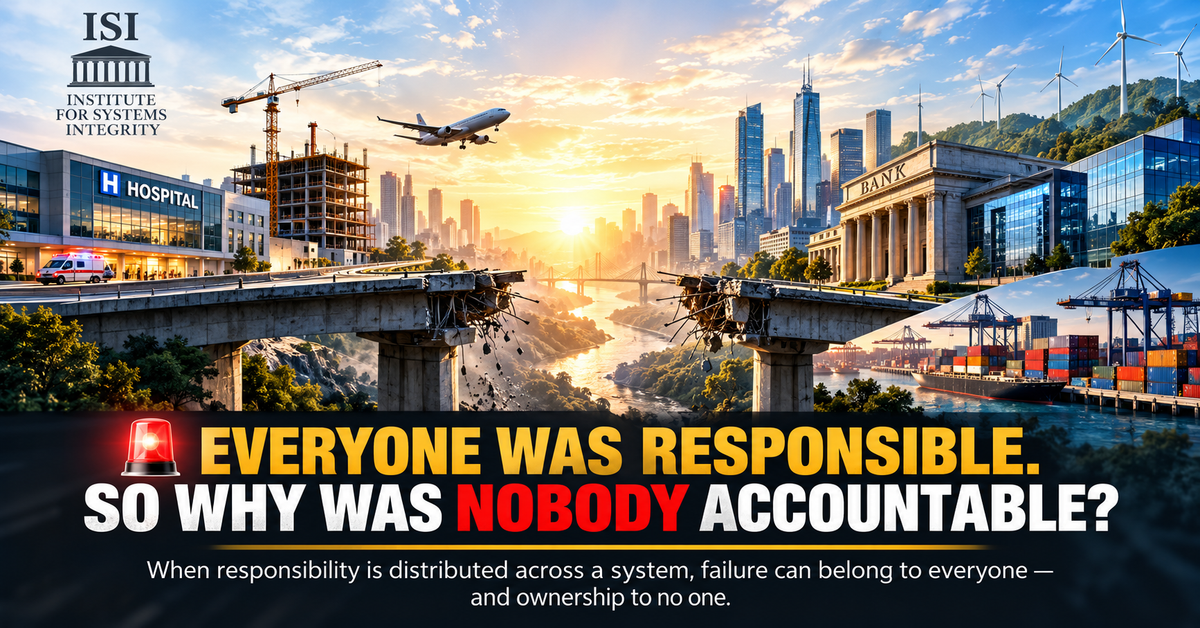
🚨 EVERYONE WAS RESPONSIBLE. SO WHY WAS NOBODY ACCOUNTABLE? When responsibility is distributed across a system, failure can belong to everyone — and ownership to no one.
Dr Alwin Tan, GAICD, MBBS, FRACS, EMBA (Melbourne Business School)
Senior Surgeon | Governance Leader | HealthTech Co-founder | Founder of Institute for Systems Integrity (ISI) | Harvard Medical School — AI in Healthcare | University of Oxford — Sustainable Enterprise | Bastas Academy for Healthcare Leadership — Triple Scholar
When responsibility is distributed across a system, failure can belong to everyone — and ownership to no one.
The patient deteriorated.
The nurse escalated.
The junior doctor reviewed.
The registrar called ICU.
ICU gave advice.
The surgical team remained involved.
The bed manager knew capacity was tight.
Everyone had done something.
Then the patient arrested.
The investigation began.
Six teams could explain what they had done.
Six people could point to a handover, referral, phone call, policy or escalation.
And slowly, one extraordinary sentence began to emerge:
“THAT WASN’T ACTUALLY MY RESPONSIBILITY.”
Nobody necessarily abandoned the patient.
Nobody necessarily broke a rule.
Nobody necessarily ignored the problem.
Everybody owned a piece.
BUT WHO OWNED THE OUTCOME?
That may be one of the defining governance problems of the modern organisation.
Because we have become extraordinarily sophisticated at distributing responsibility.
Across teams.
Committees.
Professions.
Departments.
Executives.
Boards.
Contractors.
Vendors.
Regulators.
And increasingly:
Algorithms.
But there is an uncomfortable paradox.
THE MORE PEOPLE RESPONSIBLE FOR SOMETHING, THE EASIER IT MAY BECOME FOR NOBODY TO OWN IT END-TO-END.
AMAZON SAYS: NEVER SAY “THAT’S NOT MY JOB”
Amazon's Ownership principle expects leaders to act on behalf of the entire organisation, think beyond their own teams, take a long-term view and never say:
“That's not my job.”
There is considerable wisdom in that.
The leader who discovers a serious problem should not simply forward an email and consider their responsibility discharged.
The nurse should not think:
“I told the doctor. Done.”
The engineer should not think:
“I emailed Safety. Done.”
The director should not think:
“Management knows. Done.”
The executive should not think:
“Risk owns it. Done.”
Ownership means caring whether the problem actually reaches resolution.
But there is another side.
Because telling everyone to “take ownership” can also produce:
duplicated authority,
unclear decision rights,
interference,
hero dependency,
burnout,
and people being held accountable for outcomes they have no power to control.
So perhaps the leadership challenge is more difficult than:
“Take ownership.”
It is:
DON’T SAY “THAT’S NOT MY JOB.”
BUT DON’T PRETEND EVERYTHING IS EVERYONE’S JOB EITHER.
Because when everything belongs to everybody—
NOTHING MAY TRULY BELONG TO ANYBODY.
THE ACCOUNTABILITY VACUUM™
ISI proposes the Accountability Vacuum™:
The condition created when responsibility is distributed across multiple actors, but nobody has sufficient end-to-end ownership, authority and obligation to ensure the outcome is protected.
This is not a new organisational phenomenon.
Thompson famously described the “problem of many hands”: when many people contribute to an outcome, identifying responsibility for that outcome becomes increasingly difficult.
More recently, Karimova and LeMay describe accountability decoupling in complex organisations, where decision-making is distributed across committees, procedures, technologies and external partners while accountability for consequences becomes unclear.
Modern organisations may have amplified the problem.
Because today's “many hands” can include machines.
HEALTHCARE — WHO OWNS THE PATIENT BETWEEN OWNERS?
Imagine one patient moving through:
Ambulance → Emergency → Radiology → Surgery → ICU → Ward → Pharmacy → Allied Health → Discharge → GP → Community Care
Every team can competently complete its part.
And the patient can still be harmed between those parts.
A radiologist reports an abnormality.
The junior doctor sees the report.
The consultant assumes the team will action it.
The nurse assumes medicine knows.
The discharge summary recommends follow-up.
The GP assumes the hospital arranged it.
Nobody deliberately abandons the patient.
Six weeks later, the patient returns with advanced disease.
The investigation asks:
“Who failed to follow up?”
But perhaps the more important systems question is:
WHO OWNED THE PATIENT WHEN THE PATIENT WAS BETWEEN OWNERS?
The patient experiences one journey.
The organisation experiences departments.
That difference matters.
AVIATION — EVERYBODY HAD A PIECE OF THE PICTURE
An aircraft develops a problem.
The first officer notices an abnormal indication.
The captain is dealing with another issue.
Cabin crew have information from the cabin.
Maintenance knows the aircraft's recent history.
Operations has information on the ground.
Air traffic control knows the external environment.
Nobody is incompetent.
Nobody is necessarily withholding information.
The danger is different:
EVERYBODY KNOWS SOMETHING.
NOBODY NECESSARILY KNOWS EVERYTHING.
And everybody may assume somebody else has connected the pieces.
That is why high-consequence systems require more than expertise.
They require clear escalation, communication and decision authority.
CONSTRUCTION — WHO CAN ACTUALLY SAY STOP?
A subcontractor notices something unsafe.
They tell the supervisor.
The supervisor tells the project manager.
The project manager asks engineering.
Engineering believes the design remains acceptable.
Safety records the concern.
The client representative is copied into the correspondence.
Meanwhile, the project is three weeks late.
Work continues.
An incident occurs.
Afterwards everybody produces evidence:
“I raised it.”
“I reviewed it.”
“I escalated it.”
“I was informed.”
“It wasn't my decision.”
Then ask the question that should have been answered beforehand:
WHO HAD THE UNAMBIGUOUS AUTHORITY TO SAY STOP?
Not recommend.
Not document.
Not advise.
Not put the risk on a register.
Stop.
If the organisation discovers that answer during the investigation, it discovered it too late.
MANUFACTURING — EVERYONE CAN BE TECHNICALLY CORRECT
A machine begins vibrating differently.
The operator reports it.
Maintenance checks it.
Engineering says it remains within tolerance.
Production needs the line running.
Safety has no threshold requiring shutdown.
Operations decides to continue.
Two days later, the machine fails.
The meeting begins.
Production:
“Maintenance cleared it.”
Maintenance:
“Engineering said it was acceptable.”
Engineering:
“Operations decided to continue.”
Operations:
“Safety didn't require shutdown.”
Safety:
“We don't own operational decisions.”
Every statement may be technically correct.
THAT IS EXACTLY THE PROBLEM.
MINING — STOP-WORK AUTHORITY THAT NOBODY WANTS USED
The organisation proudly says:
“Everyone has authority to stop work.”
A frontline worker sees something concerning.
They stop the operation.
Production falls.
Equipment sits idle.
Money is being lost.
Then come the questions:
“Are you absolutely sure?”
“How long is this going to take?”
“Can we restart part of the operation?”
Nobody explicitly tells the worker to ignore the risk.
But everybody nearby is watching what happens to them.
Because:
AUTHORITY THAT EXISTS ON PAPER BUT CARRIES A HIDDEN PENALTY MAY NOT EXIST IN PRACTICE.
Ownership requires more than granting authority.
The organisation must tolerate people actually using it.
BANKING — “RISK OWNS THE RISK”
A product is performing extraordinarily well.
Revenue is strong.
Targets are being exceeded.
A risk analyst notices an emerging pattern.
The business says:
“Risk reviewed it.”
Risk says:
“The business owns the risk.”
Compliance says:
“It remains within policy.”
Internal audit says:
“It isn't currently in scope.”
Management sees green indicators.
The board sees the dashboard.
Months later, the exposure becomes material.
Everyone had a role.
But:
WHO OWNED THE POSSIBILITY THAT EVERYONE’S ASSUMPTIONS WERE WRONG?
TECHNOLOGY — THURSDAY NIGHT BEFORE THE FRIDAY LAUNCH
The product launches tomorrow.
Marketing has announced it.
Customers are waiting.
Revenue forecasts assume it happens.
An engineer discovers a significant vulnerability.
Engineering tells cybersecurity.
Cybersecurity assesses severity.
Product owns release.
Operations owns deployment.
Legal considers liability.
Executives own commercial performance.
Everyone owns something.
Thursday evening somebody finally asks:
“WHO ACTUALLY HAS THE AUTHORITY TO CANCEL TOMORROW'S LAUNCH?”
If that question is being asked the night before launch:
THE GOVERNANCE FAILURE MAY HAVE OCCURRED BEFORE THE SOFTWARE FAILURE.
AI — THE LAST HUMAN BECOMES THE FIRST PERSON BLAMED
An AI-supported clinical system recommends an action.
The clinician accepts it.
The patient is harmed.
Then the accountability chain appears.
The developer:
“The model performed within specification.”
The vendor:
“The hospital configured deployment.”
IT:
“We deployed the approved version.”
Clinical governance:
“It passed validation.”
Management:
“Clinicians retained clinical responsibility.”
The clinician:
“I couldn't inspect how the recommendation was produced.”
Everybody can point somewhere else.
And the clinician standing beside the patient becomes the easiest person to see.
THE LAST HUMAN IN THE DECISION CHAIN SHOULD NOT AUTOMATICALLY BECOME THE ONLY HUMAN IN THE ACCOUNTABILITY CHAIN.
Proximity to harm is not the same as control over the system.
ACCOUNTABILITY WITHOUT AUTHORITY™
This exposes another problem.
Organisations frequently tell people:
“You own this.”
But can they actually control it?
A nurse manager accountable for patient flow who cannot create beds.
A department head accountable for expenditure who cannot control centrally mandated costs.
A project manager accountable for delivery while others control scope, budget and staffing.
A cybersecurity leader accountable for cyber risk whose recommendations executives can override.
A clinician accountable for AI-assisted decisions who cannot inspect, modify or suspend the technology.
ACCOUNTABILITY WITHOUT AUTHORITY MAY BE LITTLE MORE THAN LIABILITY WEARING A LEADERSHIP LABEL.
Before holding someone accountable, ask:
Did they know?
Could they act?
Did they have capacity?
Did they have authority?
If not, we may not have designed accountability.
We may have designed a future scapegoat.
CYBERSECURITY — EVERYONE OWNED CYBER UNTIL THE SYSTEM WENT DOWN
Ask an organisation:
“Who owns cybersecurity?”
You may hear:
CISO.
IT.
Risk.
Privacy.
Legal.
Operations.
Vendors.
Executive management.
Board risk committee.
Then ransomware shuts the organisation down.
Now ask:
Who could force remediation of a critical vulnerability?
Who could refuse deployment?
Who could override an executive accepting the risk?
Who verified that remediation actually occurred?
Those answers are often much harder.
HAVING MANY PEOPLE INVOLVED IN A RISK IS NOT THE SAME AS HAVING SOMEBODY OWN THE OUTCOME.
LOGISTICS — THE KPI WAS OWNED. THE SYSTEM WASN’T.
A distribution centre is falling behind.
Operations owns throughput.
HR owns staffing.
Safety owns workplace safety.
Maintenance owns equipment.
Transport owns dispatch.
Finance owns cost.
The shift manager says:
“We cannot achieve this target safely with current staffing.”
Operations needs throughput.
HR cannot find workers.
Finance rejects overtime.
Safety has not formally stopped operations.
The target remains.
Eventually something gives.
The organisation had six functional owners.
BUT WHO OWNED THE COLLISION BETWEEN THEIR OBJECTIVES?
This is where complex organisations often fail.
Not inside the boxes on the organisational chart.
Between them.
RETAIL — HEAD OFFICE OWNS THE MODEL. STORES OWN THE CONSEQUENCES.
Head office introduces a new staffing model.
Finance sees labour savings.
Operations sees productivity.
HR sees acceptable ratios.
The dashboard turns green.
Store managers see:
longer queues,
exhausted employees,
complaints,
experienced staff leaving.
They raise concerns.
Head office replies:
“The data doesn't support that.”
Eventually performance deteriorates.
Who owned investigating the contradiction between the dashboard and lived reality?
WHEN THE METRIC AND THE FRONTLINE DISAGREE, SOMEBODY MUST OWN FINDING OUT WHY.
ENERGY — EVERYONE OWNED THEIR COMPONENT
An ageing asset has repeatedly been flagged.
Engineering understands the technical risk.
Maintenance owns inspection.
Operations needs continuity.
Finance controls capital.
Procurement manages replacement.
Executives prioritise investment.
The board receives aggregated risk indicators.
Replacement is deferred.
Again.
Then the asset fails.
Engineering says:
“We warned.”
Maintenance:
“We inspected.”
Finance:
“We funded approved priorities.”
Management:
“We acted on available information.”
The board:
“We relied on management assurance.”
EVERYONE CAN BE CORRECT ABOUT THEIR ROLE WHILE THE SYSTEM IS WRONG ABOUT THE OUTCOME.
UNIVERSITIES — THE STUDENT BETWEEN DEPARTMENTS
A struggling student seeks help.
Academic staff identify the concern.
Student services receive a referral.
Counselling has a waiting list.
The faculty assumes wellbeing is involved.
Wellbeing assumes the faculty is managing the academic component.
Administration continues sending standard communications.
Nobody deliberately abandons the student.
But the student disappears between organisational boundaries.
HANDING SOMETHING OVER DOES NOT PROVE SOMEBODY PICKED IT UP.
Referral is not resolution.
Escalation is not ownership.
PROFESSIONAL SERVICES — THE CLIENT EXPERIENCES ONE FIRM
A major client receives advice involving legal, tax, audit, technology and risk teams.
Every specialist produces competent work.
But assumptions differ between teams.
Nobody reconciles the whole picture.
Something material is missed.
Afterwards each team produces its engagement scope.
But:
THE CLIENT EXPERIENCED ONE ORGANISATION.
THE ORGANISATION EXPERIENCED FIVE DEPARTMENTS.
That gap is where ownership can disappear.
GOVERNMENT — EVERY DEPARTMENT DID ITS PART
A major programme spans policy, funding, procurement, technology, implementation and regulation.
One department develops policy.
Another controls funding.
A contractor builds the platform.
State agencies implement.
A regulator oversees compliance.
Local organisations deliver services.
A serious problem emerges between them.
Each institution explains:
“That component sits with…”
And finishes the sentence with somebody else's name.
Nobody necessarily lies.
Nobody necessarily acts improperly.
ACCOUNTABILITY CAN DISAPPEAR WITHOUT ANYONE LYING.
Sometimes organisational architecture does the work.
EMERGENCY SERVICES — EVERY AGENCY RESPONDED
A major incident involves police, fire, ambulance, hospitals, emergency management and local government.
Every agency responds.
Every agency has expertise.
Every agency has its own command structure.
But what happens when objectives conflict?
Who sees the whole picture?
Who resolves disagreement?
Who owns the end-to-end incident?
COORDINATION WITHOUT CLEAR DECISION RIGHTS CAN BECOME COLLECTIVE ACTIVITY WITHOUT COLLECTIVE CONTROL.
THE EXECUTIVE TEAM — “I ASSUMED THE COO HAD IT”
A serious operational problem has appeared in executive meetings for months.
CEO knows.
COO knows.
CFO knows.
Risk knows.
Legal knows.
HR knows.
The relevant executive knows.
Every meeting ends:
“We'll continue monitoring it.”
Then the risk materialises.
The board asks:
“Who owned this?”
Seven executives look at one another.
IF THE ANSWER TO “WHO OWNS THIS?” IS A LIST OF PEOPLE, YOU MAY NOT HAVE AN OWNER.
THE BOARDROOM — EVERYONE FOLLOWED THE PROCESS
The risk committee reviewed it.
Management provided assurance.
Internal audit tested controls.
External advisers wrote reports.
Legal considered exposure.
The board discussed it.
Minutes were taken.
The dashboard remained green.
Then catastrophe.
Management says:
“The board was informed.”
The board says:
“Management owned operations.”
The committee says:
“We relied on management assurance.”
The business unit says:
“We followed the approved process.”
This creates perhaps the hardest governance question of all:
WHAT IF EVERYONE FOLLOWED THE PROCESS — AND THE PROCESS STILL PRODUCED NOBODY WHO OWNED THE OUTCOME?
Process compliance is not proof of governance effectiveness.
BUT BE CAREFUL: “THE SYSTEM” CAN BECOME AN EXCUSE TOO
Systems thinking matters enormously.
Leveson and colleagues argue that accidents in complex sociotechnical systems cannot always be understood by searching for a single defective component; interactions and system constraints matter.
But there is a danger.
After failure, we say:
“It was a systems problem.”
And somehow everyone disappears.
That is not what systems thinking should mean.
SYSTEMS THINKING SHOULD PREVENT SCAPEGOATING.
IT SHOULD NOT MAKE ACCOUNTABILITY DISAPPEAR.
Systems influence behaviour.
But people still make decisions.
Executives still allocate resources.
Boards still oversee.
Professionals still exercise judgment.
Leaders still decide whether to escalate.
Accountability therefore needs to exist simultaneously at the:
individual,
team,
executive,
organisational,
board,
and system levels.
OWNERSHIP IS NOT DOING EVERYONE ELSE’S JOB
This distinction is critical.
A nurse who discovers a medication problem does not need to become the pharmacist.
An executive who discovers a cyber vulnerability does not need to become the CISO.
A director who identifies an operational problem should not become management.
A CEO should not personally resolve every customer complaint.
Ownership means something else.
OWNERSHIP IS NOT DOING EVERYONE ELSE’S JOB.
OWNERSHIP IS REFUSING TO LET THE PROBLEM BECOME OWNERLESS.
Sometimes ownership means acting.
Sometimes it means escalating.
Sometimes transferring responsibility.
Sometimes demanding assurance.
Sometimes saying:
“This is outside my authority—but I will make sure it reaches somebody whose authority it is.”
And then checking that it did.
THE HERO PROBLEM
There is another trap.
Every organisation knows one.
The person everyone calls.
Every difficult customer reaches them.
Every operational crisis requires them.
Every escalation lands on their phone.
When something breaks:
“Call Sarah.”
“Get Michael.”
“He will sort it out.”
It looks like extraordinary ownership.
It may actually reveal weak system design.
Because eventually the hero goes on leave.
Burns out.
Gets promoted.
Gets sick.
Or leaves.
And suddenly nobody knows how to make the system work.
IF YOUR ORGANISATION NEEDS A HERO TO CREATE OWNERSHIP, YOU HAVE NOT BUILT OWNERSHIP.
You have built dependency.
Strong ownership should create organisational capability—
not organisational dependence on extraordinary individuals.
TOO MANY OWNERS CAN BE AS DANGEROUS AS NONE
CEO.
COO.
Clinical director.
Programme director.
Department head.
Risk owner.
Committee chair.
Vendor.
Board committee.
Everyone thinks they own it.
Now whose decision is final?
Complex organisations need to distinguish at least five things:
OUTCOME OWNERSHIP — who ensures resolution?
DECISION OWNERSHIP — who makes the consequential decision?
EXECUTION OWNERSHIP — who carries it out?
RISK OWNERSHIP — who accepts residual exposure?
ASSURANCE OWNERSHIP — who independently verifies that it worked?
Because:
FIVE PEOPLE BEING “ACCOUNTABLE” DOES NOT CREATE FIVE TIMES THE ACCOUNTABILITY.
It may create none.
THE ISI OWNERSHIP INTEGRITY MODEL™
Before telling someone:
“You own this.”
Ask five questions.
1. OUTCOME
What outcome are we protecting?
2. OWNER
Who ensures the issue reaches resolution?
3. AUTHORITY
Can that person make—or compel escalation of—the necessary decision?
4. BOUNDARY
Where does their authority end, and whose begins?
5. ASSURANCE
Who independently verifies that resolution occurred?
OUTCOME → OWNER → AUTHORITY → BOUNDARY → ASSURANCE
A RACI chart can tell us who is Responsible, Accountable, Consulted and Informed.
ISI asks something harder:
CAN THE PERSON LABELLED “ACCOUNTABLE” ACTUALLY CHANGE THE OUTCOME?
If not, the accountability may exist only on paper.
THE PATTERN ACROSS INDUSTRIES IS REMARKABLY SIMILAR
Healthcare calls it handover.
Technology calls it escalation.
Construction calls it subcontracting.
Banking calls it risk ownership.
Government calls it interdepartmental responsibility.
Boards call it delegation.
AI calls it human oversight.
Different vocabulary.
Same governance question:
WHEN THE PROBLEM CROSSES THE BOUNDARY, WHO CROSSES WITH IT?
That may be the heart of ownership.
Not everybody owning everything.
Not one heroic individual owning everything.
But ensuring that:
A CRITICAL OUTCOME NEVER BECOMES OWNERLESS SIMPLY BECAUSE IT CROSSED AN ORGANISATIONAL BOUNDARY.
STOP ASKING ONLY: “WHO IS RESPONSIBLE?”
Ask:
WHO KNEW?
WHO COULD ACT?
WHO HAD AUTHORITY?
WHO COULD ESCALATE?
WHO COULD STOP?
WHO ACCEPTED THE RESIDUAL RISK?
WHO VERIFIED THE FIX?
And ultimately:
WHO OWNED THE OUTCOME?
THE QUESTION YOUR BOARD SHOULD ASK
Don't ask management for another colourful accountability matrix.
Ask:
“SHOW US ONE CRITICAL RISK THAT EVERYONE TOUCHES — BUT NOBODY OWNS END-TO-END.”
Then ask:
Who owns the outcome?
Do they know they own it?
Do they have the information?
Do they have the resources?
Do they have the authority?
Can they escalate?
Can they stop the system?
Who can override them?
Who accepts the residual risk?
Who independently verifies resolution?
Then ask the question that matters most:
“IF THIS FAILS TOMORROW, CAN WE NAME — TODAY — WHO OWNS THE OUTCOME?”
If the answer requires a committee meeting—
the accountability failure may already have occurred.
OWNERSHIP IS NOT A SLOGAN
It is not:
“Take responsibility.”
It is not:
“That's on you.”
It is not:
“Be more accountable.”
It is not:
“Everyone needs to own this.”
And it is certainly not:
“Find somebody to blame.”
Real ownership means designing organisations in which critical problems cannot quietly become everybody's responsibility—
AND NOBODY’S PROBLEM.
Amazon is right to challenge leaders who retreat behind:
“That's not my job.”
But systems integrity requires us to go further.
Give people responsibility.
Give them information.
Give them capability.
Give them boundaries.
Give them escalation pathways.
And if you intend to hold them accountable—
GIVE THEM THE AUTHORITY TO ACT.
Because after the next failure there will be plenty of time for investigators to ask:
“Who was responsible?”
The better question belongs before the failure:
“WHO OWNS THIS OUTCOME NOW?”
And if nobody in the room can answer immediately—
THERE IS YOUR ACCOUNTABILITY VACUUM™.
Harvard references
Amazon (2026) Leadership Principles. Amazon. Available at: Amazon Leadership Principles.
Bovens, M. (2007) ‘Analysing and assessing accountability: A conceptual framework’, European Law Journal, 13(4), pp. 447–468.
Karimova, G-S. and LeMay, S.A. (2026) ‘When no one is responsible: How leaders can restore accountability in complex organizations’, Organizational Dynamics, 55(3), 101245.
Leveson, N., Dulac, N., Marais, K. and Carroll, J. (2009) ‘Moving beyond normal accidents and high reliability organizations: A systems approach to safety in complex systems’, Organization Studies, 30(2–3), pp. 227–249.
Roberts, J. (2001) ‘Trust and control in Anglo-American systems of corporate governance: The individualizing and socializing effects of processes of accountability’, Human Relations, 54(12), pp. 1547–1572.
Sinclair, A. (1995) ‘The chameleon of accountability: Forms and discourses’, Accounting, Organizations and Society, 20(2–3), pp. 219–237.
Tetlock, P.E. (1985) ‘Accountability: A social check on the fundamental attribution error’, Social Psychology Quarterly, 48(3), pp. 227–236.
Thompson, D.F. (1980) ‘Moral responsibility of public officials: The problem of many hands’, American Political Science Review, 74(4), pp. 905–916.