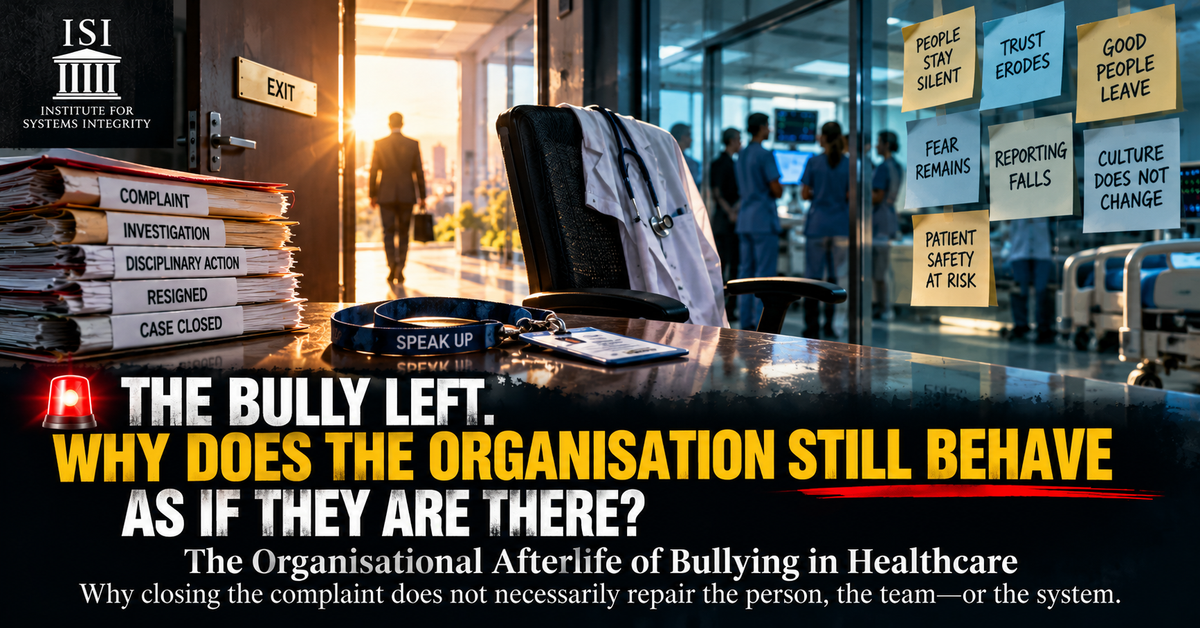
🚨 THE BULLY LEFT...WHY DOES THE ORGANISATION STILL BEHAVE AS IF THEY ARE THERE? The Organisational Afterlife of Bullying in Healthcare.
Closing a bullying complaint does not necessarily repair the harm. Explore how workplace bullying leaves lasting effects on trust, staff silence, patient safety and organisational culture.
Co authors
Dr Alwin Tan, GAICD, MBBS, FRACS, EMBA (Melbourne Business School)
Senior Surgeon | Governance Leader | HealthTech Co-founder | Founder of the Institute for Systems Integrity (ISI) |Harvard Medical School — AI in Healthcare | University of Oxford — Sustainable Enterprise | Bastas Academy for Healthcare Leadership – Triple Scholar
and
Liza K. Collins MA
Founder, The Future of Leadership | Leadership Educator & Executive Facilitator
Author, The Physiology of Bullying
Chair, Workforce & Culture, UK Digital Health & Care
Executive Education, Imperial College London, Leading Systemic Innovation in Healthcare
International Culture & Leadership Strategist
Faculty Advisor, Australian Institute of Health Executives
Workforce & Culture Chair, UK Digital Health & Care
Chair, Stop Hurt & Work Committee
INSTITUTE FOR SYSTEMS INTEGRITY
Why closing the complaint does not necessarily repair the person, the team—or the system.
THE BULLY IS GONE.
The investigation is finished.
HR has closed the file.
The executive has been briefed.
Perhaps somebody was counselled.
Perhaps somebody resigned.
Perhaps somebody was disciplined.
Perhaps everyone was simply told that the matter had been “appropriately managed.”
The Board receives assurance.
CASE CLOSED.
Except one clinician no longer speaks in meetings.
Another quietly starts looking for another job.
A witness decides never to become involved again.
A junior colleague learns who can—and cannot—be challenged.
Someone takes more sick leave.
Someone stops reporting concerns.
Someone leaves.
The behaviour may have stopped.
But the lesson remained.
And that raises a question healthcare rarely asks:
WHEN EXACTLY IS A BULLYING CASE OVER?
Not when the investigation ends.
Not when HR closes the file.
Not necessarily when the alleged perpetrator leaves.
A bullying episode may be administratively finished while its consequences continue through the people and systems left behind.
We call this:
THE ORGANISATIONAL AFTERLIFE OF BULLYING™
And it exposes an uncomfortable possibility:
Healthcare may be better at closing bullying cases than proving that the harm created around them has actually been repaired.
1. BULLYING IS NOT JUST AN EVENT
We often conceptualise workplace bullying as a relationship between two people.
There is a perpetrator.
There is a target.
Something happens between them.
So we investigate the interaction.
That model is understandable.
It may also be dangerously incomplete.
A major recent scoping review of systematic reviews and meta-analyses concerning healthcare workers identified workplace culture, organisational hierarchy, inactive institutional power and conflict as important constructs in understanding healthcare bullying.
It concluded that effective prevention and management require attention to both individual and organisational factors (Bashir and Oetzel, 2026).
That changes the frame.
Bullying does not necessarily occur inside a sealed container between Person A and Person B.
It occurs inside a social system.
Other people watch.
Managers respond.
Colleagues choose whether to intervene.
Policies are tested.
Informal power becomes visible.
The organisation reveals what it tolerates, what it challenges and whom it protects.
Everyone is learning.
🔥PEOPLE DO NOT ONLY LEARN FROM WHAT LEADERS SAY.
THEY LEARN FROM WHAT HAPPENS TO THE PERSON WHO CHALLENGES THEM.
2. THE WITNESSES MATTER
Imagine a senior clinician humiliates a junior colleague repeatedly.
Ten people witness it.
Our conventional system may identify:
one complainant
and
one respondent.
But organisationally there may have been twelve people exposed to the event.
Research supports taking witnesses seriously.
Sprigg and colleagues followed workers over time and found that witnessing workplace bullying was associated with poorer work-related wellbeing six months later under particular personal and organisational conditions; supportive supervisors and coworkers could buffer some effects (Sprigg et al., 2019).
That matters.
Because witnesses are not passive furniture in the room.
They observe:
Who intervenes?
Who stays silent?
Does leadership notice?
What happens when somebody complains?
Does the powerful person remain powerful?
Does the complainant become isolated?
Does speaking up improve anything?
And perhaps most importantly:
Would I speak up if it happened to me?
The formal investigation may be examining yesterday's conduct.
The workforce may be learning tomorrow's behaviour.
🔥 EVERY BULLYING CASE HAS TWO OUTCOMES.
WHAT HAPPENS TO THE PEOPLE INVOLVED.
AND WHAT EVERYONE WATCHING LEARNS FROM IT.
3. SOMETIMES THE SECOND INJURY COMES FROM THE ORGANISATION
This may be one of the most uncomfortable findings in the literature.
The harm associated with bullying may not be confined to the original behaviour.
The organisational response matters too.
Brewer and colleagues examined bullying among nurses and the concepts of organisational betrayal and organisational support.
Among nurses exposed to bullying, organisational betrayal was associated with substantially higher odds of burnout, job dissatisfaction and absenteeism, while organisational support was associated with lower odds of some adverse outcomes (Brewer et al., 2020).
The study was cross-sectional, so causality should not be inferred.
But the governance question is enormous.
What if the organisation responding to harm can influence the subsequent experience of that harm?
That suggests two conceptually different injuries may occur:
PRIMARY HARM
What happened between people.
SECONDARY INSTITUTIONAL HARM
What happens when the institution responds poorly to what occurred.
The complaint disappears.
The meetings continue.
The lawyers may become involved.
Language becomes procedural.
Everyone becomes careful.
And the person at the centre discovers that an organisation can comply with its process while still leaving them profoundly unsupported.
🔥 SOMETIMES THE BULLYING IS NOT THE LAST INJURY.
SOMETIMES WHAT HAPPENS AFTER SOMEONE REPORTS IT BECOMES PART OF THE HARM.
4. “BUT WE INVESTIGATED IT.”
Good.
An investigation may be essential.
Procedural fairness is essential.
The respondent must have an opportunity to answer allegations.
Facts matter.
Evidence matters.
Natural justice matters.
And importantly:
Not every allegation of bullying is substantiated.
Management direction is not automatically bullying.
Performance management is not automatically bullying.
Professional disagreement is not automatically bullying.
A robust organisation must protect people from bullying without converting every difficult workplace interaction into misconduct.
But even an excellent investigation answers only certain questions.
What happened?
Was policy breached?
Can an allegation be substantiated?
What action is appropriate?
Those are important questions.
They are not necessarily the same as:
What happened to the team?
What did witnesses learn?
Has psychological safety changed?
Did people leave?
Has sickness absence changed?
Do people still report concerns?
Has trust recovered?
🔥 THE BODY DOES NOT RECOGNISE ADMINISTRATIVE CLOSURE
There is another dimension to organisational recovery that is frequently overlooked: the physiology of sustained threat. Bullying is not experienced solely as a series of interpersonal events. Repeated exposure to humiliation, intimidation, exclusion or unpredictable behaviour can also be experienced as a persistent psychosocial stressor.
The human stress response supports adaptation to challenge. However, as McEwen’s work on allostatic load explains, repeated or prolonged activation of stress-response systems can carry physiological costs (McEwen, 1998).
An organisation may remove the source of bullying, but a person may continue to perceive aspects of the working environment as threatening. Familiar relationships, hierarchies or interactions may remain associated with previous experiences. The end of exposure does not necessarily produce an immediate return to a sense of safety.
Recovery may involve rebuilding trust, restoring predictability, recovering confidence and re-establishing agency. An HR investigation can close a case. It cannot, by administrative decision alone, restore a person's sense of safety.
This is a plausible application of established stress physiology, not a claim that all targets experience the same biological effects or recovery timeline.
Did the conditions that allowed the behaviour change?
That is the distinction between case resolution and system recovery.
ADMINISTRATIVE CLOSURE ≠ ORGANISATIONAL RECOVERY™
An organisation can successfully complete its procedure while unsuccessfully repairing its system.
Those are different outcomes.
And we should stop pretending otherwise.
5. THE HUMAN CONSEQUENCES DO NOT OBEY HR TIMELINES
HR systems have closure dates.
Human beings do not.
The evidence linking workplace bullying with subsequent adverse outcomes is substantial.
A systematic review and meta-analysis using prospective and registry-based studies found exposure to workplace bullying associated with increased sickness absence, with a pooled odds ratio of 1.58 (Nielsen, Indregard and Øverland, 2016).
A later meta-analysis found bullying exposure associated with a 26% increased risk of sickness absence across follow-up periods and also reported evidence of a bidirectional relationship involving long-term sickness absence (Liao et al., 2023).
A 2025 systematic review and meta-analysis found workplace bullying associated with increased turnover intentions, including an association in the smaller subset of prospective studies (Sun et al., 2025).
This does not mean every person who experiences bullying becomes psychologically injured.
It does not establish that every absence, resignation or mental-health difficulty following a bullying complaint was caused by bullying.
And it certainly does not mean recovery is impossible.
It means something simpler:
THE END OF EXPOSURE SHOULD NOT BE CONFUSED WITH THE END OF CONSEQUENCE.
6. THE ORGANISATION MAY REMOVE THE PERSON AND PRESERVE THE SYSTEM
This is where healthcare needs to become uncomfortable.
Suppose the person responsible leaves.
Problem solved?
Maybe.
But what if the conditions that allowed the behaviour remain?
The same hierarchy.
The same tolerance of incivility.
The same leader who looked away.
The same fear of reporting.
The same informal power networks.
The same opaque investigation process.
The same team that watched what happened.
The same incentive to remain silent.
Then the organisation has removed an actor.
It has not necessarily changed the script.
A FINDING FROM NHS RESEARCH IN 2002
This concern is not new. In a 2002 MA dissertation examining harassment and bullying in London NHS Trusts, Collins used qualitative action inquiry and interviews to explore the influence of organisational power, hierarchy and culture. The study identified a tendency to address harassment and bullying at the level of individuals rather than as organisational problems, and argued that policies and formal systems needed to be accompanied by cultural change and senior leadership engagement (Collins, 2002).
Using the McKinsey 7S framework, the research distinguished the formal elements of strategy, structure and systems from staff, skills, management style and shared values. Its central implication remains relevant to the present argument: changing a procedure, or removing one individual, cannot by itself demonstrate that the organisational conditions enabling harmful behaviour have changed. As a small qualitative study, these findings provide historical and conceptual insight, not a representative estimate of bullying across the NHS.
Bashir and Oetzel's synthesis is particularly important here because healthcare bullying is situated within broader constructs including hierarchy, workplace culture, institutional power and conflict.
That means the governance response cannot stop at:
“What do we do with this individual?”
WHEN SILENCE BECOMES AN ADAPTIVE RESPONSE
Silence is often interpreted as agreement, disengagement or an absence of concern. But silence may also reflect learning. When employees witness bullying, retaliation or a failure to intervene, they may reassess the personal consequences of speaking up.
Research links team psychological safety with learning behaviour (Edmondson, 1999). Research on employee voice and silence identifies organisational conditions and anticipated consequences as important influences on whether staff raise concerns (Morrison, 2014; 2023).
A clinician who no longer feels safe challenging authority may still possess the same expertise and professional commitment. What may have changed is their willingness to take an interpersonal risk. The organisation has not necessarily lost their knowledge. It may have lost access to their voice.
In healthcare, where escalation, challenge and reporting matter for safety, this represents a potential clinical governance risk. The absence of complaints must never be treated in isolation as evidence of a healthy culture.
It must also ask:
“WHAT WAS TRUE ABOUT OUR ORGANISATION THAT ALLOWED THIS TO HAPPEN?”
That is a systems question.
And systems questions belong in governance.
🔥 IF YOU REMOVE THE BULLY BUT PRESERVE THE CONDITIONS THAT ENABLED THE BULLYING, YOU HAVE NOT FIXED THE SYSTEM.
YOU HAVE CREATED A VACANCY.
7. THE QUIETEST CONSEQUENCE MAY BE THE MOST DANGEROUS
Imagine what happens next.
A clinician sees something unsafe.
Previously they might have challenged it.
Now they calculate.
Not consciously, perhaps.
But organisational memory operates through people.
They remember what happened to Sarah.
They remember how long the investigation took.
They remember what happened to the registrar who supported her.
They remember who was promoted.
They remember who disappeared.
And so they make a perfectly rational decision:
Not this time.
Nothing appears on the incident register.
There is no complaint.
No grievance.
No whistleblower report.
No HR case.
From the Board's perspective:
green.
But silence is not necessarily evidence of safety.
Sometimes silence is evidence that people have learned.
This matters profoundly in healthcare because safety depends on people being willing to challenge hierarchy, report risk and surface weak signals.
Australia's 2026 National Model for Clinical Governance explicitly expects boards and executives to build a healthy workforce culture, systematically measure workforce culture including psychosocial safety, provide systems that respond appropriately and transparently to staff concerns, and ensure people feel safe to speak up for safety.
The model also identifies inadequate Board oversight of indicators such as retention and absenteeism as a warning sign.
That moves bullying firmly beyond the HR department.
It becomes a governance issue.
8. STOP COUNTING COMPLAINTS AS IF THEY MEASURE CULTURE
Imagine two hospitals.
HOSPITAL A
Twenty bullying complaints.
HOSPITAL B
Two bullying complaints.
Which hospital has the safer culture?
We do not know.
Hospital A may have a terrible bullying problem.
Or it may have a culture where people trust the reporting system.
Hospital B may be psychologically safe.
Or everybody may have learned not to complain.
The denominator matters.
Reporting confidence matters.
Workforce mobility matters.
Absenteeism matters.
Exit data matter.
Patterns matter.
Complaint counts alone tell us remarkably little.
The same problem applies after an individual case.
The Board may hear:
“Investigation completed.”
“Recommendations implemented.”
“Case closed.”
Excellent.
Now show us:
What happened to retention in that team?
What happened to sick leave?
What happened to staff engagement?
What happened to reporting?
What happened to the witnesses?
MEASURING THE CONDITIONS FOR RECOVERY
Organisations must distinguish the absence of reported harm from the presence of conditions that support safety. Fewer complaints might reflect improvement, or declining confidence in the reporting system.
Recovery assessment should consider confidence in speaking up, procedural fairness, trust in leadership, support after harmful experiences, and evidence that enabling conditions have changed. These indicators should be interpreted over time alongside workforce measures and qualitative accounts.
These are proposed assessment domains, not direct biological measurements of recovery or a validated post-bullying recovery scale. The question is not simply whether bullying has stopped, but whether the organisation has changed sufficiently to reduce recurrence risk and support those affected.
What happened to the complainant six months later?
What happened to the respondent?
Did leadership change?
Did the same behaviour reappear under another name?
Where is the recovery data?
🔥 IF YOUR ONLY MEASURE OF BULLYING IS THE NUMBER OF COMPLAINTS, THE SAFEST-LOOKING ORGANISATION MAY SIMPLY BE THE ONE WHERE PEOPLE HAVE STOPPED REPORTING.
9. THE BULLYING RECOVERY MEASUREMENT GAP™
Here lies what we believe is an important governance problem.
Healthcare has become increasingly sophisticated at:
measuring prevalence;
writing policies;
receiving complaints;
conducting investigations;
training staff;
and documenting closure.
But the evidence for interventions remains surprisingly limited.
The Cochrane review of workplace-bullying prevention interventions found some potentially beneficial organisational and individual interventions, but judged the overall evidence to be very low quality and called for stronger controlled studies with validated outcomes and adequate follow-up (Gillen et al., 2017).
We therefore face an uncomfortable asymmetry:
We know considerably more about the consequences associated with bullying than we know about how to demonstrate organisational recovery after it.
We call this:
THE BULLYING RECOVERY MEASUREMENT GAP™
And until we close it, healthcare should be cautious about declaring victory merely because a file has been closed.
10. A NEW MODEL: THE ORGANISATIONAL AFTERLIFE OF BULLYING™
We propose seven interconnected stages as a conceptual framework, not a validated linear recovery model. Responses, perceived threat, adaptation and organisational conditions may influence one another over time.
1. EVENT
Bullying or alleged harmful workplace behaviour occurs.
↓
2. EXPOSURE
The effects potentially extend beyond the two principal parties.
Targets.
Witnesses.
Teams.
Managers.
↓
3. ORGANISATIONAL RESPONSE
Leadership.
HR.
Investigation.
Support.
Procedural fairness.
Communication.
Governance.
↓
4. RESIDUE
Potential consequences may include:
distress;
absence;
loss of trust;
turnover intention;
changed relationships;
reduced willingness to challenge;
and altered perceptions of organisational support.
↓
5. ADAPTATION
People learn.
Who is protected?
Who is believed?
What happens when you speak?
Is challenging power worth it?
↓
6. SYSTEM EFFECT
Possible downstream signals include:
turnover;
absence;
reduced engagement;
loss of expertise;
silence;
reduced reporting;
fragmented teams;
and potential implications for quality and safety.
↓
7. REPAIR—or RECURRENCE
The organisation either learns and changes—
or the conditions remain available for the next episode.
11. WHAT SHOULD BOARDS ASK?
Not:
“How many bullying complaints did we receive?”
Ask:
“What patterns sit behind them?”
Not:
“Was the investigation completed?”
Ask:
“What changed because of it?”
Not:
“Was the individual dealt with?”
Ask:
“Did the conditions that enabled the behaviour change?”
Not:
“Why hasn't anyone complained recently?”
Ask:
“Do our people still trust us enough to complain?”
And after a significant bullying matter:
“WHAT EVIDENCE DO WE HAVE THAT THE TEAM AND SYSTEM HAVE RECOVERED?”
Potential indicators might include:
retention;
absenteeism;
psychosocial-safety measures;
staff engagement;
incident reporting;
grievance patterns;
exit interviews;
repeat allegations;
team mobility;
and qualitative feedback from those affected.
Three additional recovery domains may guide boards: psychological and physiological wellbeing, including a restored sense of safety; relational recovery, including trust and confidence in speaking up; and systemic recovery, including sustained changes to enabling conditions. These are proposed lines of inquiry, not validated diagnostic measures.
None should be interpreted alone.
Together they may tell a story that “case closed” cannot.
12. THERE IS ANOTHER SIDE TO THIS
There must be.
A just organisation cannot automatically accept every allegation as fact.
Respondents also deserve procedural fairness.
Managers must still manage.
Poor performance must still be addressed.
Clinical standards must still be enforced.
People will disagree.
Teams will experience conflict.
Not every uncomfortable conversation is bullying.
And an organisation obsessed with eliminating all interpersonal discomfort may create another unsafe culture—one in which legitimate challenge, supervision and accountability become impossible.
That is not what we advocate.
The answer to bullying is not organisational timidity.
It is organisational integrity.
Investigate properly.
Protect procedural fairness.
Distinguish evidence from allegation.
Support everyone involved.
Reach findings that can withstand scrutiny.
Act proportionately.
And then keep looking.
Because the investigation determines what happened.
The months afterwards may reveal what it did to the system.
🔥 PROCEDURAL FAIRNESS AND HUMAN COMPASSION ARE NOT COMPETING VALUES.
A MATURE ORGANISATION SHOULD BE CAPABLE OF BOTH.
13. THE REAL TEST COMES AFTER THE CASE IS CLOSED
Healthcare has spent decades learning to investigate incidents involving patients.
We understand that identifying the immediate actor is not enough.
We ask about:
systems;
environment;
communication;
supervision;
workload;
culture;
barriers;
latent conditions;
and recurrence.
Yet when harm involves our own workforce, we can still fall back into remarkably individual explanations.
Who bullied whom?
Was it substantiated?
What sanction applies?
Those questions matter.
But perhaps we need one more:
WHAT DID THIS EPISODE TEACH THE ORGANISATION?
Because every time somebody experiences bullying, everybody watching receives information about the institution.
They learn whether leadership acts.
They learn whether process is fair.
They learn whether powerful people are accountable.
They learn whether reporting is worth the personal cost.
They learn whether witnesses are protected.
They learn whether people who have been harmed are supported afterwards.
And eventually those lessons become culture.
THE FINAL QUESTION
The bully leaves.
HR closes the file.
The investigation is archived.
The Board moves to the next agenda item.
But somewhere in the organisation a clinician who once challenged unsafe practice now remains silent.
A witness who once trusted leadership now keeps their head down.
A talented employee quietly leaves.
Nobody connects those events to the bullying matter because technically:
the case is closed.
Perhaps that is the problem.
WE HAVE CONFUSED CLOSING THE FILE WITH CLOSING THE HARM.
The question for healthcare leaders is therefore no longer simply:
“Did we deal with the bully?”
It is:
“WHAT DID THE BULLYING LEAVE BEHIND?”
And the question for Boards is harder still:
“HOW WOULD WE KNOW IF IT WERE STILL HERE?”
References
Bashir, S. and Oetzel, J.G. (2026) ‘Workplace bullying in healthcare organisations: A scoping review of the systematic reviews and meta-analyses on workplace bullying of healthcare workers’, Journal of Advanced Nursing, 82(8), pp. 7668–7687. doi:10.1111/jan.70339.
Brewer, K.C., Oh, K.M., Kitsantas, P. and Zhao, X. (2020) ‘Workplace bullying among nurses and organizational response: An online cross-sectional study’, Journal of Nursing Management, 28(1), pp. 148–156. doi:10.1111/jonm.12908.
Gillen, P.A., Sinclair, M., Kernohan, W.G., Begley, C.M. and Luyben, A.G. (2017) ‘Interventions for prevention of bullying in the workplace’, Cochrane Database of Systematic Reviews, 1, CD009778. doi:10.1002/14651858.CD009778.pub2.
Nielsen, M.B., Indregard, A.M.R. and Øverland, S. (2016) ‘Workplace bullying and sickness absence: a systematic review and meta-analysis of the research literature’, Scandinavian Journal of Work, Environment & Health, 42(5), pp. 359–370. doi:10.5271/sjweh.3579.
Sprigg, C.A., Niven, K., Dawson, J., Farley, S. and Armitage, C.J. (2019) ‘Witnessing workplace bullying and employee well-being: A two-wave field study’, Journal of Occupational Health Psychology, 24(2), pp. 286–296. doi:10.1037/ocp0000137.
Sun, S., Chen, H., He, Y., Yu, F., Yang, Y., Chen, H. et al. (2025) ‘Workplace bullying and turnover intentions among workers: a systematic review and meta-analysis’, BMC Public Health, 25, 2394.
Liao, X., Wang, Y., Zeng, Q., Wang, J., Yang, X., Yan, W., Wang, G. and Zeng, Y. (2023) ‘Is there a bidirectional relationship between workplace bullying and the risk of sickness absence? Systematic review and meta-analysis of prospective studies’, Occupational and Environmental Medicine, 80(9), pp. 529–537.
Australian Commission on Safety and Quality in Health Care (2026) National Model for Clinical Governance: The foundations of high-quality care. Sydney: ACSQHC.
Collins, L. (2002) The NHS: Can It Create a Harassment Free Environment & Non-Bullying Culture? MA dissertation, Department of Sociology, City University London. [Unpublished dissertation; bibliographic details to be confirmed against original.]
McEwen, B.S. (1998) “Protective and damaging effects of stress mediators.” New England Journal of Medicine, 338(3), pp. 171–179.
Edmondson, A. (1999) “Psychological safety and learning behavior in work teams.” Administrative Science Quarterly, 44(2), pp. 350–383.
Morrison, E.W. (2014) “Employee voice and silence.” Annual Review of Organizational Psychology and Organizational Behavior, 1, pp. 173–197.
Morrison, E.W. (2023) “Employee voice and silence: Taking stock a decade later.” Annual Review of Organizational Psychology and Organizational Behavior, 10, pp. 79–107.
Paper 2 — Bullying in Healthcare Series
Dr Alwin Tan & Liza K Collins
Institute for Systems Integrity