🚨 YOUR CEO HIT EVERY KPI. SO WHY IS THE ORGANISATION FALLING APART? .....CEO Evaluation as a Governance Stability Mechanism
A CEO can deliver revenue, profit and strategy while trust, culture, capability and workforce health deteriorate. ISI asks whether boards are measuring CEO performance — or merely the numbers.
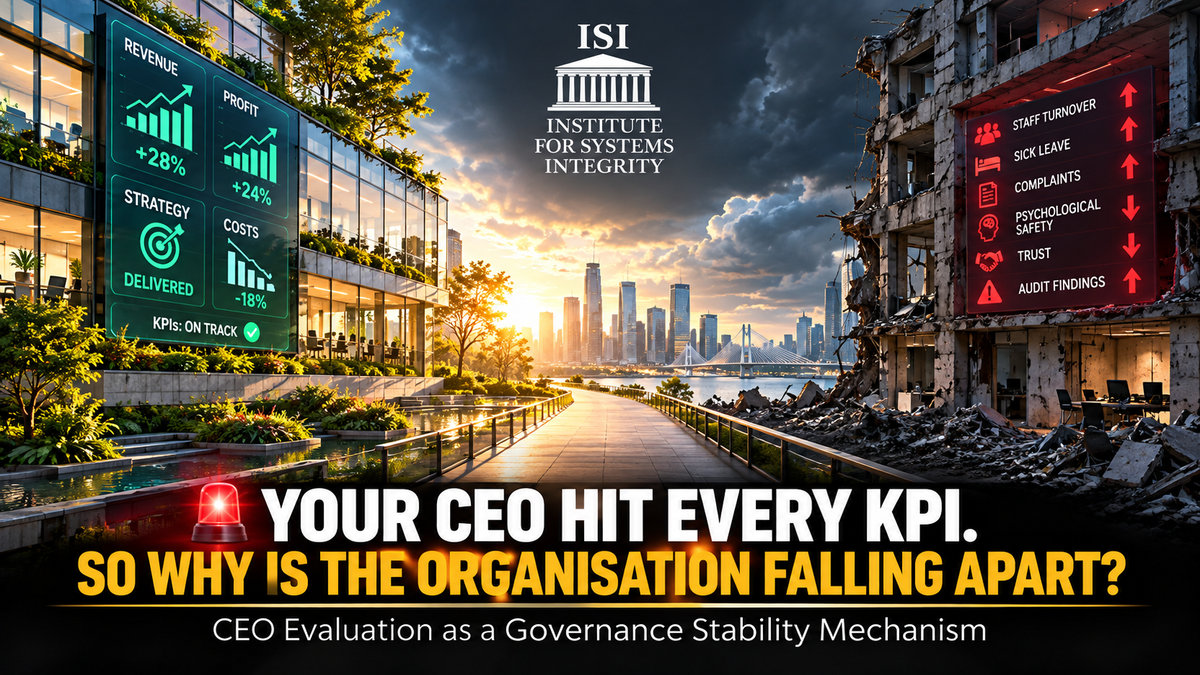
When boards reward the numbers but fail to measure what producing those numbers is doing to the organisation
Dr Alwin Tan, GAICD, MBBS, FRACS, EMBA (Melbourne Business School)
Senior Surgeon | Governance Leader | HealthTech Co-founder | Founder of Institute for Systems Integrity (ISI) | Harvard Medical School — AI in Healthcare | University of Oxford — Sustainable Enterprise | Bastas Academy for Healthcare Leadership — Triple Scholar
Institute for Systems Integrity (ISI)
When boards reward the numbers but fail to measure what producing those numbers is doing to the organisation
THE CEO DELIVERED.
Revenue up.
Margin up.
Costs down.
Strategy milestones achieved.
Projects delivered.
The dashboard is green.
The remuneration committee approves the bonus.
There is only one problem.
The organisation underneath those numbers may be deteriorating.
Good people are leaving.
Sick leave is climbing.
Staff no longer challenge senior leaders.
Customer complaints are increasing.
Audit findings keep returning.
Psychological safety is falling.
Middle managers are exhausted.
Near misses are becoming normal.
And people have started saying privately what they have stopped saying publicly.
Yet the CEO remains classified as:
“Exceeding expectations.”
Perhaps the uncomfortable question is not whether the CEO has performed.
Perhaps it is:
WHAT IF THE BOARD HAS BEEN MEASURING THE WRONG THING?
1. THE KPI CAN BE GREEN WHILE THE ORGANISATION IS RED
Boards need KPIs.
This paper is not an argument against them.
Financial performance, strategy execution, productivity, growth and capital management matter enormously.
But a KPI tells the board something very specific:
whether a defined target has been achieved.
It does not necessarily tell the board:
what achieving that target has done to the organisation.
A CEO can reduce costs by reducing organisational capacity.
Increase productivity by intensifying workload.
Deliver projects by normalising unsustainable effort.
Protect margins by postponing investment.
Reduce reported incidents by creating a culture in which people become reluctant to report them.
Improve apparent stability by surrounding themselves with executives who no longer challenge them.
In each case, the KPI may improve.
The system may not.
That distinction changes CEO evaluation fundamentally.
2. WE HAVE CONFUSED MEASUREMENT WITH PERFORMANCE
Boards understandably gravitate towards what can be quantified.
Revenue.
EBITDA.
Return on capital.
Growth.
Cost.
Market share.
Project completion.
They look objective.
Culture is messier.
Trust is messier.
Psychological safety is messier.
Workforce exhaustion is messier.
The quality of challenge reaching the CEO is much harder to put into a spreadsheet.
But:
DIFFICULT TO MEASURE DOES NOT MEAN UNIMPORTANT TO GOVERN.
The contemporary governance direction increasingly recognises this.
The AICD warns boards to think carefully about performance measures because people naturally direct behaviour towards achieving the targets against which they are assessed, particularly when incentives are attached.
APRA's CPS 511 goes further in regulated institutions: remuneration frameworks must promote management of financial and non-financial risks, sustainable performance and long-term soundness, while material non-financial measures must affect performance-related variable remuneration. APRA
The OECD similarly states that executive remuneration should align with the company's longer-term interests, and notes the role of appropriate sustainability goals and metrics. OECD
This gives us an important governance principle:
WHAT A BOARD REWARDS IS NOT JUST WHAT IT MEASURES.IT IS WHAT IT TEACHES THE ORGANISATION TO PRIORITISE.
3. A KPI IS A BEHAVIOURAL INSTRUCTION
Imagine telling a CEO:
Increase margin by 8%.
Then adding:
“We also care deeply about our people.”
Which instruction wins when they conflict?
The one appearing in the remuneration formula usually has considerably more organisational force than the one appearing on the values poster.
That is why CEO scorecards do more than measure performance.
They shape behaviour.
Targets influence executives.
Executives influence managers.
Managers influence frontline behaviour.
Frontline behaviour produces organisational outcomes.
The CEO scorecard therefore propagates through the organisation.
A board may never tell employees:
“Hit the target at any cost.”
It doesn't have to.
Poorly designed incentives can transmit that message for it.
APRA explicitly recognises this relationship by requiring remuneration frameworks to align business objectives, risk management, sustainable performance and conduct risk. APRA
4. TRICKER'S GOVERNANCE DILEMMA HAS MOVED INTO THE CEO SCORECARD
Tricker's classic governance distinction separates board responsibilities between broadly:
Performance
Strategy.
Value creation.
and:
Conformance
Accountability.
Oversight.
Control.
Neither is sufficient alone.
Too much conformance can produce bureaucratic governance that protects procedure while suffocating enterprise.
Too much performance orientation can allow growth and financial achievement to outrun controls, risk management and institutional integrity.
But there is a deeper implication.
Boards can formally recognise both dimensions while constructing CEO evaluation overwhelmingly around one.
That creates what ISI describes as:
Performance Dominance Drift™
The board has not abandoned governance.
The audit committee still meets.
Risk registers still exist.
Policies remain approved.
Culture surveys continue.
But everyone gradually learns which numbers determine whether the CEO is considered successful.
And therefore which numbers matter most.
5. THE BOARD MAY BE REWARDING THE CEO FOR BORROWING FROM THE FUTURE
Consider two CEOs.
CEO A
Profit ↑
Growth ↑
Costs ↓
But:
Turnover ↑
Burnout ↑
Complaints ↑
Trust ↓
Control failures ↑
CEO B
Profit grows more slowly.
But:
Capability ↑
Retention ↑
Trust ↑
Controls ↑
Succession depth ↑
Psychological safety ↑
Which CEO performed better?
A conventional annual scorecard may favour CEO A.
A five-year organisational perspective may tell a very different story.
Because some performance is real value creation.
And some performance is simply:
TODAY'S RESULTS PURCHASED WITH TOMORROW'S ORGANISATIONAL CAPACITY.
The OECD's governance principles explicitly connect longer-term company success with stakeholder considerations, including attracting, retaining and developing productive employees. OECD
6. STOP CALLING CULTURE AND WORKFORCE HEALTH “SOFT”
Culture.
Employee wellbeing.
Psychological safety.
Speak-up behaviour.
Trust.
Leadership credibility.
These are often placed on the softer side of the board agenda.
That distinction is becoming increasingly difficult to sustain.
The UK's current Corporate Governance Code guidance states that transparency and accountability are reflected in stakeholder relationships, speak-up culture, ethics and compliance. It describes positive working culture as supporting organisational resilience and performance, and places ultimate responsibility on the board for ensuring workforce policies and practices align with purpose, values and desired culture. FRC (Financial Reporting Council)
These variables can affect:
retention,
conduct,
safety,
decision quality,
innovation,
risk detection,
customer experience,
and eventually financial performance.
They are not decorations around performance.
They are part of the machinery that produces it.
7. BUT DO NOT TURN EVERYTHING INTO ANOTHER KPI
Here is where the argument becomes more complicated.
The answer is not to replace five financial KPIs with 25 culture KPIs.
Nor should boards assume:
Happy employees = excellent CEO.
Leadership sometimes requires unpopular decisions.
Restructuring may be necessary.
Poor performers may need to be held accountable.
An unviable business may need to close.
Resources sometimes need to be reallocated.
Employee satisfaction could temporarily deteriorate because leadership is confronting problems that previous leaders avoided.
So culture surveys cannot become popularity contests.
And wellbeing metrics cannot become automatic determinants of executive bonuses.
Otherwise we simply replace one simplistic scorecard with another.
8. DASHBOARD ≠ CEO EVALUATION ≠ REMUNERATION
This distinction is crucial.
There are three separate governance questions:
What should the board SEE?
What should influence the board's JUDGEMENT of the CEO?
What should mechanically affect REMUNERATION?
They are not the same.
A board might need visibility of employee turnover without making turnover a bonus metric.
It may need psychological-safety data without attaching 10% of remuneration to a survey score.
It may need customer complaints without automatically penalising a CEO whenever complaints rise.
Why?
Because governance requires context and judgement.
The OECD supports measurable longer-term executive performance criteria while emphasising alignment among remuneration, strategy, governance and risk management. OECD
The answer is not more arithmetic.
It is better governance.
9. ISI PROPOSES THREE DIFFERENT SIGNALS
Rather than placing everything into one scorecard, boards should distinguish:
1. Outcome KPIs
What did we achieve?
Financial performance.
Growth.
Strategic delivery.
Productivity.
Customer/patient outcomes.
2. System Health Indicators™
What condition is the organisation in?
Workforce sustainability.
Culture.
Psychological safety.
Trust.
Control effectiveness.
Leadership depth.
Conduct.
Capability.
3. Divergence Signals™
Are performance and organisational health moving apart?
This third category may be the most important.
Because individual numbers rarely tell the whole story.
Patterns do.
10. THE BOARD SHOULD BECOME OBSESSED WITH CONTRADICTIONS
Consider:
Revenue ↑ / Employee trust ↓
Productivity ↑ / Sick leave ↑
Costs ↓ / Critical vacancies ↑
Growth ↑ / Complaints ↑
Reported incidents ↓ / Speak-up confidence ↓
Projects delivered ↑ / Executive turnover ↑
Profit ↑ / Repeat audit findings ↑
None proves leadership failure.
But each creates a question.
Several moving simultaneously create a governance signal.
ISI calls this:
Performance–System Divergence™
The point at which reported organisational performance and underlying organisational health begin travelling in opposite directions.
That is precisely when a board should become curious.
Not accusatory.
Not complacent.
Curious.
11. CEO EVALUATION SHOULD BECOME A CONTROL LOOP
The conventional model looks like this:
TARGET → RESULT → SCORE → BONUS
That is a scorecard.
ISI proposes something different:
EXPECTATIONS
↓
CEO DECISIONS & BEHAVIOURS
↓
ORGANISATIONAL CONDITIONS
↓
OUTCOMES
↓
INDEPENDENT SIGNALS BACK TO THE BOARD
↓
CHALLENGE • JUDGEMENT • CONSEQUENCE
↺
That is a Governance Stability Loop™.
And it changes the board's role.
The board is no longer merely asking whether management delivered.
It is asking whether the system producing those results remains healthy enough to continue delivering them.
12. THE CEO CANNOT BE THE SOLE AUTHOR OF THE CEO'S PERFORMANCE STORY
This is another uncomfortable governance problem.
Where does the board obtain information about:
culture?
executive relationships?
psychological safety?
employee trust?
leadership behaviour?
organisational resistance?
Sometimes from the CEO and executive team themselves.
That creates obvious information asymmetry.
Independent directors are particularly important precisely where management's interests and the organisation's interests may diverge; the OECD specifically identifies executive remuneration and management evaluation among areas where independent judgement matters. OECD
Boards therefore need triangulation.
Employee data.
Customers.
Whistleblowing and speak-up channels.
Risk functions.
Audit.
Regulators.
Exit data.
Independent culture assessments where appropriate.
Direct workforce engagement.
The principle is simple:
THE PERSON BEING EVALUATED SHOULD NOT CONTROL THE EVIDENCE THROUGH WHICH THEY ARE EVALUATED.
13. FIVE QUESTIONS BEFORE ANYTHING BECOMES A CEO METRIC
Before adding another measure, boards should ask:
MATERIALITY
Does it genuinely matter to sustainable organisational performance?
CAUSALITY
Is there a plausible connection between this indicator and the outcome we care about?
CONTROLLABILITY
Can the CEO materially influence it?
INTEGRITY
Can the information be independently verified?
CONSEQUENCE
What will the board actually do if it deteriorates?
If the board cannot answer these questions, the measure may belong on the dashboard.
It probably does not belong in the bonus formula.
14. THE REAL CEO PERFORMANCE QUESTION
At the end of the year, boards traditionally ask:
Did the CEO deliver?
Perhaps every CEO evaluation should now contain a second question:
WHAT CONDITION IS THE ORGANISATION IN BECAUSE OF HOW THE CEO DELIVERED?
That question changes everything.
Because revenue matters.
Profit matters.
Growth matters.
Strategy matters.
But so do:
people,
trust,
culture,
controls,
capability,
safety,
and organisational resilience.
A CEO who improves the first group by destroying the second has not necessarily created value.
They may simply have transferred costs across time.
CONCLUSION
Boards should not abandon KPIs.
They should stop confusing KPIs with the totality of CEO performance.
The contemporary governance challenge is not:
financial versus non-financial.
Nor:
performance versus people.
Nor even:
profit versus culture.
It is understanding whether the system producing today's results is becoming stronger or weaker.
APRA now explicitly connects executive remuneration with financial and non-financial risk, conduct, sustainable performance and long-term soundness. APRA
The OECD connects executive oversight and remuneration with long-term corporate interests and sustainability. OECD
And international governance guidance increasingly places culture, workforce practices, ethics and speak-up within board oversight. FRC (Financial Reporting Council)
The direction is clear.
CEO evaluation should evolve from:
Did they hit the number?
to:
What produced the number?
What did producing it cost?
Can the organisation do it again?
And:
DID THE CEO LEAVE THE ORGANISATION STRONGER THAN THEY FOUND IT?
Because there may be few greater governance failures than:
REWARDING A CEO FOR EXCELLENT PERFORMANCE —
ONLY TO DISCOVER THAT THE PERFORMANCE WAS ACHIEVED BY CONSUMING THE ORGANISATION THAT PRODUCED IT.
That is why CEO evaluation should not merely be a scorecard.
It should be a Governance Stability Mechanism™.
References — Harvard style
Australian Institute of Company Directors (AICD) (n.d.) Principle 6: Performance. Sydney: AICD.
Australian Prudential Regulation Authority (APRA) (2026) Prudential Practice Guide CPG 511 Remuneration. Sydney: APRA. APRA
Australian Prudential Regulation Authority (APRA) (2023) Prudential Standard CPS 511 Remuneration. Sydney: APRA. APRA
Financial Reporting Council (FRC) (2024) UK Corporate Governance Code 2024. London: Financial Reporting Council. FRC (Financial Reporting Council)
Financial Reporting Council (FRC) (2024) Corporate Governance Code Guidance. London: Financial Reporting Council. FRC (Financial Reporting Council)
Ittner, C.D. and Larcker, D.F. (2003) ‘Coming up short on nonfinancial performance measurement’, Harvard Business Review, 81(11), pp. 88–95.
Ittner, C.D., Larcker, D.F. and Randall, T. (2003) ‘Performance implications of strategic performance measurement in financial services firms’, Accounting, Organizations and Society, 28(7–8), pp. 715–741.
OECD (2023) G20/OECD Principles of Corporate Governance 2023. Paris: OECD Publishing. doi:10.1787/ed750b30-en. OECD
Tricker, B. (2019) Corporate Governance: Principles, Policies and Practices. 4th edn. Oxford: Oxford University Press.