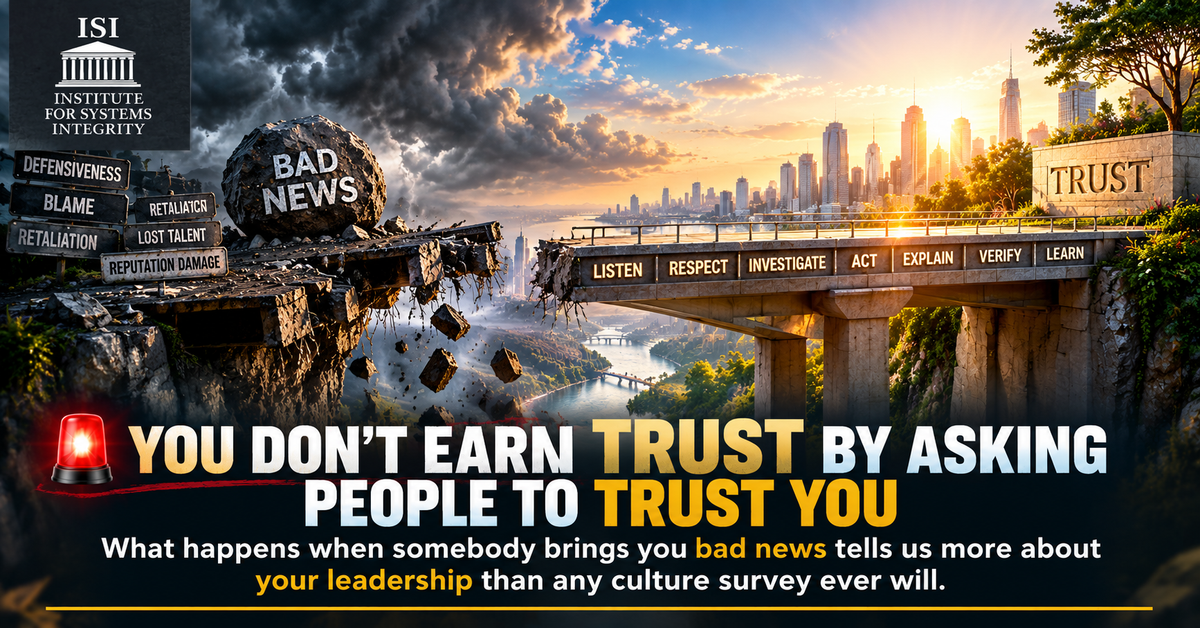
🚨 YOU DON’T EARN TRUST BY ASKING PEOPLE TO TRUST YOU What happens when somebody brings you bad news tells us more about your leadership than any culture survey ever will.
Every organisation says trust matters. But trust is not measured when everyone agrees. It is tested when someone brings bad news to power. This paper examines what happens next—and why the response may reveal more about organisational culture than any trust survey.
Dr Alwin Tan, GAICD, MBBS, FRACS, EMBA (Melbourne Business School)
Senior Surgeon | Governance Leader | HealthTech Co-founder | Founder of Institute for Systems Integrity (ISI) | Harvard Medical School — AI in Healthcare | University of Oxford — Sustainable Enterprise | Bastas Academy for Healthcare Leadership — Triple Scholar
What happens when somebody brings you bad news tells us more about your leadership than any culture survey ever will.
Every organisation says trust matters.
We measure it.
Survey it.
Workshop it.
Put it in leadership frameworks.
Print it in annual reports.
CEOs tell employees:
“My door is always open.”
Boards are reassured:
“Management has a strong culture.”
Then one day somebody walks through that open door carrying information the leader does not want to hear.
The strategy is failing.
The numbers are wrong.
The patient is deteriorating.
The production line is unsafe.
The project is months behind.
The customer is being harmed.
The AI model is drifting.
The executive everyone trusts may be the problem.
NOW WE GET TO MEASURE TRUST.
Because trust is not demonstrated when everybody agrees with leadership.
TRUST IS TESTED WHEN TELLING THE TRUTH BECOMES PERSONALLY EXPENSIVE.
And what happens next tells us almost everything.
AMAZON GETS SOMETHING IMPORTANT RIGHT
Amazon's Earn Trust principle expects leaders to listen attentively, speak candidly, treat people respectfully and be vocally self-critical, including when that is awkward or embarrassing. Amazon CEO Andy Jassy has further described Earn Trust as distinct from simply being nice or avoiding disagreement: it includes listening, respectful challenge, delivering commitments and being self-critical when things are not going well. Amazon News
That matters.
Leadership development has spent decades teaching executives how to project:
confidence,
certainty,
control,
decisiveness,
credibility.
Perhaps we have spent less time teaching powerful people how to say:
“I WAS WRONG.”
“YOU SAW SOMETHING I MISSED.”
“MY DECISION CONTRIBUTED TO THIS.”
“WE NEED TO CHANGE COURSE.”
Those sentences do not necessarily destroy trust.
Sometimes they are what earns it.
INCLUSION OPENS THE DOOR.
TRUST IS DETERMINED BY WHAT HAPPENS AFTER SOMEBODY WALKS THROUGH IT.
Our previous Institute for Systems Integrity paper asked:
CAN TRUTH TRAVEL UPHILL?
This paper asks what may be an even harder question:
WHAT HAPPENS WHEN THE TRUTH ARRIVES?
THE SAME LEADERSHIP TEST. DIFFERENT INDUSTRIES.
The circumstances change.
The hierarchy changes.
The language changes.
The consequences change.
But the human behaviour can be remarkably similar.
🏥 HEALTHCARE
It is 2:00 am.
A junior nurse believes a postoperative patient is deteriorating.
The observations are technically still within an acceptable range.
But the nurse has been watching the patient for hours.
Something has changed.
They call the registrar.
“I'm still worried.”
The registrar can say:
“The numbers are fine. Keep monitoring.”
Or:
“Tell me what you're seeing.”
The nurse is not merely testing the escalation policy.
They are learning something about the organisation:
WHAT HAPPENS HERE WHEN SOMEONE JUNIOR REFUSES TO STOP BEING CONCERNED?
In healthcare, psychological safety can become physical safety.
✈️ AVIATION
The aircraft is descending.
The captain is experienced.
The first officer notices something they believe is wrong.
There is very little time.
The first officer now has two problems.
One is technical.
The other is hierarchical.
How hard can I challenge the person flying the aircraft?
A mature safety system does not rely solely on the captain being approachable.
It builds challenge into professional practice.
Because in high-consequence environments:
AUTHORITY MUST EXIST.
BUT AUTHORITY MUST REMAIN CHALLENGEABLE.
🏭 MANUFACTURING
The production target is behind.
The plant has promised the customer delivery tomorrow.
A frontline worker notices something abnormal.
Stopping the line means lost production.
Continuing means hitting today's KPI.
The worker reaches for the stop mechanism.
Now watch the supervisor's face.
That reaction may teach fifty employees more about the company's safety culture than fifty PowerPoint presentations.
Does the supervisor ask:
“What did you see?”
Or:
“Do you realise what this stoppage is costing us?”
SOMETIMES THE REAL SAFETY POLICY IS WRITTEN ON THE MANAGER'S FACE.
🏗️ CONSTRUCTION
A subcontractor notices something unsafe.
The programme is already late.
Every lost hour costs money.
The company proudly advertises Stop Work Authority.
The worker stops the job.
Technically, the policy worked.
But what happens tomorrow?
Are they thanked?
Ridiculed?
Moved?
Given fewer shifts?
Remembered as “difficult”?
That is the difference between having an escalation policy and having an escalation culture.
A RIGHT THAT CARRIES A HIDDEN PENALTY IS NOT MUCH OF A RIGHT.
🏦 BANKING AND FINANCIAL SERVICES
Quarter-end approaches.
The business is close to target.
A risk analyst identifies transactions or assumptions that make the numbers look considerably less comfortable.
The executive has choices.
Investigate.
Escalate.
Adjust.
Disclose.
Or ask:
“Are you absolutely sure?”
Then:
“Is this really material?”
Then:
“Could this wait until next quarter?”
Nobody needs to order anyone to falsify anything.
Sometimes organisational pressure works more subtly.
People learn which questions executives welcome.
And which questions threaten careers.
CULTURE DOES NOT NEED TO TELL PEOPLE TO HIDE BAD NEWS.
IT ONLY NEEDS TO TEACH THEM WHAT HAPPENS TO PEOPLE WHO KEEP RAISING IT.
💻 TECHNOLOGY
The product launch is next week.
Marketing is ready.
Customers have been promised delivery.
Millions have already been spent.
An engineer identifies a security vulnerability.
The vulnerability might never be exploited.
Fixing it will delay launch.
The engineering lead walks into the executive meeting.
Now trust becomes measurable.
Does leadership ask:
“How serious could this become?”
Or:
“Can we ship and patch later?”
The engineer will remember that conversation.
So will everyone else in the room.
Because:
THE FIRST PERSON WHO BRINGS BAD NEWS TEACHES LEADERS ABOUT THE PROBLEM.
THE LEADER'S RESPONSE TEACHES EVERYONE ELSE ABOUT THE CULTURE.
🤖 ARTIFICIAL INTELLIGENCE
The AI system performed beautifully during validation.
Six months later, frontline clinicians notice something odd.
The model has not necessarily changed.
But the population has.
Workflow has changed.
Data has changed.
Clinical practice has changed.
The anecdotes no longer match the dashboard.
Amazon's Dive Deep principle is relevant here too: leaders are expected to remain connected to detail, audit frequently and be sceptical when metrics and anecdotes diverge. Amazon News
The governance question is therefore not simply:
“Did the AI pass validation?”
It becomes:
“WHAT HAPPENS WHEN THE FRONTLINE TELLS US THE VALIDATED MODEL NO LONGER LOOKS RIGHT?”
Trusting technology is not governance.
Continuous assurance is.
🛒 RETAIL
Head office introduces a new staffing model.
The spreadsheet says productivity improves.
Labour costs fall.
The KPI goes green.
Store managers say something different:
queues are longer,
staff are exhausted,
customer complaints are increasing,
experienced employees are leaving.
Head office has data.
The frontline has experience.
Which one does leadership trust?
The right answer may be:
Investigate why they disagree.
Because a dashboard should not automatically outrank reality.
🚚 LOGISTICS
The distribution centre is under enormous pressure.
Volumes are high.
The shift is short-staffed.
A team leader believes the target cannot be achieved safely.
Operations leadership says:
“Everyone is under pressure. We just need to execute.”
The target is eventually achieved.
Leadership celebrates.
But employees have learned something dangerous:
The number mattered more than the warning.
That lesson will survive long after the KPI resets.
⛏️ MINING
A worker detects something that does not feel right underground.
Production is interrupted.
Equipment sits idle.
Costs accumulate by the minute.
The worker's authority to stop work may be written into policy.
But again, policy is not the real test.
The real test comes later.
IS THE PERSON WHO STOPPED PRODUCTION TREATED AS SOMEONE WHO PROTECTED THE BUSINESS — OR SOMEONE WHO COST THE BUSINESS MONEY?
That answer determines whether the next person stops the job.
🏛️ GOVERNMENT AND PUBLIC SERVICE
A policy has already been announced.
The Minister has defended it.
The department has invested months developing it.
Implementation has begun.
An analyst produces evidence suggesting an important assumption may be wrong.
At this point, changing direction carries political, financial and reputational cost.
The analyst is no longer merely presenting evidence.
They are challenging institutional commitment.
Now watch what happens.
Is the evidence tested?
Or is the analyst asked to “reframe” the briefing?
THE MORE AN ORGANISATION HAS INVESTED IN AN ANSWER, THE MORE COURAGE IT MAY TAKE TO HEAR EVIDENCE THAT THE ANSWER IS WRONG.
🎓 UNIVERSITIES
A junior academic raises concerns about methodology, research integrity, supervision or departmental culture.
The professor involved is internationally recognised.
They attract funding.
They publish.
They have influence.
Formally, the junior academic has every right to raise the concern.
Informally, they understand the power structure perfectly.
That is where governance becomes real.
A REPORTING SYSTEM IS ONLY AS STRONG AS ITS ABILITY TO INVESTIGATE PEOPLE THE ORGANISATION CANNOT AFFORD TO UPSET.
⚖️ PROFESSIONAL SERVICES
A junior lawyer, accountant or consultant discovers a problem with work already approved by a partner.
The client relationship is valuable.
The deadline is approaching.
The partner's reputation is attached to the advice.
The junior professional now faces an uncomfortable calculation:
Do I protect the work—or challenge the person who controls my career?
That is why ethics cannot depend solely on individual courage.
Systems must make challenge structurally possible.
🏢 THE EXECUTIVE TEAM
The CEO has championed a transformation for two years.
Millions have been invested.
Consultants engaged.
Teams restructured.
Careers attached to it.
The COO finally says:
“I don't think this is working.”
Silence.
Everyone looks at the CEO.
This may be one of the most important moments in the entire transformation.
Not because the COO is necessarily right.
But because everyone is about to learn:
CAN THE CEO'S FAVOURITE IDEA BE CHALLENGED WITHOUT CHALLENGING THE CEO'S IDENTITY?
🪑 THE BOARDROOM
The CEO is exceptional.
Results have been strong.
Investors like them.
Directors trust them.
Management presents another green dashboard.
Then one director says:
“The stories we're hearing from the frontline don't match these numbers.”
Another director says:
“I trust management.”
That sentence sounds reassuring.
It should also make us slightly uncomfortable.
Because:
“WE TRUST THE CEO” MUST NEVER BECOME “THEREFORE WE DON'T NEED TO VERIFY THE CEO.”
Trust should strengthen governance.
It should never replace it.
THE TRUST EVIDENCE GAP™
This is why ISI proposes looking beyond trust surveys.
WHAT LEADERS SAY
“Speak up.”
“We value transparency.”
“Mistakes are learning opportunities.”
“We welcome challenge.”
“My door is always open.”
“You can trust us.”
WHAT PEOPLE WATCH
Who gets promoted.
Who gets protected.
Who gets blamed.
Who gets excluded.
Who gets heard.
Who gets labelled difficult.
Who admits mistakes.
Whether executives face the same accountability as everyone else.
Whether bad news reaches the board intact.
And most importantly:
WHAT HAPPENED TO THE LAST PERSON WHO CHALLENGED SOMEONE POWERFUL?
The distance between organisational rhetoric and lived experience is what we call:
THE TRUST EVIDENCE GAP™
AND TRUST ITSELF CAN BECOME DANGEROUS
This is the uncomfortable counterargument.
Trust is usually presented as something organisations need more of.
But Skinner, Dietz and Weibel challenge the assumption that trust is universally beneficial, examining circumstances in which it can become a “poisoned chalice.” Trust necessarily involves vulnerability, expectations and obligations.
So perhaps the governance objective is not maximum trust.
It is appropriate trust supported by verification.
Healthcare:
Trust the consultant. Check the dose.
Aviation:
Respect the captain. Challenge the decision when necessary.
Banking:
Trust management. Audit the numbers.
Technology:
Trust the engineer. Test the system.
AI:
Trust validation. Monitor performance.
Boardrooms:
Trust the CEO. Independently assure the assumptions.
TRUST WITHOUT CHALLENGE CAN BECOME COMPLACENCY.
TRUST WITHOUT VERIFICATION CAN BECOME GOVERNANCE FAILURE.
THE TRUST ACCOUNTABILITY LOOP™
ISI therefore proposes:
LISTEN → ACKNOWLEDGE → EXAMINE → ACT → EXPLAIN → VERIFY → LEARN
LISTEN — Receive uncomfortable information.
ACKNOWLEDGE — Demonstrate that it was actually heard.
EXAMINE — Investigate the evidence, not the personality of the messenger.
ACT — Correct what requires correction.
EXPLAIN — Close the loop, including when advice is rejected.
VERIFY — Demonstrate that the corrective action worked.
LEARN — Change the system.
Without verification, organisations can finish with:
“Trust us. We've fixed it.”
Systems integrity demands something stronger:
SHOW US.
STOP SHOWING THE BOARD THE TRUST SCORE
Show the board where trust was tested.
Ask:
“SHOW US THREE OCCASIONS WHERE FRONTLINE CHALLENGE CHANGED AN EXECUTIVE DECISION.”
Ask:
“WHICH MANAGEMENT ASSUMPTIONS DID WE INDEPENDENTLY VERIFY?”
Ask:
“WHEN DID A SENIOR LEADER LAST PUBLICLY SAY, ‘I WAS WRONG’?”
Ask:
“WHAT CHANGED AFTERWARDS?”
And then ask the question that may tell us more about organisational culture than another hundred-slide employee survey:
“SHOW US THE EVIDENCE THAT PEOPLE CAN TELL POWER THE TRUTH WITHOUT PAYING A PRICE.”
TRUST IS NOT COMFORT
Sometimes trust looks like a difficult conversation.
A nurse refusing to stop escalating.
A pilot challenging the captain.
A worker stopping production.
An engineer delaying the launch.
An analyst questioning the forecast.
A store manager challenging head office.
A public servant presenting inconvenient evidence.
A junior professional challenging the partner.
A director interrogating the CEO.
And sometimes:
A CEO looking at the room and saying:
“I GOT THIS WRONG.”
That may be leadership at its strongest.
Because Amazon's own explanation of Earn Trust makes an important distinction: trust is not about constant agreement or social cohesion; it includes reliability, candour, respectful disagreement and owning mistakes. Amazon News
TRUST IS NOT WHAT LEADERS ASK PEOPLE TO GIVE THEM.
TRUST IS WHAT THE SYSTEM EARNS THROUGH REPEATED EVIDENCE.
So the next time the employee survey says:
“People trust leadership.”
Don't stop there.
Ask what happened when the numbers were bad.
Ask what happened when the deadline was threatened.
Ask what happened when the whistleblower became inconvenient.
Ask what happened when the board's preferred strategy was challenged.
Ask what happened when the junior person was right.
And the senior person was wrong.
Then ask perhaps the simplest question of all:
WHAT HAPPENED TO THE LAST PERSON WHO TOLD YOUR MOST POWERFUL LEADER SOMETHING THEY DID NOT WANT TO HEAR?
Find that person.
Follow what happened next.
THERE IS YOUR TRUST CULTURE.
Harvard references
Amazon (2026) Leadership Principles. Amazon. Available at: Amazon Leadership Principles (Accessed: 28 September 2026). Amazon News
Coutifaris, C.G.V. and Grant, A.M. (2022) ‘Taking your team behind the curtain: The effects of leader feedback-sharing and feedback-seeking on team psychological safety’, Organization Science, 33(4), pp. 1574–1598.
Detert, J.R. and Burris, E.R. (2007) ‘Leadership behavior and employee voice: Is the door really open?’, Academy of Management Journal, 50(4), pp. 869–884.
Dirks, K.T. and Ferrin, D.L. (2002) ‘Trust in leadership: Meta-analytic findings and implications for research and practice’, Journal of Applied Psychology, 87(4), pp. 611–628.
Gao, L., Janssen, O. and Shi, K. (2011) ‘Leader trust and employee voice: The moderating role of empowering leader behaviors’, The Leadership Quarterly, 22(4), pp. 787–798.
Kim, P.H., Cooper, C.D., Dirks, K.T. and Ferrin, D.L. (2013) ‘Repairing trust with individuals vs. groups’, Organizational Behavior and Human Decision Processes, 120(1), pp. 1–14.
Mayer, R.C., Davis, J.H. and Schoorman, F.D. (1995) ‘An integrative model of organizational trust’, Academy of Management Review, 20(3), pp. 709–734.
O'Donovan, R. and McAuliffe, E. (2020) ‘A systematic review exploring the content and outcomes of interventions to improve psychological safety, speaking up and voice behaviour’, BMC Health Services Research, 20, 101.
Skinner, D., Dietz, G. and Weibel, A. (2014) ‘The dark side of trust: When trust becomes a “poisoned chalice”’, Organization, 21(2), pp. 206–224.