
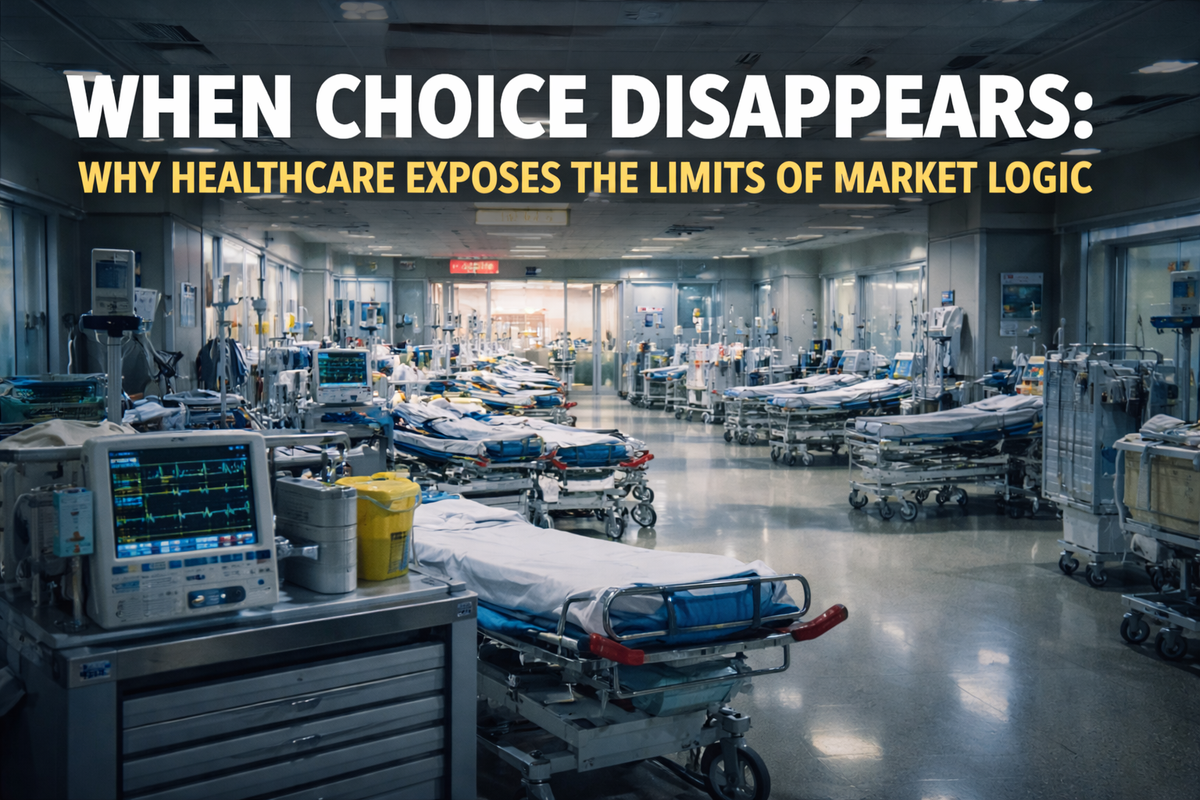
When Choice Disappears: Why Healthcare Exposes the Limits of Market Logic
A systems-level analysis of why healthcare behaves differently from ordinary markets, especially when urgency, dependence, and information asymmetry remove consumer choice
Dr Alwin Tan, MBBS, FRACS, EMBA (Melbourne Business School)
Senior Surgeon | Governance Leader | HealthTech Co-founder
Harvard Medical School — AI in Healthcare
Australian Institute of Company Directors — GAICD candidate
University of Oxford — Sustainable Enterprise
Institute for Systems Integrity (ISI) Paper
Markets are powerful systems.
They can allocate resources, reward innovation, create competition, and drive efficiency. In many sectors, they outperform central planning precisely because they respond to price signals, customer preference, and competitive pressure.
But markets are not magic.
They depend on conditions.
And when those conditions disappear, market logic can fail.
Healthcare is one of the clearest examples.
Not because markets have no role in healthcare.
But because the moments that matter most in healthcare often occur under conditions where markets function least effectively.
That is the systems lesson.
The Five Conditions Markets Prefer
For competitive markets to work well, several conditions usually help:
- informed buyers
- transparent pricing
- time to compare options
- low switching costs
- bargaining power between buyer and seller
These conditions are common when purchasing travel, electronics, food, or many professional services.
They are far less common when purchasing emergency healthcare.
A patient with sepsis, trauma, stroke, internal bleeding, or acute respiratory failure does not operate as a conventional consumer.
They may not know what is wrong.
They may not know what treatment is needed.
They may have minutes to act.
They may have no mobility.
They may have no ability to compare providers.
They may be unconscious.
That changes the system.
Arrow’s landmark analysis argued that healthcare differs from standard markets because uncertainty and information asymmetry are structural features, not peripheral imperfections (Arrow 1963).
When Choice Disappears
Much healthcare commentary uses the language of choice.
Choice of insurer.
Choice of doctor.
Choice of hospital.
Choice of treatment.
In lower-acuity settings, this can be meaningful.
But in acute illness, choice often narrows rapidly.
The ambulance route, clinical urgency, network restrictions, geography, bed capacity, and referral pathways may determine destination more than consumer preference.
This matters because markets discipline price partly through exit.
When exit becomes impossible, pricing power can shift.
Evidence from concentrated provider markets in the United States has shown that hospital consolidation can raise prices, often without commensurate quality gains (Cooper et al. 2019; KFF 2020).
This is not a moral argument.
It is a structural one.
Healthcare Is Not One Market
One persistent policy error is speaking of “healthcare” as though it were a single economic environment.
It is not.
Healthcare contains multiple sub-markets with different dynamics:
Consumer-Compatible Segments
- wellness products
- fitness technology
- elective convenience care
- cosmetic procedures
- preventive subscriptions
- some telehealth services
Mixed Segments
- planned elective surgery
- diagnostics
- chronic disease management
- private insurance purchasing
Market-Fragile Segments
- emergency medicine
- intensive care
- trauma
- neonatal care
- mental health crisis
- catastrophic illness
Treating these as economically identical creates design failure.
Why Every Serious System Builds Guardrails
Even countries with substantial private sectors usually retain mechanisms such as:
- pooled insurance or tax funding
- public hospitals
- medicine price negotiation
- emergency access guarantees
- subsidy systems
- licensing and safety regulation
- consumer protections
- limits on catastrophic out-of-pocket exposure
Why?
Because societies eventually discover that unbuffered vulnerability creates instability.
World Health Organization frameworks treat financial protection as a core objective of health-system design, not an optional add-on (WHO 2025).
The issue is not whether markets are useful.
The issue is whether markets alone can absorb human vulnerability without distortion.
The Governance Failure Hidden in Plain Sight
Boards and policymakers often ask:
“How do we make healthcare more efficient?”
A valid question.
But incomplete.
The governance-critical question is:
Efficient for whom, under what conditions, and at what hidden cost?
If efficiency is achieved by:
- delaying access
- transferring costs to patients
- compressing clinician time
- overloading staff
- exploiting information gaps
- narrowing service availability
then apparent efficiency may be deferred harm.
Systems frequently move cost before they remove cost.
That distinction matters.
The Better Model: Contextual Capitalism
The most resilient health systems are rarely purely statist or purely market-driven.
They are hybrids.
They use:
- competition where comparison is realistic
- regulation where bargaining power collapses
- public funding where risk is catastrophic
- private innovation where value is demonstrable
- governance where incentives distort behaviour
- clinician input where operational reality matters
This is not ideological compromise.
It is adaptive design.
Final Observation
Healthcare is where elegant theories meet biological reality.
And biology does not wait for pricing models.
A smartwatch can be a market.
A wellness app can be a market.
But a ruptured appendix at 2 a.m. is not.
The systems that understand this earliest will govern healthcare best.
Harvard References
Arrow, K.J. 1963, ‘Uncertainty and the welfare economics of medical care’, American Economic Review, vol. 53, no. 5, pp. 941–973.
Barber, S.L., Lorenzoni, L. & Ong, P. 2019, Price Setting and Price Regulation in Health Care, OECD Publishing, Paris.
Cooper, Z., Craig, S.V., Gaynor, M. & Van Reenen, J. 2019, ‘The price ain’t right? Hospital prices and health spending on the privately insured’, Quarterly Journal of Economics, vol. 134, no. 1, pp. 51–107.
Kaiser Family Foundation 2020, What We Know About Provider Consolidation, KFF, San Francisco.
World Health Organization 2025, Universal Health Coverage (UHC), WHO, Geneva.