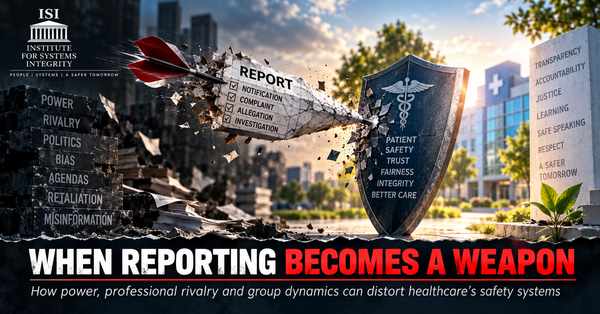
Employee Assistance Programmes and the Illusion of Care : Why Underutilisation Is a System Signal, Not a Workforce Failure
Employee Assistance Programmes are widely promoted as workplace care, yet remain underused. This paper argues low uptake is not a workforce failure, but a system signal—revealing misalignment between organisational intent and the conditions that create employee distress.
Co Authors:
Assoc. Prof. Nainaben Dhana DCRT (London), HDRT( South Africa) Grad Cert EBP ( Monash) , ACA registered Counsellor
RT Education and Quality Lead, Adjunct Industry Associate Professor of RMIT, AUSCEP participant (2025-26) &
Dr Alwin Tan, GAICD, MBBS, FRACS, EMBA (Melbourne Business School)
Senior Surgeon | Governance Leader | HealthTech Co-founder
Harvard Medical School — AI in Healthcare
Australian Institute of Company Directors — GAICD graduate
University of Oxford — Sustainable Enterprise
Institute for Systems Integrity (ISI)
Abstract
Employee Assistance Programmes (EAPs) are widely adopted as mechanisms to support employee wellbeing. Yet utilisation remains persistently low across industries and jurisdictions. Conventional explanations focus on stigma, awareness, and access barriers. This paper challenges that framing.
Drawing on emerging literature, including Long’s (2024) labour process analysis, we argue that underutilisation is not a failure of employees or programme design alone, but a signal of system misalignment. EAPs are typically deployed downstream, while the drivers of distress remain embedded upstream in workload design, organisational culture, leadership behaviour, and incentive structures.
We introduce the concept of “Care Displacement”—where organisations signal concern through support services without altering the conditions that generate harm—and examine the governance implications of treating EAPs as symbolic rather than structural interventions.
The paper reframes EAPs as diagnostic instruments of system strain, not standalone solutions, and outlines governance requirements for restoring integrity between organisational intent and employee experience.
1. Introduction: The Paradox of Available Support
Across healthcare, corporate, and public sectors, Employee Assistance Programmes are promoted as accessible, confidential support services.
Yet a persistent paradox remains:
Support is available.
Utilisation is low.
This paradox has been repeatedly observed in the literature (Joseph, Walker & Fuller-Tyszkiewicz 2018; Long 2024).
The dominant explanations are familiar:
- stigma
- lack of awareness
- access barriers
These explanations are not incorrect.
But they are incomplete.
They focus on the individual decision to seek help, rather than the system that creates the need for help in the first place.
2. Reframing the Problem: From Utilisation to System Design
Long (2024) provides a critical shift in perspective by applying labour process analysis to EAP utilisation.
Rather than asking:
“Why don’t employees use EAPs?”
The more relevant question becomes:
“Why might employees rationally choose not to use them?”
This reframing surfaces three structural tensions:
2.1 Trust and Alignment
EAPs are employer-funded services.
Employees may question:
- confidentiality
- independence
- alignment with their interests
Where trust is uncertain, utilisation will remain low.
2.2 Proximity to Harm
EAPs are positioned downstream.
They respond to:
- burnout
- distress
- psychological injury
But do not directly address:
- excessive workload
- unsafe staffing
- poor leadership behaviour
This creates a structural mismatch.
2.3 Symbolic Versus Structural Action
EAPs can function as visible signals of organisational care.
But when underlying conditions remain unchanged, they risk becoming:
symbolic responses to structural problems
3. Care Displacement: A Systems Integrity Failure
We introduce the concept of Care Displacement.
Definition:
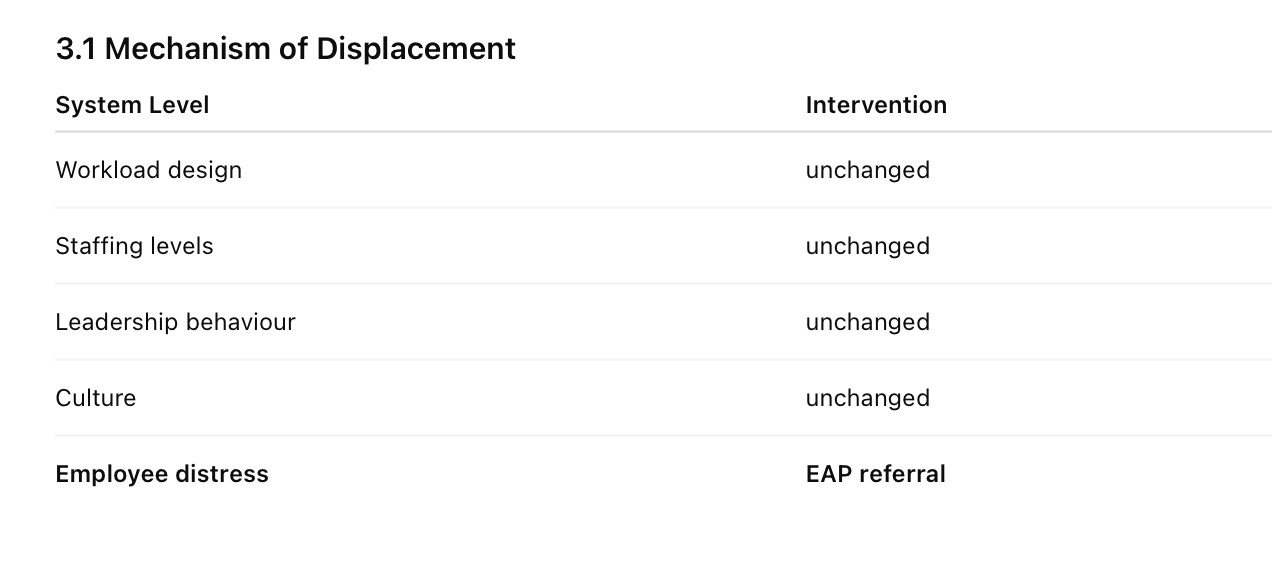
The transfer of responsibility for managing system-generated distress
from the organisation to the individual.
This occurs when:
- harm originates in system design
- remediation is offered at the individual level
3.1 Mechanism of Displacement
3.2 Consequences
Care Displacement produces predictable outcomes:
- low utilisation
- perceived irrelevance
- erosion of trust
- normalisation of distress
From a governance perspective, this represents a failure of alignment between stated values and operational reality.
4. What the Evidence Actually Shows
The literature presents a nuanced picture.
4.1 Evidence of Benefit
EAP use has been associated with:
- improved functioning
- reduced presenteeism
(Joseph, Walker & Fuller-Tyszkiewicz 2018)
4.2 Evidence of Constraint
However:
- utilisation remains low
- outcomes vary by organisational context
- trust and climate significantly influence engagement
(Bouzikos et al. 2022; Xiao, Cooke & Wang 2024)
4.3 Structural Insight
Long (2024) extends this by demonstrating that:
Underutilisation may be a rational response to perceived misalignment between employee needs and organisational intent.
5. EAPs as Diagnostic Signals
Rather than asking whether EAPs are effective, we propose a different framing:
What does low utilisation reveal about the system?
5.1 EAP Utilisation as a Signal
Low engagement may indicate:
- low psychological safety
- lack of trust in confidentiality
- perceived lack of organisational responsiveness
- misalignment between support and lived experience
5.2 Misinterpretation Risk
Organisations often interpret low utilisation as:
- low demand
- programme success
- cost efficiency
This is a critical error.
From a systems perspective:
Low utilisation is not absence of need.
It is potential evidence of signal suppression.
6. Governance Implications
EAPs should not be governed as standalone wellbeing initiatives.
They should be governed as part of an integrated system of:
- workforce design
- risk management
- organisational culture
- leadership accountability
6.1 Board-Level Questions
Boards should ask:
- What are the primary drivers of distress in our organisation?
- How do EAP usage patterns correlate with workload and staffing data?
- What level of psychological safety exists for help-seeking?
- How is confidentiality assured and communicated?
- Are we addressing causes or managing consequences?
6.2 Risk Framing
EAP underutilisation should be treated as:
a leading indicator of system strain and cultural misalignment
7. From Intervention to Integration
The future of EAPs lies not in expansion, but integration.
Effective systems will:
- align EAPs with psychosocial risk management
- embed them within leadership accountability frameworks
- link utilisation data with operational metrics
- treat them as part of organisational sensing systems
8. Conclusion
EAPs do not fail because they are ineffective.
They fail when they are expected to solve problems they did not create.
The persistent underutilisation of EAPs is not a workforce problem.
It is a system signal.
Until organisations address:
- how work is designed
- how leaders behave
- how culture operates
EAPs will remain:
visible, available, and underused.
The governance challenge is not to increase utilisation.
It is to restore alignment between:
what organisations say they care about
and what their systems actually produce.
References (Harvard style)
Bouzikos, S., Le Roux, C., Dunford, B.B. & Dollard, M.F. 2022, ‘Contextualising the effectiveness of an employee assistance programme intervention on psychological health: The role of corporate climate’, International Journal of Environmental Research and Public Health, vol. 19, no. 9.
Joseph, B., Walker, A. & Fuller-Tyszkiewicz, M. 2018, ‘Evaluating the effectiveness of employee assistance programmes: A systematic review’, European Journal of Work and Organizational Psychology, vol. 27, no. 1, pp. 1–15.
Long, T. 2024, ‘Why are employee assistance programmes under-utilised and marginalised and how to address it? A critical review and a labour process analysis’, Human Resource Management Journal, vol. 34, no. 4, pp. 1134–1153.
Long, T. & Cooke, F.L. 2023, ‘Advancing the field of employee assistance programs research and practice’, Human Resource Management Review, vol. 33.
Xiao, Q., Cooke, F.L. & Wang, J. 2024, ‘Framing a strategic, stakeholder and contextual view of employee assistance programmes’, International Journal of Management Reviews, vol. 26, no. 4.
Attridge, M. 2019, ‘A global perspective on promoting workplace mental health and the role of employee assistance programs’, American Journal of Health Promotion, vol. 33, no. 4.