How Boards Set Good Culture — Including the Risks of Tribalism and Bias : Culture as a control system for truth, behaviour, and risk
Boards do not control behaviour directly. They shape the conditions under which behaviour occurs — including whose voice is heard, how risk is escalated, and whether truth reaches the board intact.
Dr Alwin Tan, GAICD,MBBS, FRACS, EMBA (Melbourne Business School)
Senior Surgeon | Governance Leader | HealthTech Co-founder |
Harvard Medical School — AI in Healthcare |
Australian Institute of Company Directors — GAICD graduate |
University of Oxford — Sustainable Enterprise
By Institute for Systems Integrity (ISI)
Executive summary
Organisational culture is often described as intangible.
In practice, it is not.
Culture is the control system that determines whether truth moves, risk is surfaced, and behaviour aligns with intent.
Across major failures — financial services, healthcare, aviation, and public institutions — the pattern is consistent:
Organisations rarely fail because rules were absent.
They fail because culture altered how those rules were applied.
Boards that treat culture as a “soft” concept are not governing the layer where failure begins.
Culture is a system — not a sentiment
Culture is commonly framed as:
- values,
- tone,
- or engagement.
This framing is incomplete.
Evidence from regulatory inquiries and system failures shows that culture operates as a dynamic control systemcomposed of three interacting elements:
1. Signal integrity
Whether information — particularly bad news — moves upward accurately and early.
2. Incentive alignment
Whether the organisation rewards behaviour consistent with its stated intent.
3. Response discipline
How consistently the organisation reacts to breaches, deviations, and early warnings.
When these elements align, culture reinforces governance.
When they misalign, culture overrides it.
The distortion layer: tribalism, hierarchy, and bias
Culture is not neutral.
It is shaped by power structures and group dynamics that determine whose voice is heard and whose is discounted.
These include:
- tribalism (in-groups vs out-groups),
- hierarchy bias (seniority overriding evidence),
- professional silos (e.g. discipline-based authority),
- cultural or racial bias (unequal weighting of voices).
These forces introduce a distortion layer into the system.
They do not remove information.
They reshape it.
How distortion occurs
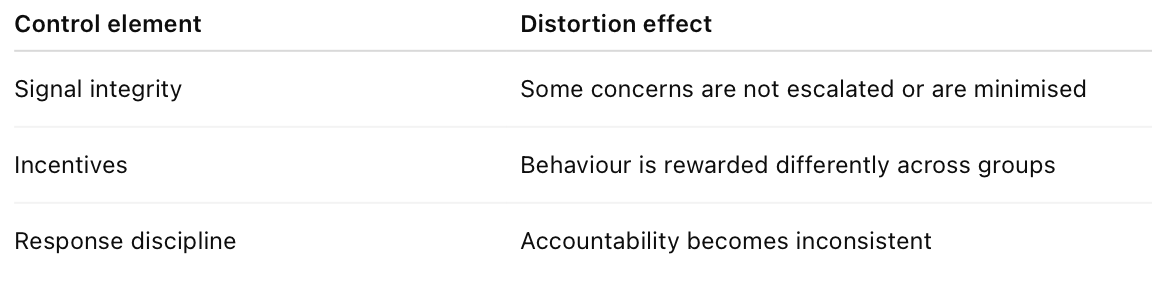
The result is predictable:
Truth does not fail to exist.
It fails to reach decision-makers intact.
Why this is a governance issue
These dynamics are often framed as:
- culture,
- diversity,
- or workforce issues.
This is a categorisation error.
When distortion exists:
- risk signals become unevenly distributed,
- escalation pathways become unreliable,
- accountability becomes selective,
- and boards receive partial reality.
This is not a people issue.
It is a system integrity failure.
How boards actually set culture
Boards do not control behaviour directly.
They shape the conditions under which behaviour occurs.
Five governance levers determine cultural outcomes:
1. Board attention
What the board consistently focuses on becomes organisational priority.
- Effective boards interrogate how results are achieved, not just outcomes.
- Ineffective boards accept performance without examining behaviour.
2. Incentive structures
Incentives determine behavioural alignment.
- Effective systems reward conduct, escalation, and integrity.
- Distorted systems reward results irrespective of behaviour.
3. Response to failure
Culture is defined in the organisation’s response to adverse events.
- Effective responses reinforce learning and accountability.
- Distorted responses minimise, delay, or selectively assign responsibility.
4. Information flow
Boards rely on signals shaped by culture.
- High-integrity systems allow direct, unfiltered escalation.
- Distorted systems produce curated reporting and delayed visibility.
5. Boardroom behaviour
Boards model the culture they expect.
- Effective boards demonstrate constructive challenge and independence.
- Distorted boards exhibit over-collegiality and deference.
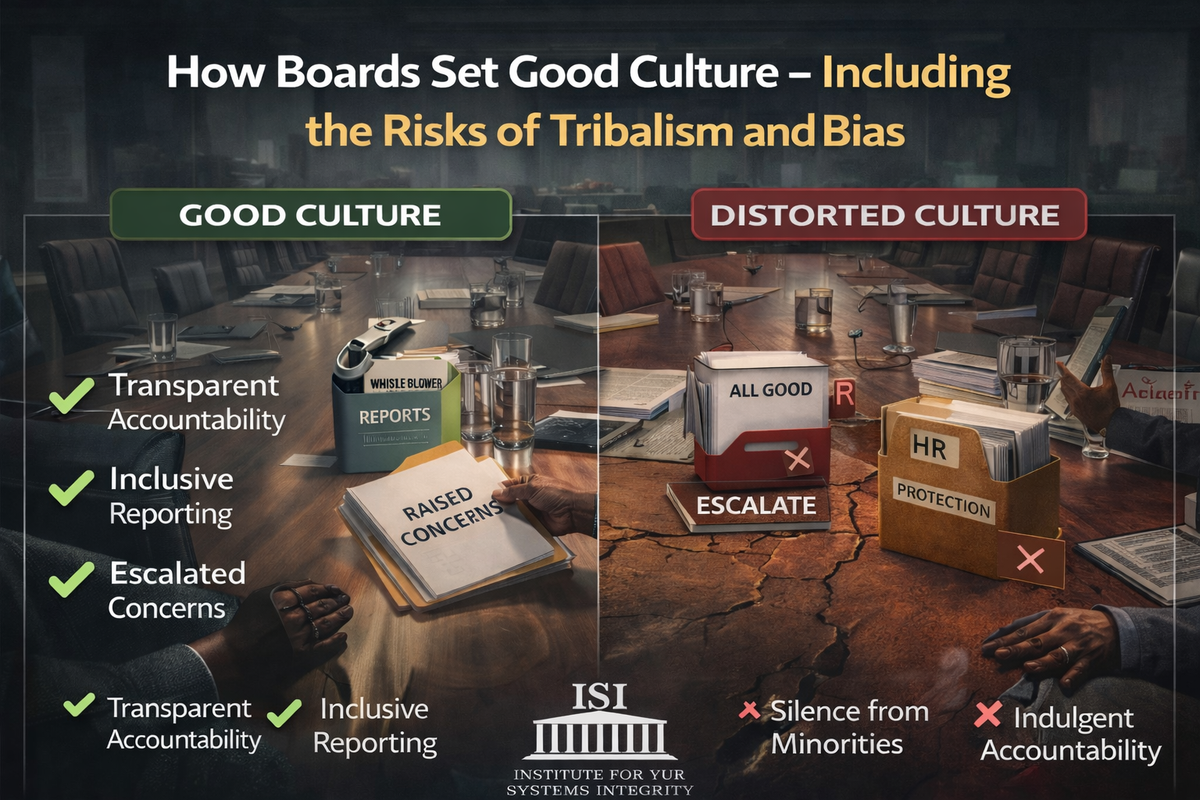
What good culture looks like
A high-integrity culture is not defined by harmony.
It is defined by signal clarity and behavioural consistency.
Observable characteristics include:
- early escalation of concerns,
- willingness to challenge authority,
- consistent application of rules,
- transparency in incident handling,
- equal weighting of voices across hierarchy and groups.
From a board perspective, this environment often feels:
- uncomfortable,
- incomplete,
- and dynamic.
This aligns with APRA’s concept of:
“chronic unease” — structured vigilance as a control mechanism.
What distorted culture looks like
Distorted culture does not appear chaotic.
It often appears stable.
Observable characteristics include:
- delayed or suppressed escalation,
- normalisation of deviations,
- protection of in-groups or high performers,
- inconsistent accountability,
- divergence between policy and practice.
From a board perspective, this environment feels:
- smooth,
- controlled,
- and predictable.
Until it is not.
This reflects:
“chronic ease” — a state of dangerous comfort.
Evidence from major inquiries
Banking Royal Commission
The Royal Commission found:
- misconduct was often known,
- but not escalated or acted upon,
- with incentives prioritising profit over conduct.
The failure was behavioural, not regulatory.
APRA Prudential Inquiry into CBA
APRA identified:
- complacency,
- reactivity,
- insularity,
- and insufficient challenge.
Critically, it highlighted how board and executive dynamics contributed to cultural failure.
The governance shift: from legality to legitimacy
Modern governance expectations have evolved.
Boards are no longer assessed solely on:
- compliance,
- legality,
- or performance.
They are assessed on judgement.
Events such as:
- the destruction of Juukan Gorge,
- and failures in casino governance,
demonstrate:
Legal permission does not guarantee legitimacy.
Seeing culture: board-level indicators
Culture is observable through system signals:
- absence of bad news at board level,
- misalignment between policy and practice,
- delayed escalation of issues,
- inconsistent consequences,
- under-representation of certain voices,
- over-reliance on a single reporting channel.
A consistent pattern across failures is:
If the board only hears good news, signal integrity has already failed.
ISI position
Culture must be governed as a control system with a distortion layer.
Boards should explicitly test:
1. Signal integrity
Are we hearing the truth — and from whom?
2. Incentive alignment
Are behaviours rewarded consistently across groups?
3. Response discipline
Are similar behaviours producing similar consequences?
4. Distortion risk
Where are hierarchy, tribalism, or bias affecting outcomes?
Failure in these domains is not cultural ambiguity.
It is a governance failure.
Conclusion
Culture determines whether:
- truth travels,
- risk is visible,
- and decisions are made with integrity.
Boards are not judged solely on outcomes.
They are judged on:
- what they knew,
- when they knew it,
- and what they chose to act on.
Culture sits at the centre of that judgement.
Not as a soft concept.
But as the system that determines whether reality reaches the board intact.
Harvard-style references (ISI)
APRA 2018, Prudential Inquiry into the Commonwealth Bank of Australia: Final Report, Australian Prudential Regulation Authority, Sydney.
ASIC 2016, The Importance of Corporate Culture, speech by G Medcraft, Australian Securities and Investments Commission, Sydney.
ASX Corporate Governance Council 2019, Corporate Governance Principles and Recommendations, 4th edn, ASX, Sydney.
Australian Government 1995, Criminal Code Act 1995 (Cth), Commonwealth of Australia, Canberra.
Commonwealth of Australia 2019, Royal Commission into Misconduct in the Banking, Superannuation and Financial Services Industry: Final Report, Canberra.
OECD 2023, G20/OECD Principles of Corporate Governance, OECD Publishing, Paris.