🚨 THE TRANSFORMATION DELUSION : Why Most Change Programs Fail Before They Begin
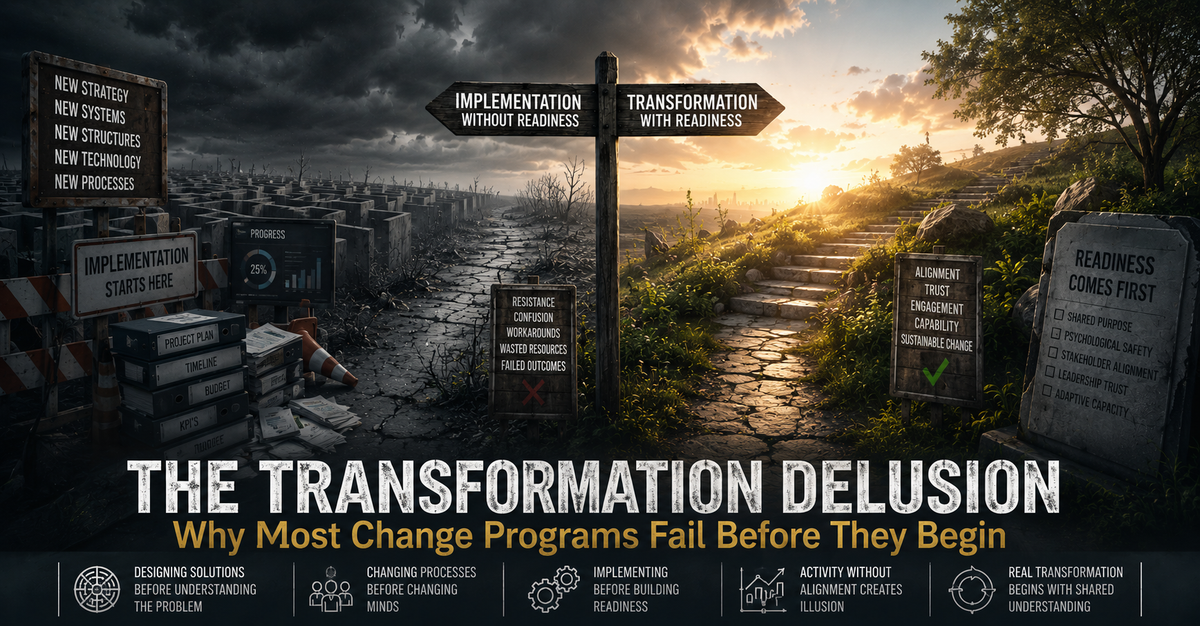
Most change programmes fail before implementation begins because organisations try to change processes before creating trust, capability, shared understanding and readiness.
Dr Alwin Tan, GAICD, MBBS, FRACS, EMBA (Melbourne Business School)
Senior Surgeon | Governance Leader | HealthTech Co-founder |
Harvard Medical School — AI in Healthcare |
Australian Institute of Company Directors — GAICD graduate |
University of Oxford — Sustainable Enterprise
Executive Summary
Organisations invest billions every year in transformation. Digital platforms, artificial intelligence, restructures, mergers, new operating models and governance reforms promise better performance, greater efficiency and sustainable growth.
Yet most transformations fail to deliver what they promise.
The problem is rarely poor implementation. The problem is that organisations misunderstand what transformation actually is.
Transformation is not the installation of new technology, the redesign of processes or the launch of a strategic programme.
Transformation is the collective adoption of a new understanding of reality.
Until leaders recognise this distinction, they will continue to confuse activity with progress, implementation with transformation and project success with organisational success.
The Transformation Delusion
Transformation almost always follows the same script.
A problem is identified.
Leaders design a solution.
Funding is approved.
Technology is purchased.
Governance structures are established.
Training commences.
Implementation begins.
Months later the programme is declared successful.
Yet something important has not changed.
The organisation still behaves exactly as it did before.
The technology works. The behaviours do not.
The project succeeded. The transformation failed.
Implementation changes systems.
Transformation changes people.
Confusing the two has become one of modern management's greatest mistakes.
Transformation Begins Before Implementation
Most transformation programmes begin with an assumption that is rarely questioned.
"If we build a better future, people will naturally move towards it."
Research and experience suggest otherwise.
People do not change because leaders announce a compelling future.
People change when they collectively conclude that the present is no longer acceptable.
Understanding the problem comes before embracing the solution.
Leaders often spend enormous effort explaining where the organisation is going.
Far fewer spend enough time helping people understand why remaining where they are has become impossible.
Without that shared understanding, implementation becomes compliance rather than commitment.
Projects move. People do not.
What Organisational Research Has Been Telling Us
Nearly eighty years ago, Kurt Lewin proposed that successful transformation begins with Unfreezing, before change can occur.
John Kotter later argued that creating urgency is the first responsibility of leadership.
Edgar Schein demonstrated that culture changes only when underlying assumptions change.
Karl Weick showed that organisations act according to the meaning people assign to events rather than objective reality itself.
Amy Edmondson demonstrated that psychological safety determines whether people experiment, learn and adapt.
Although these scholars approached transformation differently, they reached a remarkably similar conclusion.
Transformation begins by changing shared understanding before changing behaviour.
Modern organisations frequently reverse this sequence.
They redesign processes first.
They hope understanding follows.
It rarely does.
Resistance Is Usually Misdiagnosed
Leaders often say people resist change.
Most do not.
People resist losing something valuable.
Control.
Competence.
Identity.
Status.
Trust.
Predictability.
What organisations dismiss as resistance is often valuable information.
It reveals where trust is weak.
Where assumptions differ.
Where communication has failed.
Where capability is inadequate.
Resistance is rarely the problem. It is often the diagnosis.
The most effective leaders do not suppress resistance.
They study it.
The Readiness Gap
Organisations carefully assess implementation readiness.
Financial readiness.
Technical readiness.
Operational readiness.
Regulatory readiness.
Cybersecurity readiness.
Far fewer assess the conditions that determine whether transformation can succeed.
Do people trust leadership?
Do they understand why change is necessary?
Do they believe success is achievable?
Do they feel psychologically safe enough to learn?
Do they possess the capability required?
Technology rarely limits transformation. Human readiness does.
The Readiness Illusion
Many organisations mistake activity for readiness.
Town halls.
Training sessions.
Communication campaigns.
Leadership videos.
Newsletters.
These activities demonstrate communication.
They do not demonstrate understanding.
Attendance is not commitment.
Communication is not comprehension.
Training is not confidence.
Implementation is not transformation.
Readiness exists only when people share a common understanding of why change is necessary and how they contribute to it.
Transformation Readiness Integrity™
The Institute for Systems Integrity proposes that organisations should govern something largely absent from conventional transformation programmes.
Transformation Readiness Integrity™
Transformation Readiness Integrity is the degree to which an organisation possesses the psychological, cultural and organisational conditions necessary for sustainable transformation.
It depends upon five interconnected elements:
- Shared understanding
- Trust
- Psychological safety
- Capability
- Collective ownership
Weakness in any one of these undermines every implementation activity that follows.
Projects can proceed despite poor readiness. Transformation cannot.
Transformation Is an Information Integrity Problem
Transformation failures are often described as implementation failures.
A better explanation exists.
Most transformation failures are failures of organisational information integrity.
As information travels through organisations it is translated, filtered, simplified and interpreted.
Executives believe employees understand because presentations have been delivered.
Employees believe executives understand because meetings have occurred.
Neither assumption is necessarily correct.
Reality gradually loses fidelity as it moves through organisational layers.
Different parts of the organisation eventually begin solving different problems.
Transformation fails because organisations lose shared reality before implementation even begins.
The Governance Blind Spot
Boards receive reassuring transformation dashboards.
Projects remain on schedule.
Budgets remain within tolerance.
Milestones are completed.
Deliverables are achieved.
Meanwhile the conditions required for success quietly deteriorate.
Trust declines.
Learning slows.
Psychological safety weakens.
Capability erodes.
Operational engagement falls.
The most dangerous transformation programmes are not those running behind schedule.
They are those delivering perfectly into organisations that are not ready to receive them.
This is not merely a project failure.
It is a governance failure.
Projects Have Milestones. Transformation Has Thresholds.
Projects measure activity.
Transformation measures adoption.
A milestone reports:
"The platform has been successfully deployed."
A transformation threshold asks:
"Are people making fundamentally different decisions because of it?"
Those are entirely different questions.
Technology enables transformation. Behaviour confirms it.
Many organisations celebrate implementation while failing to notice that decision-making remains unchanged.
The Transformation Integrity Model™
Sustainable transformation follows a predictable sequence.
Shared Reality
↓
Shared Urgency
↓
Shared Trust
↓
Shared Capability
↓
Shared Ownership
↓
Behaviour Change
↓
Process Change
↓
Technology Adoption
↓
Sustainable Transformation
Technology appears near the end because it amplifies transformation.
It rarely creates it.
The Systems Integrity Test
Before approving any major transformation initiative, boards should ask:
- Do people genuinely agree there is a problem?
- Do they understand why change is necessary?
- Do they trust those leading it?
- Do they feel psychologically safe?
- Do they believe success is achievable?
- Do they understand their role?
- Are we solving the right problem?
If these questions cannot be answered confidently, implementation should pause.
Implementation is not the beginning of transformation.
It is evidence that transformation has already begun.
Implications for Boards
Boards should spend less time asking:
"Is the project on track?"
And considerably more time asking:
"Is the organisation becoming ready?"
Alongside budgets and milestones, boards should monitor:
- Trust
- Psychological safety
- Shared understanding
- Leadership credibility
- Learning capability
- Change fatigue
- Cross-functional alignment
- Transformation Readiness Integrity™
The most valuable transformation dashboard may not measure project activity.
It may measure whether the organisation has become capable of genuine change.
Conclusion
Most organisations do not fail because they cannot change.
They fail because they misunderstand how change actually happens.
Transformation is not the deployment of technology.
It is not the launch of a programme.
It is not the publication of a strategy.
Transformation occurs when people collectively adopt a different understanding of reality.
Everything else follows.
Processes.
Technology.
Governance.
Performance.
These are consequences of transformation. They are not its cause.
Until leaders learn to create readiness before implementation, organisations will continue confusing movement with progress, activity with transformation and successful projects with genuine organisational change.
The greatest governance failure is not launching the wrong transformation.
It is launching the right transformation before the organisation is ready.
Key Quote
"The greatest transformation risk is not poor execution. It is beginning before the organisation is ready."
References (Harvard)
Argyris, C. (1991) ‘Teaching Smart People How to Learn’, Harvard Business Review, 69(3), pp. 99–109.
Beer, M. and Nohria, N. (2000) ‘Cracking the Code of Change’, Harvard Business Review, 78(3), pp. 133–141.
Edmondson, A.C. (1999) ‘Psychological Safety and Learning Behavior in Work Teams’, Administrative Science Quarterly, 44(2), pp. 350–383.
Hiatt, J. (2006) ADKAR: A Model for Change in Business, Government and Our Community. Loveland, CO: Prosci.
Kotter, J.P. (1995) ‘Leading Change: Why Transformation Efforts Fail’, Harvard Business Review, 73(2), pp. 59–67.
Kotter, J.P. (1996) Leading Change. Boston, MA: Harvard Business School Press.
Lewin, K. (1947) ‘Frontiers in Group Dynamics’, Human Relations, 1(1), pp. 5–41.
Schein, E.H. (2017) Organizational Culture and Leadership. 5th edn. Hoboken, NJ: Wiley.
Weick, K.E. (1995) Sensemaking in Organizations. Thousand Oaks, CA: Sage Publications.