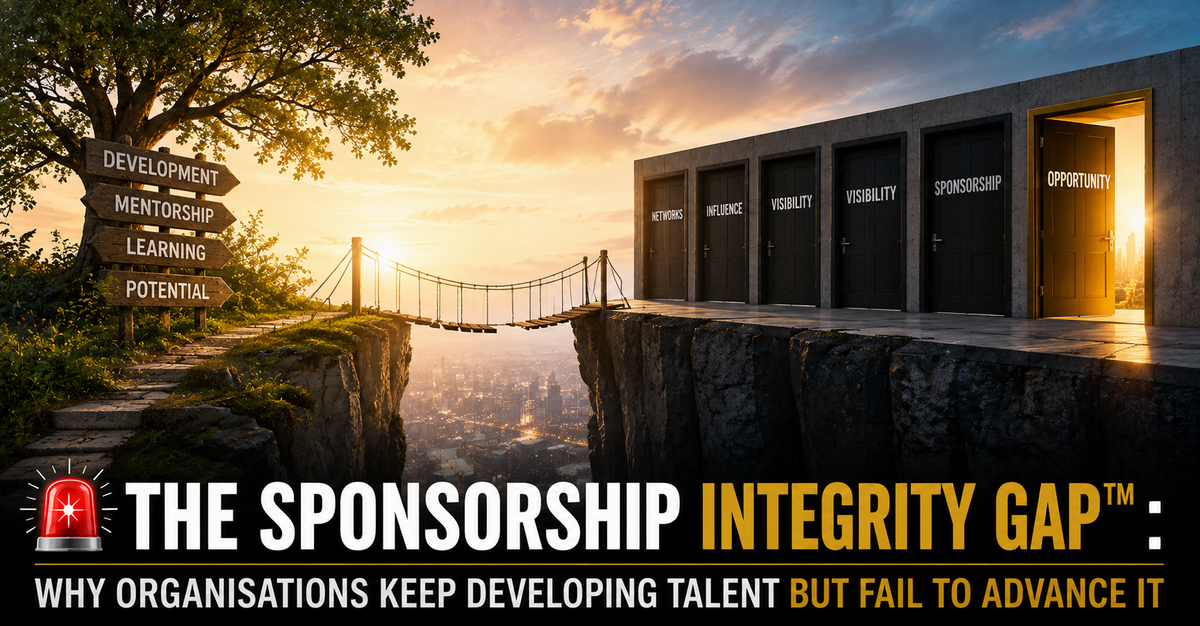
🚨 THE SPONSORSHIP INTEGRITY GAP : Why Organisations Keep Developing Talent But Fail to Advance It
Organisations invest heavily in developing talent. But who actually gets the opportunity to advance? The Sponsorship Integrity Gap™ examines how visibility, advocacy and informal networks shape who eventually leads.
Dr Alwin Tan, GAICD, MBBS, FRACS, EMBA (Melbourne Business School)
Senior Surgeon | Governance Leader | HealthTech Co-founder | Founder of Institute for Systems Integrity (ISI) |Harvard Medical School — AI in Healthcare| University of Oxford — Sustainable Enterprise | Bastas Academy for Healthcare Leadership - Triple Scholar
INSTITUTE FOR SYSTEMS INTEGRITY
“Find a mentor.”
It is one of the most common pieces of career advice in healthcare and leadership.
Increasingly, that advice has evolved.
“Find a sponsor.”
The distinction is compelling.
Mentors help people grow.
Sponsors help people advance.
There is truth in that distinction.
But it misses a much larger problem.
The greatest barrier to leadership is often not a lack of mentoring.
Nor even a lack of sponsorship.
It is the absence of integrity in how organisations allocate opportunity.
Because sponsors do not operate in isolation.
They operate inside systems of power, trust, visibility, reputation and governance.
And when those systems disproportionately reward proximity, familiarity, status or existing networks, sponsorship can become another mechanism through which existing advantage reproduces itself.
The question is therefore not simply whether organisations need more sponsors.
The question is whether the system that converts capability into opportunity has integrity.
Mentorship Develops Capability.
Sponsorship Allocates Opportunity.
Mentorship is fundamentally developmental.
Mentors teach.
Challenge.
Encourage.
Correct.
Support.
They help professionals develop knowledge, judgement, confidence and professional capability.
Mentoring has long been associated with professional development, career satisfaction and retention across medicine and academia
Mentorship matters because capability matters.
But capability alone does not determine careers.
Promotion and leadership appointments involve more than technical competence.
They involve:
Trust.
Visibility.
Reputation.
Perceived readiness.
Judgement.
Risk.
And often advocacy.
Sponsors influence these decisions because they lend something more powerful than advice.
They lend credibility.
A sponsor says:
“I know this person.”
“I trust this person.”
“I believe they are ready.”
“I am willing to attach my reputation to them.”
That endorsement can change trajectories.
Not because sponsors possess perfect insight.
But because organisations routinely rely on trusted judgement when making decisions under uncertainty.
So the distinction matters:
Mentorship influences capability.
Sponsorship influences opportunity.
Governance determines whether the relationship between the two has integrity.
The Hidden Assumption Nobody Questions
Most organisations celebrate sponsorship.
Few ask who receives it.
Even fewer ask why.
The underlying assumption is often that sponsorship naturally follows talent.
Research suggests the reality is more complicated.
Studies in academic medicine have identified sponsorship as an important mechanism for career advancement while also describing unequal experiences of sponsorship across gender and groups historically underrepresented in medicine
Networking and access to influential professional relationships can themselves be unevenly distributed
This creates an uncomfortable organisational possibility:
The organisation may develop everyone.
But only advance some.
That is not simply a workforce issue.
It is a governance issue.
Opportunity Is Never Random
Leadership positions do not appear by accident.
Neither do board appointments.
Committee memberships.
Research collaborations.
Conference invitations.
Executive secondments.
Stretch assignments.
Acting roles.
Succession opportunities.
Someone decides.
Someone recommends.
Someone advocates.
Someone says:
“You should consider her.”
“He's ready.”
“Give them this opportunity.”
These moments rarely appear in annual reports.
Yet accumulated over years, they can shape careers, leadership pipelines and ultimately institutional authority.
This exposes a much larger governance issue.
Opportunity allocation may be one of the least visible governance processes inside modern organisations — and one of the most powerful.
The Sponsorship Integrity Gap™
We define the Sponsorship Integrity Gap™ as:
The systematic divergence between demonstrated capability and access to career-advancing advocacy, visibility and opportunity, particularly where that divergence is influenced by proximity, affinity, status or informal networks rather than evidence of readiness.
The gap does not exist simply because one person receives an opportunity and another does not.
Leadership is competitive.
Judgement is necessary.
Not everyone can receive every opportunity.
Different roles legitimately require different capabilities.
The integrity problem arises when patterns of access become persistently disconnected from legitimate evidence of capability, contribution and organisational need.
The gap may emerge when sponsorship becomes driven:
Less by evidence than proximity.
Less by contribution than familiarity.
Less by readiness than visibility.
Less by judgement than politics.
The consequences can accumulate.
Highly capable professionals remain less visible.
Others accumulate increasingly visible experience.
Leadership pipelines narrow.
Trust in merit declines.
Eventually people stop asking:
“How do I become better?”
And begin asking:
“Who do I need to know?”
At that moment, the organisation has more than a career-development problem.
It has a legitimacy problem.
The Sponsorship Reinforcement Loop™
The most important problem with sponsorship may not be any single decision.
It is what happens when opportunity begins to compound.
Consider the pathway:
PROXIMITY
↓
VISIBILITY
↓
ADVOCACY
↓
OPPORTUNITY
↓
EXPERIENCE
↓
CREDIBILITY
↓
PERCEIVED READINESS
↓
GREATER SPONSORSHIP
The cycle can reinforce itself.
Someone receives an important project.
That project creates visibility.
Visibility produces relationships.
Relationships generate advocacy.
Advocacy creates another opportunity.
That opportunity generates experience.
Experience becomes evidence of readiness.
And evidence of readiness justifies the next opportunity.
Nothing necessarily improper has occurred.
That is precisely why the mechanism can be difficult to see.
The Opportunity Compounding Effect™
Opportunity is not simply allocated.
It compounds.
A single stretch assignment may create experience.
Experience creates credibility.
Credibility attracts sponsorship.
Sponsorship creates greater opportunity.
Greater opportunity generates stronger evidence of leadership readiness.
The inverse may also occur.
Someone denied an early high-value opportunity does not merely lose that opportunity.
They may lose the experience it would have created.
Then the visibility.
Then the relationship.
Then the advocacy.
Then the next opportunity.
Years later, two professionals may appear to possess objectively different levels of leadership experience.
But the organisation should ask a harder question:
How much of that difference was capability — and how much was accumulated access to opportunity?
This does not invalidate achievement.
It demands greater sophistication in understanding how achievement becomes possible.
When Sponsorship Reproduces the Existing Organisation
Sponsorship is not inherently virtuous.
Nor is it inherently corrupt.
It is a form of discretionary organisational influence.
And discretionary systems can reproduce patterns even when nobody intends to reproduce them.
Social identity theory demonstrates the significance of group identification in human behaviour .
Research on homophily similarly demonstrates the tendency for relationships and networks to form disproportionately among people who share characteristics or social positions (McPherson, Smith-Lovin and Cook, 2001).
Organisational network and social-capital research further demonstrates that access to relationships and network positions can generate meaningful advantages
The resulting sponsorship pattern may therefore develop without anyone deliberately deciding to exclude others.
Leaders trust people they know.
Those people receive opportunities.
Opportunities create visibility.
Visibility creates credibility.
Credibility produces future leaders.
Those leaders then develop their own trusted networks.
The cycle repeats.
Eventually an organisation can begin to confuse:
familiarity with readiness,
visibility with capability,
and sometimes,
similarity with excellence.
The Case for Informal Sponsorship
The answer is not to eliminate informal sponsorship.
Nor should organisations attempt to bureaucratise every professional relationship.
Trust matters.
Tacit knowledge matters.
Leadership judgement matters.
Senior leaders frequently possess information about people's judgement, behaviour and potential that no performance dashboard can fully capture.
And organisations must often allocate opportunities quickly.
Informal advocacy can therefore be enormously valuable.
The problem is not discretion.
The problem is unexamined discretion repeatedly producing patterned advantage.
The governance challenge is therefore not to remove judgement.
It is to ensure that accumulated discretionary decisions do not quietly become an alternative succession system operating beyond meaningful organisational scrutiny.
The Cost of Sponsorship Without Integrity
The greatest organisational cost may not simply be unfairness.
It may be blindness.
When opportunity repeatedly flows through narrow networks, organisations risk overlooking people who:
Think differently.
Challenge differently.
Notice different risks.
Hold different experiences.
Solve problems differently.
Diversity can broaden the information, perspectives and problem-solving approaches available to organisations.
But diversity alone does not guarantee better decisions.
Difference must also be visible, heard, psychologically safe and capable of influencing institutional judgement.
That creates an uncomfortable paradox.
Organisations may invest heavily in diverse recruitment.
Invest in leadership development.
Invest in mentoring.
Invest in executive education.
Then quietly undermine those investments through opportunity systems that repeatedly favour the already visible.
The Mentorship Trap
Many organisations respond to leadership-pipeline problems by expanding mentoring programmes.
Mentoring is valuable.
But mentoring cannot solve an opportunity-allocation problem.
A professional may:
Complete leadership programmes.
Receive coaching.
Attend conferences.
Gain additional qualifications.
Publish research.
Demonstrate excellent performance.
Develop substantial capability.
And still remain outside the relationships through which career-changing opportunities are allocated.
Development without opportunity eventually becomes frustration.
More importantly, it reveals a fundamental organisational design problem.
Organisations may have sophisticated systems for developing talent and primitive systems for deciding whose talent becomes visible.
We invest heavily in:
CAPABILITY FORMATION
but frequently pay far less attention to:
OPPORTUNITY CONVERSION.
Between the two sit:
Recognition → Visibility → Advocacy → Opportunity
If that bridge lacks integrity, development may never become leadership.
Organisations Do Not Simply Have Talent Pipelines
The language of the “talent pipeline” can itself obscure what actually happens.
It implies capable people naturally progress through an organisational system.
But people do not simply flow upward.
Decisions move them.
Someone nominates them.
Someone assigns them.
Someone invites them.
Someone introduces them.
Someone recommends them.
Someone puts their name into the room.
Perhaps organisations should therefore think less about talent pipelines and more about:
OPPORTUNITY-ALLOCATION SYSTEMS.
Because capability without access does not automatically become leadership.
The Governance Question Nobody Is Asking
Boards routinely receive information about:
Workforce engagement.
Training expenditure.
Leadership programmes.
Succession planning.
Executive turnover.
Diversity.
Organisational culture.
But how often do they ask:
Who enters succession pipelines?
Who receives strategically important assignments?
Who receives acting leadership roles?
Which functions consistently produce future executives?
Which professions remain absent?
Whose names repeatedly appear?
Who is consistently overlooked?
How concentrated are influential sponsorship networks?
Do leadership-development participants subsequently receive meaningful opportunities?
Are some groups being heavily developed but rarely advanced?
These are not questions about individual sponsorship relationships.
Boards should not manage those relationships.
They are questions about patterns.
Management governs the process.
Leaders exercise individual judgement.
Boards oversee whether the resulting system continues to demonstrate integrity.
Because sponsorship ultimately influences who may one day govern the organisation itself.
The Sponsorship Integrity Framework™
The Institute for Systems Integrity proposes that organisations evaluate sponsorship and opportunity allocation through six principles.
1. Evidence Before Advocacy
Sponsorship should be anchored wherever possible in demonstrated capability, contribution, values, judgement and readiness — not merely familiarity or personal loyalty.
2. Visibility of Opportunity
Career-shaping opportunities should not systematically remain hidden inside privileged networks.
Not every opportunity requires an open recruitment process.
But organisations should understand which opportunities materially create leadership capital and how they are being allocated.
3. Diversity of Advocacy
Leadership pipelines should not depend excessively upon one executive, profession, faction or network.
Multiple pathways to visibility reduce dependency and organisational capture.
4. Contestability
Material patterns of opportunity allocation should be capable of legitimate questioning.
Not:
“Why didn't I get everything I wanted?”
But:
“Can the organisation explain how access to career-shaping opportunities is being distributed?”
5. Outcome Intelligence
Organisations should measure more than participation in leadership development.
They should examine what happens afterwards.
Who receives opportunity?
Who progresses?
Who remains invisible?
Who leaves?
Development metrics without advancement intelligence tell only half the story.
6. Governance Oversight
Boards should not supervise individual sponsorship decisions.
They should examine patterns within succession, opportunity allocation and leadership pipelines.
The governance question is not:
“Who sponsored this person?”
It is:
“Does our system reliably convert demonstrated capability into legitimate opportunity?”
Sponsorship Integrity Does Not Mean Equal Outcomes
Integrity does not require everyone to receive the same opportunity.
Nor does it eliminate:
Competition.
Discretion.
Judgement.
Performance differentiation.
Organisational need.
Or legitimate selection.
Equal opportunity does not mean equal outcome.
Sponsorship integrity instead requires reasonable confidence that access to consideration and career-shaping opportunity is not systematically distorted by factors unrelated to legitimate organisational need or demonstrated capability.
The objective is not mechanical equality.
It is trustworthy allocation.
Beyond Sponsorship
The real objective is therefore not simply more sponsorship.
It is:
Trusted sponsorship.
Ethical sponsorship.
Evidence-informed sponsorship.
Contestable sponsorship.
Governed sponsorship.
Because sponsorship is not merely about helping individuals.
It influences who eventually leads:
Hospitals.
Research institutes.
Universities.
Health services.
Professional colleges.
Corporations.
Boards.
It influences whose judgement shapes policy.
Whose experience enters decision-making.
Whose values influence culture.
Whose voices eventually acquire institutional authority.
In other words:
Sponsorship quietly helps determine the future architecture of organisational power.
Conclusion
The familiar saying remains useful:
Mentors help people grow.
Sponsors change trajectories.
But it is incomplete.
Talent does not automatically become leadership.
Capability does not automatically become visibility.
Performance does not automatically become opportunity.
Between talent and leadership sits an allocation system.
Some of it is formal.
Much of it is not.
And if organisations govern the development of talent but fail to govern the allocation of opportunity, they may spend years building capability that their own systems never permit to lead.
The challenge facing organisations is therefore not simply whether they invest in mentoring or sponsorship.
It is whether they possess the governance maturity to ensure that capability can legitimately become opportunity.
Because:
THE GOVERNANCE PROBLEM IS NOT WHO HAS A SPONSOR.
IT IS WHETHER THE SYSTEM THAT CONVERTS CAPABILITY INTO OPPORTUNITY HAS INTEGRITY.
Organisations are ultimately led not by the people with the greatest potential.
They are led by the people their systems choose to recognise.
References
Ayyala, M.S., Skarupski, K., Bodurtha, J.N., González-Fernández, M., Ishii, L.E., Fivush, B. and Levine, R.B. (2019) ‘Mentorship is not enough: exploring sponsorship and its role in career advancement in academic medicine’, Academic Medicine, 94(1), pp. 94–100.
Burt, R.S. (2005) Brokerage and Closure: An Introduction to Social Capital. Oxford: Oxford University Press.
Callander, E.J. et al. (2025) ‘Networking disparities in academic medicine: a review of barriers and opportunities’, relevant academic literature on professional networking and sponsorship.
Catalyst (2023) Managing with a Sponsorship Mindset: Why Sponsorship Matters. New York: Catalyst.
Hewlett, S.A. (2013) Forget a Mentor, Find a Sponsor: The New Way to Fast-Track Your Career. Boston, MA: Harvard Business Review Press.
Ibarra, H., Carter, N.M. and Silva, C. (2010) ‘Why men still get more promotions than women’, Harvard Business Review, 88(9), pp. 80–85.
LeanIn.Org and McKinsey & Company (2025) Women in the Workplace 2025. Palo Alto, CA: LeanIn.Org and McKinsey & Company.
Levine, R.B. et al. (2021) research examining gender and sponsorship within academic medicine.
Mahendran, G.N. et al. (2022) research examining sponsorship and the advancement of women within surgery.
McPherson, M., Smith-Lovin, L. and Cook, J.M. (2001) ‘Birds of a feather: homophily in social networks’, Annual Review of Sociology, 27, pp. 415–444.
Ragins, B.R. and Kram, K.E. (eds.) (2007) The Handbook of Mentoring at Work: Theory, Research, and Practice. Thousand Oaks, CA: Sage.
Sambunjak, D., Straus, S.E. and Marušić, A. (2006) ‘Mentoring in academic medicine: a systematic review’, JAMA, 296(9), pp. 1103–1115.
Schwartz, R. et al. (2024) scoping review examining sponsorship and equity in career advancement within academic medicine.
Tajfel, H. and Turner, J.C. (1979) ‘An integrative theory of intergroup conflict’, in Austin, W.G. and Worchel, S. (eds.) The Social Psychology of Intergroup Relations. Monterey, CA: Brooks/Cole.
Williams, S.N. et al. (2023) research examining perceived disparities in sponsorship within academic medicine.