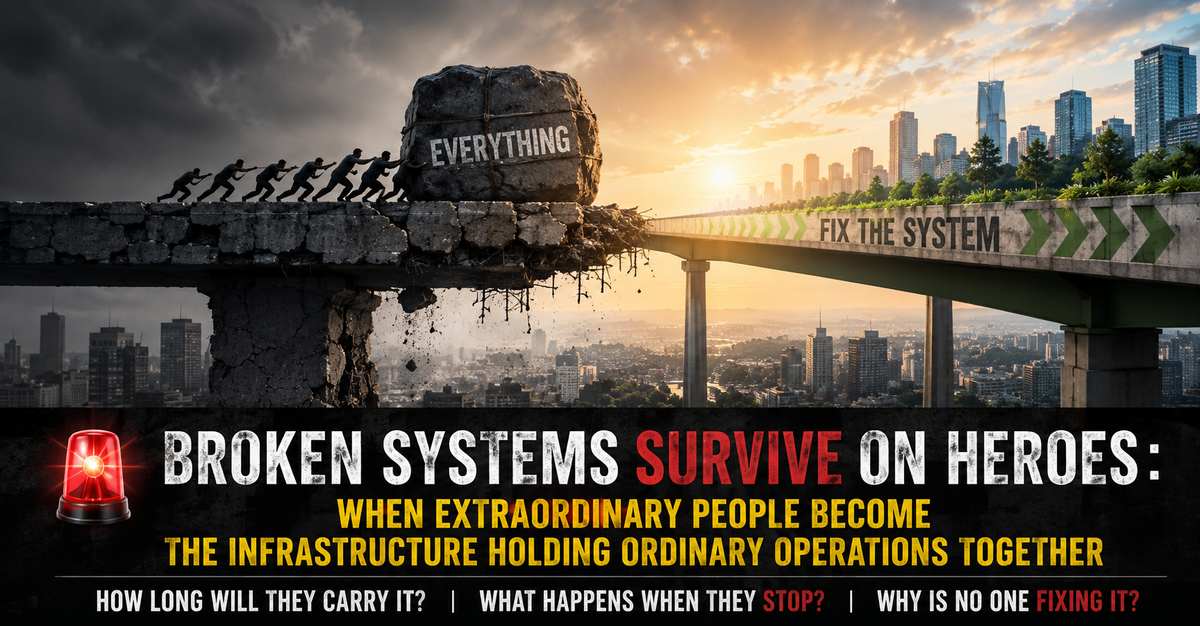
🚨 BROKEN SYSTEMS SURVIVE ON HEROES -- When 150% Becomes the Expectation, Appreciation Falls to minus 70% — And Extraordinary People Become the Invisible Infrastructure Holding Ordinary Operations Together
What if your organisation only works because extraordinary people keep saving it? When 150% effort becomes expected and appreciation falls to minus 70%, heroism can become invisible infrastructure — hiding broken systems, distorting performance and allowing organisational fragility to remain unseen.
Dr Alwin Tan, GAICD, MBBS, FRACS, EMBA (Melbourne Business School)
Senior Surgeon | Governance Leader | HealthTech Co-founder | Founder of Institute for Systems Integrity (ISI) | Harvard Medical School — AI in Healthcare | University of Oxford — Sustainable Enterprise | Bastas Academy for Healthcare Leadership - Triple Scholar
INSTITUTE FOR SYSTEMS INTEGRITY
There is a particular kind of organisation that looks remarkably resilient.
The targets are met.
The patients are seen.
The customers are served.
The deadlines somehow hold.
The dashboard remains green.
Every time something threatens to fall apart, somebody fixes it.
Someone stays late.
Someone covers the gap.
Someone finds the missing equipment.
Someone knows who to call.
Someone chases the approval.
Someone remembers the workaround.
Someone catches the mistake.
Someone quietly does what the formal system failed to do.
And the work gets done.
Again.
And again.
And again.
Leadership looks at the outcome and concludes:
The system works.
But perhaps it doesn't.
PERHAPS THE PEOPLE DO.
And that difference may be one of the most important indicators of organisational fragility that our dashboards never measure.
YOUR BEST PEOPLE MAY BE HIDING YOUR WORST SYSTEMS
This is not an argument against capable people.
It is an argument against organisations becoming dependent upon their capability to compensate for structural weakness.
Complex organisations need adaptation.
Healthcare certainly does.
No policy, procedure, algorithm or operating model can anticipate every patient, interruption, emergency or unexpected circumstance.
Human judgement matters.
Discretion matters.
Improvisation matters.
But there is a profound difference between:
extraordinary effort during extraordinary circumstances
and
extraordinary effort required to make ordinary operations function.
The first may be resilience.
The second may be system failure.
Research by Tucker and Edmondson examined how frontline nurses responded to recurring operational problems. They described how workers can solve immediate problems while the underlying causes remain unresolved, creating an illusory equilibrium in which everyday process failures erode organisational effectiveness rather than generating learning and redesign (Tucker and Edmondson, 2003).
That creates an uncomfortable possibility.
THE BETTER PEOPLE BECOME AT RESCUING A BROKEN PROCESS, THE LESS BROKEN THAT PROCESS MAY LOOK TO LEADERSHIP.
THE MOST DANGEROUS WORKAROUND MAY BE THE ONE THAT WORKS
A failed workaround attracts attention.
A successful workaround can make the problem disappear.
Imagine a system defect produces an operational failure.
If nobody intervenes:
SYSTEM DEFECT
↓
FAILURE
↓
VISIBLE CONSEQUENCE
↓
INVESTIGATION
↓
LEARNING
↓
REDESIGN
Now introduce an experienced, committed employee:
SYSTEM DEFECT
↓
FAILURE BEGINS
↓
CAPABLE PERSON INTERVENES
↓
OUTCOME PROTECTED
↓
FAILURE SIGNAL WEAKENED
↓
NO URGENCY TO REDESIGN
↓
SYSTEM DEFECT REMAINS
↓
SAME PERSON RESCUES IT AGAIN
The organisation records the outcome.
It may never record the rescue.
Debono and colleagues' review of 58 studies of nursing workarounds found precisely the complexity we should expect: workarounds can enable the delivery of care, but they can also compromise it. Their use is influenced by organisational, workflow, professional and cultural factors (Debono et al., 2013).
The lesson is not that workarounds are inherently bad.
It is something more important.
A WORKAROUND CAN PROTECT TODAY'S OUTCOME WHILE HIDING THE SYSTEM THAT WILL CREATE TOMORROW'S PROBLEM.
THEN SOMETHING EVEN MORE DANGEROUS HAPPENS
At first, extraordinary effort is noticed.
Someone stays late.
Someone covers another shift.
Someone takes responsibility outside their role.
Someone fixes the problem nobody else could fix.
Someone gives 150%.
The organisation says:
Thank you.
Then the extraordinary happens again.
And again.
And again.
Eventually, extraordinary becomes familiar.
Familiar becomes expected.
Expected becomes normal.
And normal becomes invisible.
YESTERDAY'S 150% EFFORT QUIETLY BECOMES TOMORROW'S 100% EXPECTATION.
This is where hero dependency becomes particularly corrosive.
The organisation no longer sees 150%.
It sees the baseline.
Then one day that employee can only give 100%.
And suddenly the conversation changes.
"What's wrong?"
"You don't seem as committed."
"You used to be more flexible."
"You always used to sort this out."
"Why wasn't this done?"
The employee may not have reduced their professional contribution at all.
They may simply have stopped providing the additional labour that the organisation had quietly incorporated into its operating model.
THE EXPECTATION IS 150%. THE APPRECIATION IS −70%.
The numbers are deliberately provocative.
They are not intended as literal organisational measurements.
They describe a phenomenon many workplaces will recognise.
At first:
150% effort receives appreciation.
Eventually:
150% effort receives expectation.
Then:
100% effort can be interpreted as underperformance.
That is how appreciation can effectively become minus 70%.
The organisation does not merely stop recognising extraordinary contribution.
It can begin penalising the absence of an extraordinary contribution it was never entitled to expect in the first place.
And research on organisational citizenship behaviour gives this argument an important empirical foundation.
Going beyond formal role requirements can benefit organisations, but Bolino and Turnley cautioned that citizenship behaviours must be properly managed if they are to enhance rather than damage employee and organisational performance (Bolino and Turnley, 2003).
Later research went further.
Bolino et al. found that citizenship pressure — pressure to behave like the organisational “good soldier” — was associated with job stress, work–family conflict, work–leisure conflict and intentions to quit, even after accounting for other job demands (Bolino et al., 2010).
That matters.
Because discretionary effort stops being truly discretionary when the organisation begins depending upon it.
WHEN GOING ABOVE AND BEYOND BECOMES THE PRICE OF BEING CONSIDERED ADEQUATE, HEROISM HAS BECOME AN OPERATING REQUIREMENT.
THE HERO DEPENDENCY CYCLE
We propose a simple organisational dynamic:
System weakness
↓
Operational friction
↓
Capable person compensates
↓
Outcome protected
↓
Failure signal suppressed
↓
Dashboard remains healthy
↓
Leadership sees little urgency
↓
Underlying defect persists
↓
Same person becomes increasingly relied upon
↓
Exceptional effort becomes expected effort
↓
150% becomes the new 100%
↓
Recognition declines
↓
Human load accumulates
↓
The person withdraws, takes leave, burns out or leaves
↓
LATENT SYSTEM FAILURE BECOMES VISIBLE
And leadership asks:
“What happened?”
Perhaps nothing happened.
THE COMPENSATION SIMPLY DISAPPEARED.
THE PERSON DIDN'T SUDDENLY BECOME LESS COMMITTED
This is one of the most dangerous attribution errors organisations can make.
Performance falls after a highly capable person withdraws discretionary effort.
Leadership concludes:
"Their attitude changed."
Maybe.
But there is another possibility.
The person stopped subsidising the organisation.
They stopped staying late.
Stopped answering every call.
Stopped rescuing every deadline.
Stopped remembering everything for everyone.
Stopped navigating every dysfunctional process.
Stopped sacrificing their own capacity to compensate for insufficient organisational capacity.
And suddenly the system appears weaker.
But the system may have been weak all along.
THE PERSON DID NOT FAIL THE SYSTEM.
THEY MAY SIMPLY HAVE STOPPED COMPENSATING FOR ITS FAILURE.
THE DASHBOARD MAY STILL BE GREEN
This creates a serious governance problem.
Imagine a dashboard showing:
97% TARGET ACHIEVED
Excellent.
But underneath that 97%:
staff skipped breaks;
someone stayed two hours late;
a manager personally chased approvals;
a nurse borrowed equipment from another department;
an employee used an unofficial spreadsheet;
experienced staff relied upon personal relationships;
someone covered an unfilled position;
and one person prevented the entire process from collapsing.
The dashboard records:
97%.
It does not record:
HOW MUCH HUMAN COMPENSATION WAS REQUIRED TO PRODUCE 97%.
So the formal equation appears to be:
SYSTEM → PERFORMANCE
When reality may be:
SYSTEM + WORKAROUNDS + TACIT KNOWLEDGE + DISCRETIONARY EFFORT + PERSONAL RELATIONSHIPS + UNRECORDED HUMAN LABOUR → PERFORMANCE
Both produce the same KPI.
They do not describe the same organisational health.
A KPI CAN BE ACCURATE AND STILL GIVE LEADERSHIP THE WRONG PICTURE OF REALITY.
THE HEROIC COMPENSATION PARADOX
This leads us to what we call the:
HEROIC COMPENSATION PARADOX
The more successfully individuals compensate for system weakness, the less visible that weakness may become to those responsible for governing it.
The hero does not hide the failure intentionally.
Quite the opposite.
They hide it by preventing it.
Every successful rescue potentially removes evidence.
No delayed patient.
No missed deadline.
No failed service.
No angry customer.
No red KPI.
No escalation.
No incident.
No obvious reason for executive intervention.
The absence of failure is then interpreted as evidence that the system works.
But absence of failure and presence of system integrity are not the same thing.
WE REWARD FIREFIGHTERS. WE RARELY CELEBRATE THE PEOPLE WHO REMOVED THE MATCHES
Repenning and Sterman described a related organisational problem in their work on process improvement.
Their title says almost everything:
“Nobody Ever Gets Credit for Fixing Problems That Never Happened.”
Their work describes how organisational structures and pressures can undermine sustained process improvement and reinforce pathological patterns rather than long-term capability development (Repenning and Sterman, 2001).
The firefighter is visible.
Prevention is invisible.
One manager runs a dysfunctional operation and rescues five crises.
Another redesigns the operation so the crises never happen.
Who gets noticed?
Too often, the person standing beside the fire.
WE SHOULD BE CAREFUL NOT TO CONFUSE VISIBLE RESCUE WITH SUPERIOR LEADERSHIP.
Sometimes the strongest system is the boring one.
Nothing dramatic happens.
Nobody stays until midnight.
Nobody makes the heroic phone call.
Nobody needs to save the day.
Because the day was designed not to require saving.
WE CALL IT RESILIENCE. SOMETIMES IT IS DEPENDENCY.
There is an important counterargument.
Human adaptation is essential.
Especially in healthcare.
No organisation should attempt to eliminate professional judgement or frontline improvisation.
Workaround research itself demonstrates that adaptations can be necessary to achieving care while also introducing potential risks (Debono et al., 2013).
The objective therefore cannot be:
STOP ADAPTING.
It should be:
STOP REQUIRING THE SAME ADAPTATION TO SOLVE THE SAME PREDICTABLE PROBLEM.
That gives us an important distinction.
Resilient adaptation
Unexpected problem.
↓
People adapt.
↓
Outcome protected.
↓
Adaptation becomes visible.
↓
Organisation learns.
↓
System improves.
Hero dependency
Predictable problem.
↓
Someone compensates.
↓
Outcome protected.
↓
Compensation remains invisible.
↓
Nothing changes.
↓
Same person compensates again.
One uses human ingenuity to increase organisational capability.
THE OTHER USES HUMAN INGENUITY AS A SUBSTITUTE FOR ORGANISATIONAL CAPABILITY.
THE HERO EVENTUALLY BECOMES INFRASTRUCTURE
Listen carefully to the language inside organisations.
"Call Sarah."
"Mohammed knows how to fix it."
"Priya has the spreadsheet."
"Jenny knows who to speak to."
"Michael always gets it through."
"Don't worry. They'll sort it out."
Sometimes this reflects expertise.
But repeated dependency on named individuals can reveal something else.
The organisation may have transferred critical capability into:
personal memory;
informal relationships;
undocumented processes;
individual discretion;
institutional knowledge;
and personal willingness to keep giving more.
That creates a dangerous illusion.
The organisation believes it possesses a capability.
IN REALITY, A PERSON POSSESSES IT.
The distinction becomes visible when that person disappears.
HEROISM CAN BECOME ORGANISATIONAL DEBT
Every rescue buys the organisation time.
But if that time is not used to repair the underlying problem, the organisation accumulates debt.
The staffing model remains inadequate because somebody always covers.
The approval process remains dysfunctional because somebody always escalates.
The technology remains inadequate because staff know the workaround.
The communication pathway remains broken because someone knows whom to call.
The process remains undocumented because the experienced person remembers everything.
The organisation effectively borrows against human capability.
And like all debt, eventually it becomes payable.
Through exhaustion.
Through disengagement.
Through turnover.
Through absence.
Through lost institutional knowledge.
Through error.
Or through sudden operational failure.
THE ORGANISATION HAS BEEN WITHDRAWING FROM THE SAME HUMAN ACCOUNT FOR YEARS — AND THEN ACTS SURPRISED WHEN THE ACCOUNT IS EMPTY.
STOP CELEBRATING EVERY RESCUE WITHOUT INVESTIGATING WHY IT WAS NECESSARY
People who protect patients, colleagues, customers and organisations deserve recognition.
But gratitude cannot substitute for governance.
If the same person repeatedly rescues the same process:
investigate the process.
If employees repeatedly stay late to achieve the KPI:
investigate the capacity model.
If clinicians repeatedly improvise around missing resources:
investigate resource availability.
If managers repeatedly need personal relationships to obtain approvals:
investigate decision architecture.
If employees repeatedly bypass formal processes:
investigate whether the formal process actually works.
And if 150% effort has quietly become the minimum acceptable contribution:
investigate the organisation.
Because:
150% EXPECTATION + −70% APPRECIATION IS NOT A HIGH-PERFORMANCE CULTURE.
IT IS AN UNSUSTAINABLE OPERATING MODEL.
BOARDS NEED TO ASK A DIFFERENT QUESTION
Boards routinely ask:
“Are we meeting our KPIs?”
That question remains necessary.
But it is insufficient.
Boards should also ask:
“HOW MUCH UNDOCUMENTED HUMAN COMPENSATION IS REQUIRED FOR US TO MEET THEM?”
And perhaps an even more uncomfortable question:
“WHICH PROCESSES WOULD FAIL TOMORROW IF THE PEOPLE WHO NORMALLY RESCUE THEM SIMPLY STOPPED?”
Look for:
repeated manual interventions;
persistent workarounds;
out-of-hours rescue work;
hidden overtime;
unofficial spreadsheets;
dependency on personal relationships;
single-person knowledge;
recurring escalations;
routine skipped breaks;
and processes that deteriorate whenever particular individuals are absent.
These are not anecdotes.
They are not merely workforce concerns.
THEY ARE GOVERNANCE SIGNALS.
DO NOT REMOVE THE HERO BEFORE REPAIRING THE SYSTEM
There is one final warning.
Once leadership discovers workaround dependency, the wrong response is:
"Stop doing workarounds."
That may simply expose patients, customers or employees to the original defect.
Workarounds can simultaneously enable and potentially compromise care. Their function therefore needs to be understood before they are eliminated (Debono et al., 2013).
The sequence should be:
IDENTIFY
↓
UNDERSTAND
↓
PROTECT
↓
REDESIGN
↓
TEST
↓
INSTITUTIONALISE THE LEARNING
↓
REMOVE UNNECESSARY DEPENDENCY
The hero should become a source of organisational intelligence.
Not permanent organisational infrastructure.
YOUR HEROES MAY BE YOUR BEST EARLY-WARNING SYSTEM
So perhaps we should stop asking only:
“Who are our highest performers?”
And start asking:
“What are they repeatedly compensating for?”
Stop merely praising resilience.
Ask:
“Why is so much resilience required?”
Stop celebrating the person who always solves the problem.
Ask:
“Why does this problem keep returning?”
Stop describing people as indispensable without considering what that says about organisational design.
And above all:
do not wait until they leave to discover everything they were quietly holding together.
Because the green dashboard may not always be evidence of system health.
Sometimes it is evidence of extraordinary human compensation.
Sometimes the organisation is achieving 100% of its target because particular people are giving 150% of themselves.
And sometimes those same people eventually discover that the appreciation for their 150% contribution has somehow fallen to minus 70%.
That is when heroism stops looking like commitment.
It starts looking like subsidy.
BROKEN SYSTEMS SURVIVE ON HEROES.
But there is something even more dangerous.
THEY CAN BECOME SO DEPENDENT ON HEROES THAT THEY FORGET THEY ARE BROKEN.
Until one day the hero stops.
And everyone asks:
“Why did the system suddenly fail?”
The answer may be uncomfortable.
IT DIDN'T.
THE FAILURE WAS THERE ALL ALONG.
THE PERSON WHO KEPT HIDING IT SIMPLY STOPPED COMPENSATING FOR IT.
References
Bolino, M.C. and Turnley, W.H. (2003) ‘Going the extra mile: Cultivating and managing employee citizenship behavior’, Academy of Management Executive, 17(3), pp. 60–71. doi:10.5465/AME.2003.10954754.
Bolino, M.C., Turnley, W.H., Gilstrap, J.B. and Suazo, M.M. (2010) ‘Citizenship under pressure: What’s a “good soldier” to do?’, Journal of Organizational Behavior, 31(6), pp. 835–855. doi:10.1002/job.635.
Debono, D.S., Greenfield, D., Travaglia, J.F., Long, J.C., Black, D., Johnson, J. and Braithwaite, J. (2013) ‘Nurses’ workarounds in acute healthcare settings: a scoping review’, BMC Health Services Research, 13, 175. doi:10.1186/1472-6963-13-175.
Edmondson, A.C. (1999) ‘Psychological safety and learning behavior in work teams’, Administrative Science Quarterly, 44(2), pp. 350–383.
Hollnagel, E. (2009) The ETTO Principle: Efficiency-Thoroughness Trade-Off. Farnham: Ashgate.
Hollnagel, E. (2014) Safety-I and Safety-II: The Past and Future of Safety Management. Farnham: Ashgate.
Morrison, E.W. and Milliken, F.J. (2000) ‘Organizational silence: A barrier to change and development in a pluralistic world’, Academy of Management Review, 25(4), pp. 706–725.
Rasmussen, J. (1997) ‘Risk management in a dynamic society: A modelling problem’, Safety Science, 27(2–3), pp. 183–213.
Reason, J. (2000) ‘Human error: models and management’, BMJ, 320, pp. 768–770.
Repenning, N.P. and Sterman, J.D. (2001) ‘Nobody ever gets credit for fixing problems that never happened: Creating and sustaining process improvement’, California Management Review, 43(4), pp. 64–88. doi:10.2307/41166101.
Tucker, A.L. and Edmondson, A.C. (2003) ‘Why hospitals don’t learn from failures: Organizational and psychological dynamics that inhibit system change’, California Management Review, 45(2), pp. 55–72. doi:10.2307/41166165.
Vaughan, D. (1996) The Challenger Launch Decision: Risky Technology, Culture, and Deviance at NASA. Chicago: University of Chicago Press.