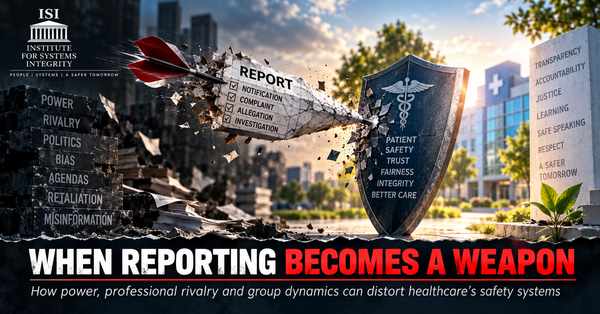
🚨 WHEN ACCOUNTABILITY DEPENDS ON WHO YOU ARE : How Power, Status and Institutional Value Distort Justice in Healthcare
Accountability should follow evidence, not hierarchy. But when status, relationships, tribal belonging or institutional value influence who receives context, scrutiny or protection, accountability itself becomes a governance risk.

Dr Alwin Tan, GAICD, MBBS, FRACS, EMBA (Melbourne Business School)
Senior Surgeon | Governance Leader | HealthTech Co-founder | Founder of Institute for Systems Integrity (ISI) |Harvard Medical School — AI in Healthcare| University of Oxford — Sustainable Enterprise | Bastas Academy for Healthcare Leadership - Triple Scholar
Nadra Gadeed BSc Psychology, MSc Forensic Psychology, MA Health Research
Founder and Strategic Advisor of Edify & Grow, a workforce risk advisory practice for boards and C-suite leaders in private healthcare across the GCC and Asia-Pacific. | NHS senior leadership experience spanning strategic, operational and clinical leadership. - 20 years experience - Combining expertise in Psychology, Forensic Psychology and Health Research |
Institute for Systems Integrity
Part III of the Institute for Systems Integrity : Tribalism in Healthcare Series
THE MOST DANGEROUS FORM OF TRIBALISM MAY NOT BE WHO WE INCLUDE OR EXCLUDE.
IT MAY BE WHO WE HOLD ACCOUNTABLE — AND WHO WE DO NOT.
Healthcare needs accountability.
Patients deserve it.
Professionals expect it.
Boards must ensure it.
Serious misconduct cannot be excused as system failure.
Recklessness cannot be disguised as human error.
Seniority should place no one beyond scrutiny.
But there is another question healthcare organisations rarely examine with the same rigour:
WOULD THE SAME EVIDENCE PRODUCE THE SAME RESPONSE IF A DIFFERENT PERSON WERE INVOLVED?
One clinician receives context.
Another receives scrutiny.
One adverse event is interpreted as unavoidable complexity.
Another becomes evidence of poor judgement.
One person receives remediation.
Another receives investigation.
One dissenting voice is considered courageous.
Another is labelled disruptive.
The evidence may be similar.
The organisational position of the person may not be.
And when accountability changes according to
who someone is,
where they sit,
whom they know
or how valuable they are to the institution,
accountability itself becomes a governance risk.
Executive Summary
Parts I and II of the ISI Tribalism in Healthcare Series examined how professional identity creates tribes across healthcare and how hidden hierarchies can emerge even within the same profession.
Part II introduced the Protection Gradient™ and Commercial Protection Gradient™: the possibility that proximity to organisational influence and perceived institutional value may affect how individuals are believed, challenged, forgiven or protected.
This third paper asks the next question:
What happens when those protection gradients enter the machinery of accountability?
That question matters as much for the workforce as for any single decision.
When accountability itself becomes uneven, the people watching learn far more from what actually happens than from any stated policy. What they learn shapes whether they stay, speak up or quietly disengage.
Healthcare organisations increasingly embrace just culture: examining system conditions, learning from error and distinguishing human error from reckless conduct.
But even an excellent accountability framework can fail if it is applied differently to different people.
Status can influence credibility.
Institutional value can influence escalation.
Relationships can influence context.
Reputation can influence interpretation.
Professional belonging can influence whose account is believed.
The Institute for Systems Integrity proposes that these forces can produce an Accountability Distortion Pathway™through which power may influence accountability long before a formal decision is reached.
The consequence extends beyond individual fairness.
Selective accountability teaches staff who can safely be challenged.
It alters what gets reported.
It changes what witnesses are willing to say.
It contaminates organisational information.
And ultimately, it can distort what boards believe is happening inside the organisations they govern.
This paper therefore proposes the Accountability Integrity Framework™ and a simple governance test — the Accountability Counterfactual™:
IF THE EVIDENCE STAYED THE SAME BUT THE PERSON CHANGED, WOULD THE OUTCOME CHANGE?
Because accountability should follow evidence.
Not hierarchy.
1. From Tribalism to Accountability
Tribalism does not end when people enter a governance process.
The relationships, loyalties, identities and hierarchies that exist before an incident do not disappear when an investigation begins.
They enter the room with it.
Part I of this series examined tribes between professions.
Part II examined tribes within professions and the unequal protection that status, belonging and institutional value may create.
Paper III examines the next stage:
What happens when protection becomes consequential?
The progression is important:
Tribal identity
↓
Belonging and status
↓
Protection gradients
↓
Interpretive differences
↓
Different accountability pathways
↓
Different consequences
Tribalism therefore becomes more than a cultural problem when it influences governance.
It becomes a question of organisational justice.
This is also where the series' throughline sharpens.
Protection debt, introduced in Paper II, has so far been visible in belonging and credibility.
Paper III traces what may happen when that same debt is called in through a formal process — and who ends up paying it once accountability itself becomes the mechanism through which protection is expressed.
2. The Accountability Paradox
Healthcare must hold people accountable.
Without accountability, unsafe behaviour can persist.
Poor conduct can become normalised.
Patients can be harmed.
Trust can disappear.
But accountability can itself cause harm when responsibility is allocated inconsistently or without appropriate consideration of system conditions.
This creates an accountability paradox.
Too little accountability permits unsafe conduct.
Excessive individual blame suppresses reporting and organisational learning.
Selective accountability combines the dangers of both.
Some individuals may receive insufficient scrutiny.
Others may receive disproportionate scrutiny.
Just-culture approaches attempt to resolve this tension by distinguishing human error, at-risk behaviour and reckless conduct while examining the systems surrounding an event
More recent review evidence identifies leadership commitment, education and training, accountability and open communication as recurring requirements for implementing just culture successfully
That distinction remains essential.
But there is an assumption underneath it:
that the organisation will apply those distinctions consistently.
That assumption cannot simply be trusted.
It must be governed.
The problem is visible in what professionals actually do.
In a large survey of physicians, approximately one-third of those with direct personal knowledge of a significantly impaired or incompetent colleague had not reported that colleague, despite most respondents agreeing that reporting was a professional responsibility
The finding does not establish selective accountability as the cause of non-reporting.
It demonstrates something broader and important: formal professional obligations alone do not guarantee that concerns will travel through an organisation.
Selective accountability does not need a villain to sustain it.
It only needs enough people making individually understandable decisions not to be the one who escalates.
3. Accountability Is Not Blame
Accountability asks:
- What happened?
- What information was available?
- What conditions influenced the decision?
- What responsibility was reasonably held?
- Was the behaviour inadvertent, risky or reckless?
- What should be learned?
- What response is fair and proportionate?
Blame begins somewhere different.
It asks:
- Who can carry responsibility?
- Who is easiest to isolate?
- Whose removal demonstrates action?
- Who can be punished without destabilising the organisation?
Removing an individual gives an organisation a fast, visible way to demonstrate that something has been done — often faster than the slower, more uncomfortable work of establishing what the system itself contributed.
Just-culture literature has warned against collapsing accountability into individual blame while failing to examine the wider conditions surrounding an event
Reason's systems approach demonstrated that adverse events rarely emerge from one isolated act. They arise through interactions between human behaviour, latent conditions, organisational decisions and weakened defences (Reason, 2000).
A mature accountability system can therefore examine individual responsibility without abandoning systems thinking.
A defensive organisation may do the opposite.
Under regulatory, reputational, operational or legal pressure, complexity can become inconvenient.
A person is easier to investigate than a system.
A disciplinary outcome is easier to describe than organisational failure.
Removing an individual can create the appearance of resolution.
The conditions that produced the event may remain.
THE FASTEST WAY FOR AN ORGANISATION TO APPEAR ACCOUNTABLE MAY BE TO FIND ONE PERSON TO CARRY A FAILURE CREATED BY MANY.
4. The Accountability Distortion Pathway™
Selective accountability rarely begins with somebody explicitly deciding:
Protect this person. Punish that one.
Distortion can be subtler.
It may develop through a sequence of seemingly reasonable decisions.
The Institute for Systems Integrity proposes the following:
THE ACCOUNTABILITY DISTORTION PATHWAY™
Incident or concern
↓
Identity and status recognition
Who is involved?
↓
Institutional value assessment
How influential, connected, prestigious, operationally important or commercially valuable are they?
↓
Interpretive framing
Is the event understood as complexity, error, misconduct, personality or system failure?
↓
Credibility allocation
Whose account receives the greatest weight?
↓
Procedural selection
Is the matter discussed, reviewed, escalated or formally investigated?
↓
Context allocation
Whose behaviour is interpreted within workload, resources, communication, history and system conditions?
↓
Consequence allocation
Who receives support, remediation, restriction, exclusion or punishment?
↓
Narrative consolidation
Which version of the event becomes organisational truth?
The Bawa-Garba case illustrates why such a pathway deserves examination.
Following the death of a child from sepsis in 2011, a paediatric trainee was subsequently convicted of gross-negligence manslaughter amid substantial debate about the relationship between individual responsibility and significant system-related factors surrounding the event (Cohen, 2017).
The case does not itself prove the Accountability Distortion Pathway™ proposed here.
It demonstrates why governance must examine the pathway by which complex events become individual accountability narratives — including whether system conditions, individual responsibility and relevant context are incorporated consistently when responsibility is allocated.
The critical insight is this:
ACCOUNTABILITY CAN BE DISTORTED BEFORE AN INVESTIGATION HAS EVEN FORMALLY BEGUN.
Power may influence which concern is considered credible.
Framing influences which evidence is sought.
Evidence influences which context appears relevant.
Context influences proportionality.
And proportionality influences consequence.
By the time a formal decision is reached, organisational power may already have influenced what decision-makers believe happened.
5. The Context–Scrutiny Divide™
Fair accountability requires context.
Healthcare decisions occur under uncertainty.
Clinicians work with incomplete information, competing priorities, fatigue, resource constraints, communication failures and time pressure.
Context does not eliminate responsibility.
It makes responsibility intelligible.
The governance problem begins when context itself is distributed unequally.
Consider two ways an organisation might interpret adverse events.
For one individual:
- The case was exceptionally complex.
- The situation evolved rapidly.
- They were working under considerable pressure.
- Their intentions were appropriate.
- Their broader record should be considered.
- Remediation and support are appropriate.
For another:
- They failed to recognise the risk.
- Their judgement is questionable.
- They failed to meet expectations.
- Their conduct may represent a pattern.
- Formal intervention is required.
The difference may sometimes be entirely justified.
But organisations should be able to demonstrate why.
Otherwise a dangerous divide can emerge.
The Institute for Systems Integrity describes this as the
Context–Scrutiny Divide™:
SOME PEOPLE HAVE THEIR CONDUCT EXPLAINED.
OTHERS HAVE THEIR CHARACTER EXAMINED.
Once conduct becomes interpreted primarily as character, the accountability pathway changes.
The individual is no longer simply a participant in an event.
They become the problem the organisation believes it needs to manage.
Research across healthcare and organisational behaviour demonstrates that hierarchy, professional status, psychological safety and leadership conditions can affect voice, participation and influence (Edmondson, 1999; Nembhard and Edmondson, 2006; Essex et al., 2023).
That evidence does not establish that status automatically produces differential accountability.
It establishes why organisations should test for the possibility rather than assume neutrality.
The same discipline should apply when an adverse outcome is reconstructed retrospectively.
One person's history may be used as evidence that an event was isolated.
Another person's history may be assembled retrospectively into evidence of a pattern.
Whether either interpretation is justified should depend upon tested evidence — not upon the organisational standing of the person involved.
6. Accountability Elasticity™
Paper II described how protection may vary according to organisational proximity and institutional value.
Paper III proposes a related governance consequence:
Accountability Elasticity™
Accountability Elasticity™ is the degree to which thresholds for scrutiny, escalation, contextual consideration or consequence vary according to the organisational status or perceived institutional value of the individual involved.
In a high-integrity system:
Comparable evidence → comparable accountability pathway.
In a highly elastic system:
Comparable evidence → different accountability pathways depending upon who is involved.
For one person, an isolated concern may rapidly become formal.
For another, repeated concerns may remain informal.
One person's history may provide mitigating context.
Another person's history may be assembled into evidence of a pattern.
One may receive remediation.
Another may receive exclusion.
Not every difference represents unfairness.
Different circumstances legitimately require different responses.
The governance question is whether the difference can be explained by evidence and relevant context rather than power.
7. Institutional Value and the Price of Accountability
Healthcare organisations are moral institutions.
They are also operational and economic organisations.
They depend on workforce, referrals, reputation, funding, activity, research, accreditation and public confidence.
Some individuals inevitably become particularly important to those interests.
They may:
- generate significant clinical activity;
- control referral networks;
- lead important services;
- attract research funding;
- hold prestigious appointments;
- possess difficult-to-replace expertise;
- maintain influential external relationships.
None of this demonstrates misconduct.
Nor does institutional value prove preferential treatment.
It establishes something different:
a potential conflict capable of influencing accountability.
Part II described this through the Commercial Protection Gradient™.
Paper III extends the governance implication.
When the perceived cost of challenging an individual rises, leaders may face pressures — conscious or unconscious — to preserve service continuity, relationships, reputation or organisational stability.
That does not prove that accountability has been compromised.
It means governance should test whether it has been.
THE EXISTENCE OF INSTITUTIONAL VALUE DOES NOT PROVE PROTECTION.
IT CREATES A CONFLICT GOVERNANCE SHOULD NOT IGNORE.
Financial value must never become moral value.
And institutional dependence must never quietly become immunity.
Conflicts of interest can influence professional judgement even where individuals do not perceive their own judgement to have been compromised (Thirumoorthy, 2023).
Institutional dependency raises a related governance concern.
The conflict does not require anyone to act in bad faith to become relevant.
8. The Power to Define the Story
Every investigation creates more than findings.
It creates a narrative.
That narrative determines:
- what is included;
- what is excluded;
- which events are connected;
- whose testimony is credible;
- which contextual factors matter;
- whether the problem is individual or systemic;
- and what future decision-makers will believe occurred.
Power therefore operates not only through the final decision.
It can operate through the authority to define the story.
People with greater organisational power may possess:
- stronger professional networks;
- greater familiarity with decision-makers;
- easier access to institutional leaders;
- more advocates willing to provide context;
- greater confidence navigating governance processes.
People with less power may have none of these advantages.
The formal procedure may look neutral.
The narrative environment surrounding it may not be.
THE PERSON WHO SHAPES THE NARRATIVE DOES NOT NEED TO CONTROL THE FINAL DECISION.
THEY MAY ALREADY HAVE SHAPED WHAT THE DECISION-MAKER BELIEVES IS POSSIBLE.
Research into reconstructive memory provides an important caution about how subsequent information can alter recollection and interpretation (Loftus, 2005).
Organisational investigations are not equivalent to experimental memory studies, and that research should not be treated as direct proof of organisational narrative distortion.
It does, however, reinforce a broader principle:
accounts of events are not immune to framing, sequencing and information introduced after the event.
Governance should therefore distinguish contemporaneous evidence, subsequent interpretation and organisational narrative as carefully as possible.
9. When the Reporter Becomes the Risk
Selective accountability does not affect only people accused of wrongdoing.
It affects those who report it.
Healthcare repeatedly tells staff:
Speak up.
But the real test of psychological safety begins after somebody does.
A reporter may initially be considered a respected colleague.
After raising a difficult concern, the questions can shift.
Why did they report this?
Why now?
Are they conflicted?
Are they difficult?
Can they work collaboratively?
Are they damaging the team?
The safety concern can become displaced by scrutiny of the person carrying it.
Waring (2016) describes how whistle-blowers can themselves become the focus and victim of the organisational response — a phenomenon framed as the problem of the “third victim.”
Research demonstrates that hierarchy, anticipated consequences, leadership behaviour and psychological safety influence speaking-up behaviour in healthcare (Edmondson, 1999; Okuyama, Wagner and Bijnen, 2014; Morrow, Gustavson and Jones, 2016; O'Donovan and McAuliffe, 2020).
When staff observe negative consequences following voice, the lesson extends beyond the reporter.
Others learn what the formal policy never says.
Do not challenge someone more powerful than you.
Do not assume the right to report means it is safe to report.
Do not mistake a reporting mechanism for protection.
The organisation may retain a formal speaking-up system.
But increasingly it may receive only the information people believe is safe to provide.
WHEN RAISING A RISK MAKES THE REPORTER THE RISK, GOVERNANCE HAS TURNED AGAINST ITS OWN INFORMATION SYSTEM.
10. Selective Accountability Is an Information Integrity Failure
This is where accountability becomes a board-level patient-safety issue.
Boards depend upon information.
They need reliable signals about behaviour, operational conditions, clinical risk and patient harm.
But information does not travel neutrally through organisations.
It moves through hierarchy.
Relationships.
Professional identity.
Reputation.
Fear.
Commercial dependency.
When staff observe inconsistent accountability, behaviour can adapt.
Concerns may be withheld.
Witnesses may moderate their accounts.
Uncertainty may go undocumented.
Teams may protect insiders.
Reports may become strategically worded.
Individuals may preserve evidence primarily for self-protection.
Informal narratives may replace tested facts.
Eventually, official information risks increasingly representing:
what is safe to say
rather than:
what is true.
The board may receive more dashboards, reports and assurances than ever.
And understand less about organisational reality.
Selective accountability therefore weakens Signal Integrity.
It reduces Information Fidelity.
It distorts the Judgement Environment.
And ultimately it compromises Decision Integrity.
THE GOVERNANCE FAILURE IS NOT ONLY THAT ONE PERSON MAY HAVE BEEN TREATED UNFAIRLY.
IT IS THAT EVERYONE WATCHING LEARNS WHAT THE ORGANISATION REALLY REWARDS, PROTECTS AND PUNISHES.
11. The Myth of Procedural Neutrality
Organisations often assume accountability is fair because the correct procedure was followed.
But:
PROCEDURAL COMPLETION IS NOT PROOF OF PROCEDURAL JUSTICE.
A policy does not decide:
- which concern receives immediate attention;
- who investigates;
- how the scope is framed;
- which witnesses are interviewed;
- which documents are sought;
- how conflicting evidence is weighed;
- which contextual factors are considered;
- whether comparable cases are examined;
- or how findings are described.
People make those decisions.
And people operate inside systems containing hierarchy, relationships, identity, loyalty and institutional pressures.
Organisational justice research identifies consistency, impartiality, accuracy, correctability and respectful treatment as important dimensions of procedural fairness (Greenberg, 1990; Colquitt et al., 2001).
An investigation can therefore be technically compliant yet still require scrutiny of the substantive fairness of the decisions made within it.
A policy can be identical.
Its application can still be unequal.
Boards should therefore ask more than:
Was the policy followed?
They should ask:
Was the policy interpreted and applied consistently across comparable people and comparable events?
The governance challenge lies not only in whether procedural steps occurred, but in the discretionary decisions embedded within those steps.
Who defined the scope?
What evidence was sought?
Which alternative explanations were tested?
Were conflicts identified?
Was contradictory evidence given equivalent weight?
Those are questions procedural completion alone cannot answer.
12. The Accountability Counterfactual™
The Institute for Systems Integrity proposes a simple test.
Before significant accountability decisions are finalised, ask:
THE ACCOUNTABILITY COUNTERFACTUAL™
IF THE EVIDENCE STAYED THE SAME BUT THE PERSON CHANGED, WOULD THE OUTCOME CHANGE?
Imagine the individual possessed substantially:
more power.
Would the concern still have been escalated?
Now imagine they possessed substantially:
less power.
Would the same context have been considered?
Would the same witnesses have been believed?
Would the same language have been used?
Would the same remediation have been offered?
Would the same consequence have followed?
The counterfactual does not determine whether a decision is correct.
It exposes where power may be influencing the pathway.
And it creates a question governance can actually test.
The counterfactual becomes more powerful when checked against organisational data rather than intuition alone.
If the evidence stayed the same but the person changed, the strongest test is not simply to imagine the answer.
It is to examine whether genuinely comparable people in genuinely comparable circumstances have historically received comparable pathways and outcomes.
Workforce records, escalation data, investigation patterns, remediation decisions, appeals and exit data may provide useful signals.
The objective is not crude numerical equivalence.
It is explainable consistency.
13. The Accountability Integrity Framework™
The Institute for Systems Integrity proposes the Accountability Integrity Framework™ to evaluate whether accountability remains evidence-based, proportionate and resistant to distortion.
It contains seven domains.
1. Evidentiary Integrity
- Are findings based upon tested evidence?
- Were contradictory accounts examined?
- Were assumptions separated from established facts?
- Was relevant evidence excluded?
- Was the evidentiary threshold clear?
2. Contextual Integrity
- Were workload, resources, supervision and information conditions considered?
- Was equivalent context available to everyone involved?
- Were individual and organisational contributions separated?
3. Comparative Integrity
- How were genuinely comparable cases treated?
- Are accountability thresholds consistent across seniority, profession and organisational status?
- Would the pathway have been similar for someone with substantially more or less influence?
4. Procedural Integrity
- Was the process sufficiently independent?
- Were conflicts identified and managed?
- Could the scope identify both individual and system contributors?
- Was there meaningful opportunity to respond?
- Was review available?
5. Narrative Integrity
- Was the language factual or characterological?
- Did findings overstate certainty?
- Were labels such as difficult, disruptive or unprofessional linked to clearly defined conduct?
- Was examination of the reporter substituted for examination of the concern?
6. Consequence Integrity
- Was the response proportionate to the evidence and behaviour?
- Were support and remediation appropriately considered?
- Were organisational contributors addressed?
- Could commercial, reputational or operational dependency have influenced the outcome?
7. Learning Integrity
- What changed after the event?
- Were relevant system conditions corrected?
- Was learning shared?
- Did the process increase or reduce willingness to report?
- Can the organisation demonstrate that safety improved?
Together, these domains move accountability beyond procedural compliance.
They make the integrity of accountability itself governable.
14. What Boards Should Govern
Boards should not become alternative investigation panels.
They should not determine individual clinical findings or employment disputes.
But boards are responsible for the integrity of the systems through which accountability occurs.
That requires aggregate assurance.
Boards should understand:
- whether formal investigation rates differ across organisational groups;
- who tends to enter formal processes and who is managed informally;
- whether comparable events generate comparable responses;
- how frequently investigations identify organisational contributors;
- whether conflicts and institutional dependencies are appropriately managed;
- whether appeals reveal recurring procedural weaknesses;
- whether reporters subsequently experience counter-allegations, exclusion or departure;
- whether staff believe accountability processes are fair;
- and whether speaking up improves safety.
The purpose is not to infer discrimination, bias or misconduct from raw numbers.
Differences may have legitimate explanations.
The purpose is to identify patterns that require explanation.
A board monitoring adverse events without monitoring the integrity of the accountability system sees only part of the risk.
Boards therefore need assurance not about individual cases, but about the properties of the accountability system itself.
Is it consistent?
Is it independent enough?
Does it detect conflicts?
Does it preserve context?
Does it identify system contributors?
Does it withstand power?
THE BOARD'S JOB IS NOT TO DECIDE WHO SHOULD BE PUNISHED.
ITS JOB IS TO KNOW WHETHER POWER CAN DISTORT THE SYSTEM THAT DECIDES.
15. Accountability as a Workforce Risk Signal
Every mechanism described in this paper — the Distortion Pathway, the Context–Scrutiny Divide and Accountability Elasticity — may eventually surface somewhere measurable.
It may surface in attrition.
In disengagement.
In declining willingness to speak up.
In escalation patterns.
In exit interviews.
In who repeatedly enters formal processes — and who rarely does.
This is not a separate risk sitting alongside accountability.
It may be accountability expressed through workforce data rather than investigation findings.
Earlier comparative evidence illustrates the potential economic scale of workforce loss.
Using a consistent costing methodology across four countries, Duffield et al. (2014) estimated the cost of nurse turnover in Australia at approximately US$48,790 per turnover in 2014-adjusted dollars, higher than the comparator countries examined in that study.
That figure should not be interpreted as a contemporary Australian turnover cost.
Its relevance here is different.
Workforce loss has an organisational cost, yet the governance conditions contributing to disengagement or departure may be reviewed separately from the workforce metrics through which those consequences eventually become visible.
Hierarchy is already known to shape relationships, influence and professional experience within healthcare organisations (Essex et al., 2023).
That evidence does not establish that accountability outcomes or workforce exits are distributed according to hierarchy.
It creates a governance question worth testing:
IF ACCOUNTABILITY OUTCOMES VARY BY STATUS, DOES THE SAME PATTERN APPEAR IN WORKFORCE DATA?
This suggests a second test alongside the Accountability Counterfactual:
The Workforce Mirror Test
If accountability outcomes vary across organisational groups, examine whether patterns in:
- attrition;
- engagement;
- speaking-up;
- escalation;
- counter-allegations;
- absence;
- transfer;
- and exit
show a corresponding distribution.
Correlation would not establish causation.
But converging patterns would justify deeper examination.
Most organisations already hold much of this data.
What is often missing is the discipline of reading accountability outcomes and workforce signals together rather than as unrelated reporting streams reviewed by different committees.
This workforce mirror approach is consistent with the Workforce Risk Index, a practice-based diagnostic developed by co-author Nadra Gadeed to examine workforce indicators as organisational risk signals.
The Workforce Risk Index should be understood here as an applied diagnostic framework rather than as independently validated empirical evidence.
BOARDS THAT SEPARATE WORKFORCE DATA FROM ACCOUNTABILITY DATA MAY MISS THE POSSIBILITY THAT THEY ARE OBSERVING THE SAME SYSTEMIC RISK THROUGH TWO DIFFERENT WINDOWS.
16. Executives Are Not Exempt From the Counterfactual
Everything in this paper applies to clinicians.
It applies equally to executives and managers.
An executive who generates significant commercial value, controls key relationships or holds unusual influence over a board can be just as difficult to subject to independent accountability as a commercially valuable clinician.
The question is the same:
IF THE EVIDENCE STAYED THE SAME BUT THE PERSON'S SENIORITY CHANGED, WOULD THE OUTCOME CHANGE?
Boards may find it easier to apply scrutiny downward into clinical and operational teams than upward into their own executive layer.
That possibility itself deserves governance attention because institutional value and influence are often greatest near the top of the organisation.
The Accountability Counterfactual therefore cannot stop at the executive door.
Would the same conduct be interpreted the same way if committed by:
a junior employee?
a senior clinician?
a manager?
an executive?
a chief executive?
a board member?
Would the same evidence threshold apply?
Would the same investigator be considered sufficiently independent?
Would the same contextual explanations be accepted?
Would the same language appear in the findings?
Would the same consequences remain available?
A board that has never applied the Counterfactual to its own executive layer has not fully tested whether its accountability system is resistant to power.
None of this is a call for boards to distrust executives.
It is a call for the same discipline to apply everywhere:
COMPARABLE EVIDENCE SHOULD PRODUCE A COMPARABLE ACCOUNTABILITY PATHWAY — REGARDLESS OF WHETHER THE PERSON UNDER SCRUTINY REPORTS TO THE BOARD, SITS BESIDE IT OR SITS ON IT.
This is also where institutional gravity and accountability elasticity may compound each other.
A person who is both highly valuable to the organisation and well positioned to shape how information reaches decision-makers sits at the intersection this series has traced from Paper II onward:
potentially harder to challenge, while simultaneously better positioned to influence the information environment in which that challenge is judged.
That is not evidence of wrongdoing.
It is evidence of a governance conflict requiring stronger controls.
A GOVERNANCE SYSTEM THAT ONLY PROVES IT CAN HOLD THE POWERLESS ACCOUNTABLE HAS NOT YET PROVED THAT IT CAN GOVERN POWER.
17. From Just Culture to Just Governance
Just culture made an essential contribution to patient safety.
It challenged simplistic blame.
It recognised that human behaviour occurs within systems.
It established that accountability and systems thinking are not opposites.
Contemporary reviews continue to identify leadership commitment, accountability, open communication, education and training as important conditions for implementing just culture (Murray et al., 2023).
But the literature also demonstrates that the empirical evidence base for implementing and sustaining just culture remains comparatively limited.
There is therefore another governance question to ask.
Just Culture asks how organisations should understand human error and accountability.
Just Governance asks whether those principles survive contact with power.
Fairness cannot depend solely upon good intentions.
It requires governance architecture.
Comparable-case review.
Conflict management.
Independent escalation pathways.
Protection against retaliation.
Oversight of patterns.
Transparent standards.
And assurance that status and institutional dependency do not determine outcomes.
Psychological-safety research provides an important parallel.
Leader inclusiveness and professional status can influence whether people feel sufficiently safe to participate in improvement efforts and speak openly within healthcare teams (Nembhard and Edmondson, 2006).
Just governance, in this sense, is not simply another set of controls.
It is the architecture required to make fair accountability more resistant to variations in local power.
A just culture describes the environment an organisation wants.
Just governance creates the controls required to protect that environment when powerful interests are involved.
Without those controls, psychological safety and accountability risk becoming dependent upon local leadership quality — present in one team, weaker in another, and potentially most vulnerable precisely where challenge is most difficult.
JUSTICE THAT DEPENDS UPON THE COURAGE OR GOODWILL OF INDIVIDUAL LEADERS IS NOT YET GOVERNANCE.
Conclusion
Healthcare does not need a blameless culture.
It needs an accountable one.
Unsafe, reckless and unethical conduct must be confronted.
Patients deserve protection.
Professionals deserve meaningful standards.
Organisations must be able to act when trust is breached.
But accountability must follow evidence.
It must consider systems without erasing individual responsibility.
It must examine individuals without converting uncertainty into character judgement.
And it must remain resistant to hierarchy, prestige, relationships, tribal membership and institutional value.
Parts I and II of this series examined how tribalism shapes belonging and protection.
Paper III exposes the final danger:
Protection can enter the accountability system itself.
When that happens, the damage extends beyond one person.
Staff watch.
They learn who can be challenged.
They learn whose mistakes receive context.
They learn whose voice carries credibility.
They learn whether reporting is actually safe.
And they adjust their behaviour accordingly.
The result is not simply unfairness.
It is degraded organisational intelligence.
Because the true test of an accountability system is not whether somebody was punished.
It is whether comparable evidence would have produced comparable scrutiny, comparable consideration of context, a fair process and a proportionate response regardless of who stood before it.
So perhaps every board should periodically ask one uncomfortable question:
IF THE EVIDENCE STAYED THE SAME BUT THE PERSON CHANGED, WOULD THE OUTCOME CHANGE?
If the answer might be yes, the organisation has more than a culture problem.
It has a governance problem.
Because:
THE TRUE TEST OF ACCOUNTABILITY IS NOT WHETHER SOMEONE WAS PUNISHED.
IT IS WHETHER POWER COULD HAVE CHANGED THE OUTCOME.
Accountability should never depend upon who belongs to the tribe.
And no one should sit above the integrity of the system.
Across this series, the pattern has never really been about tribes, hierarchies or accountability in isolation.
It has been about where risk hides before it is measured:
in the boundary no one owns;
in the protection debt someone else quietly pays;
in the signal people no longer believe is safe to send;
and in the accountability outcome that changes depending upon who is standing there.
These are not merely cultural problems.
They are information problems.
Workforce problems.
Patient-safety problems.
And ultimately:
governance problems.
References
Boysen, P.G. II (2013) ‘Just culture: A foundation for balanced accountability and patient safety’, Ochsner Journal, 13(3), pp. 400–406.
Cohen, D. (2017) ‘Back to blame: The Bawa-Garba case and the patient safety agenda’, BMJ, 359, j5534. doi:10.1136/bmj.j5534.
Colquitt, J.A., Conlon, D.E., Wesson, M.J., Porter, C.O.L.H. and Ng, K.Y. (2001) ‘Justice at the millennium: A meta-analytic review of 25 years of organizational justice research’, Journal of Applied Psychology, 86(3), pp. 425–445.
Dekker, S. (2016) Just Culture: Restoring Trust and Accountability in Your Organization. 3rd edn. Boca Raton, FL: CRC Press.
DesRoches, C.M., Rao, S.R., Fromson, J.A., Birnbaum, R.J., Iezzoni, L., Vogeli, C. and Campbell, E.G. (2010) ‘Physicians’ perceptions, preparedness for reporting, and experiences related to impaired and incompetent colleagues’, JAMA, 304(2), pp. 187–193.
Duffield, C.M., Roche, M.A., Homer, C., Buchan, J. and Dimitrelis, S. (2014) ‘A comparative review of nurse turnover rates and costs across countries’, Journal of Advanced Nursing, 70(12), pp. 2703–2712. doi:10.1111/jan.12483.
Edmondson, A.C. (1999) ‘Psychological safety and learning behavior in work teams’, Administrative Science Quarterly, 44(2), pp. 350–383.
Essex, R. et al. (2023) ‘A scoping review exploring the impact and negotiation of hierarchy in healthcare organisations’, Nursing Inquiry, 30(4), e12571.
Greenberg, J. (1990) ‘Organizational justice: Yesterday, today, and tomorrow’, Journal of Management, 16(2), pp. 399–432.
Loftus, E.F. (2005) ‘Planting misinformation in the human mind: A 30-year investigation of the malleability of memory’, Learning & Memory, 12(4), pp. 361–366.
Morrow, K.J., Gustavson, A.M. and Jones, J. (2016) ‘Speaking up behaviours (safety voices) of healthcare workers: A metasynthesis of qualitative research studies’, International Journal of Nursing Studies, 64, pp. 42–51.
Murray, J.S., Lee, J., Larson, S., Range, A., Scott, D. and Clifford, J. (2023) ‘Requirements for implementing a “just culture” within healthcare organisations: An integrative review’, BMJ Open Quality, 12(2), e002237. doi:10.1136/bmjoq-2022-002237.
Nembhard, I.M. and Edmondson, A.C. (2006) ‘Making it safe: The effects of leader inclusiveness and professional status on psychological safety and improvement efforts in health care teams’, Journal of Organizational Behavior, 27(7), pp. 941–966.
O'Donovan, R. and McAuliffe, E. (2020) ‘A systematic review of factors that enable psychological safety in healthcare teams’, International Journal for Quality in Health Care, 32(4), pp. 240–250.
Okuyama, A., Wagner, C. and Bijnen, B. (2014) ‘Speaking up for patient safety by hospital-based health care professionals: A literature review’, BMC Health Services Research, 14, 61.
Reason, J. (2000) ‘Human error: Models and management’, BMJ, 320(7237), pp. 768–770.
Thirumoorthy, T. (2023) ‘Conflicts of interest in medicine: Understanding the concepts to preserve the integrity of professional judgement and promote trust in the profession’, Singapore Medical Journal, 64(2), pp. 121–126.
Waring, J. (2016) ‘When whistle-blowers become the story: The problem of the “third victim”: Comment on “Cultures of silence and cultures of voice: The role of whistleblowing in healthcare organisations”’, International Journal of Health Policy and Management, 5(2), pp. 133–135. doi:10.15171/ijhpm.2015.197.