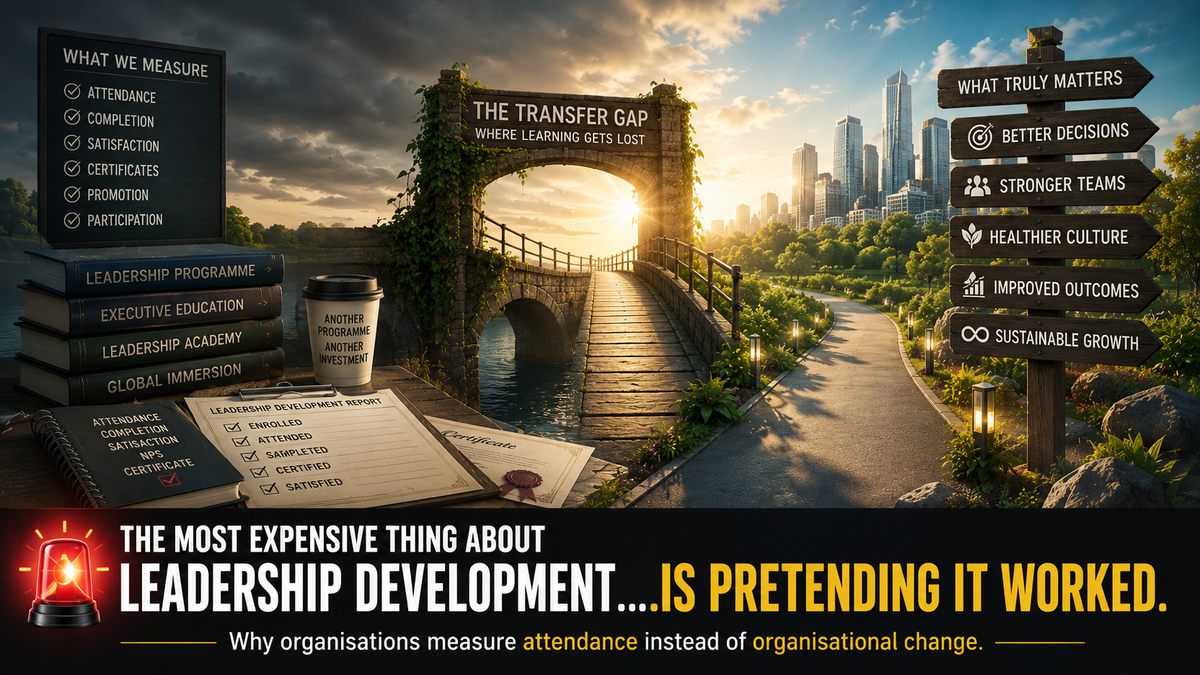
THE MOST EXPENSIVE THING ABOUT LEADERSHIP DEVELOPMENT... ...IS PRETENDING IT WORKED
Organisations invest heavily in leadership development, yet rarely ask whether the organisation actually changed. ISI examines the Leadership Transfer Gap and asks a harder governance question: Did better leadership development actually produce better decisions, culture and capability?
Dr Alwin Tan, GAICD, MBBS, FRACS, EMBA (Melbourne Business School)
Senior Surgeon | Governance Leader | HealthTech Co-founder | Founder of Institute for Systems Integrity (ISI) |Harvard Medical School — AI in Healthcare| University of Oxford — Sustainable Enterprise | Bastas Academy for Healthcare Leadership - Triple Scholar
Why organisations measure attendance instead of organisational change.
Every year, organisations spend billions of dollars on leadership development.
Executives attend Harvard.
INSEAD.
Oxford.
Melbourne Business School.
Company Directors courses.
Leadership academies.
Executive coaching.
Global immersions.
The investment is impressive.
The intentions are genuine.
But almost nobody asks the one question that matters.
Did the organisation become better because those leaders came back?
Not:
Did they enjoy the programme?
Did they complete it?
Did they receive a certificate?
Did they recommend it to colleagues?
But, Did the organisation actually change?
If the answer is unclear, then leadership development may have become one of the least-governed investments in modern organisations.
THE GREAT MEASUREMENT FAILURE
Most organisations carefully measure:
Attendance
Completion rates
Participant satisfaction
Promotion rates
Training budgets
Learning hours
Yet they rarely measure:
- Better decisions
- Better governance
- Better judgement
- Better collaboration
- Better succession
- Better challenge
- Better culture
- Better organisational learning
- Better patient or customer outcomes
We measure the investment.
We assume the impact.
That is not evidence.
It is hope.
THE BIGGEST MYTH IN LEADERSHIP DEVELOPMENT
There is a dangerous assumption hiding inside many leadership programmes.
That learning automatically becomes leadership.
It does not.
Leadership is not created because someone attended a world-class programme.
Leadership emerges only when organisations allow new knowledge to reshape how decisions are made, how authority is distributed and how people behave.
Without organisational change, learning remains personal.
The organisation remains exactly the same.
THE LEADERSHIP TRANSFER GAP
Imagine an executive returns from one of the world's best leadership programmes.
They begin delegating more authority.
Their manager continues approving every decision.
They encourage constructive challenge.
The executive team still rewards agreement.
They promote psychological safety.
Staff continue believing that speaking up is career limiting.
They champion systems thinking.
Performance measures still reward functional silos.
Did the programme fail?
Perhaps not.
Perhaps the organisation simply rejected what it had paid to develop.
THIS IS NOT AN EDUCATION PROBLEM.
IT IS A GOVERNANCE PROBLEM.
Boards approve millions of dollars in leadership investment.
But very few ask for evidence that leadership capability has transferred into organisational capability.
They govern expenditure.
They rarely govern transfer.
That is a missing governance control.
Introducing the ISI Leadership Transfer Integrity™ Framework
The Institute for Systems Integrity proposes that leadership development should be evaluated across six dimensions.
1. Behaviour Transfer
Did leaders actually change how they lead?
2. Decision Transfer
Did decision quality improve?
3. Team Transfer
Did the leader develop capability in others?
4. Governance Transfer
Did transparency, accountability and decision-making improve?
5. Cultural Transfer
Did the organisation become safer to question assumptions and surface difficult truths?
6. System Transfer
Did organisational performance improve because leadership behaviours changed?
If the answer to these questions is unknown, organisations cannot honestly claim leadership development has succeeded.
THE PROBLEM IS NOT THE COURSE.
Leadership programmes work.
Research consistently shows that well-designed leadership development can improve knowledge, behaviours and organisational outcomes when participants have opportunities to practise, receive feedback and apply learning in supportive environments (Lacerenza et al., 2017).
The problem begins afterwards.
Learning transfer depends less on the quality of the classroom and more on the quality of the organisational environment.
An organisation that centralises authority, discourages challenge and rewards conformity will eventually neutralise even the best leadership programme.
Culture becomes stronger than curriculum.
LEADERSHIP DEVELOPMENT CANNOT OUTRUN ORGANISATIONAL DESIGN
Many organisations expect leadership programmes to solve problems that actually originate elsewhere.
Poor decision rights.
Weak governance.
Political cultures.
Lack of psychological safety.
Siloed incentives.
Punitive responses to failure.
Leadership development cannot permanently compensate for organisational systems that prevent leadership from being exercised.
You cannot teach empowerment inside a system that refuses to let people decide.
You cannot teach courage inside a culture that punishes honesty.
You cannot teach innovation inside governance that rewards certainty.
THE RETURN-TO-WORK TEST
The success of leadership development should never be judged at the end of the course.
It should be judged six months later.
Has decision-making improved?
Has collaboration improved?
Has succession strengthened?
Has governance improved?
Has culture changed?
Has organisational capability increased?
If not, perhaps the course was never the intervention.
Perhaps the organisation was.
WHAT BOARDS SHOULD ASK
Boards should stop asking:
"How many people completed leadership development?"
Instead ask:
- What organisational behaviours changed?
- What decisions improved?
- What evidence shows learning transferred into practice?
- What barriers prevented transfer?
- How has leadership investment strengthened governance?
- Has the organisation become more capable—not merely more educated?
Those are governance questions.
CONCLUSION
Leadership development is not expensive because programmes cost money.
It becomes expensive when organisations mistake participation for transformation.
A certificate does not improve governance.
A leadership retreat does not improve culture.
An executive programme does not strengthen organisational capability.
Only transferred learning changes organisations.
Until boards begin governing that transfer...
...the most expensive thing about leadership development will not be the programme.
It will be pretending it worked.
Harvard References
Conger, J.A. and Fulmer, R.M. (2003) ‘Developing your leadership pipeline’, Harvard Business Review, 81(12), pp. 76–84.
Day, D.V. and Dragoni, L. (2015) ‘Leadership development: An outcome-oriented review based on time and levels of analyses’, Annual Review of Organizational Psychology and Organizational Behavior, 2, pp. 133–156.
Lacerenza, C.N., Reyes, D.L., Marlow, S.L., Joseph, D.L. and Salas, E. (2017) ‘Leadership training design, delivery, and implementation: A meta-analysis’, Journal of Applied Psychology, 102(12), pp. 1686–1718.
World Economic Forum (2025) The Future of Jobs Report 2025. Geneva: World Economic Forum.