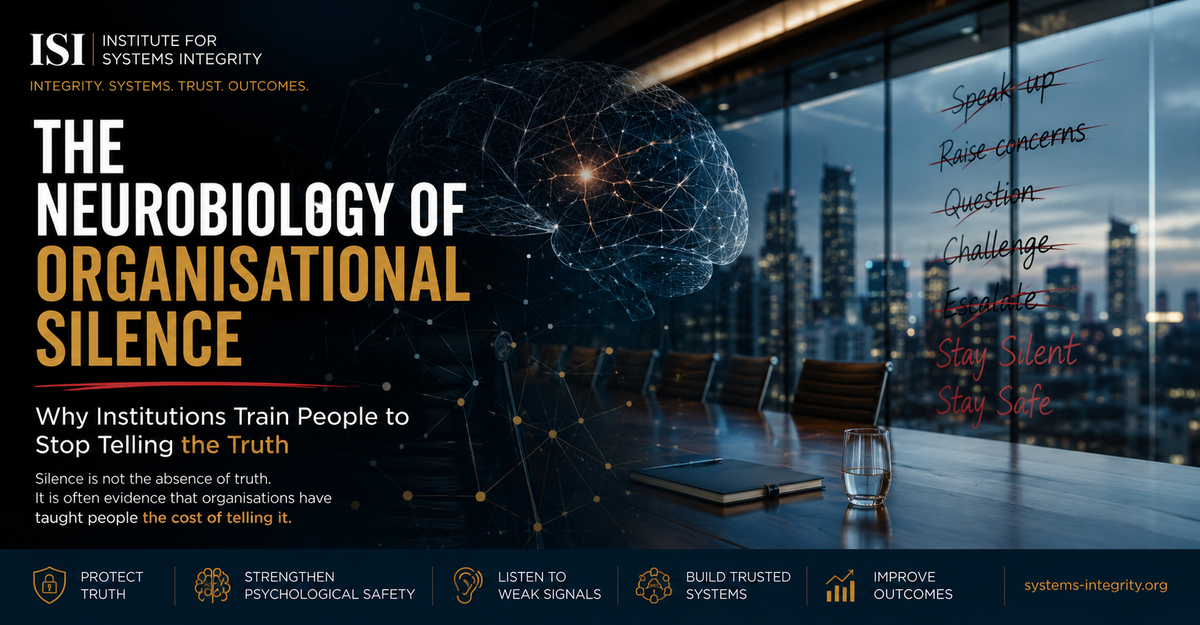
THE NEUROBIOLOGY OF ORGANISATIONAL SILENCE : Why Institutions Train People to Stop Telling the Truth
Silence is not always a choice. It may be an adaptive response. This paper examines how repeated suppression of concerns conditions people to withhold truth, weakening organisational learning, risk detection, and governance effectiveness.
Dr Alwin Tan, GAICD, MBBS, FRACS, EMBA (Melbourne Business School)
Senior Surgeon | Governance Leader | HealthTech Co-founder |
Harvard Medical School — AI in Healthcare |
Australian Institute of Company Directors — GAICD graduate |
University of Oxford — Sustainable Enterprise
Institute for Systems Integrity (ISI)
People rarely stop caring. They stop believing it is safe to care out loud.
One of the most enduring assumptions in organisational life is that silence is a choice.
If people witness something unsafe, unethical or concerning, they will simply speak up.
If they do not, we often assume complacency, disengagement, weakness, or lack of courage.
But what if we have misunderstood silence entirely?
What if silence is not simply a behavioural decision?
What if it is an adaptive response?
What if organisations are unknowingly training people not to tell the truth?
The greatest governance failures are rarely failures of information. They are failures of honesty.
Boards worry about incompetence.
Poor performance.
Weak controls.
Operational failures.
Compliance breaches.
Yet some of the most devastating institutional failures occurred in organisations filled with intelligent, capable and committed people.
NASA before Challenger.
Boeing before the 737 MAX crisis.
Mid Staffordshire before the public inquiry.
The issue was rarely that warning signs did not exist.
People knew.
Concerns had been raised.
Weak signals were present.
The real failure was that organisations progressively lost the ability to hear themselves honestly.
Truth became psychologically expensive.
Silence became adaptive.
Every organisation teaches.
Not only through policies.
Not only through mission statements.
But through experience.
Speak up and be heard.
Or speak up and be dismissed.
Raise a concern and be thanked.
Or raise a concern and become the concern.
Over time, people learn what the organisation truly values.
Not what it says.
What it does.
People stop asking, "Is this the right thing to do?" They start asking, "What will happen to me if I do it?"
Traditional governance assumes people make rational calculations.
If something is wrong, they report it.
However, organisational psychology suggests that repeated experiences shape expectations (Morrison, 2023).
When concerns are minimised, reframed, delayed or personalised, individuals begin to anticipate threat.
Speaking up becomes associated with embarrassment.
Isolation.
Career risk.
Futility.
Eventually, silence requires less effort than truth.
Not because people care less.
Because they have adapted.
The body remembers what the organisation repeatedly teaches.
Liza K Collins argues that workplace bullying and repeated exposure to psychological threat are not merely emotional experiences.
They are physiological ones.
The nervous system learns.
People stop trusting not only institutions.
They begin to doubt themselves.
What they saw.
What they knew.
What they felt.
The body keeps score long after the meeting has ended.
This does not mean every experience of silence reflects trauma.
But it does suggest that repeated experiences of dismissal alter expectations of safety.
And expectations shape behaviour.
Most patient harm is not prevented by heroics. It is prevented by ordinary people feeling safe enough to have difficult conversations.
Healthcare depends upon countless moments of everyday courage.
Questioning a medication order.
Escalating deterioration.
Challenging assumptions.
Admitting uncertainty.
Saying:
"I think we've missed something."
Patient safety relies upon truth travelling upwards without distortion.
When people no longer believe it is safe to raise concerns, weak signals disappear.
Near misses remain hidden.
Learning slows.
Risk accumulates unseen.
Silence is often mistaken for stability. Sometimes it is adaptation.
The most dangerous organisations are not always chaotic.
Many appear calm.
Meetings run smoothly.
KPIs remain green.
Complaints decrease.
Escalations stabilise.
Everyone appears aligned.
Boards interpret this as evidence of health.
It may instead reflect fear.
The absence of complaints is not evidence of safety.
It may be evidence that people have concluded telling the truth is no longer worth the cost.
Institutions often lose honesty before they lose control.
The tragedy is that many of the people who become silent were once the people who cared the most.
The nurse who always raised concerns.
The registrar who challenged inconsistencies.
The administrator who noticed patterns.
The patient who tried repeatedly to be heard.
The clinician who asked difficult questions.
Many eventually become quieter.
Not because they agree.
Because they adapt.
Because they survive.
Culture is not what organisations say. Culture is what people come to expect.
Perhaps one of the most confronting questions leaders can ask is this:
What have we taught our people happens when they tell us uncomfortable truths?
Have we taught curiosity?
Or defensiveness?
Learning?
Or reputation management?
Support?
Or containment?
Because culture is not defined by aspiration.
It is defined by expectation.
Psychological safety is not softness. It is infrastructure.
Psychological safety determines whether organisations can sense reality accurately.
It determines whether:
• weak signals surface
• uncertainty travels
• mistakes become visible
• assumptions are challenged
• learning occurs
Without it, organisations become epistemically blind.
Silence is therefore not merely a people problem.
It is a governance problem.
A sensing problem.
A patient-safety problem.
Those moments teach people that truth has somewhere safe to land.
The leaders people remember are rarely those who had all the answers.
They are the ones who said:
"Tell me what I don't want to hear."
"Help me understand."
"What have we missed?"
"Thank you for raising that."
These moments matter.
They teach people that honesty is welcome.
That uncertainty is tolerated.
That truth still has somewhere safe to land.
People do not stop speaking because they stop caring. They stop speaking because organisations teach them that survival matters more than truth.
Institutions do not fail because people raise concerns.
Healthcare systems do not collapse because difficult conversations occur.
Organisations fail when reality becomes too dangerous to communicate honestly.
When that happens, silence ceases to be a choice.
It becomes adaptation.
And once institutions begin training people to survive rather than speak, failure has already begun.
Because the greatest threat to organisational safety is not that people do not know the truth.
It is that they no longer believe it is safe to tell it.
People rarely stop caring. More often, they stop believing it is safe to care out loud. Restoring that belief may be one of the most important leadership responsibilities of our time.
References
Collins, L.K. (2025) The Physiology of Bullying: How Bullying Hijacks the Nervous System and What Leaders Must Do. Life Sized Publishing.
Edmondson, A.C. (1999) ‘Psychological safety and learning behavior in work teams’, Administrative Science Quarterly, 44(2), pp. 350–383.
Francis, R. (2013) Report of the Mid Staffordshire NHS Foundation Trust Public Inquiry. London: The Stationery Office.
Institute for Systems Integrity (2026a) Gaslighting as a Governance Failure in Healthcare: Why Suppression of Truth Signals Is a Patient-Safety Risk, Not a Cultural Issue. Melbourne: Institute for Systems Integrity.
Institute for Systems Integrity (2026b) The Most Dangerous Organisations Are the Ones Where Nobody Feels Safe Escalating Risk: Why Institutions Lose Honesty Before They Lose Control. Melbourne: Institute for Systems Integrity.
Institute for Systems Integrity (2026c) Decision Integrity as a Governance Control System. Melbourne: Institute for Systems Integrity.
Institute for Systems Integrity (2026d) Culture as a Control System: How Boards Set Good Culture. Melbourne: Institute for Systems Integrity.
Milliken, F.J., Morrison, E.W. and Hewlin, P.F. (2003) ‘An exploratory study of employee silence: Issues that employees do not communicate upward and why’, Journal of Management Studies, 40(6), pp. 1453–1476.
Morrison, E.W. (2014) ‘Employee voice and silence’, Annual Review of Organizational Psychology and Organizational Behavior, 1, pp. 173–197.
Morrison, E.W. (2023) ‘Employee voice and silence: Taking stock a decade later’, Annual Review of Organizational Psychology and Organizational Behavior, 10, pp. 79–107.
Porges, S.W. (2022) ‘Polyvagal theory: A science of safety’, Frontiers in Integrative Neuroscience, 16, Article 871227.
Sherf, E.N., Parke, M.R. and Isaakyan, S. (2021) ‘Distinguishing voice and silence at work: Unique relationships with perceived impact, psychological safety, and burnout’, Academy of Management Journal, 64(1), pp. 114–148.
van der Kolk, B.A. (2014) The Body Keeps the Score: Brain, Mind, and Body in the Healing of Trauma. New York: Viking.