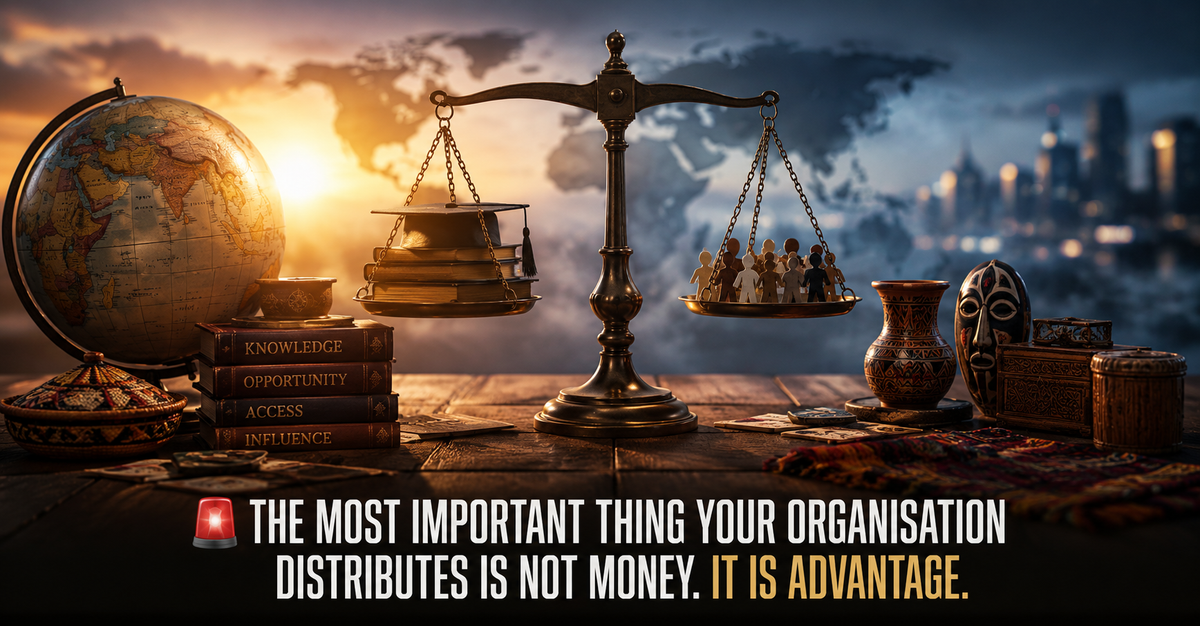
🚨 THE MOST IMPORTANT THING YOUR ORGANISATION DISTRIBUTES IS NOT MONEY : IT IS ADVANTAGE.
Most organisations believe inequality begins with pay. It does not. Organisations distribute opportunity, visibility, influence and credibility long before compensation differences appear. The real governance question is who receives advantage—and who never gets access to it.
Dr Alwin Tan, GAICD, MBBS, FRACS, EMBA (Melbourne Business School)
Senior Surgeon | Governance Leader | HealthTech Co-founder |
Harvard Medical School — AI in Healthcare |
Australian Institute of Company Directors — GAICD graduate |
University of Oxford — Sustainable Enterprise
Institute for Systems Integrity (ISI)
Why Inequality Begins Long Before The Pay Gap Appears
Most leaders think inequality is a financial problem.
They measure:
- salaries
- bonuses
- executive remuneration
- pay ratios
And when inequality appears, they assume it started there.
It didn't.
By the time inequality appears in a payroll report, the system has often been distributing advantage unevenly for years.
Because organisations do not simply distribute money.
They distribute:
- information
- opportunity
- visibility
- influence
- sponsorship
- credibility
- trust
- access
And these often shape a person's future more profoundly than compensation ever will.
🚨 EVERY ORGANISATION IS A POWER DISTRIBUTION SYSTEM.
We like to think organisations exist to create value.
That is only half the story.
Organisations also determine who receives the resources needed to succeed.
Not just economic resources.
But social resources.
Knowledge resources.
Reputational resources.
Political resources.
Every day leaders decide:
Who gets invited into important conversations?
Who receives mentoring?
Who gains exposure to decision-makers?
Who gets trusted with strategic work?
Whose ideas are amplified?
Whose concerns are ignored?
These decisions may appear small.
They are not.
Over time they determine who accumulates advantage.
And who does not.
🚨 CAREERS RARELY ADVANCE THROUGH CAPABILITY ALONE.
The uncomfortable reality is that capability is rarely sufficient.
People advance because capability becomes visible.
Visibility creates opportunity.
Opportunity creates credibility.
Credibility creates influence.
Influence creates power.
Power creates further opportunity.
Advantage compounds.
Meanwhile others remain unseen.
Not because they lack talent.
But because they lack access.
Many organisations describe this outcome as meritocracy.
Often it is accumulated opportunity masquerading as merit.
The Four Capitals Organisations Distribute
The work of Pierre Bourdieu provides a powerful lens for understanding this phenomenon.
He argued that people accumulate multiple forms of capital.
Economic Capital
Money.
Assets.
Financial resources.
Social Capital
Relationships.
Networks.
Access to influential people.
Cultural Capital
Knowledge.
Skills.
Expertise.
Education.
Symbolic Capital
Credibility.
Status.
Legitimacy.
Reputation.
Most organisations focus almost exclusively on the first.
Yet the remaining three frequently determine long-term success.
A promotion may increase income.
But a sponsor may change a career.
A training course may build skills.
But credibility may open doors for decades.
A salary can be spent.
A network can compound.
🚨 THE REAL CURRENCY OF ORGANISATIONAL LIFE IS OFTEN INVISIBLE.
Many of the most valuable resources inside organisations never appear on a balance sheet.
Consider two employees.
Both receive identical salaries.
One gains:
- mentoring
- strategic exposure
- executive access
- sponsorship
- leadership opportunities
The other receives none of these.
Financially they appear equal.
In reality they are accumulating entirely different futures.
One is receiving compounding capital.
The other is not.
This is how inequality often begins.
Quietly.
Incrementally.
Systemically.
🚨 THE MOST IMPORTANT THING BOARDS RARELY GOVERN IS THE DISTRIBUTION OF OPPORTUNITY.
Boards routinely review:
- financial performance
- workforce numbers
- remuneration reports
- risk registers
Yet almost never ask:
Who receives leadership exposure?
Who gains access to influence?
Who receives sponsorship?
Who is consistently excluded?
Who becomes visible?
Who remains invisible?
These are often treated as culture questions.
They are governance questions.
Because they determine how power is distributed throughout the system.
The Missing Piece In Stakeholder Governance
Recent stakeholder governance research has made an important contribution.
It argues that organisations shape inequality through the distribution of economic, social, cultural and symbolic capital.
This is true.
But there is an even deeper layer.
Before organisations distribute capital, they distribute signals.
Before someone receives opportunity, they must first receive information.
Before someone gains influence, they must first gain visibility.
Before someone develops credibility, they must first be heard.
Signal distribution precedes capital distribution.
And when signals become distorted:
- opportunities become concentrated
- visibility becomes selective
- influence becomes protected
- power becomes entrenched
This is where stakeholder governance and systems integrity converge.
🚨 SIGNAL INTEGRITY PRECEDES CAPITAL INTEGRITY.
If people cannot speak freely, they cannot contribute.
If concerns cannot travel upward, opportunities cannot travel downward.
If reality becomes filtered, advantage becomes concentrated.
Organisational silence is therefore not merely a communication failure.
It is a capital allocation failure.
A power distribution failure.
A governance failure.
Because when institutions lose signal integrity, they begin allocating advantage based on access rather than reality.
The Compounding Nature Of Inequality
The most dangerous inequalities are not immediate.
They are cumulative.
One overlooked opportunity.
One missed introduction.
One ignored voice.
One absent sponsor.
None appear significant in isolation.
Repeated hundreds of times across years, they create profoundly different outcomes.
One person accumulates:
- networks
- credibility
- visibility
- influence
Another accumulates frustration.
Eventually the gap becomes visible.
By then the underlying causes have often been operating for years.
🚨 INEQUALITY RARELY BEGINS WITH COMPENSATION.
It begins with exclusion.
It begins with invisibility.
It begins with silence.
The organisations that thrive in the future will not simply be those that create value.
They will be those that distribute human potential more fairly.
Because the greatest governance challenge of the next decade may not be wealth inequality.
It may be opportunity inequality.
And organisations are among its most powerful architects.
References
Amis, J.M., Barney, J.B., Mahoney, J.T. and Wang, H. (2020) ‘Why we need a theory of stakeholder governance—and why this is a hard problem’, Academy of Management Review, 45(3), pp. 499–503.
Amis, J.M., Mair, J. and Munir, K.A. (2020) ‘The organizational reproduction of inequality’, Academy of Management Annals, 14(1), pp. 195–230.
Bapuji, H., Ertug, G. and Shaw, J.D. (2020) ‘Organizations and societal economic inequality: A review and way forward’, Academy of Management Annals, 14(1), pp. 60–91.
Bourdieu, P. (1986) ‘The forms of capital’, in Richardson, J.G. (ed.) Handbook of Theory and Research for the Sociology of Education. New York: Greenwood, pp. 241–258.
Bridoux, F. and Stoelhorst, J.W. (2022) ‘Stakeholder governance: Solving the collective action problems in joint value creation’, Academy of Management Review, 47(2), pp. 214–236.
Freeman, R.E. (1984) Strategic Management: A Stakeholder Approach. Boston: Pitman.
Pavlisa, K., Harvey, W.S. and Doh, J. (2026) ‘Stakeholder governance and inequality: A theory of reciprocal exchange’, Organization Theory, 7, pp. 1–25.