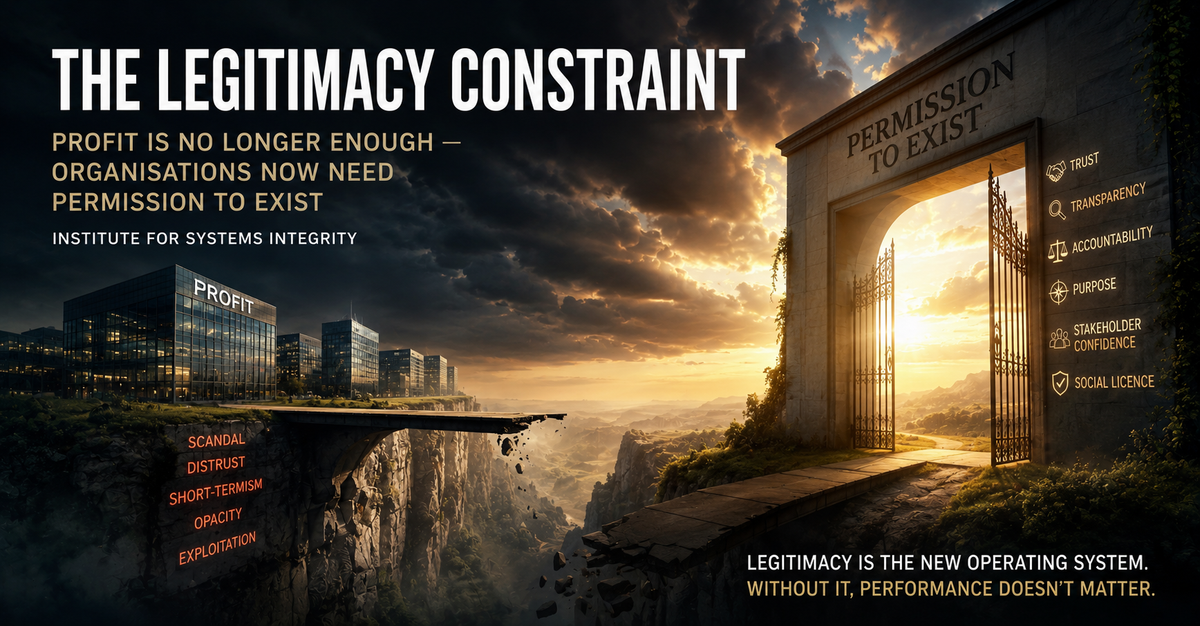
The Legitimacy Constraint Profit Is No Longer Enough — Organisations Now Need Permission to Exist
Strong financial performance once protected organisations from scrutiny. Today, trust can collapse before revenue does. This article explores legitimacy as an emerging governance constraint and why societal permission may become one of the defining risks of the next decade.
Dr Alwin Tan, GAICD, MBBS, FRACS, EMBA (Melbourne Business School)
Senior Surgeon | Governance Leader | HealthTech Co-founder |
Harvard Medical School — AI in Healthcare |
Australian Institute of Company Directors — GAICD graduate |
University of Oxford — Sustainable Enterprise
Institute for Systems Integrity (ISI)
For decades, organisations believed one thing protected them above all else:
👉 performance.
If revenue grew, markets expanded, and shareholders remained satisfied, most institutions assumed legitimacy would follow automatically.
That assumption is now collapsing.
Because increasingly, organisations are discovering something profoundly uncomfortable:
👉 society can withdraw trust before the balance sheet deteriorates.
And once legitimacy starts collapsing, financial performance often becomes irrelevant.
This is the new governance reality many boards still do not fully understand.
The modern organisation is no longer constrained only by:
- capital
- labour
- competition
- regulation
- operational capability
It is increasingly constrained by legitimacy.
By whether society still believes the organisation deserves:
- trust
- influence
- authority
- scale
- protection
- tolerance
- permission to continue operating
And that permission is becoming far more fragile.
Profit No Longer Protects You
There was a time when powerful organisations could survive despite:
- public distrust
- internal toxicity
- worker exploitation
- ethical failures
- weak transparency
- environmental damage
- cultural dysfunction
Many still generated enormous profits.
Many still appeared operationally successful.
Many still convinced themselves that performance proved legitimacy.
But the environment has changed.
Today:
- information moves instantly
- scrutiny scales globally
- employees mobilise publicly
- whistleblowers bypass hierarchy
- stakeholders organise digitally
- reputational damage compounds rapidly
- distrust spreads faster than institutions can respond
And critically:
👉 legitimacy now erodes faster than most governance systems can detect.
That creates a dangerous new reality:
An organisation can still appear successful —
while society quietly decides it no longer deserves the benefit of the doubt.
The Great Governance Miscalculation
Most boards still govern as though legitimacy is permanent.
It is not.
Legitimacy is not a trophy earned once and retained forever.
It is a continuously renewed social contract.
And modern institutions are becoming dangerously overconfident about how stable that contract really is.
Because many governance systems still measure:
- earnings
- productivity
- throughput
- market performance
- shareholder return
- compliance activity
- operational efficiency
But fail to adequately measure:
- trust deterioration
- cultural cynicism
- stakeholder resentment
- workforce disengagement
- reputational fragility
- moral credibility
- public tolerance
- legitimacy exhaustion
This is where governance blindness emerges.
Because institutions often continue optimising performance metrics —
while legitimacy quietly collapses underneath them.
And once legitimacy fractures, the consequences spread rapidly.
Not symbolically.
Operationally.
Legitimacy Is Operational Infrastructure
At the Institute for Systems Integrity, we argue that legitimacy is not reputation management.
It is operational infrastructure.
Because legitimacy determines how much freedom an institution actually has.
When legitimacy is strong:
- regulators show flexibility
- stakeholders show patience
- employees remain committed
- communities tolerate mistakes
- governments cooperate
- partnerships strengthen
- strategic manoeuvrability expands
But when legitimacy weakens:
- scrutiny intensifies
- tolerance narrows
- media pressure escalates
- political intervention increases
- workforce loyalty declines
- regulators become aggressive
- strategic flexibility contracts
This is the legitimacy constraint.
And many organisations will not recognise it until they are already trapped inside it.
The Coming AI Legitimacy Crisis
This problem is accelerating dramatically with AI.
Many organisations currently believe legitimacy can be engineered through:
- ethics statements
- governance committees
- AI principles
- compliance frameworks
- “human in the loop” language
- technical validation
But legitimacy does not come from policy documents.
It comes from whether people believe institutions are still acting in human interests.
And increasingly, many do not.
Especially when:
- systems become opaque
- accountability becomes unclear
- harms are minimised
- oversight appears symbolic
- executives appear detached from consequence
- frontline concerns are ignored
The danger is that organisations may become technically advanced —
while becoming socially distrusted at exactly the same time.
That creates an extraordinarily unstable governance environment.
Because technically functional systems can still become legitimacy failures.
Healthcare Is Already Warning Us
Healthcare may be one of the clearest examples of this shift.
Many healthcare systems still measure:
- throughput
- efficiency
- activity
- optimisation
- waitlists
- financial performance
But legitimacy increasingly depends on whether patients believe the system still prioritises human care over institutional preservation.
And once healthcare workers themselves begin losing trust in the institution, legitimacy deterioration accelerates even faster.
This matters enormously.
Because healthcare systems do not operate purely through economics.
They operate through societal trust.
The moment patients, clinicians, nurses, and communities stop believing the system fundamentally exists to protect them —
the entire legitimacy foundation begins weakening.
And no amount of branding can easily repair that once fractured.
The Most Dangerous Organisations Are Often the Most Successful Ones
This is where governance becomes psychologically dangerous.
Because legitimacy erosion rarely begins during visible collapse.
It often begins during peak operational confidence.
When:
- leadership becomes insulated
- dashboards replace reality
- criticism becomes unwelcome
- culture becomes performative
- institutions mistake scale for trust
- executives mistake profitability for permission
That is when organisations become most vulnerable.
Because power itself can distort institutional self-awareness.
And once institutions stop accurately perceiving how they are experienced externally, legitimacy decay accelerates silently.
The Next Governance Failure
The next generation of institutional failure may not begin with:
- insolvency
- operational breakdown
- competitive disruption
It may begin with something far quieter.
A slow societal withdrawal of trust.
A growing belief that the institution no longer deserves:
- protection
- tolerance
- credibility
- authority
- influence
At that point, regulation becomes easier to justify.
Intervention becomes politically popular.
Stakeholder resistance intensifies.
Talent leaves.
Public patience disappears.
And suddenly the organisation discovers something that strong quarterly performance could not protect it from:
👉 society no longer believes it deserves permission to operate as it once did.
That is the legitimacy constraint.
And it may become one of the defining governance risks of the next decade.
Harvard References
Eccles, RG & Klimenko, S 2019, ‘The Investor Revolution’, Harvard Business Review, May–June.
Edelman 2026, 2026 Edelman Trust Barometer, Edelman Trust Institute.
Gehman, J, Lefsrud, LM & Fast, S 2017, ‘Social license to operate: legitimacy by another name?’, Canadian Public Administration, vol. 60, no. 2, pp. 293–317.
Kramer, MR & Porter, ME 2011, ‘Creating Shared Value’, Harvard Business Review, January–February, pp. 62–77.
Meesters, ME & Behagel, JH 2021, ‘The social licence to operate and the legitimacy of resource extraction’, Current Opinion in Environmental Sustainability, vol. 49, pp. 7–11.
Moffat, K, Lacey, J, Zhang, A & Leipold, S 2016, ‘The social licence to operate: a critical review’, Forestry, vol. 89, no. 5, pp. 477–488.
OECD 2025, OECD Corporate Governance Factbook 2025, OECD Publishing, Paris.
Paine, LS 2022, ‘Corporate Purpose in a Time of Crisis’, Harvard Business Review, September–October.
Serafeim, G 2020, ‘Social-Impact Efforts That Create Real Value’, Harvard Business Review, September–October.
Serafeim, G & Kerr, J 2024, ‘Stakeholder Capitalism Still Makes Business Sense’, Harvard Business Review, August.
Suchman, MC 1995, ‘Managing legitimacy: strategic and institutional approaches’, Academy of Management Review, vol. 20, no. 3, pp. 571–610.