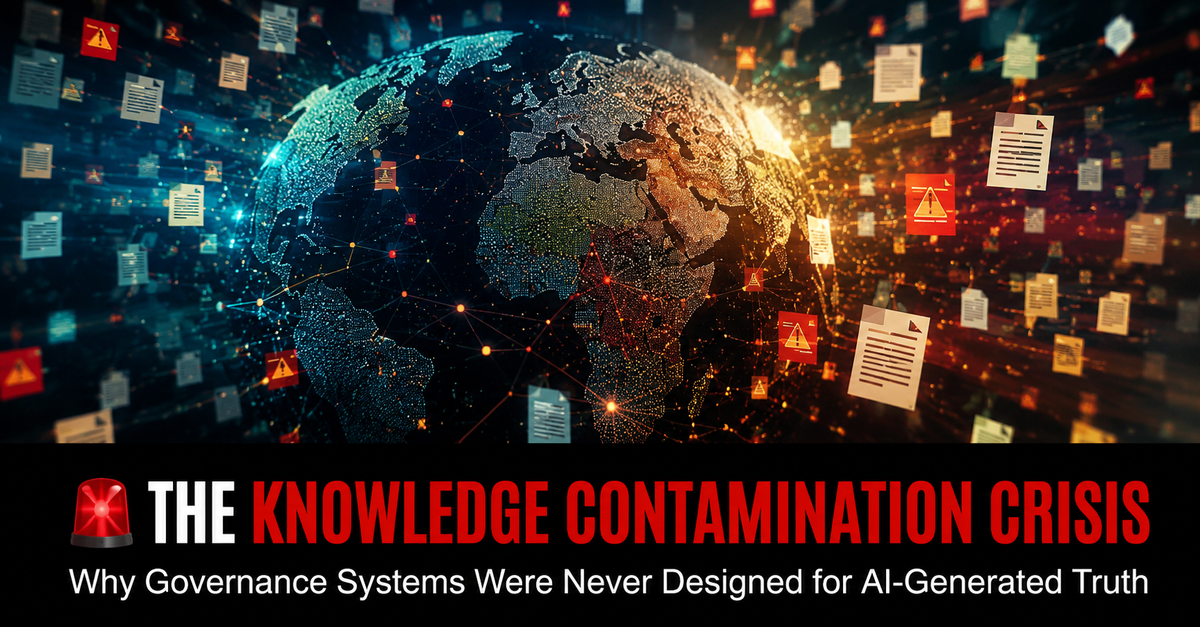
🚨 THE KNOWLEDGE CONTAMINATION CRISIS : Why Governance Systems Were Never Designed for AI-Generated Truth
Artificial intelligence may not cause harm when it gets things wrong. The greater risk may be when fabricated evidence becomes accepted knowledge. Evidence contamination could become one of the defining governance and patient safety challenges of the AI era.
Dr Alwin Tan, GAICD, MBBS, FRACS, EMBA (Melbourne Business School)
Senior Surgeon | Governance Leader | HealthTech Co-founder |
Harvard Medical School — AI in Healthcare |
Australian Institute of Company Directors — GAICD graduate |
University of Oxford — Sustainable Enterprise
Institute for Systems Integrity
For decades, organisations have invested heavily in governance.
Risk frameworks.
Compliance systems.
Audit functions.
Assurance programs.
Policies.
Controls.
Committees.
Dashboards.
Reporting structures.
Yet beneath every governance system sits a dangerous assumption.
An assumption so fundamental that most boards never stop to examine it.
The information entering the organisation broadly reflects reality.
Governance exists to evaluate information.
To analyse information.
To prioritise information.
To make decisions based upon information.
But governance was never designed to answer a much more difficult question.
Does reality actually exist underneath the information being presented?
That question is becoming increasingly important.
Because artificial intelligence is creating a category of risk that many governance systems are fundamentally unequipped to manage.
Not misinformation.
Not fraud.
Not cyber attack.
Not human error.
Knowledge contamination is the gradual infiltration of plausible but false information into the systems organisations use to understand reality.
And unlike previous information risks:
Contamination can now occur continuously, invisibly and at industrial scale.
THE MOST DANGEROUS LIE IS THE ONE NOBODY REALISES IS A LIE
Historically, organisations worried about:
- missing information
- delayed information
- incomplete information
- manipulated information
In every one of these situations, reality still existed somewhere underneath the problem.
The challenge was finding it.
AI changes that assumption.
Because AI can now generate:
- references that never existed
- legal precedents that never occurred
- research findings that were never published
- evidence that was never collected
- sources that cannot be verified
- analyses built entirely upon fabricated foundations
The danger is not simply that information can be wrong.
The danger is that it can appear right.
It can sound right.
It can feel authoritative.
It can survive scrutiny.
It can be repeated.
It can be trusted.
The most dangerous lie is no longer the obvious lie.
It is the lie that successfully impersonates truth.
This is the governance challenge many organisations have not yet recognised.
AI does not merely create errors. It creates credibility without reality.
BOARDS ARE STARTING TO GOVERN FICTION
Most organisations do not make decisions directly from reality.
They make decisions from reports about reality.
Executives rely on summaries.
Boards rely on dashboards.
Committees rely on briefing papers.
Investors rely on disclosures.
Regulators rely on submissions.
Each layer creates translation.
Each layer creates interpretation.
Each layer creates signal loss.
And:
Every layer moves decision-makers further away from direct observation.
Artificial intelligence is accelerating that distance.
AI is accelerating the distance between reality and governance.
Increasingly, organisations operate on:
summaries of reports,
summaries of summaries,
AI-generated summaries of summaries,
and eventually,
strategic decisions built on information nobody has independently verified.
Boards are increasingly being asked to trust information nobody has independently verified.
At some point the governance question changes.
It stops being:
"Is this information accurate?"
And becomes:
"Did this happen at all?"
FROM INFORMATION RISK TO REALITY RISK
Most governance systems were built to manage information risk.
Very few were designed to manage reality risk.
Reality risk emerges when organisations lose the ability to distinguish between:
- what happened
- what was observed
- what was reported
- what was interpreted
- what was generated
Historically, signal degradation occurred gradually.
AI changes the speed of contamination.
AI allows signal degradation to occur instantly.
A fabricated reference can enter a report in seconds.
A fabricated report can influence decision-makers in hours.
A fabricated assumption can shape strategy within days.
And once contamination enters organisational memory it becomes difficult to remove.
Because:
People rarely challenge information that appears credible. They build upon it.
They cite it.
They repeat it.
They institutionalise it.
They defend it.
Which means:
Organisations can institutionalise falsehood long before they discover it.
THE RISE OF SYNTHETIC TRUTH
For centuries, institutions have viewed information through a binary lens.
True.
Or false.
AI introduces a third category.
Synthetic truth.
Information that:
- looks real
- sounds authoritative
- behaves like evidence
- survives scrutiny
- gains legitimacy through repetition
Yet has no genuine foundation.
Synthetic truth gains legitimacy through repetition rather than verification.
That is what makes it dangerous.
Not because it enters organisations.
But because it becomes trusted.
The danger is not that synthetic truth enters organisations. The danger is that it becomes trusted.
By the time fabricated information is discovered:
strategy may have shifted,
capital may have been allocated,
policies may have been approved,
governance decisions may already have been made.
The organisation has unknowingly begun governing fiction.
THE KNOWLEDGE SUPPLY CHAIN IS NOW A GOVERNANCE ISSUE
Boards routinely govern:
- financial supply chains
- operational supply chains
- technology supply chains
- workforce supply chains
Yet:
Most organisations carefully govern financial supply chains while leaving their knowledge supply chains largely ungoverned.
This is becoming one of the most important governance blind spots of the AI era.
Because:
Every decision ultimately depends on a knowledge supply chain.
Knowledge enters organisations through:
- research
- experts
- consultants
- media
- analytics
- dashboards
- AI systems
Boards often focus on the quality of conclusions.
Far fewer focus on the origin of knowledge itself.
Boards that do not understand where knowledge originates cannot know whether decisions are evidence-based or merely evidence-shaped.
The danger is evolving.
The danger is no longer bad information. The danger is self-reinforcing information ecosystems that gradually lose contact with reality.
THE NEXT GOVERNANCE CRISIS WILL NOT BE A DATA CRISIS
Most organisations believe they have a data problem.
Many have exactly the opposite problem.
They possess more information than at any point in human history.
What they increasingly lack is confidence that the information is real.
Organisations do not have an information shortage. They have a reality verification problem.
This is not primarily a technology issue.
Nor a compliance issue.
Nor a cyber issue.
This is not a data crisis. It is an epistemology crisis.
A crisis of knowing.
A crisis of verification.
A crisis of reality itself.
And:
Most governance frameworks were never designed for a world where knowledge can be manufactured at scale.
SIGNAL INTEGRITY BECOMES A STRATEGIC CAPABILITY
At the Institute for Systems Integrity, we believe the next frontier of governance is changing.
The next frontier of governance is not information management. It is reality preservation.
The organisations that thrive in the AI era will not necessarily possess:
the most advanced AI,
the largest datasets,
the fastest automation,
or the most sophisticated algorithms.
Instead:
Their competitive advantage will be their ability to distinguish reality from information about reality.
Ultimately:
Signal integrity may become the defining strategic capability of the AI era.
THE MOST IMPORTANT BOARD QUESTION OF THE NEXT DECADE
Not:
"Do we have an AI strategy?"
Not:
"Are we adopting AI fast enough?"
Not:
"How many processes can we automate?"
But:
How does our organisation verify reality before reality becomes governance?
Because governance ultimately depends upon one thing.
Not compliance.
Not reporting.
Not dashboards.
Not technology.
Reality.
And:
Any organisation that loses the ability to distinguish reality from reporting is already in trouble, whether it knows it or not.
The defining governance challenge of the AI era may not be artificial intelligence itself.
It may be whether institutions can still recognise the difference between truth and its increasingly convincing imitation.
References
Bove, T. (2026) ‘AI hallucinations are infiltrating expert work—and entering the permanent body of knowledge’, Fortune, 24 May.
Charlotin, D. (2026) Database of AI Hallucinations in Legal Decisions. Available at: https://www.damiencharlotin.com/hallucinations/
Floridi, L. (2023) The Ethics of Artificial Intelligence: Principles, Challenges, and Opportunities. Oxford: Oxford University Press.
Kahneman, D., Sibony, O. and Sunstein, C.R. (2021) Noise: A Flaw in Human Judgment. London: William Collins.
Nature (2026) ‘Disease-prediction AI models raise concerns regarding data quality and validation’, Nature, May.
Topaz, M. et al. (2026) ‘Prevalence and trends of fabricated references in biomedical literature’, The Lancet Digital Health, May 2026.
Wardle, C. and Derakhshan, H. (2017) Information Disorder: Toward an Interdisciplinary Framework for Research and Policy Making. Strasbourg: Council of Europe.
Weick, K.E. and Sutcliffe, K.M. (2015) Managing the Unexpected: Sustained Performance in a Complex World. 3rd edn. Hoboken, NJ: Wiley.