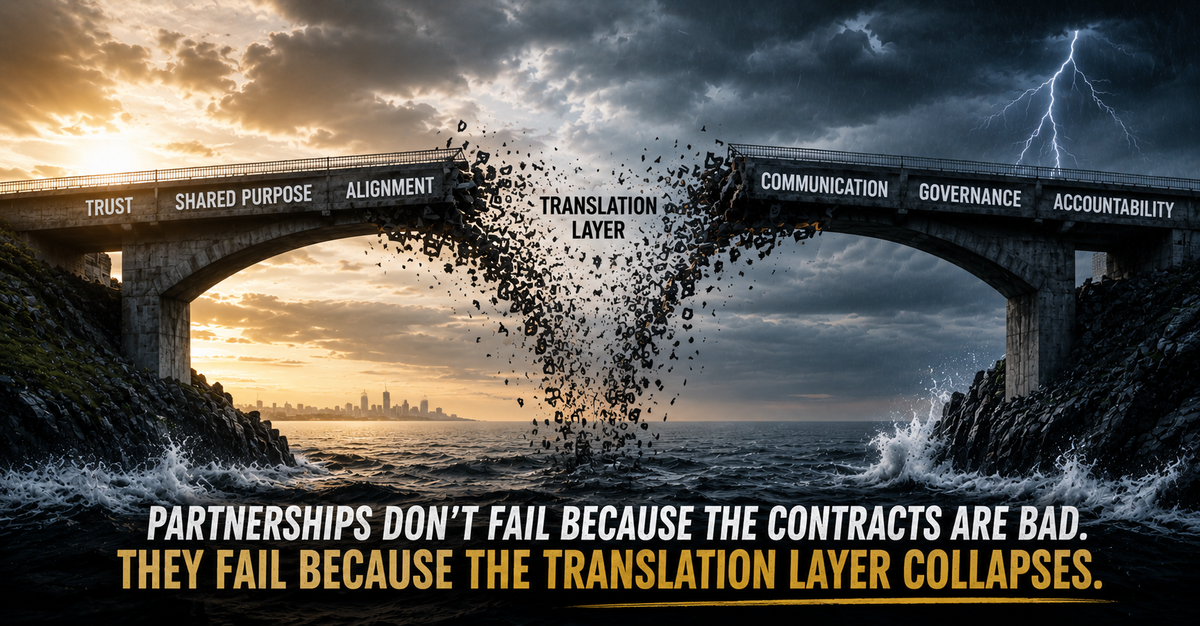
PARTNERSHIPS DON'T FAIL BECAUSE THE CONTRACTS ARE BAD :THEY FAIL BECAUSE THE TRANSLATION LAYER COLLAPSES.
Most partnerships don't fail because people stop caring. They fail because understanding collapses. Assumptions diverge, escalation slows and truth stops travelling. By the time the board sees the failure, the system has often been speaking about it for months.
Dr Alwin Tan, GAICD, MBBS, FRACS, EMBA (Melbourne Business School)
Senior Surgeon | Governance Leader | HealthTech Co-founder |
Harvard Medical School — AI in Healthcare |
Australian Institute of Company Directors — GAICD graduate |
University of Oxford — Sustainable Enterprise
By the Institute for Systems Integrity (ISI)
Boards love partnerships.
Joint ventures.
Strategic alliances.
Industry collaborations.
Public-private partnerships.
Technology ecosystems.
They signal ambition.
Growth.
Innovation.
Progress.
And when the agreement is signed, leaders congratulate themselves on having aligned strategy.
But here's the uncomfortable truth:
Most partnerships don't fail in the boardroom.
They fail in the spaces between organisations.
The handover.
The interpretation.
The assumptions.
The incentives.
The conversations nobody realised needed to happen.
Organisations assume that alignment on paper equals alignment in practice.
It doesn't.
A contract can define responsibilities.
It cannot guarantee understanding.
Governance frameworks can specify accountability.
They cannot ensure curiosity.
Performance indicators can track outputs.
They cannot detect whether people have stopped listening to one another.
The greatest governance risk in partnerships is not bad intent.
It is failed translation.
One organisation says "quality."
The other hears "speed."
One says "customer experience."
The other hears "cost containment."
One says "innovation."
The other hears "risk appetite."
Everyone believes they are aligned.
Until reality proves otherwise.
When partnerships collapse, inquiries often find:
• unclear expectations
• incompatible cultures
• competing incentives
• fragmented accountability
• poor escalation pathways
• assumptions left untested
• difficult conversations avoided
Sound familiar?
Because these are not partnership failures.
They are signal failures.
The dangerous part?
Most organisations don't govern for this.
Boards review contracts.
Approve strategies.
Monitor KPIs.
Receive assurance reports.
Tick the boxes.
Meanwhile, the translation layer remains invisible.
Nobody asks:
Do we mean the same thing when we use the same words?
Can concerns move freely across organisational boundaries?
Who notices when assumptions begin to diverge?
Where do conflicting incentives get surfaced and resolved?
How quickly can truth travel between partners?
Because the moment translation fails:
small misunderstandings become operational friction.
Operational friction becomes distrust.
Distrust becomes defensiveness.
Defensiveness suppresses escalation.
Suppressed escalation becomes surprise.
And surprise becomes crisis.
Most organisations do not fail because they lack intelligence.
They fail because intelligence stops flowing between people.
Between departments.
Between professions.
Between organisations.
Between those with power and those closest to reality.
The future will depend increasingly on partnerships.
Healthcare ecosystems.
AI alliances.
Cross-sector collaborations.
Global supply chains.
Public-private delivery models.
No organisation can solve complex problems alone.
Which means governance itself must evolve.
From governing structures...
to governing relationships.
From monitoring transactions...
to monitoring translation.
From asking:
"Did everyone do what they promised?"
to asking:
"Can reality move safely and accurately across this system?"
Because if it cannot...
the partnership has already started failing.
Even if the dashboard is still green.
Even if the KPIs look healthy.
Even if nobody has noticed yet.
Trust is not culture wallpaper.
It is governance infrastructure.
Translation is not communication.
It is a control system.
The organisations that thrive will not be those with the most partnerships.
They will be those that preserve signal integrity between them.
Because partnerships don't fail because the contracts are bad.
They fail because the translation layer collapses.
And by the time the board sees the failure...
the system has often been speaking about it for months.
Harvard References
Kanter, R.M. (1994) ‘Collaborative advantage: The art of alliances’, Harvard Business Review, July–August, pp. 96–108.
Hughes, J. and Weiss, J. (2007) ‘Simple rules for making alliances work’, Harvard Business Review, 85(11), pp. 122–131.
Edmondson, A.C. (2019) The Fearless Organization: Creating Psychological Safety in the Workplace for Learning, Innovation, and Growth. Hoboken, NJ: John Wiley & Sons.
Vargo, S.L. and Lusch, R.F. (2008) ‘Service-dominant logic: Continuing the evolution’, Journal of the Academy of Marketing Science, 36(1), pp. 1–10.
Kale, P. and Singh, H. (2009) ‘Managing strategic alliances: What do we know now, and where do we go from here?’, Academy of Management Perspectives, 23(3), pp. 45–62.
Weick, K.E. and Sutcliffe, K.M. (2015) Managing the Unexpected: Sustained Performance in a Complex World. 3rd edn. Hoboken, NJ: John Wiley & Sons.
Beer, M. (2009) High Commitment, High Performance: How to Build a Resilient Organization for Sustained Advantage. San Francisco: Jossey-Bass.