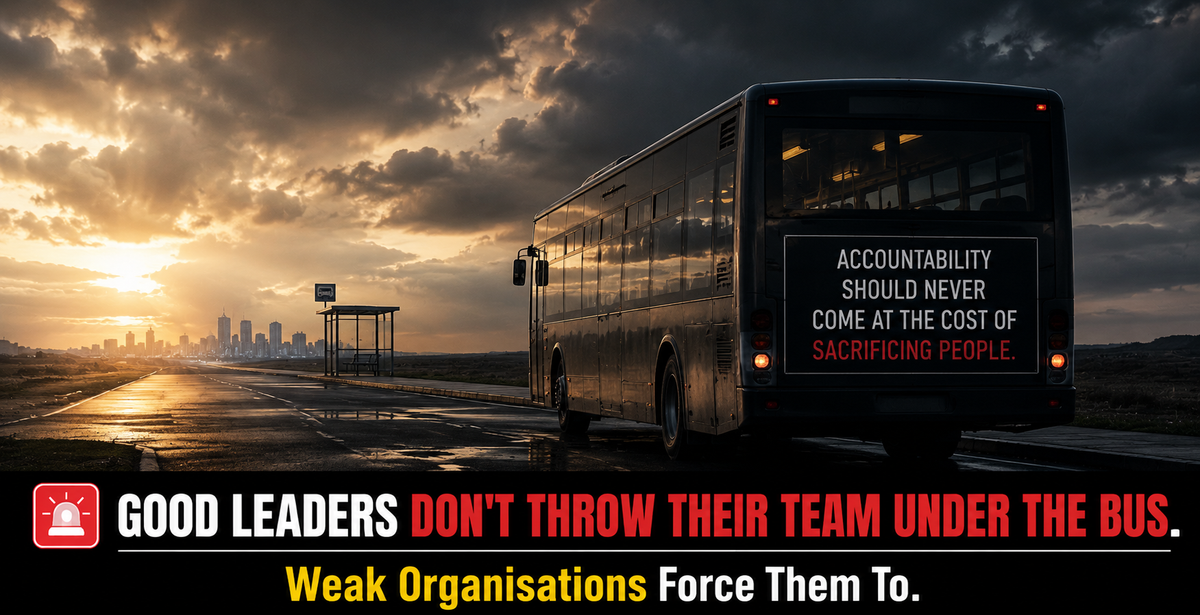
🚨 GOOD LEADERS DON'T THROW THEIR TEAM UNDER THE BUS. : Weak Organisations Force Them To
Scapegoating is not accountability. Strong organisations investigate systems before blaming individuals. Discover why leaders who abandon their teams during crises may be reflecting a deeper governance failure rather than solving one.
Dr Alwin Tan, GAICD, MBBS, FRACS, EMBA (Melbourne Business School)
Senior Surgeon | Governance Leader | HealthTech Co-founder |
Harvard Medical School — AI in Healthcare |
Australian Institute of Company Directors — GAICD graduate |
University of Oxford — Sustainable Enterprise
Institute for Systems Integrity
There is a sentence that quietly destroys organisations.
It is rarely spoken aloud.
But everyone understands what it means.
"Someone has to take responsibility."
On the surface, that sounds reasonable.
Accountability matters.
Leadership matters.
Consequences matter.
But in many organisations, "taking responsibility" has become something very different.
It has become finding someone to blame before understanding what actually happened.
And that is where leadership begins to fail.
Not because good leaders disappear.
But because weak organisations slowly teach them that survival depends on sacrificing someone else.
The First Casualty of Every Crisis Is Usually the Truth
Most crises begin with uncertainty.
Facts are incomplete.
Events are unfolding.
The causes are unclear.
Yet almost immediately, pressure arrives.
The board wants answers.
The CEO wants answers.
The regulator wants answers.
The media wants answers.
The public wants someone held accountable.
The demand for certainty quickly becomes the demand for blame.
And once that happens, organisational learning stops.
Because people stop asking:
"What failed?"
They begin asking:
"Who failed?"
Those are not the same question.
Scapegoating Is Not Accountability
Healthy organisations investigate systems.
Weak organisations investigate people.
When something goes wrong, they search for:
- the clinician who made the mistake
- the manager who missed the target
- the employee who forgot the procedure
- the individual whose name can be attached to the incident
The organisation feels reassured.
Action appears to have been taken.
Someone has been disciplined.
Someone has resigned.
Someone has been publicly criticised.
The board reports that accountability has occurred.
But nothing has actually been learned.
Because the system that created the failure remains untouched.
The same conditions.
The same incentives.
The same pressures.
The same culture.
Only the names have changed.
The Leadership Survival Trap™
Many leaders do not begin their careers intending to abandon their teams.
They begin by protecting them.
Taking responsibility.
Owning mistakes.
Creating psychological safety.
Then the first major crisis arrives.
Their executive quietly asks:
"Who was responsible?"
Not:
"What conditions produced this?"
The message is subtle but powerful.
Protect yourself.
Distance yourself.
Demonstrate decisive action.
Find the weak link.
Over time, good leaders learn a dangerous lesson.
The safest place during a crisis is never beside your team.
It is above them.
Not because they lack integrity.
Because the system rewards self-preservation over systemic learning.
The Leadership Buffer Illusion™
The best leaders spend years absorbing organisational dysfunction.
They shield their teams from impossible demands.
Translate unrealistic executive expectations.
Cover staffing shortages.
Repair broken relationships.
Calm angry patients.
Prevent burnout.
Compensate for failing systems.
From above, they appear exceptional.
From below, they appear supportive.
What few people notice is that they are quietly becoming human shock absorbers.
Every organisational weakness passes through them before reaching frontline staff.
Eventually something gives.
When the crisis finally becomes visible, the organisation often sacrifices the very leaders who spent years holding it together.
The people who protected the system become the people blamed for it.
Every Scapegoat Teaches a Lesson
The greatest damage is rarely done to the individual.
It is done to everyone watching.
When one good person is publicly sacrificed, every employee learns the same lesson.
Never be the person closest to the truth.
Do not report the near miss.
Do not challenge the executive.
Do not question the decision.
Do not admit uncertainty.
Do not volunteer bad news.
Silence becomes the safest strategy.
Not because people stopped caring.
Because the organisation demonstrated what honesty costs.
The Governance Failure Nobody Measures
Boards often monitor:
- financial risk
- cyber risk
- operational risk
- clinical risk
- legal risk
Few monitor something equally important.
Scapegoat risk.
How often does the organisation solve problems by sacrificing individuals instead of repairing systems?
How often are investigations designed to understand rather than assign blame?
How often do leaders feel psychologically safe admitting that a system—not a person—failed?
Because every unnecessary scapegoat weakens three critical organisational assets.
Trust.
Learning.
Signal integrity.
Once people believe that telling the truth makes them vulnerable, reality begins disappearing before it reaches decision-makers.
The Cost of Throwing People Under the Bus
When leaders sacrifice their teams to protect themselves, they may survive the immediate crisis.
But they lose something far more valuable.
Credibility.
Trust.
Moral authority.
People may continue reporting to them.
They stop following them.
The next time something goes wrong, staff will not ask:
"How do we solve this?"
They will ask:
"How do I avoid becoming the next one blamed?"
That single shift changes the entire organisation.
Innovation slows.
Speaking up disappears.
Near misses go unreported.
Psychological safety collapses.
The organisation becomes progressively less capable of seeing itself accurately.
Leadership Is Measured Under Pressure
Anyone can celebrate their team after success.
Anyone can claim to value culture when the numbers are good.
Leadership is revealed when things fall apart.
Do you protect the truth?
Do you investigate the system?
Do you stand beside your people while holding them accountable fairly?
Or do you sacrifice individuals to preserve appearances?
Because that decision echoes far beyond a single incident.
It teaches every employee what leadership really means.
The Systems Integrity Principle™
Good leaders do not protect incompetence.
They do not excuse misconduct.
They do not avoid accountability.
They protect something far more important.
The integrity of organisational learning.
They understand that accountability without understanding is punishment.
Understanding without accountability is negligence.
Healthy organisations require both.
The strongest leaders do not throw their teams under the bus.
And the strongest organisations never force them to choose between protecting their people and protecting themselves.
They build systems where truth is rewarded, accountability is fair, and learning matters more than finding someone to blame.
Because organisations rarely collapse because one person failed.
They collapse because everyone else learned to stay silent.
References (Harvard)
Argyris, C. (1990). Overcoming Organizational Defenses: Facilitating Organizational Learning. Boston: Allyn & Bacon.
Dekker, S. (2014). The Field Guide to Understanding 'Human Error' (3rd ed.). Farnham: Ashgate.
Detert, J.R. & Edmondson, A.C. (2011). Implicit Voice Theories: Taken-for-Granted Rules of Self-Censorship at Work. Academy of Management Journal, 54(3), 461–488.
Edmondson, A.C. (2019). The Fearless Organization: Creating Psychological Safety in the Workplace for Learning, Innovation, and Growth. Hoboken, NJ: Wiley.
Reason, J. (1997). Managing the Risks of Organizational Accidents. Aldershot: Ashgate.
Schein, E.H. & Schein, P.A. (2021). Organizational Culture and Leadership (5th ed.). Hoboken, NJ: Wiley.
Weick, K.E. & Sutcliffe, K.M. (2015). Managing the Unexpected: Sustained Performance in a Complex World (3rd ed.). Hoboken, NJ: Wiley.