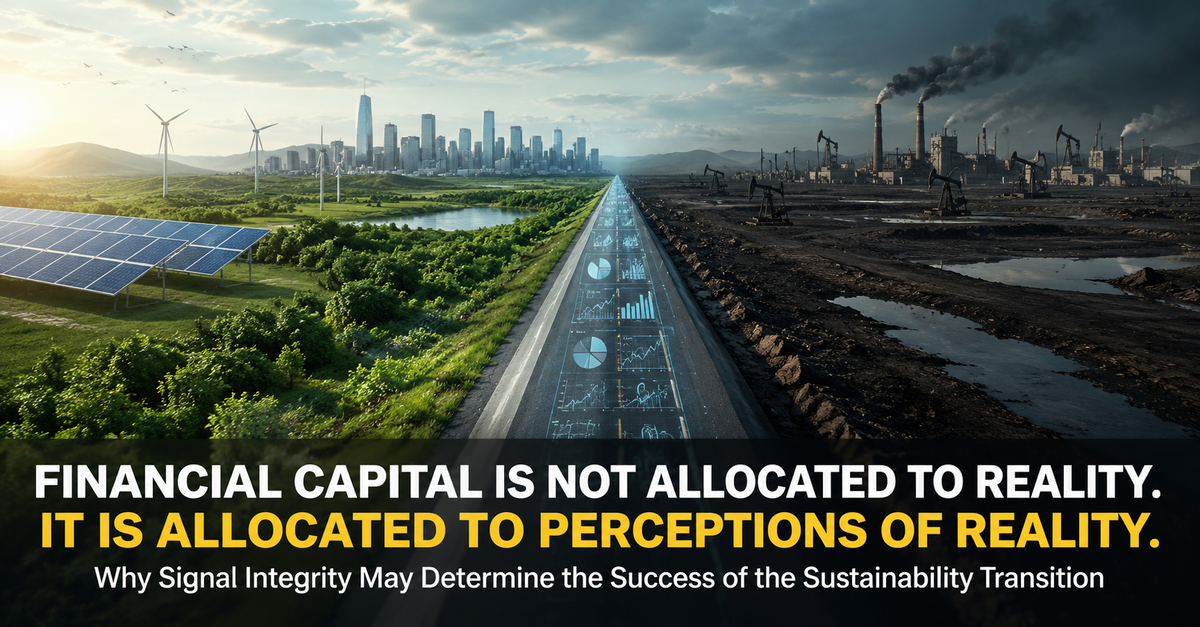
🚨 FINANCIAL CAPITAL IS NOT ALLOCATED TO REALITY : IT IS ALLOCATED TO PERCEPTIONS OF REALITY : Why Signal Integrity May Determine the Success of the Sustainability Transition
Financial capital does not flow to reality itself. It flows to perceptions of reality. In the sustainability transition, signal integrity may determine whether capital accelerates genuine transformation or rewards the appearance of impact.
Dr Alwin Tan, GAICD, MBBS, FRACS, EMBA (Melbourne Business School)
Senior Surgeon | Governance Leader | HealthTech Co-founder |
Harvard Medical School — AI in Healthcare |
Australian Institute of Company Directors — GAICD graduate |
University of Oxford — Sustainable Enterprise
Institute for Systems Integrity (ISI)
Introduction
Most discussions about sustainability focus on technology, policy and corporate responsibility.
These discussions matter.
But they often overlook one of the most powerful forces shaping the future:
financial capital.
The common assumption is that financial markets allocate capital based on objective reality.
That assumption is wrong.
Financial markets do not allocate capital to reality itself.
They allocate capital to perceptions of reality.
Investors do not directly observe the future.
They interpret information about the future.
They rely on:
- disclosures
- reports
- ratings
- forecasts
- risk models
- governance assessments
- market narratives
The quality of these signals determines how capital is allocated.
And because capital allocation shapes economic behaviour, signal quality ultimately influences which futures become possible.
From a systems perspective, sustainable finance is not simply about funding environmental initiatives.
It is about how financial systems interpret reality and convert those interpretations into economic outcomes.
🚨 The sustainability transition is not only a capital challenge. It is a signal integrity challenge.
Capital Shapes Reality
Financial capital is often viewed as a passive resource that follows economic change.
In practice, it frequently determines which changes occur.
Every major economic transformation in modern history has required large-scale capital mobilisation.
Industrialisation required investment.
Electrification required investment.
Digital transformation required investment.
Artificial intelligence requires investment.
The sustainability transition is no different.
Renewable energy systems, climate adaptation infrastructure, advanced manufacturing technologies and circular economy models all require significant financial support before they can scale.
Without capital, innovation remains potential.
With capital, innovation becomes reality.
🚨 Capital does not simply accelerate change. It decides which changes survive long enough to scale.
This gives financial institutions extraordinary influence over the future structure of the economy.
Banks, pension funds, insurers, sovereign wealth funds and asset managers collectively influence which industries grow, which technologies mature and which business models decline.
The Hidden System Behind Capital Allocation
Most people think financial systems move money.
In reality, financial systems process signals.
The pathway is often invisible:
Reality
↓
Data
↓
Disclosure
↓
Investor Interpretation
↓
Capital Allocation
↓
Corporate Behaviour
↓
Economic Outcomes
↓
Environmental and Social Impact
Every stage in this chain creates opportunities for distortion.
Data may be incomplete.
Disclosures may be selective.
Metrics may be inconsistent.
Narratives may become disconnected from measurable outcomes.
Interpretation may be influenced by assumptions and biases.
When these distortions accumulate, capital allocation begins to diverge from reality.
🚨 Financial systems do not allocate capital according to what is true. They allocate capital according to what appears to be true.
This distinction lies at the heart of sustainable finance.
Sustainability Is Becoming a Financial Risk
For decades, environmental sustainability was often viewed as a social or ethical concern.
Today it is increasingly viewed as a financial concern.
Climate change creates direct physical risks through extreme weather events, infrastructure disruption, resource scarcity and supply-chain instability.
At the same time, economies face transition risks as regulations, technologies and consumer expectations evolve.
Assets that appear valuable today may become less valuable tomorrow.
Business models that appear resilient today may become increasingly exposed to future regulatory, technological or reputational pressures.
As a result, financial institutions are incorporating environmental, social and governance (ESG) considerations into investment analysis, portfolio construction and risk management frameworks.
This shift reflects an important evolution.
Sustainability is no longer simply a question of values.
It is increasingly a question of financial stability.
The Governance Question Nobody Wants to Ask
Much of sustainable finance assumes that better sustainability information leads to better capital allocation.
But this assumption depends on a critical condition.
The information itself must be trustworthy.
🚨 Can financial markets reliably distinguish genuine sustainability from the appearance of sustainability?
This may be one of the most important governance questions facing modern financial systems.
Investors increasingly rely on sustainability reports, climate disclosures, ESG ratings and impact metrics.
Yet these systems remain fragmented.
Different reporting frameworks measure different things.
Different ratings agencies often reach different conclusions.
Different organisations apply different methodologies.
As reporting complexity increases, a dangerous possibility emerges.
Markets may begin rewarding reporting sophistication rather than actual sustainability performance.
The appearance of impact may become more investable than impact itself.
The Rise of Impact-Washing
The growing demand for sustainable investments has created powerful incentives for organisations to demonstrate environmental and social performance.
This has generated positive change.
It has also created new risks.
Greenwashing and impact-washing occur when organisations exaggerate, overstate or selectively communicate sustainability achievements.
These practices are often discussed as reputational issues.
They are far more significant than that.
From a systems perspective, they represent signal integrity failures.
When sustainability signals become unreliable, financial markets lose their ability to differentiate meaningful impact from marketing narratives.
🚨 The greatest threat to sustainable finance may not be insufficient capital. It may be the misallocation of capital caused by distorted signals.
And once signal integrity deteriorates, trust begins to deteriorate as well.
Sustainable Finance Is Ultimately a Signal Integrity System
The sustainability transition is frequently described as a technological challenge.
Others describe it as a policy challenge.
In reality, it is also an information challenge.
Financial systems continuously transform information into incentives.
Signals become beliefs.
Beliefs influence investment decisions.
Investment decisions influence organisational behaviour.
Organisational behaviour shapes economic outcomes.
Economic outcomes influence environmental and social conditions.
The pathway looks like this:
Signal
↓
Belief
↓
Capital
↓
Behaviour
↓
Reality
This process operates continuously across global financial markets.
🚨 The most important thing financial capital allocates is not money. It is belief.
Because belief determines where money flows.
And money determines which futures become possible.
Why Signal Integrity Matters
For sustainable finance to drive meaningful economic transformation, financial systems must be capable of distinguishing substance from appearance.
This requires:
- credible disclosures
- consistent reporting standards
- transparent methodologies
- independent assurance
- robust governance oversight
- high-quality data systems
Without these foundations, sustainable finance risks becoming performative rather than transformative.
Capital markets are powerful.
But their effectiveness depends on the quality of the signals they receive.
🚨 The quality of capital allocation can never exceed the quality of the information informing it.
Conclusion
The sustainability transition will not be determined by technology alone.
Nor will it be determined by government policy alone.
It will also be determined by how financial systems interpret information and allocate capital.
Financial institutions are not merely funding the future.
They are helping decide which futures become economically possible.
That responsibility carries profound governance implications.
Because financial systems do not allocate capital to reality itself.
They allocate capital to perceptions of reality.
🚨 And when perceptions become disconnected from reality, capital begins flowing in the wrong direction.
This is why sustainable finance is ultimately not just an ESG issue.
It is a governance issue.
It is a systems issue.
And increasingly, it is a signal integrity issue.
Because the success of the sustainability transition may depend less on how much capital exists and more on whether financial systems can accurately recognise where that capital should go.
References
Bolton, P. and Kacperczyk, M. (2021) ‘Do investors care about carbon risk?’, Journal of Financial Economics, 142(2), pp. 517–549.
Eccles, R.G. and Klimenko, S. (2019) ‘The investor revolution’, Harvard Business Review, 97(3), pp. 106–116.
Friede, G., Busch, T. and Bassen, A. (2015) ‘ESG and financial performance: Aggregated evidence from more than 2,000 empirical studies’, Journal of Sustainable Finance & Investment, 5(4), pp. 210–233.
Krueger, P., Sautner, Z. and Starks, L.T. (2020) ‘The importance of climate risks for institutional investors’, Review of Financial Studies, 33(3), pp. 1067–1111.
Network for Greening the Financial System (NGFS) (2024) Guide to Climate Scenario Analysis for Central Banks and Supervisors. Paris: NGFS.
Organisation for Economic Co-operation and Development (OECD) (2024) Financing Climate Futures: Rethinking Infrastructure. Paris: OECD Publishing.
Task Force on Climate-related Financial Disclosures (TCFD) (2023) Recommendations of the Task Force on Climate-related Financial Disclosures. London: Financial Stability Board.
United Nations Environment Programme Finance Initiative (UNEP FI) (2024) Financing the Sustainable Development Goals. Geneva: UNEP FI.