BOARDS DON'T GOVERN REALITY : They Govern What Reality Looks Like After It Has Passed Through the Organisation.
Boards rarely fail because they receive too little information. They fail because operational reality changes before it reaches them. This ISI paper introduces Information Fidelity as a governance capability.
Co Authors
Dr Alwin Tan, GAICD, MBBS, FRACS, EMBA (Melbourne Business School)
Senior Surgeon | Governance Leader | HealthTech Co-founder |
Harvard Medical School — AI in Healthcare |
Australian Institute of Company Directors — GAICD graduate |
University of Oxford — Sustainable Enterprise
&
Rosemary M. Boser BSN, RN, CNOR (Indiana University South Bend)
Patient Safety & Quality Systems Architect | High Reliability Organisation Advocate | Facility Quality Coordinator | Perioperative Safety & MH Specialist | Former Surgical Services Shared Governance Committee Chair
Institute for Systems Integrity (ISI)
Abstract
Boards rarely fail because they receive too little information. They fail because operational reality changes before it reaches them.
Modern organisations have never possessed more data. Boards receive sophisticated dashboards. Executives monitor real-time performance. Artificial intelligence identifies anomalies that previous generations could never observe. Yet major governance failures continue to emerge in organisations that believed they understood themselves.
This paradox suggests that governance no longer has an information problem. It has an information fidelity problem.
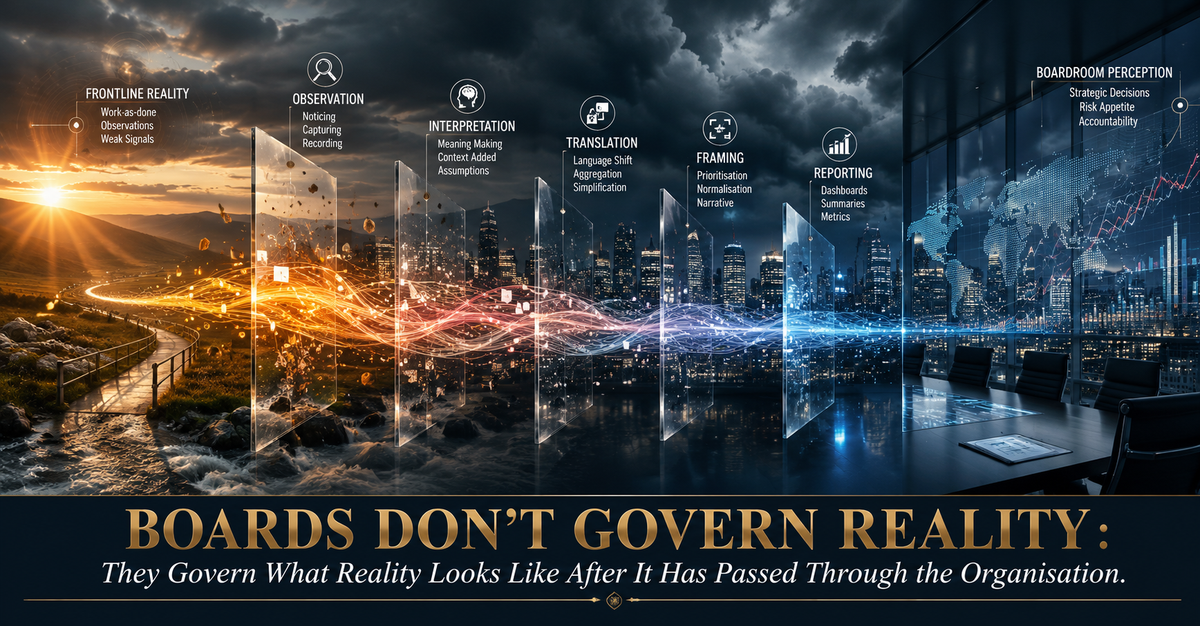
This paper proposes Information Fidelity as a governance capability describing the extent to which operational reality remains faithfully represented as information travels from the frontline to the boardroom. Drawing upon systems thinking, psychological safety, organisational silence, High Reliability Organisation (HRO) theory and Just Culture, we argue that boards do not govern operational reality directly. They govern representations of reality that have already been observed, interpreted, translated, prioritised and framed.
Rather than asking whether boards receive enough information, we propose a different governance question:
How much of operational reality survives the journey?
The implications extend well beyond healthcare. Every complex organisation depends upon preserving the integrity of reality as it moves through organisational systems. That journey may represent one of the least recognised governance risks of our time.
Introduction
Every governance decision begins with reality—but no board ever sees reality directly.
Boards oversee strategy, risk and organisational performance through reports, dashboards, assurance papers and executive briefings. These artefacts are essential. Yet they are not operational reality itself. They are organisational representations of reality.
Between the frontline and the boardroom lies an organisational signal chain. Operational events are observed, discussed, documented, summarised, translated, prioritised and aggregated before becoming governance information.
Every stage serves an important purpose. Modern organisations cannot govern millions of individual operational events.
Yet every act of simplification creates the possibility that reality changes.
Context may be compressed.
Uncertainty may be removed.
Weak signals may disappear.
Conflicting interpretations may be reconciled into a single organisational narrative.
By the time information reaches the boardroom, governance is no longer responding to operational reality itself. It is responding to what operational reality looks like after passing through the organisation.
The effectiveness of governance therefore depends not only on the availability of information, but on the fidelity with which reality survives the journey.
Reality Does Not Disappear. It Travels.
Reality rarely vanishes.
It travels.
And everything that travels through complex human systems changes.
Imagine a nurse recognising that a medication was almost administered incorrectly.
No patient is harmed.
Nothing catastrophic occurs.
The event lasts only seconds.
At that moment the organisation possesses reality in its highest fidelity.
The clinicians closest to the event understand not only what almost happened, but why.
Workload.
Interruptions.
Fatigue.
Environmental pressures.
Competing priorities.
Professional judgement.
Tacit knowledge.
The organisational journey then begins.
Should the event be reported?
Will reporting improve the system?
Will it create blame?
Will anyone listen?
If the event enters the reporting system, another transformation begins.
The near miss becomes an incident report.
The incident report becomes a departmental trend.
The trend becomes a dashboard.
The dashboard becomes one sentence within a board paper.
No single individual necessarily intends to distort reality.
Yet something has quietly changed.
Context has been reduced.
Nuance has been compressed.
Uncertainty has been simplified.
Operational experience has become governance information.
The board never sees the original event.
It sees whatever survives the organisational journey.
Healthcare is not unique.
The same pattern appears in aviation, defence, finance, government, manufacturing and technology.
Different industries.
Remarkably similar organisational behaviour.
Organisations Do Not Transmit Reality. They Transmit Interpretations.
One of the most persistent assumptions in governance is that organisations behave like information pipelines.
Reality occurs.
Information flows.
Leadership receives an accurate representation.
Complex organisations do not behave this way.
They behave as living adaptive systems.
Every organisational layer interprets before it communicates.
Frontline professionals interpret operational events.
Managers interpret operational significance.
Executives interpret strategic importance.
Boards interpret organisational risk.
Each interpretation is necessary.
Each interpretation also changes what follows.
Human beings naturally simplify.
Prioritise.
Translate.
Summarise.
Contextualise.
These behaviours make complex organisations governable.
They also create governance risk.
Tiny adjustments occurring repeatedly across multiple organisational layers can gradually produce a representation of reality that differs meaningfully from the operational conditions originally experienced.
Governance therefore depends not simply upon information quality, but upon preserving the integrity of organisational interpretation.
Information Fidelity as a Governance Capability
The future of governance will depend less upon collecting more information than preserving more reality.
We define Information Fidelity as the degree to which operational reality remains faithfully represented as information moves through organisational reporting systems without inappropriate distortion, omission or reinterpretation.
Information fidelity is not a technological property.
It is an organisational capability.
It emerges through the interaction of leadership behaviour, organisational culture, reporting design, incentives and governance architecture.
Research from multiple disciplines converges on this proposition.
Psychological safety enables individuals to report uncertainty without fear
Organisational silence prevents critical information from entering formal reporting systems
High Reliability Organisations deliberately protect weak signals because catastrophic failure is rarely without early warning .
Just Culture encourages learning by creating environments where reporting is valued over blame
Collectively these perspectives suggest a broader governance insight.
Organisations rarely fail because reality disappears. They fail because reality is progressively rewritten before governance decisions are made.
The Governance Signal Chain
Every organisation contains a governance signal chain through which operational reality progressively becomes governance information.
Operational Reality
↓
Observation
↓
Local Interpretation
↓
Managerial Translation
↓
Executive Framing
↓
Board Reporting
↓
Governance Decision
At every transition, information may undergo five forms of transformation.
Reduction removes detail.
Translation converts operational language into executive language.
Prioritisation determines what receives organisational attention.
Normalisation converts repeated deviations into accepted practice.
Sanitisation removes ambiguity, uncertainty and conflict in favour of coherent narratives.
None of these processes are inherently problematic.
Indeed, they are essential for governing complex organisations.
The governance risk emerges when necessary simplification quietly becomes organisational distortion.
Technology Cannot Preserve Reality
Artificial intelligence can accelerate information.
It cannot guarantee truth.
Digital reporting systems have dramatically increased the speed and sophistication of organisational information.
Yet technology cannot report concerns that employees never raise.
It cannot recover context that has already been removed.
It cannot reconstruct operational judgement that was never documented.
Nor can it detect weak signals that organisational culture has already suppressed.
There is therefore a risk that organisations become increasingly confident in increasingly incomplete representations of themselves.
Technology strengthens governance only when operational reality survives long enough to enter the system.
High-Performing Organisations Should Distrust Easy Reassurance
One of the most uncomfortable lessons from patient safety, High Reliability Organisations and organisational resilience is that deteriorating systems often appear healthy from a distance.
Incident reports decline.
Escalations decrease.
Board papers become increasingly reassuring.
Meetings become quieter.
Everyone assumes the organisation is improving.
Sometimes it is.
Sometimes it has simply become less capable of recognising its own deterioration.
The absence of reported problems should never automatically be interpreted as evidence that problems no longer exist.
It may reflect improvement.
It may reflect adaptation.
It may reflect fatigue.
It may reflect silence.
Governance requires the humility to distinguish between them.
Catastrophic failures rarely begin as catastrophes.
They begin as weak signals that fail to survive the organisational journey.
Governance Should Ask Different Questions
Boards already ask important questions.
Are risks appropriately managed?
Are we financially sustainable?
Are we compliant?
Are performance targets being achieved?
These remain essential.
Information Fidelity introduces another set of governance questions.
- How has operational reality changed before reaching the board?
- Where are weak signals most likely to disappear?
- Which organisational incentives shape reporting behaviour?
- Do frontline staff feel psychologically safe to communicate uncertainty?
- Which concerns never enter formal governance systems?
- Where does interpretation become distortion?
These questions move governance beyond measuring reports.
They focus governance on the integrity of the organisational processes that create those reports.
Two Careers. One Observation.
The authors professional journeys have been different.
One has centred on governance, leadership and systems thinking.
The other has centred on operating theatres, patient safety, High Reliability Organisations and forensic clinical auditing.
Different disciplines.
Different experiences.
Yet repeated conversations returned to the same observation.
Organisations rarely fail because nobody recognised emerging risk.
They fail because what was recognised gradually became something different before leadership understood it.
This is where governance begins.
Not when reports arrive.
But when organisations determine what reality is permitted to survive.
Perhaps governance's next evolution is not another dashboard.
Nor another reporting platform.
Nor another compliance framework.
Perhaps it is developing organisational capability to preserve reality before it becomes reporting.
Conclusion
Boards have never governed reality.
They have always governed representations of reality.
The critical governance question is therefore no longer:
"Do we have enough information?"
It is:
"How much of operational reality survived the journey to the boardroom?"
As organisations become increasingly data-rich and technologically sophisticated, governance advantage will belong not to those with the largest dashboards, but to those that preserve the greatest fidelity between operational truth and strategic decision-making.
The next generation of governance will not be defined by information abundance.
It will be defined by organisations that preserve reality before it becomes reporting.
References (Harvard)
Argyris, C. and Schön, D.A. (1996) Organizational Learning II: Theory, Method and Practice. Reading, MA: Addison-Wesley.
Dekker, S. (2012) Just Culture: Balancing Safety and Accountability. 2nd edn. Farnham: Ashgate.
Edmondson, A.C. (1999) 'Psychological safety and learning behavior in work teams', Administrative Science Quarterly, 44(2), pp. 350–383.
Francis, R. (2013) Report of the Mid Staffordshire NHS Foundation Trust Public Inquiry. London: The Stationery Office.
Morrison, E.W. and Milliken, F.J. (2000) 'Organizational silence: A barrier to change and development in a pluralistic world', Academy of Management Review, 25(4), pp. 706–725.
Reason, J. (1997) Managing the Risks of Organizational Accidents. Aldershot: Ashgate.
Senge, P.M. (1990) The Fifth Discipline: The Art and Practice of the Learning Organization. New York: Doubleday.
Vaughan, D. (1996) The Challenger Launch Decision: Risky Technology, Culture, and Deviance at NASA. Chicago: University of Chicago Press.
Weick, K.E. and Sutcliffe, K.M. (2007) Managing the Unexpected: Resilient Performance in an Age of Uncertainty. 2nd edn. San Francisco: Jossey-Bass.
World Health Organization. (2021) Global Patient Safety Action Plan 2021–2030: Towards Eliminating Avoidable Harm in Health Care. Geneva: World Health Organization.