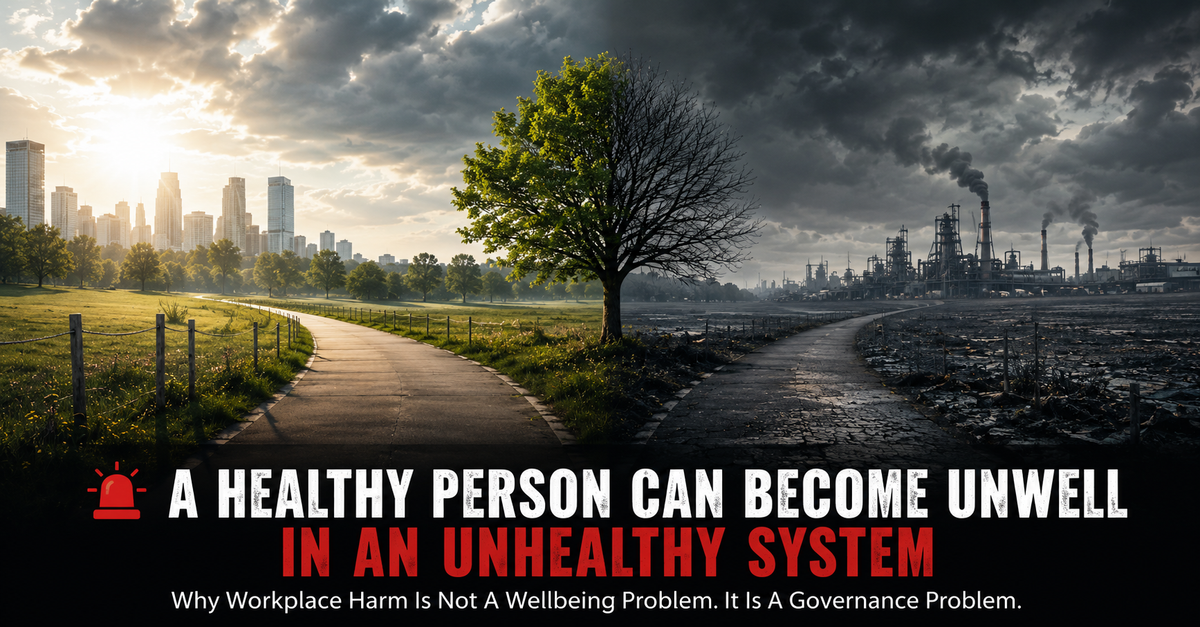
🚨 A HEALTHY PERSON CAN BECOME UNWELL IN AN UNHEALTHY SYSTEM : Why Workplace Harm Is Not A Wellbeing Problem : It Is A Governance Problem.
Workplace harm is not merely a wellbeing issue. It is a governance issue. This article explores why burnout, psychological injury and organisational silence are often symptoms of unhealthy systems—and why leaders must diagnose the workplace, not just support the people within it.
Dr Alwin Tan, GAICD, MBBS, FRACS, EMBA (Melbourne Business School)
Senior Surgeon | Governance Leader | HealthTech Co-founder |
Harvard Medical School — AI in Healthcare |
Australian Institute of Company Directors — GAICD graduate |
University of Oxford — Sustainable Enterprise
Most organisations still misunderstand workplace wellbeing.
When people become exhausted, anxious, disengaged, burned out or psychologically injured, leaders often respond with support programs.
More coaching.
More resilience training.
More wellbeing initiatives.
More counselling.
More resources to help people cope.
These interventions can be valuable.
People who are struggling deserve support.
People who have been harmed may require care, treatment, leave, rehabilitation and protection.
But many organisational responses begin with the same assumption:
That the primary problem sits inside the individual.
That the person has become less resilient.
Less adaptable.
Less capable of managing pressure.
Less able to cope.
But what if the person is not the primary problem?
What if the organisation is?
Because sometimes a healthy, capable and committed person can become unwell when exposed for long enough to an unhealthy system.
And when that happens, the individual may require support.
But the system requires diagnosis.
The Most Expensive Misdiagnosis in Modern Leadership
Imagine a highly capable employee.
Motivated.
Competent.
Committed.
Healthy.
Now place them inside a system where:
- speaking up is risky
- workloads are chronically unsustainable
- uncertainty is punished
- bullying is tolerated
- bad behaviour is normalised
- trust has broken down
- concerns disappear into bureaucracy
- reporting creates personal exposure
- leadership is increasingly disconnected from frontline reality
Then leave them there for years.
What exactly do we expect to happen?
Human beings do not operate independently of their environments.
They adapt to them.
They learn what is safe.
They learn what is dangerous.
They learn when to speak.
They learn when to remain silent.
They learn which leaders can be trusted.
They learn which concerns will be acted upon.
They learn what happens to people who tell the truth.
And eventually, the system begins shaping not only behaviour, but health.
The uncomfortable truth is this:
Organisations create human conditions.
And human conditions create human outcomes.
Yet when those outcomes become harmful, organisations often examine the individual before examining the conditions surrounding them.
Stress becomes a personal wellbeing issue.
Burnout becomes a resilience issue.
Anxiety becomes a coping issue.
Disengagement becomes an attitude issue.
Absence becomes a performance issue.
The organisation treats the visible consequence while leaving the generating system largely intact.
That may be one of the most expensive misdiagnoses in modern leadership.
Support Is Necessary. But Support Is Not Prevention.
This argument is not a case against wellbeing programs.
Coaching can help.
Counselling can help.
Employee assistance programs can help.
Peer support can help.
Clinical care can help.
Resilience matters.
Recovery matters.
But support becomes ethically dangerous when it is used as a substitute for safer work.
An employee assistance program cannot compensate for chronic understaffing.
Mindfulness cannot neutralise bullying.
Resilience training cannot repair a reporting system that punishes honesty.
Time-management coaching cannot solve impossible workloads.
A wellbeing app cannot restore trust in a leader who retaliates against dissent.
Personal boundary training cannot correct a system that repeatedly ignores those boundaries.
Support matters.
But support is not the same as prevention.
And helping people endure harmful conditions is not the same as removing those conditions.
The governance failure occurs when organisations invest heavily in the adaptive capacity of employees while refusing to examine the system consuming that capacity.
Culture Is Not Soft. It Is Biologically Experienced.
Many leaders still describe culture as though it were intangible.
Something difficult to measure.
Something secondary to performance.
Something separate from operations.
But culture is not experienced as a slogan.
It is experienced through repeated interactions with power, uncertainty, fairness, belonging and consequence.
Can I raise a concern safely?
Will bad behaviour be challenged?
Does leadership listen?
Will speaking honestly help me or harm me?
Will the rules apply equally?
Will the organisation protect me if I expose a risk?
These questions are not abstract.
They shape behaviour.
They shape attention.
They shape trust.
They shape whether people collaborate, withdraw, escalate, conceal, learn or leave.
Human beings continuously interpret cues of safety, predictability, belonging, status and threat.
Fear.
Humiliation.
Exclusion.
Powerlessness.
Unpredictability.
These are not merely workplace emotions.
When they become persistent, they can affect stress responses, sleep, concentration, decision-making, emotional regulation, physical health and the capacity to recover.
Collins (2025) argues that workplace bullying should not be understood solely as misconduct or an HR issue. Drawing on trauma-informed practice, neuroscience and lived experience, she describes bullying as a form of physiological exposure capable of affecting the nervous system, health, trust and organisational functioning.
That insight matters.
Because people do not simply work inside cultures.
They are shaped by them.
And the body may recognise organisational dysfunction long before leadership does.
Burnout May Be Organisational Intelligence
Burnout is frequently discussed as an individual outcome.
A personal problem.
A wellbeing issue.
A resilience deficit.
But burnout should never be interpreted simplistically.
Human health is shaped by many interacting factors.
Personal circumstances matter.
Medical conditions matter.
Family pressures matter.
Prior experiences matter.
Not every case of burnout can be attributed solely to work.
But when exhaustion, cynicism, moral distress, absence, disengagement and turnover begin clustering within the same team, profession, unit or organisation, leadership should stop asking only what is wrong with individuals.
The pattern itself becomes organisational intelligence.
Because long before burnout becomes visible, organisations often experience:
- growing silence
- reporting fatigue
- moral distress
- fear of escalation
- emotional exhaustion
- withdrawal
- presenteeism
- cynicism
- learned helplessness
- declining trust
- increasing turnover
Burnout is rarely the first available signal.
It may simply be the first signal the organisation can no longer dismiss.
Seen this way, burnout is not only a workforce outcome.
At aggregate level, it may be a lagging indicator that the system has exceeded its human adaptive capacity.
A workforce does not become exhausted all at once.
It is gradually depleted.
Through repeated overextension.
Repeated disappointment.
Repeated exposure to poor leadership.
Repeated failure of escalation.
Repeated evidence that the organisation expects people to absorb more than the system is prepared to repair.
When enough people begin to deteriorate, the organisation is no longer observing isolated wellbeing events.
It is receiving system data.
When Wellbeing Becomes Governance Camouflage
One of the most uncomfortable possibilities is that wellbeing initiatives can unintentionally obscure the causes of workplace harm.
The initiatives may be sincere.
The people delivering them may be highly capable.
The support may genuinely help some employees.
But structurally, the response can still shift attention away from the system.
Chronic understaffing becomes a resilience problem.
Unsafe workload becomes a time-management problem.
Bullying becomes a mediation problem.
Moral distress becomes a mindfulness problem.
Fear of speaking up becomes a confidence problem.
Broken trust becomes an engagement problem.
Retaliation becomes an interpersonal conflict.
Poor work design becomes an employee coping issue.
The danger begins when wellbeing becomes the treatment offered to employees for injuries generated by governance.
Because then the organisation can appear responsive without changing the conditions creating the harm.
It can demonstrate activity.
Launch programs.
Publish commitments.
Run surveys.
Offer support.
And still preserve the underlying system.
The question is not whether wellbeing programs exist.
The question is whether they are being used alongside meaningful hazard reduction or instead of it.
Workplace wellbeing fails when it is used to increase people’s tolerance for conditions governance has refused to change.
When Organisations Stop Listening to Their Own Signals
At the Institute for Systems Integrity, we have repeatedly argued that institutions rarely fail because information does not exist.
They fail because information does not travel.
The frontline sees reality.
Middle management translates reality.
Executives summarise reality.
Boards govern reality.
But every layer can alter the signal.
When fear enters the system:
- concerns become softened
- risks become normalised
- reporting becomes selective
- bad news is delayed
- dissent becomes dangerous
- data loses context
- leadership becomes insulated
The organisation gradually loses the ability to see itself accurately.
Workplace harm matters not only because people suffer.
It matters because suffering itself may be evidence that the system is no longer functioning safely.
When suffering becomes patterned, concentrated or recurrent, it may indicate that the system is functioning exactly as designed—but not as leaders claim.
A culture that suppresses distress also suppresses operational truth.
A workforce afraid to report bullying may also be afraid to report safety concerns.
A team unable to challenge a manager may also be unable to challenge a flawed decision.
A clinician who learns that escalation is punished may hesitate the next time a patient is deteriorating.
A worker who has repeatedly watched concerns disappear may eventually stop reporting them.
This is how workplace harm becomes organisational risk.
The same conditions that injure people can also damage learning, decision-making, safety, quality and institutional legitimacy.
The Governance Question Nobody Wants to Ask
Imagine a hospital.
Compliance remains satisfactory.
KPIs remain green.
Board reports remain reassuring.
Accreditation remains intact.
Yet clinicians are exhausted.
Nurses are afraid to escalate concerns.
Turnover is increasing.
Moral distress is spreading.
Psychological safety is deteriorating.
Incidents are being managed locally.
Exit interviews reveal patterns nobody has aggregated.
Is the organisation healthy?
Or is it measuring the wrong things?
This is fundamentally a governance question.
Because governance is not the management of reports.
Governance is the management of reality.
And reality often deteriorates before metrics do.
The board question should not simply be:
“Do we have a wellbeing program?”
It should be:
“What evidence demonstrates that our systems of work are not creating preventable psychological harm?”
And then:
“How would we know if our reporting mechanisms were concealing the answer?”
Boards should not diagnose employees.
They should not personally manage every grievance.
But they are responsible for ensuring that the organisation can:
- identify psychosocial hazards
- hear worker experience without retaliation
- detect patterns across teams and leaders
- investigate repeated harm independently
- redesign unsafe work
- resource effective controls
- test whether interventions are working
- identify gaps between policy and lived experience
- hold executives accountable for culture and work design
- obtain assurance beyond management reporting
One distressed employee may require individual assessment.
A recurring pattern of distress under the same leader, within the same unit or around the same work conditions requires organisational investigation.
That is the difference between managing an individual case and governing a system.
The Organisational Patient
Healthcare teaches us to search for root causes.
Yet organisations frequently treat symptoms while ignoring underlying pathology.
Stress becomes a wellbeing issue.
Burnout becomes an HR issue.
Bullying becomes a behavioural issue.
Turnover becomes a recruitment issue.
Absenteeism becomes a workforce issue.
Psychological injury becomes a claims issue.
Each response addresses a consequence.
Few diagnose the system generating it.
The organisation becomes increasingly focused on helping people tolerate unhealthy conditions rather than removing the conditions themselves.
It invests in coping.
It invests in recovery.
It invests in replacement.
It invests in reputation management.
But it may remain unwilling to examine power, leadership conduct, staffing, incentives, work design and accountability.
The organisation itself becomes the patient.
But unlike a biological patient, an organisation does not become unhealthy by itself.
Its conditions are produced through decisions.
Decisions about workload.
Decisions about resources.
Decisions about who is protected.
Decisions about whose voice matters.
Decisions about what behaviour is tolerated.
Decisions about whether inconvenient truth is treated as intelligence or disloyalty.
The pathology may be organisational.
But the causes are rarely ownerless.
Culture Is a Governance Control System
The next generation of leaders will need to think differently about culture.
Not as engagement.
Not as morale.
Not as employee satisfaction.
Not as the atmosphere created by leadership retreats and values statements.
Culture is a governance control system.
Because culture determines:
- what people notice
- what people say
- what people suppress
- what people escalate
- what managers transmit
- what executives hear
- what boards ultimately know
A strong psychosocial safety climate tells workers that psychological health is genuinely prioritised through leadership commitment, communication, participation and action.
A weak climate communicates something else:
Performance matters more.
Silence is safer.
Bad news carries consequences.
Protection is unequal.
Wellbeing is discussed but not defended.
An organisation can have wellbeing programs while maintaining a psychologically unsafe culture.
It can provide counselling while preserving harmful leadership.
It can conduct engagement surveys while ignoring retaliation.
It can promote resilience while designing work that continuously overwhelms human limits.
Culture is not what the organisation says it values.
Culture is what repeated experience teaches people to expect.
Once culture begins suppressing truth, the organisation loses its ability to learn.
When organisations lose their ability to learn, risk compounds.
When risk compounds, harm follows.
From Wellbeing Programs to Psychosocial Risk Governance
The future of workplace health cannot be built solely around helping people recover after harm.
It must include primary prevention.
That means identifying and controlling the conditions capable of creating harm in the first place.
A serious governance approach should ask five questions.
1. Exposure
What aspects of work may be creating psychological harm?
This may include excessive demands, inadequate control, poor role clarity, bullying, incivility, injustice, unsafe change, inadequate staffing, conflicting expectations and sustained effort without recognition or reward.
2. Signal
How can workers report those conditions safely?
Not only through formal complaints, but through trusted, low-risk and independent pathways.
3. Pattern
Can the organisation detect whether harm is clustering around particular teams, leaders, sites, professions or systems of work?
4. Control
What has actually changed in the design, management or resourcing of work?
Not merely what training has been delivered.
5. Assurance
How does the board know that controls are working in lived practice?
Not just in policy.
Not just in management reports.
Not just in survey averages.
But in the daily experience of the workforce.
This requires more than another culture program.
Organisational interventions fail when participation is symbolic, leadership remains unaccountable, resources do not change or the original power structure remains untouched.
The answer is not simply to declare workplace harm systemic.
The answer is disciplined diagnosis, redesign, implementation, accountability and independent evaluation.
The Better Question
Most organisations ask:
“How do we make people more resilient?”
The better question may be:
“What if people are already demonstrating extraordinary resilience—and the system is consuming it faster than they can replenish it?”
Because a healthy person can become unwell in an unhealthy system.
When that happens, the individual may need care.
But care is not the same as prevention.
Support is not the same as safety.
And resilience is not a licence for an organisation to preserve harmful conditions.
The person may require treatment.
The workplace may require redesign.
The leadership system may require accountability.
And the board may need to ask whether what it has been calling a wellbeing problem is actually evidence of governance failure.
Sometimes the most important patient in the organisation is not the person.
It is the organisation itself.
References
Collins, L.K. (2025) The Physiology of Bullying: How Bullying Hijacks the Nervous System and What Leaders Must Do. Life Sized Publishing.
Demerouti, E., Bakker, A.B., Nachreiner, F. and Schaufeli, W.B. (2001) ‘The job demands-resources model of burnout’, Journal of Applied Psychology, 86(3), pp. 499–512.
Dollard, M.F. and Bakker, A.B. (2010) ‘Psychosocial safety climate as a precursor to conducive work environments, psychological health problems, and employee engagement’, Journal of Occupational and Organizational Psychology, 83(3), pp. 579–599.
Edmondson, A.C. (2019) The Fearless Organization: Creating Psychological Safety in the Workplace for Learning, Innovation and Growth. Hoboken, NJ: Wiley.
International Organization for Standardization (2021) ISO 45003:2021 Occupational Health and Safety Management—Psychological Health and Safety at Work—Guidelines. Geneva: ISO.
Karasek, R.A. (1979) ‘Job demands, job decision latitude, and mental strain: Implications for job redesign’, Administrative Science Quarterly, 24(2), pp. 285–308.
Maslach, C. and Leiter, M.P. (2016) ‘Understanding the burnout experience: Recent research and its implications for psychiatry’, World Psychiatry, 15(2), pp. 103–111.
Porges, S.W. (2011) The Polyvagal Theory: Neurophysiological Foundations of Emotions, Attachment, Communication and Self-Regulation. New York: W.W. Norton.
Rugulies, R., Aust, B., Greiner, B.A., Arensman, E., Kawakami, N., LaMontagne, A.D. and Madsen, I.E.H. (2023) ‘Work-related causes of mental health conditions and interventions for their improvement in workplaces’, The Lancet, 402(10410), pp. 1368–1381.
Safe Work Australia (2022) Model Code of Practice: Managing Psychosocial Hazards at Work. Canberra: Safe Work Australia.
Siegrist, J. (1996) ‘Adverse health effects of high-effort/low-reward conditions’, Journal of Occupational Health Psychology, 1(1), pp. 27–41.
World Health Organization (2022) WHO Guidelines on Mental Health at Work. Geneva: World Health Organization.