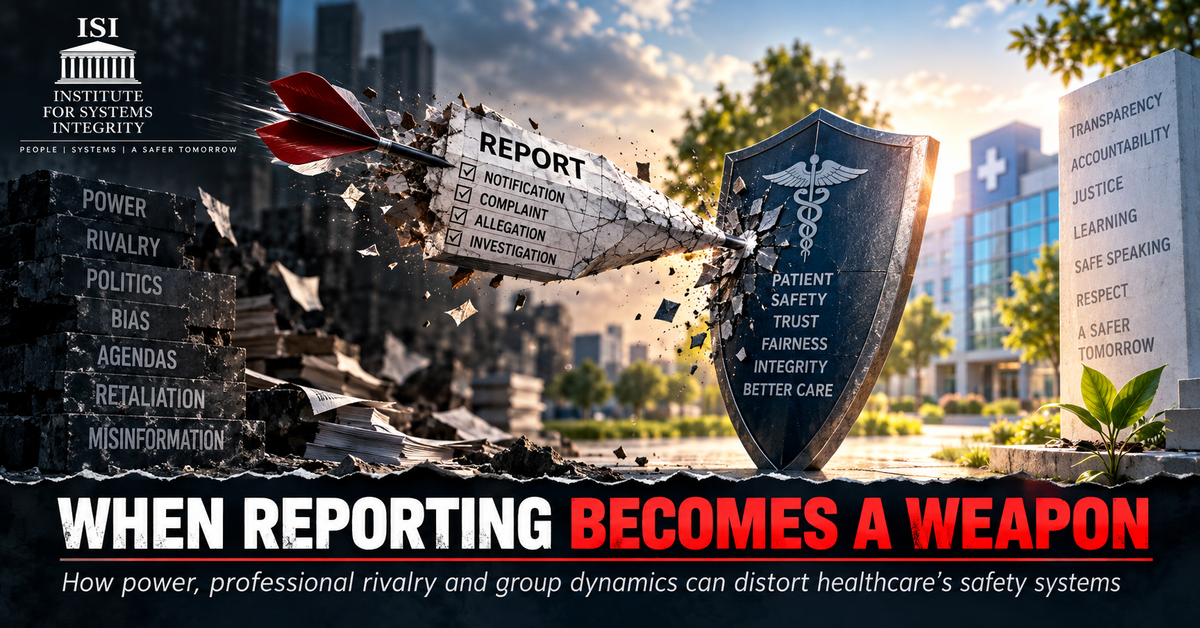
🚨 WHEN REPORTING BECOMES A WEAPON.... How power, professional rivalry and group dynamics can distort healthcare’s safety systems
How power, rivalry and group dynamics can distort healthcare reporting—and why protecting reporters must coexist with independent evidentiary testing.
Co Authors
Dr Alwin Tan, GAICD, MBBS, FRACS, EMBA (Melbourne Business School)
Senior Surgeon | Governance Leader | HealthTech Co-founder | Founder of Institute for Systems Integrity (ISI) | Harvard Medical School — AI in Healthcare | University of Oxford — Sustainable Enterprise | Bastas Academy for Healthcare Leadership — Triple Scholar
Nadra Gadeed BSc Psychology, MSc Forensic Psychology, MA Health Research
Founder and Strategic Advisor, Edify & Grow | Workforce Risk Advisor to Boards and C-Suite Leaders, Private Healthcare, GCC & Asia-Pacific | 20 Years in the NHS Across Strategic, Operational and Leadership Roles
INSTITUTE FOR SYSTEMS INTEGRITY
Healthcare depends on reporting.
It depends on the nurse who says:
“Something does not feel right.”
The junior doctor who questions a plan.
The trainee who reports unacceptable conduct.
The clinician who challenges unsafe practice.
The executive who escalates an emerging risk.
The whistleblower who refuses to stay silent.
The board willing to hear what it would rather not hear.
And the regulator willing to investigate what an organisation may have failed to address.
Without those signals, healthcare becomes blind.
Research consistently shows that hierarchy, power, psychological safety and organisational culture influence whether healthcare professionals speak up about safety concerns (Edmondson, 1999; Okuyama, Wagner and Bijnen, 2014; Morrow, Gustavson and Jones, 2016).
Reporting must therefore remain accessible. People raising genuine concerns must be protected. Retaliation against them must never become acceptable.
But there is another governance question that mature healthcare systems must also be willing to confront.
🚨 WHAT HAPPENS WHEN A SYSTEM DESIGNED TO PROTECT PATIENTS BECOMES USEFUL TO SOMEONE TRYING TO DAMAGE A PROFESSIONAL?
That question is uncomfortable.
It should be.
Because the answer cannot be to make reporting harder.
Nor can it be to assume every report is malicious.
But neither can healthcare pretend that rivalry, grievance, retaliation, commercial competition, hierarchy, institutional politics, professional tribalism and self-interest somehow disappear when someone enters a reporting portal.
They do not.
Australia’s regulatory framework itself recognises the possibility of vexatious notifications, although Ahpra defines these narrowly as notifications without substance made with an intention to cause distress, detriment or harassment.
The National Health Practitioner Ombudsman’s independent review emphasised both that genuinely vexatious notifications appear rare and that relationship breakdowns, workplace disputes, competitive motives and possible retaliation may nevertheless be relevant to how some notifications should be assessed (Ahpra, 2026a; NHPO, 2024).
That distinction matters.
Because the governance problem is wider than the formal category of vexatious reporting.
A report may contain something true.
An incident may have happened.
A disagreement may have occurred.
Communication may genuinely have been abrupt.
A legitimate clinical concern may exist.
Yet conflict, rivalry, retaliation or competing interests may still influence what gets reported, what gets omitted, how the event is characterised, when it is escalated, who is encouraged to corroborate it, and what professional consequence is sought.
A REPORT DOES NOT HAVE TO BE FALSE TO BECOME DISTORTED.
And that leads to the larger governance question.
Not merely:
Can people report?
But:
🚨 CAN THE SYSTEM DISTINGUISH A SAFETY SIGNAL FROM A PROFESSIONAL WEAPON?
1. A Notification Is Not the Event
This distinction is fundamental.
An event occurs.
Someone observes it.
They interpret it.
They describe it.
Someone else receives that description.
It is categorised, aggregated, processed and potentially escalated through organisational and regulatory systems.
At every stage, information is being transmitted.
That means:
A NOTIFICATION IS NOT THE EVENT.
IT IS INFORMATION ABOUT THE EVENT.
This sounds obvious.
Its governance implications are not.
Every reporting system is also an information-processing system. Its integrity depends on what happens to the signal between its origin and the eventual decision.
Information can become clearer. It can be independently corroborated. It can acquire additional evidence.
But it can also be selectively framed, repeated, aggregated, socially reinforced, removed from context or interpreted through an existing narrative.
ISI describes the resulting governance challenge as Notification Signal Integrity™:
The degree to which a reported concern retains evidentiary independence, contextual fidelity and proportional meaning as it moves from originating event through observation, reporting, aggregation, investigation and institutional decision-making.
The governance task is therefore not to decide prematurely whom to believe, but to preserve and test the provenance, independence and fidelity of the signal.
The question becomes not simply:
Was something reported?
But:
🚨 WHAT HAPPENED TO THE SIGNAL AFTER IT WAS REPORTED?
2. Low Barriers to Reporting Create a Downstream Obligation
Safety systems should make raising concerns reasonably easy.
The alternative is dangerous.
Healthcare professionals already encounter significant barriers to speaking up, including hierarchy, perceived futility, fear of negative consequences and uncertainty about how concerns will be received (Okuyama, Wagner and Bijnen, 2014; Morrow, Gustavson and Jones, 2016).
Ahpra has likewise reaffirmed the important role health practitioners play in reporting concerns about other practitioners where public safety may be at risk (Ahpra, 2026b).
But accessibility creates an important structural asymmetry.
A notifier can activate a potentially high-consequence process through a concern.
The practitioner who becomes the subject of that concern may then carry a substantially larger burden of responding, reconstructing events, locating records, obtaining professional advice, explaining context, managing workplace consequences and living with professional uncertainty while the signal is tested.
ISI describes this as Activation–Defence Asymmetry™:
The structural asymmetry created when one party can activate a high-consequence reporting process while the subject carries a substantially greater burden of explanation, evidence, time and professional uncertainty while the concern is assessed.
This asymmetry can carry a workforce cost even when the practitioner is ultimately cleared. Time spent responding, defending and waiting is time and attention an organisation has already lost. The experience itself may affect engagement, wellbeing and professional confidence regardless of the eventual finding.
That asymmetry is not itself evidence of injustice.
It is often unavoidable in protective systems.
We should not demand that a junior nurse assemble a prosecution brief before raising a concern.
We should not make reporting so difficult that genuine safety signals disappear.
But that creates a reciprocal obligation:
🚨 LOW BARRIERS TO REPORTING MUST BE MATCHED BY HIGH STANDARDS OF EVIDENTIARY TESTING AFTER REPORTING.
The easier a system is to activate, the more disciplined it must become after activation.
3. “Vexatious” Is Too Narrow to Describe the Whole Problem
The word vexatious attracts enormous attention.
But it can distract from the more important governance problem.
Ahpra defines a vexatious notification as one that is without substance and made with an intention to cause distress, detriment or harassment (Ahpra, 2026a).
That is deliberately narrow.
And it should be.
Calling genuine reporters vexatious can itself become a means of silencing them.
The NHPO’s independent review concluded that formally vexatious notifications appear rare. It also identified the difficulty of dealing with cases where a notification may contain substantive concerns but arise within circumstances involving relationship breakdown, workplace conflict, competitive motivations or possible retaliation (NHPO, 2024).
This creates an important middle territory.
A report can be not vexatious, not fabricated and not necessarily made wholly in bad faith—and still require heightened scrutiny because a competing interest may have affected the signal.
ISI describes this as Conflict-Contaminated Reporting™:
Reporting that may contain a genuine concern but arises within a relationship containing grievance, rivalry, retaliation, commercial conflict or another competing interest capable of influencing what is reported, how it is framed, what is omitted or why it is escalated.
Here, “contaminated” describes a governance risk to the independence, framing or contextual fidelity of the signal. It does not establish bad faith, fabrication or improper motive.
This is not an accusation against the notifier.
It is a governance condition.
The presence of conflict does not invalidate evidence.
But neither should it be regarded as irrelevant.
CONFLICT DOES NOT DISPROVE A REPORT.
IT CHANGES WHAT THE SYSTEM MUST TEST.
4. The Most Dangerous Complaint May Contain Some Truth
False complaints are relatively easy to conceptualise.
Something allegedly happened. Evidence establishes that it did not.
The harder problem is when the underlying event is real.
An argument happened.
Communication was poor.
A patient deteriorated.
A policy was breached.
A disagreement was documented.
Now the questions become more difficult.
Was all relevant context provided?
Would comparable behaviour by another practitioner have triggered the same escalation?
Was the incident independently considered before other colleagues heard about it?
Was an existing professional dispute disclosed?
Were facts separated from interpretation?
Did the concern change from:
“An interaction occurred”
to:
“This person is unsafe”?
Was the purpose of the escalation to understand risk—or obtain a professional outcome?
🚨 A MALICIOUS OR RETALIATORY MOTIVE DOES NOT REQUIRE AN INVENTED EVENT.
IT CAN HIDE INSIDE THE INTERPRETATION OF A REAL ONE.
This is why Notification Integrity cannot stop at asking:
Did something happen?
It must also ask:
What does the evidence establish?
What does it not establish?
And how did we travel from one to the other?
5. Power Changes What Happens to a Signal
Technically, many people can raise a concern.
Institutionally, they do not all carry the same power.
A junior clinician may report something.
So may a department head, senior consultant, hospital executive, credentialing chair, respected insider or someone with ready access to governance, legal and HR structures.
Their concerns may describe identical events.
But they may not enter the system with identical institutional weight.
This is not necessarily improper. Senior people often possess authority precisely because organisations need them to identify and escalate risk.
But authority creates capacity.
And capacity requires governance.
Senior organisational actors may possess:
Framing power — the ability to define an issue as a patient-safety, conduct, credentialing or reputational problem.
Process power — the ability to engage HR, legal, governance, credentialing or regulatory pathways.
Aggregation power — the ability to request, gather and connect concerns from multiple people.
Narrative power — the ability for their interpretation to acquire institutional authority because of who is expressing it.
None of these powers demonstrates misuse.
They demonstrate capacity.
🚨 POWER IS NOT EVIDENCE OF WRONGDOING.
POWER IS EVIDENCE OF CAPACITY.
AND CAPACITY IS WHY GOVERNANCE EXISTS.
The same authority that allows an executive to protect patients may, if improperly used, enable disproportionate professional harm.
The solution is not weaker leadership.
It is better-governed leadership.
This institutional gravity matters particularly at board and executive level. A board member or executive who generates significant organisational value may be harder to challenge when concerns are raised about them—and may also have greater access to the framing, process and narrative power described above.
The capacity for weaponisation is therefore unlikely to be evenly distributed.
Those with greater institutional access, authority and narrative legitimacy may have greater capacity to shape how a signal travels.
6. The Weaponised Notification Pathway™
ISI proposes a hypothesised governance failure pathway through which a legitimate reporting mechanism may become distorted when evidentiary independence, procedural separation and proportionality controls are weak.
It is not a description of every complaint.
It is not an allegation that most notifications follow this pathway.
It is a failure mode that systems should be able to detect.
This model is intended as a governance diagnostic, not an assertion that every component occurs sequentially or that every adverse professional process reflects weaponisation.
1. Underlying event or conflict
A genuine safety concern, professional rivalry, interpersonal grievance, leadership conflict, commercial competition, workplace dispute—or a combination.
↓
2. Narrative formation
An event begins becoming an identity:
“Unsafe.”
“Difficult.”
“Unprofessional.”
“Not collaborative.”
“Poor communicator.”
↓
3. Coalition formation
Other people hear the concern. Some agree. Some repeat it. Some distance themselves. Some remain silent. Some begin interpreting their own experiences through the emerging narrative.
↓
4. Narrative amplification
Past ambiguous events acquire new meaning.
↓
5. Institutional adoption
The interpretation enters management, HR, credentialing, clinical governance, risk or executive decision-making.
↓
6. Regulatory activation
A notification is made.
↓
7. Regulatory Halo of Suspicion™
The existence of regulatory scrutiny begins acquiring social meaning before substantive findings exist.
↓
8. Procedural Echo Effect™
Internal review, regulatory involvement, credentialing concern and employment action begin appearing to be several independent warning signals, even when they share a common evidentiary origin.
↓
9. Reputational contamination
Behaviour toward the practitioner changes.
↓
10. Defensive Behaviour Trap™
The practitioner begins documenting, challenging or defending themselves.
↓
11. Narrative reinforcement
Their response is interpreted as further evidence:
“Defensive.”
“Difficult.”
“Lacks insight.”
↓
12. Professional exclusion
Opportunities diminish. Roles disappear. Privileges change. Referral relationships alter. Reputation shifts.
Professional exclusion is not only a career outcome. It is a workforce risk realised.
What boards may read afterwards—a resignation, non-renewal or quiet departure—can represent the end state of this pathway, recorded without any link back to the signal that started it.
That cost may differ by seniority and role. Losing a credentialed executive or board-level clinician to a distorted pathway can carry substantial recruitment, continuity and institutional-knowledge costs, while also influencing how other senior candidates perceive the organisation’s treatment of its leadership during high-consequence processes.
The pathway is dangerous because:
🚨 A COMPLAINT CAN BEGIN AS A SIGNAL AND END AS AN ORGANISATIONAL IDENTITY.
7. Weaponisation Does Not Require a Conspiracy
Healthcare sometimes imagines coordinated mistreatment as though everyone must gather in a room and agree upon a plan.
Human group behaviour is rarely that simple.
Social identity theory has long demonstrated the power of in-group and out-group categorisation in shaping perception and behaviour (Tajfel and Turner, 1979).
Healthcare organisations add hierarchy, professional identity, specialty cultures and institutional status to those dynamics.
Research into bullying in medical environments also describes the importance of hierarchy, organisational culture and power relations rather than reducing harmful dynamics to isolated interpersonal encounters (Averbuch, Eliya and Van Spall, 2021).
A narrative can therefore spread without anyone consciously deciding to manufacture one.
People can genuinely believe what they are saying.
They may have heard an interpretation from someone they trust.
They may begin noticing behaviour they previously ignored.
Ambiguous events may suddenly fit an emerging story.
Status cues can affect whom people believe.
Silence can be interpreted as agreement.
Repetition can begin to feel like corroboration.
🚨 WEAPONISATION DOES NOT REQUIRE A SECRET MEETING.
Sometimes coordinated intent may exist.
Sometimes it does not.
The governance question remains the same:
Has social transmission altered the independence of the evidence?
8. Coalition Amplification™ and Narrative Cascading™
Healthcare bullying is often imagined as:
one aggressor → one target.
But organisations are networks.
Bystanders matter.
Professional alliances matter.
Authority matters.
Repetition matters.
ISI describes Coalition Amplification™ as:
The strengthening of an allegation, negative narrative or adverse professional interpretation when colleagues adopt, repeat, validate or fail to challenge an emerging account of another professional.
Closely related is Narrative Cascading™:
The process through which an interpretation becomes increasingly credible because it is repeatedly transmitted across a professional network, despite later repetition not necessarily representing independent evidence.
That distinction creates two forms of corroboration.
Evidentiary corroboration: independent observers or sources separately establish convergent facts.
Social corroboration: several people reproduce an interpretation after direct or indirect exposure to a common narrative.
They are not equivalent.
🚨 CONSENSUS SHOULD NOT BE COUNTED AS INDEPENDENT CORROBORATION UNLESS THE SOURCES ARE INDEPENDENT.
Five genuinely independent observers may provide extremely powerful evidence.
But five people repeating information derived from one another may still represent one evidentiary lineage.
A high-integrity investigation must know the difference.
9. Tribal Corroboration™
Healthcare is full of tribes.
Medicine. Nursing. Specialties. Departments. Training networks. Management. Executives. Hospitals. Universities. Professional colleges.
These affiliations are not inherently harmful.
They create trust, shared identity, expertise and belonging.
But they can also produce in-group loyalty, out-group suspicion, status protection, asymmetric credibility and more charitable interpretation of insiders than outsiders.
ISI describes Tribal Corroboration™ as:
The apparent strengthening of an allegation or professional narrative when members of a socially connected professional or organisational group reinforce one another’s interpretation of a person perceived as outside, peripheral to or less protected by the trusted group.
Again, multiple reports may be completely valid.
But the governance question is whether they represent independent observations or socially connected interpretations of the same narrative.
TRIBAL AGREEMENT IS NOT THE SAME THING AS INDEPENDENT CORROBORATION.
An established insider’s account may be heard differently from an outsider’s identical account. The same social dynamics that influence protection can also influence whose corroboration is given greater weight.
Boards are not exempt.
A board investigating a concern about one of its own members is precisely the kind of socially connected group this analysis describes. It can produce reflexive protection of a colleague whose removal would be organisationally costly—or rapid consensus against a member who has become isolated within the group.
Independence at board level requires the same test as independence anywhere else:
Were the conclusions reached independently—or through the same room?
10. The First Complaint Can Change the Environment Producing the Second
Imagine a practitioner receives a complaint about communication.
Other colleagues become aware that “there are concerns”.
Interactions with that practitioner receive more attention.
An abrupt conversation is documented.
Someone remembers a disagreement six months earlier.
A manager asks:
“Has anyone else had similar experiences?”
People begin searching their memories.
Additional examples emerge.
Soon someone says:
“There seems to be a pattern.”
Perhaps there is.
But something important has happened.
The environment producing later reports is no longer identical to the environment that produced the first.
ISI calls this the Notification Cascade™:
A sequence in which an initial concern changes the observational, interpretive or social environment surrounding a practitioner, increasing the likelihood that subsequent events are noticed, reinterpreted, recalled or reported.
The Notification Cascade™ does not imply that subsequent reports are false. It identifies the possibility that the first report changes the conditions in which later reports arise.
The later reports may be entirely genuine.
That is precisely why the issue is difficult.
The question is not:
Are these people lying?
It is:
How independent are these observations from the first notification and the narrative it created?
🚨 THE FIRST COMPLAINT MAY NOT ONLY DESCRIBE THE ENVIRONMENT.
IT MAY CHANGE THE ENVIRONMENT THAT PRODUCES THE NEXT COMPLAINT.
11. Regulatory Involvement Is Not a Finding
Once people hear:
“The regulator is investigating,”
social meaning changes.
Formally, it means:
a regulatory process exists.
Informally, it may be heard as:
there must be something serious here.
Those propositions are not equivalent.
A notification is not proof.
An investigation is not a finding.
The involvement of a regulator should never be treated as evidence beyond what the regulator has actually established.
ISI describes the Regulatory Halo of Suspicion™ as:
The tendency for the existence of regulatory scrutiny to be socially or institutionally interpreted as supporting an allegation before substantive findings have been established.
This is proposed as a hypothesised organisational effect, not as an assertion about the conduct or decision-making of regulators themselves.
The halo can also feed backwards.
Internal concern may trigger notification.
Notification may trigger credentialing concern.
Credentialing concern may trigger heightened monitoring.
Heightened monitoring may generate additional observations or concerns.
Those concerns may then appear to validate the original notification.
And now the system can begin corroborating itself.
🚨 THE REGULATOR MAY BE INVESTIGATING THE ORGANISATION’S NARRATIVE WHILE THE ORGANISATION USES THE EXISTENCE OF THAT INVESTIGATION TO VALIDATE THE SAME NARRATIVE.
That is not independent corroboration.
It is a potential Procedural Echo Effect™.
12. The Procedural Echo Effect™
Imagine a board is told that a practitioner has:
an internal complaint;
an HR investigation;
a credentialing review;
a regulatory notification;
and a professional restriction.
At first glance, that looks like five separate warning signals.
But what if all five began with the same allegation?
Then the organisation may not have five signals.
It may have:
one originating signal generating five institutional consequences.
ISI describes the Procedural Echo Effect™ as:
The apparent multiplication of evidence when multiple institutional processes originate from, rely upon or recursively validate the same underlying signal.
A process is not evidence simply because another process exists.
A consequence is not corroboration of the allegation that produced it.
An investigation does not validate another investigation merely because both were triggered.
FIVE PROCESSES DO NOT NECESSARILY MEAN FIVE SIGNALS.
This blind spot can extend to workforce dashboards. An organisation that treats five procedural echoes as five independent signals may also treat the resulting departure as routine attrition rather than the terminal stage of a single pathway.
That requires organisations to understand something rarely displayed on dashboards:
Signal Lineage™
The traceable evidentiary ancestry of an allegation, identifying whether later reports, processes and decisions arise from genuinely independent sources or descend from a common originating signal.
Boards should not merely ask:
How many complaints exist?
They should ask:
🚨 HOW MANY INDEPENDENT SIGNAL LINEAGES EXIST?
13. Defensive Behaviour Can Become Part of the Evidence
There is another feedback loop.
A professional who believes they are being treated unfairly may request documents, challenge assertions, seek legal advice, keep detailed notes, contest decisions, ask for procedural fairness or repeatedly attempt to correct the record.
Those behaviours may be understandable responses to perceived threat.
But inside an existing negative narrative, they can acquire another meaning:
“Defensive.”
“Combative.”
“Difficult.”
“Not reflective.”
“Lacks insight.”
Now the person’s response to the process becomes evidence supporting the narrative that created the process.
ISI describes this as the Defensive Behaviour Trap™.
🚨 A SYSTEM MUST BE VERY CAREFUL WHEN IT USES SOMEONE’S RESPONSE TO AN ACCUSATION AS EVIDENCE THAT THE ACCUSATION WAS CORRECT.
This does not mean defensive behaviour is never relevant.
It means behaviour generated by a high-stakes process must be interpreted in context.
Procedural justice research has repeatedly demonstrated that perceptions of fairness, voice, neutrality and respectful treatment influence how people respond to authority and organisational decision-making (Colquitt et al., 2001).
The process can change the person it is observing.
Adjacent forensic-psychology research illustrates a comparable interpretive problem: innocence itself does not necessarily protect an accused person from adverse interpretation, and responses generated under accusation can influence how that person is subsequently judged (Kassin, 2005). The analogy does not establish the same mechanism in healthcare regulation, but it reinforces the need to avoid treating process-generated behaviour as self-validating evidence.
A mature system accounts for that possibility.
14. But “Vexatious” Can Become a Weapon Too
Everything above has a mirror image.
Senior leaders can misuse systems.
Colleagues can misuse reporting.
Groups can reinforce distorted narratives.
But powerful practitioners can also attack legitimate reporters.
They can dismiss them as:
“Vexatious.”
“Jealous.”
“Disgruntled.”
“Malicious.”
“Difficult.”
“Incompetent.”
That can silence precisely the people reporting systems were created to protect.
The NHPO has specifically cautioned against approaches that could discourage legitimate notifications, while Ahpra continues to emphasise the importance of practitioners raising concerns where public safety may be at stake (NHPO, 2024; Ahpra, 2026b).
So motive must never substitute for evidence.
The question cannot be:
Do we like the reporter?
Nor:
Do we trust the practitioner?
Nor:
Which one has more institutional status?
It must be:
🚨 DOES THE SIGNAL SURVIVE INDEPENDENT EVIDENTIARY TESTING?
Protecting the reported must never require silencing reporters.
Protecting reporters must never require abandoning evidentiary fairness.
15. Protecting Reporters and Protecting the Reported Are Not Opposites
Healthcare sometimes behaves as though it must choose.
Protect the whistleblower—or protect the practitioner.
Believe the notifier—or believe the accused.
Support reporting—or insist upon due process.
These are false choices.
A high-integrity system must be capable of doing several things at once.
It must make genuine reporting safe.
It must make retaliation unacceptable.
It must allow concerns to be raised before perfect evidence exists.
It must protect the subject from prejudgment.
It must recognise power and conflicts of interest.
It must test whether apparently multiple concerns are independent.
It must distinguish allegation from evidence.
It must distinguish investigation from finding.
And it must remain capable of identifying serious practitioner risk even when the practitioner is influential, popular or institutionally valuable.
🚨 THE SAFEST REPORTING SYSTEM IS NOT ONE THAT ASSUMES EVERY REPORTER IS RIGHT.
NOR ONE THAT ASSUMES EVERY REPORTED PRACTITIONER IS INNOCENT.
IT IS ONE STRONG ENOUGH TO PROTECT THE SIGNAL FROM BOTH POWER AND MOTIVE.
16. Notification Integrity™
ISI proposes Notification Integrity™ as a governance standard for high-consequence reporting systems.
A high-integrity system should test at least nine domains.
1. Source Integrity
Who directly observed the event?
Who received it second-hand?
What is the source of each material allegation?
2. Relationship Integrity
What relationship existed between notifier and reported practitioner?
Was there workplace conflict, professional rivalry, commercial dispute, employment disagreement, leadership conflict, prior grievance or another material competing interest?
Conflict does not invalidate the signal.
But it should not be hidden from the assessment.
3. Independence Integrity
Are several reports genuinely independent?
Did reporters discuss the issue with one another?
Had they been exposed to an existing narrative?
Were concerns solicited after the first complaint?
4. Evidence Integrity
What has been objectively established?
What is interpretation?
What is inference?
What remains allegation?
Have professional labels replaced descriptions of actual behaviour?
5. Context Integrity
Was materially relevant context preserved?
Were facts presented consistently?
Were alternative explanations considered?
6. Process Integrity
Are multiple institutional processes genuinely independent?
Or are they echoes of the same originating signal?
Can decision-makers trace the Signal Lineage™?
7. Proportionality Integrity
Does the degree of escalation correspond to demonstrated evidence and risk?
What new evidence justified each additional escalation?
8. Consistency Integrity™
Were comparable behaviours treated comparably?
Were similar incidents involving other professionals escalated using similar thresholds?
Or did status, belonging, institutional value or professional relationships change the response?
Consistency Integrity is also a workforce-risk test. When comparable behaviour by different people produces different institutional responses, the implications extend beyond the case itself. The wider workforce observes which behaviours appear safe, tolerated or risky.
Consistency testing shifts the inquiry from presumed motive to observable institutional behaviour.
9. Protection Integrity
Has the reporter been protected from retaliation?
Has the reported professional been protected from prejudgment, reputational contamination and procedural misuse?
Can both parties participate without intimidation?
Together, these principles produce a simple doctrine:
REPORT FREELY.
TEST INDEPENDENTLY.
TRACE THE SIGNAL.
17. The Corroboration Independence Test™
Whenever several complaints appear to establish a pattern, decision-makers should ask five questions.
1. Origin — Did each concern originate independently?
2. Exposure — Before reporting, had each person been exposed to allegations or interpretations from others?
3. Observation — What did each reporter directly observe?
4. Transmission — What information moved between reporters, managers, executives or investigators?
5. Convergence — Do the accounts independently converge on objective facts—or primarily reproduce the same interpretation?
This is the Corroboration Independence Test™.
Its purpose is not to dismiss multiple complaints.
Quite the opposite.
If five genuinely independent sources converge upon the same risk, that may be extremely significant.
But:
🚨 THE MORE SERIOUS THE CONSEQUENCE, THE MORE IMPORTANT IT IS TO KNOW WHETHER CORROBORATION IS ACTUALLY INDEPENDENT.
18. The Reporting Signal Integrity Pathway™
A high-integrity reporting system should be able to trace a concern through the following sequence:
EVENT
What actually occurred?
↓
OBSERVATION
Who directly witnessed or experienced it?
↓
INTERPRETATION
What meaning did the observer assign?
↓
REPORTING
What was communicated? What was omitted?
↓
SOCIAL TRANSMISSION
Who discussed the concern with whom?
↓
AGGREGATION
Are additional accounts independent?
↓
INSTITUTIONAL PROCESSING
How was the concern framed by management, HR, governance or credentialing?
↓
REGULATORY PROCESSING
What evidence survives independent scrutiny?
↓
DECISION
What conclusion and response are justified by the evidence?
At each stage, governance should examine potential contamination from hierarchy, professional rivalry, retaliation, commercial interest, tribal loyalty, status, confirmation bias, narrative repetition, procedural echo and reputational pressure.
The objective is not perfect information.
Healthcare rarely has perfect information.
It is information whose limitations are visible.
19. What Boards and Regulators Should Be Asking
Not:
How many complaints were made?
But:
How many genuinely independent signals exist?
Not:
How many processes are underway?
But:
How many independent signal lineages created them?
Not:
Was there conflict between the parties?
But:
Did the allegation survive rigorous testing despite that conflict?
Not:
Why is the practitioner defensive?
But:
Has the process itself influenced the behaviour we are now interpreting?
Not:
Has the regulator become involved?
But:
What substantive evidence has actually been established?
Not:
Do several colleagues agree?
But:
Did they arrive at their conclusions independently?
Not merely:
Was the behaviour inappropriate?
But also:
Were comparable behaviours by comparable professionals treated similarly?
And at every escalation:
🚨 WHAT NEW INDEPENDENT EVIDENCE JUSTIFIED MOVING TO THE NEXT STAGE?
That question should become non-negotiable.
20. High-Integrity Reporting Requires Symmetry
Healthcare needs whistleblowers.
It needs nurses prepared to escalate.
Doctors willing to challenge colleagues.
Executives able to act.
Boards willing to investigate.
Regulators prepared to intervene.
Those functions protect patients.
But every system with the power to protect also has the capacity to harm when its safeguards fail.
That does not make the system bad.
It makes governance necessary.
And this symmetry test must apply up the hierarchy as well as down it.
A system that rigorously tests notifications about junior staff while treating notifications about its own executives as more sensitive, more political or less likely to be pursued has not built a high-integrity system.
It has simply relocated the asymmetry to a higher pay grade.
Organisational justice depends not simply upon outcomes but on the perceived fairness and integrity of the processes producing them (Colquitt et al., 2001).
Psychological safety likewise depends upon people believing that interpersonal risk—including raising concerns and admitting uncertainty—can occur without inappropriate punishment (Edmondson, 1999).
We therefore should not build systems around a presumption that the notifier is truthful, the notifier is malicious, the practitioner is unsafe or the practitioner is innocent.
We should build them around a stronger presumption:
THE SIGNAL MUST BE TESTED.
Conclusion
Healthcare cannot function without reporting.
It cannot function without whistleblowers.
It cannot function without people prepared to say:
“Something is wrong.”
Nothing in this paper should be interpreted as an argument for making that harder.
Quite the opposite.
People should be able to raise genuine concerns without fear.
Organisations should respond.
Regulators should investigate when appropriate.
Patients deserve nothing less.
But there can be a workforce cost at every stage of this pathway—and on both sides of it.
A reporter who is not protected may become less willing to report again.
A practitioner who experiences a prolonged or distorted pathway may not return to the same level of trust, engagement or professional confidence.
Colleagues who observe either outcome may draw conclusions about what the system rewards, protects and punishes—conclusions capable of influencing future voice, trust and retention long before they reach a board paper.
Reporting occurs inside human systems.
And human systems contain power, status, rivalry, fear, loyalty, competition, grievance, tribalism, commercial interest and self-preservation.
None of those automatically invalidates a concern.
But pretending they disappear when a notification is made does not strengthen patient safety.
It weakens it.
Because the greatest danger is not simply false complaints.
Nor is it unsafe practitioners escaping scrutiny.
The deeper danger is a system unable to distinguish:
signal from narrative;
corroboration from repetition;
independent evidence from procedural echo;
accountability from retaliation;
reporting from coercion;
and:
investigation from proof.
🚨 LOW BARRIERS TO REPORTING.
HIGH STANDARDS OF EVIDENCE.
ZERO TOLERANCE FOR RETALIATION.
ZERO NAÏVETY ABOUT MOTIVE.
And one question should follow every high-consequence reporting process:
🚨 HOW MANY INDEPENDENT SIGNALS ARE ACTUALLY HERE?
Not how many complaints.
Not how many processes.
Not how many people have heard the narrative.
How many independent signals?
Because:
A SAFETY SYSTEM THAT CANNOT DISTINGUISH A GENUINE SIGNAL FROM A PROFESSIONAL WEAPON IS NOT YET A HIGH-INTEGRITY SYSTEM.
The solution is not to report less.
It is to govern reporting better.
REPORT FREELY.
TEST INDEPENDENTLY.
TRACE THE SIGNAL.
References
Ahpra (Australian Health Practitioner Regulation Agency) (2020) A framework for identifying and dealing with vexatious notifications. Melbourne: Australian Health Practitioner Regulation Agency.
Ahpra (Australian Health Practitioner Regulation Agency) (2026a) Vexatious notifications. Melbourne: Australian Health Practitioner Regulation Agency.
Ahpra (Australian Health Practitioner Regulation Agency) (2026b) ‘Ahpra confirms crucial role of health professionals in reporting concerns’, 24 February. Melbourne: Australian Health Practitioner Regulation Agency.
Averbuch, T., Eliya, Y. and Van Spall, H.G.C. (2021) ‘Systematic review of academic bullying in medical settings: dynamics and consequences’, BMJ Open, 11, e043256. doi:10.1136/bmjopen-2020-043256.
Colquitt, J.A., Conlon, D.E., Wesson, M.J., Porter, C.O.L.H. and Ng, K.Y. (2001) ‘Justice at the millennium: A meta-analytic review of 25 years of organizational justice research’, Journal of Applied Psychology, 86(3), pp. 425–445. doi:10.1037/0021-9010.86.3.425.
Edmondson, A.C. (1999) ‘Psychological safety and learning behavior in work teams’, Administrative Science Quarterly, 44(2), pp. 350–383.
Kassin, S.M. (2005) ‘On the psychology of confessions: Does innocence put innocents at risk?’, American Psychologist, 60(3), pp. 215–228. doi:10.1037/0003-066X.60.3.215.
Morrow, K.J., Gustavson, A.M. and Jones, J. (2016) ‘Speaking up behaviours (safety voices) of healthcare workers: A metasynthesis of qualitative research studies’, International Journal of Nursing Studies, 64, pp. 42–51. doi:10.1016/j.ijnurstu.2016.09.014.
National Health Practitioner Ombudsman (NHPO) (2024) Review of Ahpra’s Framework for identifying and managing vexatious notifications. Melbourne: National Health Practitioner Ombudsman.
Okuyama, A., Wagner, C. and Bijnen, B. (2014) ‘Speaking up for patient safety by hospital-based health care professionals: a literature review’, BMC Health Services Research, 14, 61. doi:10.1186/1472-6963-14-61.
Rauwolf, P. and Jones, A. (2019) ‘Exploring the utility of internal whistleblowing in healthcare via agent-based models’, BMJ Open, 9(1), e021705. doi:10.1136/bmjopen-2018-021705.
Tajfel, H. and Turner, J.C. (1979) ‘An integrative theory of intergroup conflict’, in Austin, W.G. and Worchel, S. (eds.) The Social Psychology of Intergroup Relations. Monterey, CA: Brooks/Cole, pp. 33–47.