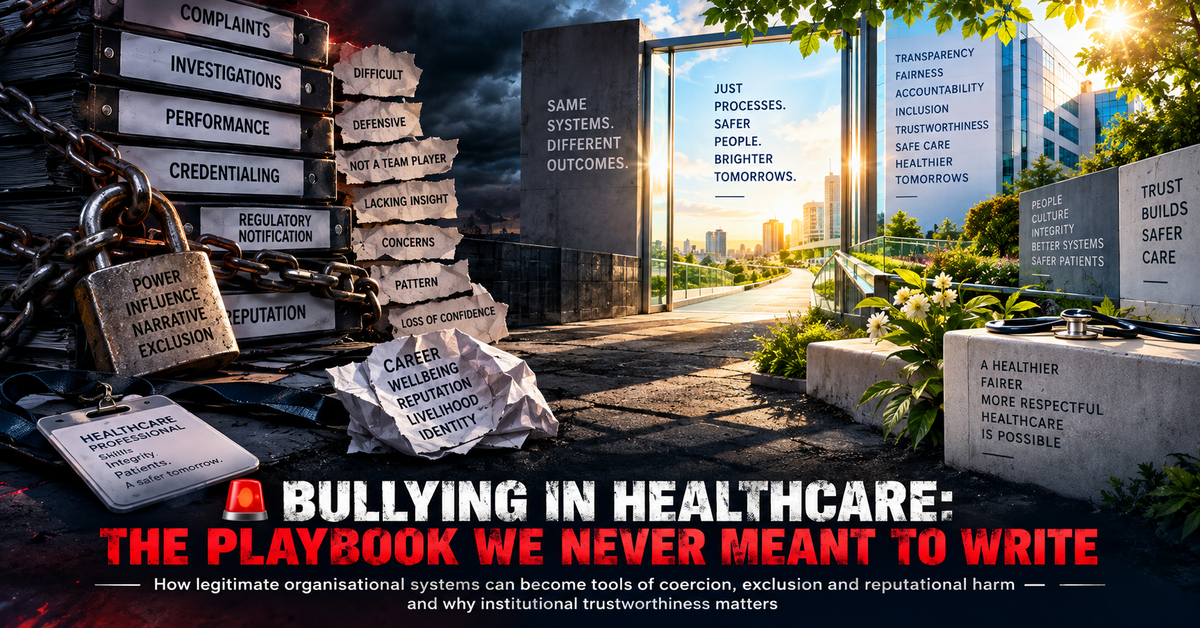
🚨 BULLYING IN HEALTHCARE: THE PLAYBOOK WE NEVER MEANT TO WRITE: .. How legitimate organisational systems can become tools of coercion, exclusion and reputational harm — and why institutional trustworthiness matters
What if the most dangerous bully in healthcare never shouts or breaks a rule — but simply knows how to use the system? We examine how legitimate processes can become tools of coercion and why institutional trustworthiness matters.
Co authors
Dr Alwin Tan, GAICD, MBBS, FRACS, EMBA (Melbourne Business School)
Senior Surgeon | Governance Leader | HealthTech Co-founder | Founder of the Institute for Systems Integrity (ISI) |Harvard Medical School — AI in Healthcare | University of Oxford — Sustainable Enterprise | Bastas Academy for Healthcare Leadership – Triple Scholar
and
Liza K. Collins MA
Founder, The Future of Leadership | Leadership Educator & Executive Facilitator
Author, The Physiology of Bullying
Chair, Workforce & Culture, UK Digital Health & Care
Executive Education, Imperial College London, Leading Systemic Innovation in Healthcare
International Culture & Leadership Strategist
Faculty Advisor, Australian Institute of Health Executives
Workforce & Culture Chair, UK Digital Health & Care
Chair, Stop Hurt & Work Committee
INSTITUTE FOR SYSTEMS INTEGRITY
How legitimate organisational systems can become tools of coercion, exclusion and reputational harm — and why institutional trustworthiness matters
Healthcare knows what a bully looks like.
Or at least we think we do.
The shouting consultant.
The humiliating manager.
The intimidating executive.
The colleague who belittles, threatens or undermines.
Those behaviours matter.
But they may represent the easiest form of bullying to recognise.
There is another form that is harder to see.
It may involve no shouting.
No explicit threat.
No abusive email.
No obvious breach of policy.
Instead, it can arrive wearing the language of legitimacy:
Performance.
Professionalism.
Teamwork.
Patient safety.
Stakeholder concerns.
Culture.
Loss of confidence.
An emerging pattern.
And sometimes:
A formal notification.
None of these mechanisms is inherently abusive.
Healthcare organisations must manage performance.
They must investigate safety concerns.
Healthcare professionals have ethical and sometimes legal obligations to raise genuine concerns.
Regulators must protect patients.
But that is precisely what makes the governance problem so difficult.
🚨 THE MOST EFFECTIVE BULLY MAY NEVER NEED TO BREAK A RULE.
THEY MAY ONLY NEED TO KNOW HOW TO USE ONE.
The challenge for healthcare is therefore bigger than identifying individuals who behave badly.
It is ensuring that the legitimate machinery of the organisation — including the machinery of professional regulation — cannot be turned into an instrument of coercion.
1. Bullying Is Not Just a Behaviour Problem
Workplace bullying is often approached as a behavioural or cultural issue.
Who said what?
Who behaved badly?
Was the conduct repeated?
Was it unreasonable?
Those questions matter.
But they can obscure something deeper.
Power asymmetry is central to understanding how workplace bullying can develop, persist and become difficult to challenge.
In healthcare, power can be unusually concentrated.
A senior clinician may influence training.
A supervisor may influence references.
A department head may influence appointments.
An executive may influence credentialing.
A manager may influence rostering.
A respected insider may influence reputation.
A colleague may have access to formal reporting systems capable of triggering processes far beyond the original workplace dispute.
The imbalance therefore extends beyond personality.
It involves access to institutional machinery.
**THE DANGEROUS QUESTION IS NOT ONLY:
“WHO HAS MORE POWER?”
IT IS:
“WHAT INSTITUTIONAL MACHINERY CAN THEY ACTIVATE?”**
This is why bullying in healthcare cannot be separated from governance.
2. When Legitimate Systems Become Coercive
Healthcare organisations need formal mechanisms for:
performance management;
clinical review;
credentialing;
professional conduct;
patient-safety investigation;
complaints management;
workplace behaviour;
disciplinary action; and
external regulatory notification.
Removing these systems would not create safer workplaces.
It would create less accountable ones.
The risk arises when legitimate mechanisms are applied selectively, disproportionately, in bad faith or without adequate safeguards.
The same system designed to protect patients can potentially become coercive when:
- allegations are accepted before being properly tested;
- vague behavioural labels replace defined conduct;
- one person's account gains institutional credibility before another is heard;
- repeated informal concerns become a presumed “pattern”;
- context is considered for some but not others;
- conflicts of interest remain unmanaged;
- defensive behaviour is interpreted as further evidence of wrongdoing;
- the person raising concerns subsequently becomes the focus of scrutiny; or
- an external reporting mechanism is activated primarily to damage, intimidate or disadvantage another practitioner.
The governance problem is therefore not that organisations possess powerful processes.
It is whether those processes remain evidence-based, proportionate and resistant to power distortion.
**🚨 A PERFORMANCE PROCESS CAN BE LEGITIMATE.
A REGULATORY NOTIFICATION CAN BE LEGITIMATE.
THAT DOES NOT MAKE EVERY USE OF EITHER LEGITIMATE.**
3. The Institutional Bullying Enablement Pathway™
The Institute for Systems Integrity proposes that organisational bullying risk can escalate through a recognisable pathway.
Not every workplace conflict follows this sequence.
Not every investigation represents bullying.
Not every notification is vexatious.
But where hierarchy is strong and procedural safeguards are weak, the pathway deserves attention.
Power asymmetry
Who controls access, opportunity, reputation or process?
↓
Interpersonal or professional friction
A disagreement occurs.
A concern is raised.
A decision is challenged.
An individual resists pressure.
A professional relationship deteriorates.
↓
Interpretive reframing
The disagreement becomes:
“attitude.”
“communication.”
“professionalism.”
“team fit.”
“behaviour.”
↓
Narrative accumulation
Separate events begin to be interpreted through the same emerging story.
↓
Social validation
Other people are asked whether they have observed similar concerns.
↓
Procedural activation
The narrative enters HR, credentialing, clinical governance, performance management or regulatory machinery.
↓
Defensive response
The individual begins documenting, challenging, questioning or protecting themselves.
↓
Defensive behaviour reinterpretation
Their response becomes:
“defensive.”
“difficult.”
“lacking insight.”
“not collaborative.”
↓
Institutional consolidation
The original disagreement becomes secondary.
The organisation increasingly understands the problem as:
the person.
This is the Institutional Bullying Enablement Pathway™.
Its central warning is simple:
🚨 AN ORGANISATION CAN BEGIN MANAGING A PERSON LONG BEFORE IT HAS ADEQUATELY ESTABLISHED THE PROBLEM.
4. The Defensive Behaviour Trap™
One of the most dangerous features of a distorted workplace process is the double bind.
Imagine an individual who believes they are being treated unfairly.
If they say nothing:
They must accept the concern.
If they respond strongly:
They are defensive.
If they document everything:
They are obsessive.
If they dispute the account:
They lack insight.
If they ask for evidence:
They are adversarial.
If they seek external advice:
They are escalating the matter.
If they withdraw:
They are disengaged.
If they keep speaking:
They are disruptive.
ISI describes this as the Defensive Behaviour Trap™:
The situation in which behaviours adopted to protect oneself from perceived unfairness are subsequently interpreted as evidence supporting the original negative characterisation.
🚨 WHEN EVERY DEFENCE BECOMES FURTHER EVIDENCE AGAINST YOU, THE PROCESS ITSELF REQUIRES SCRUTINY.
5. The Power of “Pattern”
Few words in workplace governance are as powerful as:
pattern.
Repeated concerns may reveal genuine misconduct.
Organisations must not dismiss them.
But repetition alone does not establish evidentiary strength.
Governance should ask:
Were the events independently substantiated?
Are they actually comparable?
Did earlier allegations influence interpretation of later events?
Were concerns elicited after an emerging narrative was already established?
Were similar behaviours by others treated the same way?
Are different incidents being collapsed into one vague label?
Is the apparent pattern behavioural — or narrative?
ISI describes Pattern Inflation™ as:
The retrospective assembly of heterogeneous or weakly substantiated events into a coherent character narrative that may appear stronger than the underlying evidence warrants.
Sometimes multiple independent concerns really do demonstrate a pattern.
The answer is not to distrust patterns.
It is to test them.
AGGREGATION IS NOT A SUBSTITUTE FOR EVIDENCE.
6. When Reporting Becomes a Professional Weapon
Healthcare depends upon reporting.
That point must be unequivocal.
Patients need healthcare workers to raise genuine concerns.
Professionals have obligations to report serious risks.
Regulators need access to information that organisations may otherwise suppress.
Nothing in this paper should discourage good-faith reporting.
But precisely because reporting systems possess enormous protective value, their misuse deserves serious governance attention.
Ahpra recognises vexatious notifications within its regulatory framework and has established a framework for identifying and dealing with potentially vexatious notifications.
Importantly, genuinely vexatious notifications appear to be rare.
That matters.
The greater patient-safety danger may still be the failure to report legitimate concerns.
But rarity does not mean misuse should be ignored.
A regulatory notification can carry consequences even before its underlying allegations have been determined.
It can potentially involve:
- formal correspondence;
- requests for records and explanations;
- insurer and legal involvement;
- prolonged uncertainty;
- professional anxiety;
- reputational concern;
- employment consequences;
- credentialing questions; and
- significant personal distress.
The notification does not need ultimately to succeed for the process itself to have consequences.
🚨 WHEN THE PROCESS ITSELF CARRIES A PROFESSIONAL COST, ACTIVATING THE PROCESS CAN BECOME A FORM OF POWER.
ISI describes Regulatory Process Weaponisation Risk™ as:
The risk that a legitimate professional reporting mechanism is invoked primarily or substantially for an ulterior interpersonal, organisational, competitive, retaliatory or reputational purpose rather than a genuine patient-safety concern.
This must not become a label casually applied to complaints someone dislikes.
An unsubstantiated complaint is not necessarily vexatious.
A mistaken complaint is not necessarily malicious.
A complaint made in good faith may ultimately prove incorrect.
Intent, evidence and context matter.
But the opposite principle matters too:
A PATIENT-SAFETY SYSTEM SHOULD NEVER BECOME A SAFE HARBOUR FOR BAD-FAITH PROFESSIONAL RETALIATION.
7. The Regulatory Threat as Organisational Leverage
There is an important difference between:
making a genuine notification
and
using the possibility of notification as leverage.
Consider the organisational power contained in statements such as:
“We may need to report this.”
“This could become a regulatory matter.”
“We will have to consider notifying the regulator.”
Those statements may be entirely appropriate where genuine regulatory obligations arise.
But where used improperly, the regulatory system can become a shadow hanging over an employment or professional dispute.
The issue is not merely whether a notification is eventually made.
It is whether regulatory jeopardy itself becomes leverage.
**🚨 YOU DO NOT HAVE TO DESTROY SOMEONE'S CAREER TO CONTROL THEIR BEHAVIOUR.
SOMETIMES YOU ONLY HAVE TO MAKE THEM BELIEVE THEIR CAREER IS AT RISK.**
A notification mechanism created to protect patients should never become a bargaining chip.
8. The Procedural Echo Effect™
A single allegation can potentially spread across multiple domains:
Regulation.
Employment.
Credentialing.
Reputation.
Professional relationships.
Wellbeing.
Career trajectory.
An internal complaint becomes a credentialing concern.
The credentialing concern becomes a performance question.
The performance question becomes a regulatory notification.
The notification becomes evidence that “concerns exist”.
The existence of multiple processes is then interpreted as confirmation of the original narrative.
This creates a dangerous feedback loop:
Allegation
↓
Procedural activation
↓
Multiple institutional processes
↓
Existence of those processes interpreted as corroboration
↓
Stronger organisational narrative
↓
Further escalation
🚨 THE EXISTENCE OF MULTIPLE INVESTIGATIONS IS NOT, BY ITSELF, EVIDENCE THAT THE UNDERLYING ALLEGATION WAS TRUE.
Processes can multiply from the same originating signal.
Governance must distinguish independent corroboration from procedural echo.
ISI describes this as the Procedural Echo Effect™:
The amplification of an allegation when multiple organisational or regulatory processes arising from the same underlying concern are mistakenly interpreted as independent evidence of its validity.
9. Hidden Agendas Are a Governance Question — Not an Assumption
A colleague may report another practitioner because of a genuine concern.
They may also be mistaken.
They may have incomplete information.
Interpersonal conflict may influence interpretation.
Commercial competition may exist.
Professional rivalry may exist.
Employment disputes may exist.
Organisational politics may exist.
Retaliation may sometimes exist.
None of these factors proves that a notification is vexatious.
But neither should governance pretend those factors are irrelevant.
When material conflicts exist, organisations and regulators should be capable of asking:
- What is the underlying relationship?
- Is there an employment dispute?
- Is there professional or commercial competition?
- Has either party previously raised concerns about the other?
- Is there evidence of retaliation?
- Are the allegations independently corroborated?
- Was the notifier directly positioned to know the facts alleged?
- Are patient-safety concerns distinguishable from interpersonal conflict?
- Has the same allegation been propagated through multiple channels?
- Are multiple complaints genuinely independent?
The objective is not to psychoanalyse the notifier.
It is to protect the integrity of the signal.
**GOOD GOVERNANCE DOES NOT ASK WHETHER THE REPORTER IS A GOOD PERSON OR A BAD PERSON.
IT ASKS WHETHER THE SIGNAL SURVIVES INDEPENDENT EVIDENTIARY TESTING.**
10. The Person Who Controls the Narrative May Control the Process
Workplace bullying does not require formal authority.
Narrative authority can be enough.
Some individuals possess stronger relationships with leaders.
Greater organisational familiarity.
More professional allies.
More access to informal conversations.
Greater reputational capital.
Their version of an event may acquire credibility before a formal process has even begun.
🚨 YOU DO NOT NEED TO SILENCE SOMEONE IF YOU CAN MAKE EVERYONE STOP BELIEVING THEM.
The governance challenge is therefore not only protection from overt intimidation.
It is protection against narrative capture.
11. When the Organisation Starts Carrying the Conflict
One person raises concerns.
Another records them.
Another escalates them.
Another investigates.
Another restricts access.
Another manages performance.
Another makes a regulatory notification.
Another communicates findings.
No individual believes they are bullying anyone.
Each action may appear administratively defensible.
Yet cumulatively the individual may experience overwhelming institutional pressure.
ISI describes this as Distributed Institutional Harm™:
Harm produced through multiple organisational actions that may appear reasonable in isolation but become coercive, exclusionary or psychologically unsafe when experienced cumulatively.
🚨 WHEN EVERYONE IS “JUST DOING THEIR JOB”, WHO IS RESPONSIBLE FOR WHAT THE SYSTEM IS DOING?
12. The Body Enters the Governance System Too
There is another dimension healthcare cannot ignore.
Workplace bullying does not remain neatly contained within meetings, emails and HR files.
Collins' work on the physiology of bullying draws attention to how sustained exposure to threat, fear, uncertainty and loss of control can affect the nervous system, cognition, trust, behaviour, performance and recovery.
That creates a systems problem.
A healthcare worker experiencing sustained threat is still expected to:
make complex decisions;
communicate clearly;
exercise judgement;
manage uncertainty;
care for patients;
lead teams;
and recognise weak signals.
The human nervous system is therefore part of the decision environment.
**🚨 WHEN AN ORGANISATION ALLOWS FEAR TO BECOME A WORKING CONDITION, THE CONSEQUENCES DO NOT STOP AT CULTURE.
THEY CAN ENTER HUMAN PERFORMANCE.**
The question is therefore not merely whether somebody has been bullied.
It is whether organisational conditions are creating sustained psychological and physiological threat in the very workforce expected to exercise safe judgement.
And this produces an important systems proposition:
🚨 THE HUMAN NERVOUS SYSTEM DOES NOT REQUIRE A SHOUT OR A PHYSICAL THREAT FOR SUSTAINED ORGANISATIONAL THREAT TO MATTER.
The source may differ.
The physiological and psychological consequences of sustained threat may still matter.
13. Bystanders Are Making Calculations Too
Other staff watch.
They learn.
They calculate.
Should I intervene?
Will it change anything?
Who has more influence?
Could I be reported too?
Will this affect my training?
My reference?
My appointment?
Silence can become a rational response to organisational risk.
ISI describes this as Bystander Risk Calculation™:
Moral obligation to intervene
versus
Perceived professional cost of becoming involved.
Do not simply ask:
“Why didn't anyone speak up?”
Ask:
🚨 WHAT DID OUR ORGANISATION MAKE SPEAKING UP COST?
14. Bullying Is Also an Information Integrity Failure
When people fear professional consequences, information changes.
Concerns are softened.
Questions go unasked.
Witnesses disengage.
Bad news moves slowly.
Staff document defensively.
Uncertainty stays hidden.
Some people leave.
The organisation may still possess incident systems, dashboards, complaint pathways and whistleblowing policies.
But increasingly those systems may capture:
what people believe is safe to report
rather than:
what leaders need to know.
This paper proposes the following pathway:
Bullying / coercive process risk
↓
Psychological threat
↓
Silence and defensive behaviour
↓
Signal loss
↓
Reduced Information Fidelity
↓
Distorted organisational reality
↓
Poorer Decision Integrity
↓
Patient-safety risk
🚨 A WORKFORCE THAT IS AFRAID TO SPEAK CANNOT GIVE LEADERS AN ACCURATE PICTURE OF RISK.
15. Beyond Psychological Safety: Organisational Safety and Institutional Trustworthiness
Psychological safety has become an important concept within healthcare.
Edmondson (1999) conceptualised psychological safety as a shared belief that a team is safe for interpersonal risk-taking.
Subsequent healthcare research has demonstrated its importance to speaking up, learning behaviours and the conditions supporting patient safety (O'Donovan and McAuliffe, 2020).
But psychological safety cannot, by itself, carry the full burden of organisational safety.
Psychological safety can vary between teams.
It can change as leaders, relationships and local conditions change.
The organisation remains.
An organisation therefore cannot infer from the existence of psychologically safe teams that its institutional systems are themselves safe.
Research on Psychosocial Safety Climate (PSC) provides an important organisational-level precedent.
PSC locates psychological health and safety upstream in organisational policies, practices and procedures and in the priority senior management gives to protecting workers' psychological health (Dollard and Bakker, 2010).
Research has subsequently associated PSC with workplace bullying and harassment, psychological health and employee engagement (Law et al., 2011; Dollard et al., 2017).
This suggests that safety should be examined not only as an interpersonal experience but also as an organisational responsibility.
In the specific context of institutional power examined in this paper, we use organisational safety to describe whether the structures through which institutional power is exercised are sufficiently trustworthy, fair and robust to protect people when:
hierarchy is challenged;
concerns are raised;
evidence is disputed;
or powerful actors are involved.
For the purposes of this paper, the distinction can be expressed simply:
**🚨 PSYCHOLOGICAL SAFETY ASKS:
“CAN I SPEAK?”
ORGANISATIONAL SAFETY ASKS:
“WHAT WILL THIS ORGANISATION DO WHEN I SPEAK?”**
The second question cannot be answered through individual confidence, resilience or communication skills alone.
It depends upon governance.
Research on organisational trust provides an important foundation.
Trust involves a willingness to accept vulnerability under conditions of uncertainty, while perceived trustworthiness is influenced by assessments of ability, benevolence and integrity (Mayer, Davis and Schoorman, 1995).
Meta-analytic evidence demonstrates important relationships between trust, trustworthiness, risk-taking and workplace performance (Colquitt, Scott and LePine, 2007).
Organisational justice research similarly identifies distinct relationships involving distributive, procedural, interpersonal and informational justice and a range of organisational outcomes (Colquitt et al., 2001).
Within healthcare, organisational trust has been identified as important to organisational effectiveness and to the reporting and learning processes upon which patient safety depends (Firth-Cozens, 2004).
Trust should therefore not be understood simply as an interpersonal sentiment or employee-engagement score.
A high-integrity healthcare organisation should be capable of demonstrating institutional trustworthiness.
Can it demonstrate that:
- organisational processes operate consistently?
- evidence is independently tested?
- conflicts of interest are identified and managed?
- institutional power is appropriately constrained?
- legitimate challenge is tolerated?
- people raising concerns are protected from retaliation?
- procedural fairness survives hierarchy?
- and breaches of trust can be recognised and repaired?
This changes the governance question.
It is no longer simply:
“Do our employees trust us?”
It becomes:
🚨 “WHAT EVIDENCE DO WE HAVE THAT OUR ORGANISATION IS WORTHY OF THEIR TRUST?”
16. Trust Literacy: From Feeling Trust to Governing Trustworthiness
This leads to a further proposed organisational capability:
Trust Literacy
Trust Literacy is proposed here not as a validated psychometric construct or replacement for established measures of psychological safety, organisational justice or Psychosocial Safety Climate.
We use the term descriptively as an organisational capability rather than as an established measurement construct.
In this paper, Trust Literacy describes:
the capacity of an organisation and its leaders to understand how trust is created, damaged, assessed and repaired, and to recognise how institutional systems and the exercise of power influence whether an organisation is experienced as worthy of trust.
That distinction matters.
Trust Literacy should not become another engagement score.
Nor should organisations simply ask:
“Do you trust leadership?”
Instead, leaders and boards should understand the architecture that makes trust rational.
Can people predict how processes will operate?
Does evidence matter regardless of hierarchy?
Are similar cases treated similarly?
Can someone challenge a powerful individual without the challenge itself becoming evidence against them?
Does procedural fairness survive organisational inconvenience?
What happens after somebody speaks?
Can institutional trust be repaired when the organisation gets something wrong?
This suggests a proposed governance pathway:
Institutional trustworthiness
↓
Organisational safety
↓
Voice and Information Fidelity
↓
Decision Integrity
↓
Patient safety
And conversely:
Institutional untrustworthiness
↓
Threat and defensive behaviour
↓
Silence or distorted information
↓
Reduced Information Fidelity
↓
Poorer Decision Integrity
↓
Increased organisational and patient-safety risk
These pathways should not be interpreted as a validated causal model.
Rather, they integrate established research on psychological safety, Psychosocial Safety Climate, organisational justice and organisational trust with the information-integrity and decision-integrity argument advanced in this paper.
The proposition is nevertheless important:
**🚨 TRUST IS NOT SOMETHING AN ORGANISATION SHOULD EXPECT FROM ITS PEOPLE.
TRUSTWORTHINESS IS SOMETHING THE ORGANISATION SHOULD BE ABLE TO DEMONSTRATE TO THEM.**
17. But Do Not Weaponise “Vexatious” Either
There is a crucial mirror risk.
Organisations can weaponise the accusation of weaponisation.
A genuine notifier can be dismissed as:
“vexatious.”
“malicious.”
“disgruntled.”
“difficult.”
That would reproduce precisely the failure this paper seeks to prevent.
Ahpra's framework is intended to enable potentially vexatious notifications to be identified and managed without undermining the reporting of genuine concerns.
The National Health Practitioner Ombudsman's review similarly emphasised that genuinely vexatious notifications appear to be rare.
Therefore:
🚨 “VEXATIOUS” MUST NEVER BECOME A LABEL USED TO DISCREDIT AN INCONVENIENT SAFETY SIGNAL.
A just system protects both sides.
It protects patients and staff who raise genuine concerns.
And it protects practitioners from demonstrably bad-faith misuse of reporting machinery.
These are not competing objectives.
They are both requirements of signal integrity.
18. From Anti-Bullying Policy to Anti-Bullying Architecture
A mature healthcare organisation requires more than a bullying policy.
It requires Anti-Bullying Architecture.
Independent reporting pathways
So individuals do not have to report through the hierarchy they are challenging.
Conflict-of-interest screening
Including relevant professional, employment and commercial relationships.
Evidentiary integrity
So allegation, inference and established fact remain distinguishable.
Regulatory proportionality
So external escalation follows genuine safety and regulatory thresholds rather than interpersonal leverage.
Procedural Echo Checks™
So multiple processes originating from one allegation are not mistaken for independent corroboration.
Narrative integrity
So labels require defined evidence.
Anti-retaliation surveillance
So organisations examine what happens to people after they speak.
Cumulative-harm oversight
So apparently separate organisational actions are considered together.
Institutional Trustworthiness and Organisational Safety Assurance
So boards assess not only whether staff report trust and psychological safety, but whether the organisation can demonstrate that power, challenge, reporting, investigation and accountability are consistently exercised in ways worthy of that trust.
Board-level assurance
So bullying and misuse of institutional processes become governance risks rather than isolated HR files.
This is not bureaucracy for its own sake.
IT IS PROTECTION AGAINST THE MISUSE OF BUREAUCRACY.
19. What Boards Should Ask
Boards should move beyond asking:
“Do our people feel psychologically safe?”
They should also ask:
“Is this organisation demonstrably trustworthy and safe when its power is exercised?”
And then go further.
Boards should ask:
Do we assess institutional trustworthiness rather than simply asking employees whether they trust their leaders?
Can staff trust organisational processes when the person being challenged holds greater positional, professional or institutional power?
Where does accountability for organisational safety sit at Board level?
What evidence demonstrates that reporting, investigation, performance and escalation processes operate consistently across different levels of organisational hierarchy?
Do we know whether multiple “concerns” represent independent signals or procedural echoes of the same originating allegation?
How do we identify and repair breaches of institutional trust?
Do we know what happens professionally to people after they raise concerns?
Can we identify retaliation even when each individual organisational action appears legitimate?
Could our credentialing, performance, complaints or regulatory machinery be manipulated by somebody with greater institutional power?
Can our system distinguish bad-faith weaponisation from a genuine but uncomfortable safety signal?
That leads to two mirror questions every healthcare board should be willing to confront:
🚨 COULD A POWERFUL EXECUTIVE, CLINICAL LEADER OR COLLEAGUE USE OUR PERFORMANCE, COMPLAINT, CREDENTIALING OR REGULATORY SYSTEMS TO HARM SOMEONE FOR AN ULTERIOR PURPOSE — WHILE EVERY INDIVIDUAL STEP STILL LOOKED PROFESSIONAL?
And:
🚨 COULD WE MISTAKE A GENUINE WHISTLEBLOWER FOR A VEXATIOUS COMPLAINANT BECAUSE THEIR MESSAGE THREATENED SOMEONE POWERFUL?
A high-integrity system must be able to prevent both.
Conclusion
Healthcare needs reporting.
Healthcare needs regulation.
Healthcare needs accountability.
Healthcare needs leaders willing to confront genuinely unsafe practitioners.
Those principles should not be weakened.
They should be protected.
Because the credibility of a reporting system depends upon two things simultaneously:
Genuine concerns must be safe to raise.
And:
Reporting mechanisms must not be safe to abuse.
But this paper adds another requirement.
The organisation itself must remain trustworthy when its power is exercised.
That means psychological safety matters.
Psychosocial Safety Climate matters.
Procedural justice matters.
Institutional trustworthiness matters.
Information Fidelity matters.
Decision Integrity matters.
And what happens to the human being inside those systems matters.
The most difficult form of workplace bullying may therefore not involve shouting at all.
It may occur when interpersonal power acquires institutional machinery.
When narrative becomes process.
When process becomes reputation.
When reputation becomes presumed evidence.
When fear alters behaviour.
When silence alters information.
When institutional systems that were created to protect people become the very systems people fear.
And when almost every attempt by the person at the centre to defend themselves generates another reason to question them.
The ultimate test is therefore not whether an organisation has:
an anti-bullying policy;
a whistleblower policy;
a complaints system;
a wellbeing program;
a reporting portal;
or a staff survey showing high psychological safety.
The test is what the institution actually does when somebody challenges power.
**🚨 PSYCHOLOGICAL SAFETY ASKS:
“CAN I SPEAK?”
ORGANISATIONAL SAFETY ASKS:
“WHAT WILL THIS ORGANISATION DO WHEN I SPEAK?”
INSTITUTIONAL TRUSTWORTHINESS ASKS:
“CAN THE ORGANISATION PROVE THAT ITS ANSWER DESERVES MY TRUST?”**
Because ultimately:
**🚨 THE REAL TEST OF A REPORTING SYSTEM IS NOT HOW EASY IT IS TO MAKE AN ALLEGATION.
IT IS WHETHER THE SYSTEM CAN DISTINGUISH A SAFETY SIGNAL FROM A PROFESSIONAL WEAPON — WITHOUT DESTROYING EITHER THE REPORTER OR THE PERSON REPORTED.**
And perhaps the deepest governance question is this:
🚨 BULLYING BECOMES A GOVERNANCE FAILURE WHEN THE ORGANISATION STARTS DOING THE BULLYING FOR THEM.
References
Australian Health Practitioner Regulation Agency (Ahpra) (2025) A framework for identifying and dealing with vexatious notifications. Melbourne: Australian Health Practitioner Regulation Agency.
Australian Health Practitioner Regulation Agency and Medical Board of Australia (2022) ‘Joint statement by the Medical Board of Australia and Ahpra: No place for sexism, sexual harassment or bullying in healthcare’, 25 July.
Boysen, P.G. II (2013) ‘Just culture: A foundation for balanced accountability and patient safety’, Ochsner Journal, 13(3), pp. 400–406.
Collins, L.K. (2025) The Physiology of Bullying: How Bullying Hijacks the Nervous System and What Leaders Must Do. Life Sized Publishing.
Colquitt, J.A., Conlon, D.E., Wesson, M.J., Porter, C.O.L.H. and Ng, K.Y. (2001) ‘Justice at the millennium: A meta-analytic review of 25 years of organizational justice research’, Journal of Applied Psychology, 86(3), pp. 425–445. doi:10.1037/0021-9010.86.3.425.
Colquitt, J.A., Scott, B.A. and LePine, J.A. (2007) ‘Trust, trustworthiness, and trust propensity: A meta-analytic test of their unique relationships with risk taking and job performance’, Journal of Applied Psychology, 92(4), pp. 909–927. doi:10.1037/0021-9010.92.4.909.
Dollard, M.F. and Bakker, A.B. (2010) ‘Psychosocial safety climate as a precursor to conducive work environments, psychological health problems, and employee engagement’, Journal of Occupational and Organizational Psychology, 83(3), pp. 579–599. doi:10.1348/096317909X470690.
Dollard, M.F., Dormann, C., Tuckey, M.R. and Escartín, J. (2017) ‘Psychosocial safety climate (PSC) and enacted PSC for workplace bullying and psychological health problem reduction’, European Journal of Work and Organizational Psychology, 26(6), pp. 844–857. doi:10.1080/1359432X.2017.1380626.
Edmondson, A.C. (1999) ‘Psychological safety and learning behavior in work teams’, Administrative Science Quarterly, 44(2), pp. 350–383.
Firth-Cozens, J. (2004) ‘Organisational trust: the keystone to patient safety’, Quality and Safety in Health Care, 13(1), pp. 56–61. doi:10.1136/qshc.2003.007971.
Goh, H.S., Hosier, S. and Zhang, H. (2022) ‘Prevalence, antecedents, and consequences of workplace bullying among nurses: A summary of reviews’, International Journal of Environmental Research and Public Health, 19(14), 8256. doi:10.3390/ijerph19148256.
Greenberg, J. (1990) ‘Organizational justice: Yesterday, today, and tomorrow’, Journal of Management, 16(2), pp. 399–432.
Law, R., Dollard, M.F., Tuckey, M.R. and Dormann, C. (2011) ‘Psychosocial safety climate as a lead indicator of workplace bullying and harassment, job resources, psychological health and employee engagement’, Accident Analysis & Prevention, 43(5), pp. 1782–1793.
Mayer, R.C., Davis, J.H. and Schoorman, F.D. (1995) ‘An integrative model of organizational trust’, Academy of Management Review, 20(3), pp. 709–734. doi:10.5465/AMR.1995.9508080335.
Morrow, K.J., Gustavson, A.M. and Jones, J. (2016) ‘Speaking up behaviours (safety voices) of healthcare workers: A metasynthesis of qualitative research studies’, International Journal of Nursing Studies, 64, pp. 42–51. doi:10.1016/j.ijnurstu.2016.09.014.
National Health Practitioner Ombudsman (2024) Review of Ahpra's framework for identifying and managing vexatious notifications. National Health Practitioner Ombudsman, 9 December.
O'Donovan, R. and McAuliffe, E. (2020) ‘A systematic review of factors that enable psychological safety in healthcare teams’, International Journal for Quality in Health Care, 32(4), pp. 240–250. doi:10.1093/intqhc/mzaa025.
Okuyama, A., Wagner, C. and Bijnen, B. (2014) ‘Speaking up for patient safety by hospital-based health care professionals: A literature review’, BMC Health Services Research, 14, 61. doi:10.1186/1472-6963-14-61.
Royal Australasian College of Surgeons (2015) Expert Advisory Group on Discrimination, Bullying and Sexual Harassment: Report to the Royal Australasian College of Surgeons. 28 September. Melbourne: Royal Australasian College of Surgeons.
Safe Work Australia (2024) Snapshot: Psychological Health and Safety in the Workplace. Canberra: Safe Work Australia.