The Systems Integrity Toolkit — Phase 1
The Systems Integrity Toolkit – Phase I introduces a governance architecture for understanding how integrity fails under system stress and how organisations can intervene before harm occurs.

A governance architecture for understanding integrity failure under system stress
Institute for Systems Integrity (ISI)
Dr Alwin Tan, MBBS, FRACS, EMBA (University of Melbourne), AI in Healthcare (Harvard Medical School)
Institute for Systems Integrity
Abstract
Integrity failures in complex systems rarely begin with bad actors or poor intent.
They emerge from predictable interactions between system conditions, decision degradation, governance mediation, and failure dynamics under sustained pressure.
The Systems Integrity Toolkit — Phase 1 consolidates the Institute for Systems Integrity’s foundational research into a practical governance architecture. It provides boards, executives, regulators, and system leaders with a structured way to:
- See integrity risk earlier than incident review allows
- understand why warning signals disappear
- Identify where oversight loses visibility under pressure
- intervene before resilience narratives mask accumulating harm
This article introduces the Phase 1 of the Toolkit, situates it within the ISI canon, and formally publishes the three toolkit frameworks that operationalise it.
Phase I focuses on the architecture of integrity failure — not the human experience of leading inside systems under constraint.
1. Why is a toolkit needed
Across sectors, integrity failure is commonly investigated after outcomes crystallise. At that point, attention shifts rapidly to individual decisions, professional conduct, or procedural breaches.
ISI’s work demonstrates a different pattern:
- decision quality degrades before harm
- Oversight loses visibility before escalation
- warning signals are filtered, normalised, or suppressed
- Resilience often appears just before governance failure
These dynamics are explored in ISI’s foundational papers:
- Decision-Making Under System Stress
- Why Oversight Fails Under Pressure
- When Resilience Appears, Governance Has Already Failed
Phase 1 of the Toolkit translates these insights into a coherent system-level architecture.
It does not attempt to resolve why systems resist change once these patterns are visible.
This tees up the bridge paper without naming it
2. The Phase I architecture
The Systems Integrity Toolkit — Phase I maps integrity risk across five system stages:
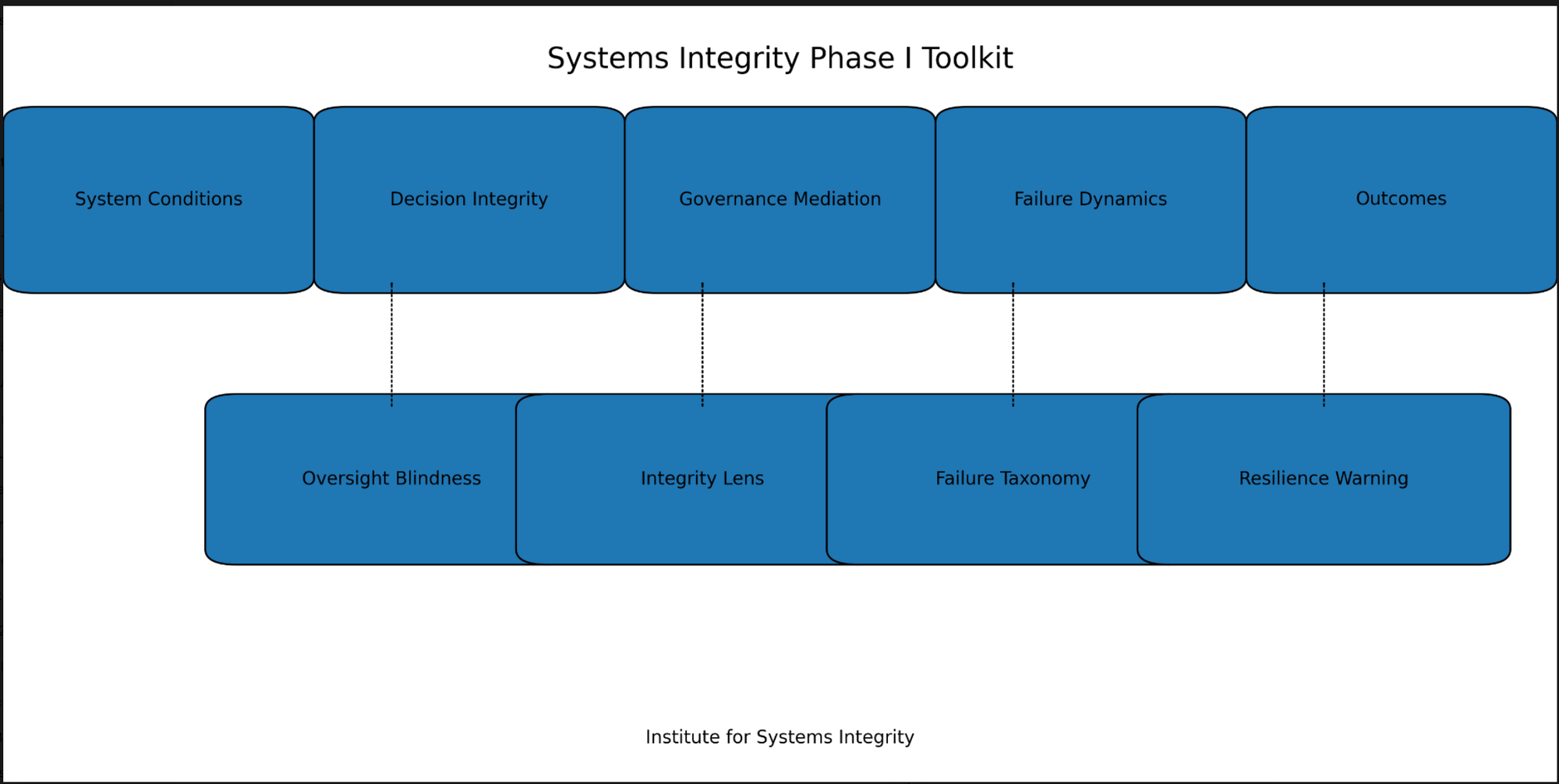
- System Conditions
- Decision Integrity
- Governance Mediation
- Failure Dynamics
- Outcomes
Beneath this flow sit four analytical lenses that interrogate where integrity is lost:
- Oversight Blindness
- Integrity Lens
- Failure Taxonomy
- Resilience Warning
Phase 1 is diagnostic and preventive.
It is not a compliance checklist, audit tool, or post-incident attribution model.
3. Relationship to the ISI canon
Phase I is grounded in ISI’s existing architectures and derived views, including:
- The Systems Integrity Cascade
- Oversight Blindness Pathway (Derived View)
- Integrity as a System Property (Derived Lens)
These frameworks explain how harm emerges over time.
Phase 1 adds operational traction by enabling earlier recognition and governance intervention.
4. Toolkit frameworks (Phase 1 instruments)
Phase 1 is operationalised through three published toolkit frameworks.
These are board-usable, regulator-safe, and sector-agnostic.
Each framework addresses a distinct governance failure mode.
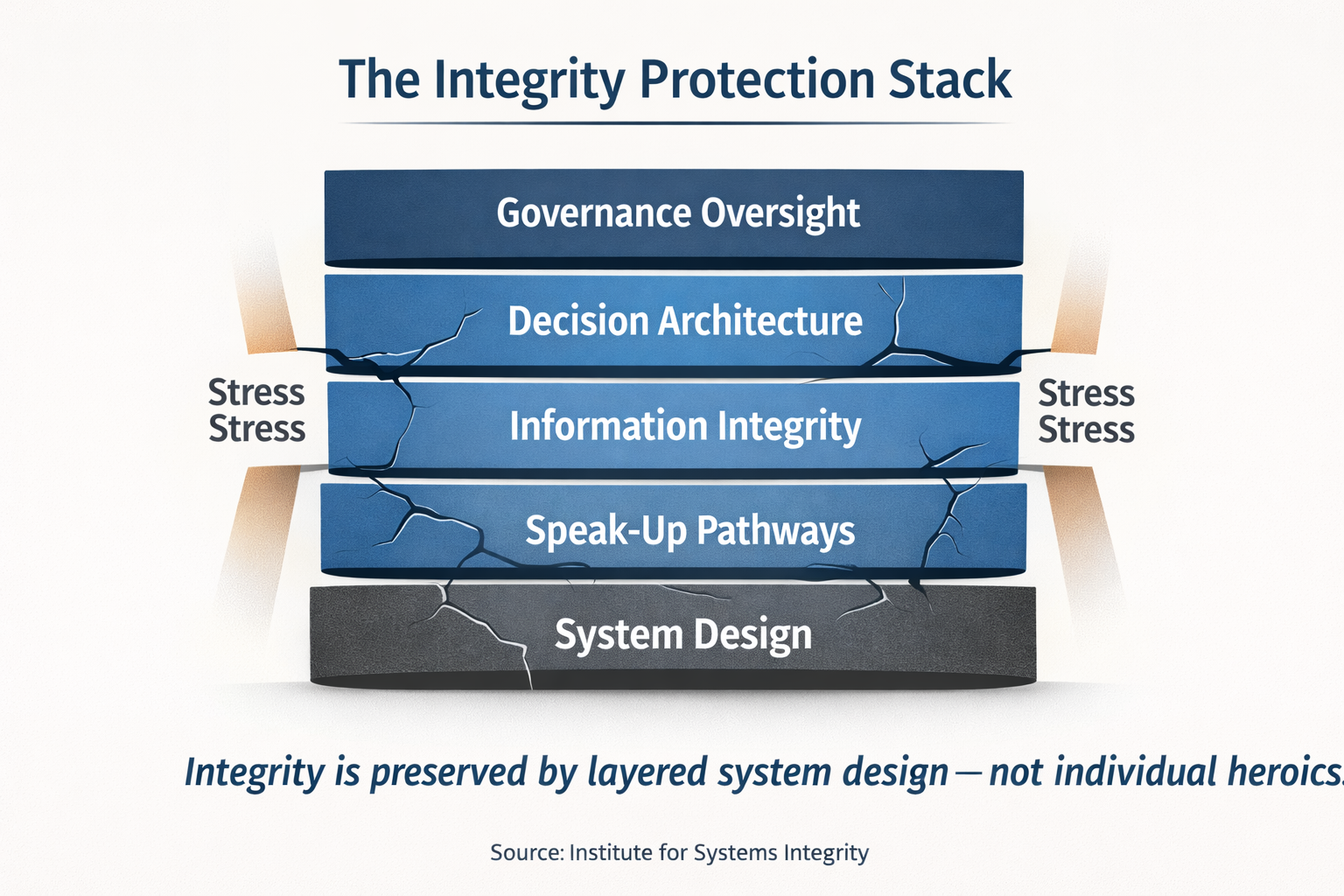
4.1 The Integrity Protection Stack (IPS)
Purpose
To explain where integrity is protected — or lost — within system design, rather than attributing failure to individual behaviour.
Definition
The Integrity Protection Stack is a layered governance architecture that preserves integrity under system stress by ensuring multiple protective system layers remain intact when individual judgment is constrained.
Five layers (fixed order)
- System Design
- Decision Architecture
- Information Integrity
- Speak-Up Pathways
- Governance Oversight
Applied in
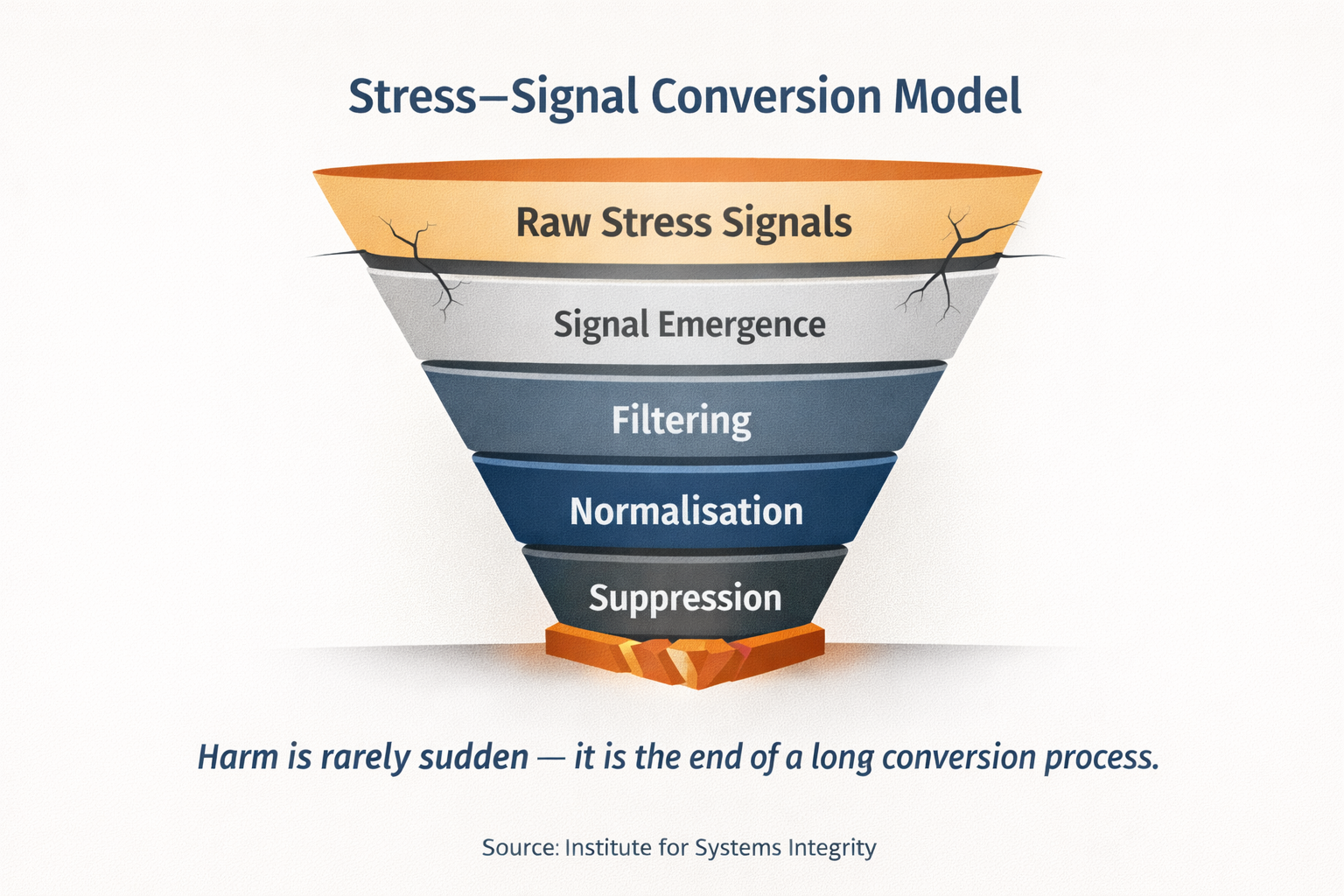
4.2 The Stress–Signal Conversion Model (SSCM)
Purpose
To explain why early warning signals are visible but not acted upon before harm occurs.
Definition
The Stress–Signal Conversion Model describes the systematic process by which early stress signals are filtered, normalised, and suppressed, transforming warning signs into organisational silence before harm occurs.
Four stages (fixed)
- Signal Emergence
- Signal Filtering
- Signal Normalisation
- Signal Suppression
Applied in
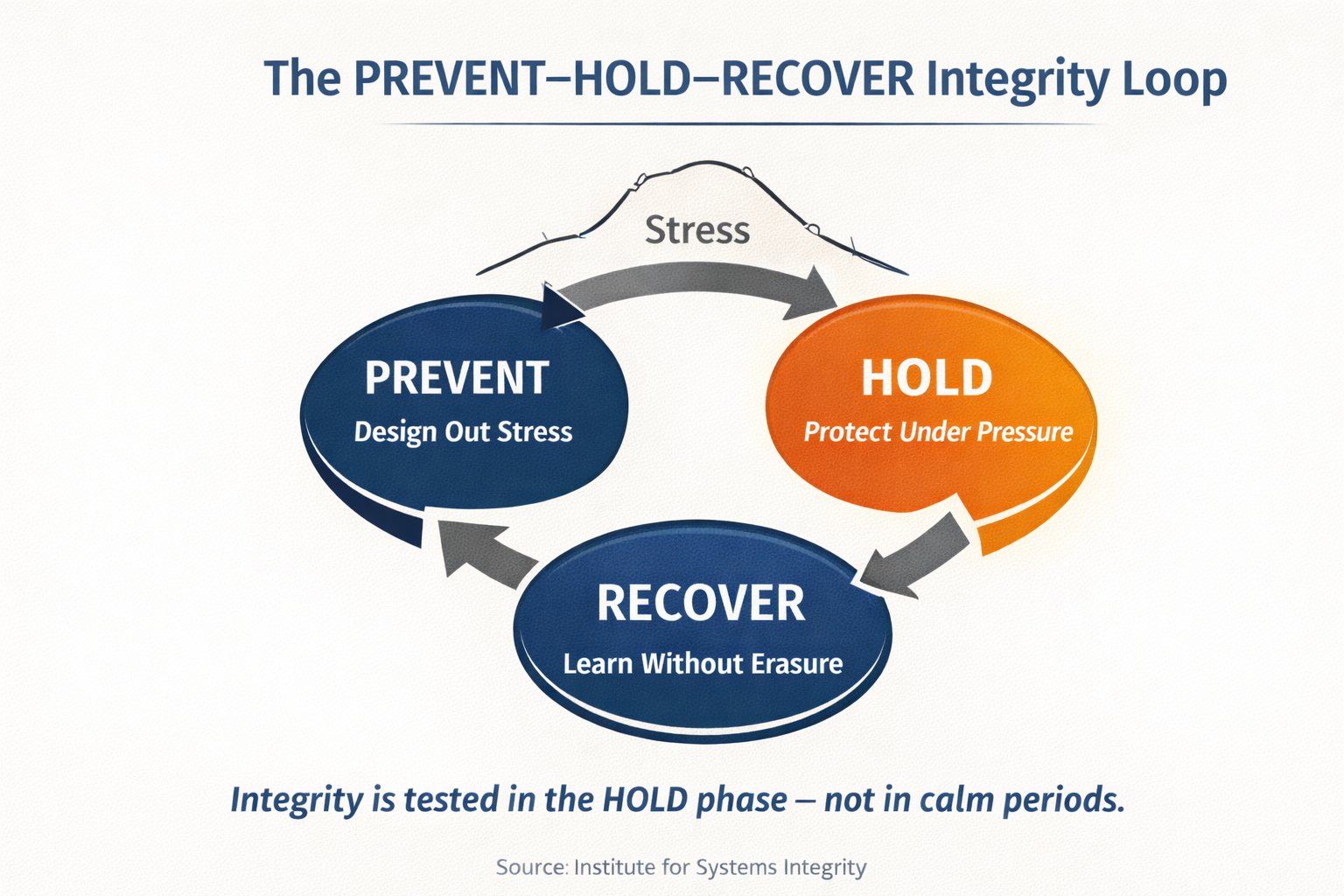
4.3 The PREVENT–HOLD–RECOVER Integrity Loop
Purpose
To identify when integrity is most vulnerable across system lifecycles.
Definition
The PREVENT–HOLD–RECOVER Integrity Loop maps integrity risk across periods of stability, stress, and recovery, identifying the HOLD phase as the point where decision quality is most vulnerable.
Phases (fixed)
- PREVENT — reduce baseline system stress
- HOLD — protect judgment under sustained pressure
- RECOVER — learn without erasing memory
Applied in
5. What Phase 1 is — and is not
Phase 1 is:
- a governance sense-making architecture
- a way to see integrity risk earlier
- a bridge between theory and intervention
Phase 1 is not:
- a scoring system
- a compliance framework
- a substitute for regulatory standards
- a tool for individual blame
Later phases will introduce sector-specific overlays (Phase II) and diagnostic instruments (Phase III).
6. Conclusion
Integrity failure is rarely sudden.
It is the predictable outcome of systems under sustained pressure where governance can no longer see clearly.
The Systems Integrity Toolkit — Phase 1 provides a shared language and structure for recognising that moment before outcomes harden.
Understanding why these risks persist even when they are visible requires a separate analysis of system resistance and governance refusal.
How to cite (Harvard style)
Institute for Systems Integrity (2026). The Systems Integrity Toolkit — Phase I. ISI. Available at: https://www.systemsintegrity.org/systems-integrity-toolkit/phase-1/