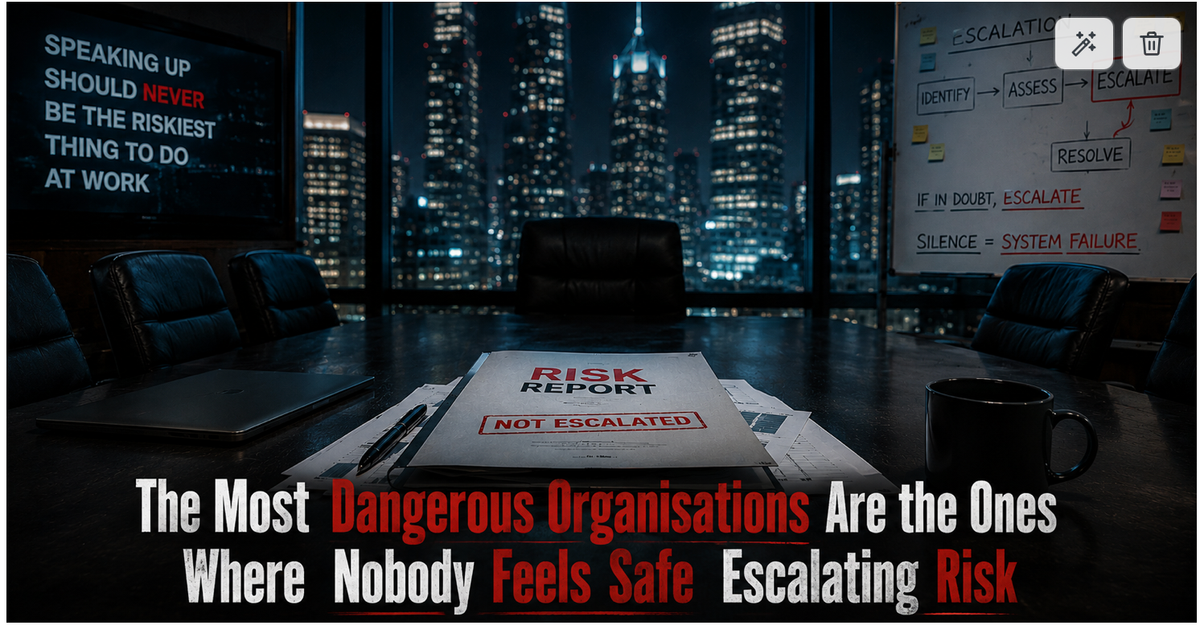
The Most Dangerous Organisations Are the Ones Where Nobody Feels Safe Escalating Risk : Why Institutions Lose Honesty Before They Lose Control
Most organisations do not fail because risk exists. They fail because reality becomes too dangerous to communicate honestly. Fear distorts signal flow, silence replaces escalation, and leaders lose contact with operational truth long before outcomes collapse.
Dr Alwin Tan, GAICD, MBBS, FRACS, EMBA (Melbourne Business School)
Senior Surgeon | Governance Leader | HealthTech Co-founder |
Harvard Medical School — AI in Healthcare |
Australian Institute of Company Directors — GAICD graduate |
University of Oxford — Sustainable Enterprise
Institute for Systems Integrity (ISI)
Most organisations believe danger comes from incompetence.
It does not.
The greatest organisational dangers often emerge inside systems filled with intelligent people, accomplished executives, respected brands, sophisticated reporting structures, and high operational capability.
The danger begins somewhere far less visible.
It begins the moment people stop feeling safe telling the truth upward.
That is when institutions start losing contact with reality.
Not because information disappears.
But because human beings begin editing it before it reaches power.
And that may be one of the most dangerous governance failures of our time.
The Myth of Competence
When major failures occur, the public often asks:
"How could intelligent people let this happen?"
The question assumes collapse is caused by a lack of capability.
History suggests otherwise.
The organisations involved in some of the world's most catastrophic failures were often staffed by exceptional people.
Experienced engineers.
Highly trained clinicians.
Talented executives.
Prestigious institutions.
Strong brands.
Sophisticated governance structures.
The issue was not that people did not know.
The issue was that systems progressively lost the ability to hear what people knew.
The uncomfortable truth is this:
Organisations rarely fail because nobody sees the danger.
They fail because reality becomes too dangerous to communicate honestly.
How Institutions Manufacture Blindness
Governance failures rarely begin with scandal.
They begin with adaptation.
People learn quickly.
They observe:
- what leadership wants to hear;
- what creates friction;
- what threatens careers;
- what attracts executive irritation;
- what is rewarded;
- which concerns disappear without action;
- which truths are emotionally unwelcome.
The consequences are subtle.
Warnings become softened.
Concerns become diluted.
Escalation slows.
Language becomes cautious.
Uncertainty is carefully managed.
Bad news travels less directly.
Eventually, leadership receives something profoundly dangerous:
a psychologically edited version of reality.
The organisation still possesses information.
It simply no longer possesses truth.
Silence Is Not Stability
One of the greatest misconceptions in governance is the belief that calm organisations are safe organisations.
Boards frequently interpret the absence of noise as evidence of health.
Few complaints.
Minimal conflict.
Stable dashboards.
Positive reports.
No surprises.
Everything appears under control.
But fear creates artificial smoothness.
People stop challenging assumptions.
They stop exposing uncertainty.
They stop surfacing weak signals.
They stop escalating discomfort.
The organisation appears increasingly efficient.
Until reality breaks through violently.
The absence of escalation is therefore not proof of safety.
It may be evidence that people have learned escalation is unsafe.
That distinction matters enormously.
The Real Governance Failure
Complex systems always contain risk.
Hospitals.
Banks.
Airlines.
Universities.
Governments.
Technology companies.
Risk itself is not exceptional.
The defining characteristic of resilient organisations is not that they eliminate risk.
It is that reality continues travelling upward intact.
Institutions fail when signal integrity deteriorates.
When information is filtered through fear, politics, hierarchy, reputation management, or emotional self-protection, leadership becomes progressively disconnected from operational truth.
Governance shifts from managing reality to managing appearances.
That transition marks the true beginning of collapse.
The Hidden Psychology of Organisational Blindness
Inside every institution, people unconsciously ask a simple question:
"What happens to people who tell uncomfortable truths here?"
The answer determines the health of the entire information ecosystem.
If escalation leads to:
- punishment;
- humiliation;
- executive defensiveness;
- career damage;
- exclusion;
- labelling someone as "difficult";
- reputational discomfort;
then silence becomes rational.
People adapt.
No conspiracy is required.
Only self-preservation.
Once silence becomes rational, blindness becomes systemic.
The organisation starts manufacturing ignorance as an unintended consequence of its own culture.
Why Prestigious Organisations Are Especially Vulnerable
The most dangerous organisations are often the most polished.
That is the uncomfortable truth.
Major institutional collapses rarely emerge from obviously dysfunctional systems.
They occur inside admired systems.
Prestigious systems.
Successful systems.
Sophisticated systems.
Because high-status institutions become exceptionally skilled at:
- narrative management;
- reputational protection;
- performance theatre;
- dashboard optimisation;
- political smoothing of risk.
Everything appears stable externally.
Meanwhile, internally, truth becomes increasingly difficult to communicate honestly.
Institutions usually lose honesty before they lose control.
History Repeats the Same Pattern
The pattern is strikingly consistent.
NASA did not lack intelligence before the Challenger disaster.
Engineers expressed concerns regarding O-ring performance, but escalating concerns were progressively normalised within a culture that had become increasingly tolerant of deviance under operational pressure (Vaughan 1996).
Boeing did not lack engineering capability before the 737 MAX tragedies.
Commercial imperatives, fragmented accountability, and failures in communication impaired the movement of critical safety signals across organisational boundaries (Gelles 2021).
Mid Staffordshire NHS Foundation Trust did not fail because staff stopped caring about patients.
Institutional defensiveness, target cultures, and failure to act upon concerns allowed patient harm to persist despite repeated warnings (Francis 2013).
In each case, the core failure was remarkably similar.
The institution became progressively less able to tell itself the truth.
That was the real collapse.
Fear Corrupts Data Before It Corrupts Outcomes
Modern governance remains deeply attached to data.
But data itself is not immune from distortion.
Because people decide:
- what gets reported;
- what gets classified;
- what gets escalated;
- what gets minimised;
- what gets coded;
- what gets hidden.
Fear alters behaviour.
Incident reporting changes.
Escalation thresholds rise.
Weak signals disappear.
Language softens.
Metrics become politically managed.
Leaders receive cleaner stories than reality deserves.
This creates one of the most dangerous illusions in governance:
Leadership believes it is monitoring reality when it is actually monitoring filtered psychology.
Filtered systems inevitably drift away from operational truth.
Psychological Safety Is Infrastructure
Psychological safety is often dismissed as a "soft" issue.
It is not.
It is infrastructure.
It determines whether:
- truth travels;
- uncertainty surfaces;
- mistakes become visible;
- risk moves;
- systems remain adaptive under pressure.
Edmondson's seminal work demonstrated that psychologically safe teams report more errors, not because they fail more frequently, but because reality is allowed to move honestly through the system (Edmondson 1999).
This distinction is critical.
Organisations that punish discomfort eventually lose access to truth itself.
When Leaders Become the Risk
The tipping point arrives when employees stop managing operational reality and start managing leadership emotions.
That is the moment governance begins to fracture.
Optics replace learning.
Politics replace honesty.
Image replaces curiosity.
Self-protection replaces awareness.
The organisation becomes increasingly committed to looking safe rather than being safe.
From that point onward, deterioration accelerates silently.
Complexity punishes blind systems brutally over time.
The Board Question That Matters Most
Boards routinely ask:
- Are we compliant?
- Are KPIs stable?
- Is strategy executing?
- Are risks monitored?
These questions matter.
But they are not the most important ones.
The question that may determine whether governance still functions is this:
How psychologically expensive is it to tell the truth inside this organisation?
That single question may reveal more about future collapse than every dashboard combined.
Because institutions rarely fail from a lack of information.
They fail because reality becomes too dangerous to communicate honestly.
Delaying Collision With Reality
The most dangerous organisations are not always chaotic.
Often they are:
- financially strong;
- publicly admired;
- operationally sophisticated;
- successful;
- compliant on paper;
- apparently stable.
Yet beneath the surface:
fear has replaced trust;
silence has replaced escalation;
and leadership has become progressively disconnected from lived operational reality.
At that point, the organisation is no longer managing risk.
It is merely delaying collision with reality.
The true measure of institutional safety is therefore not whether risk exists.
It is whether people still feel safe enough to report it.
Because once they no longer do,
failure has already begun.
Reference
Francis, R. (2013) Report of the Mid Staffordshire NHS Foundation Trust Public Inquiry. London: The Stationery Office.
Gelles, D. (2021) Flying Blind: The 737 MAX Tragedy and the Fall of Boeing. New York: Doubleday.
Vaughan, D. (1996) The Challenger Launch Decision: Risky Technology, Culture, and Deviance at NASA. Chicago: University of Chicago Press.