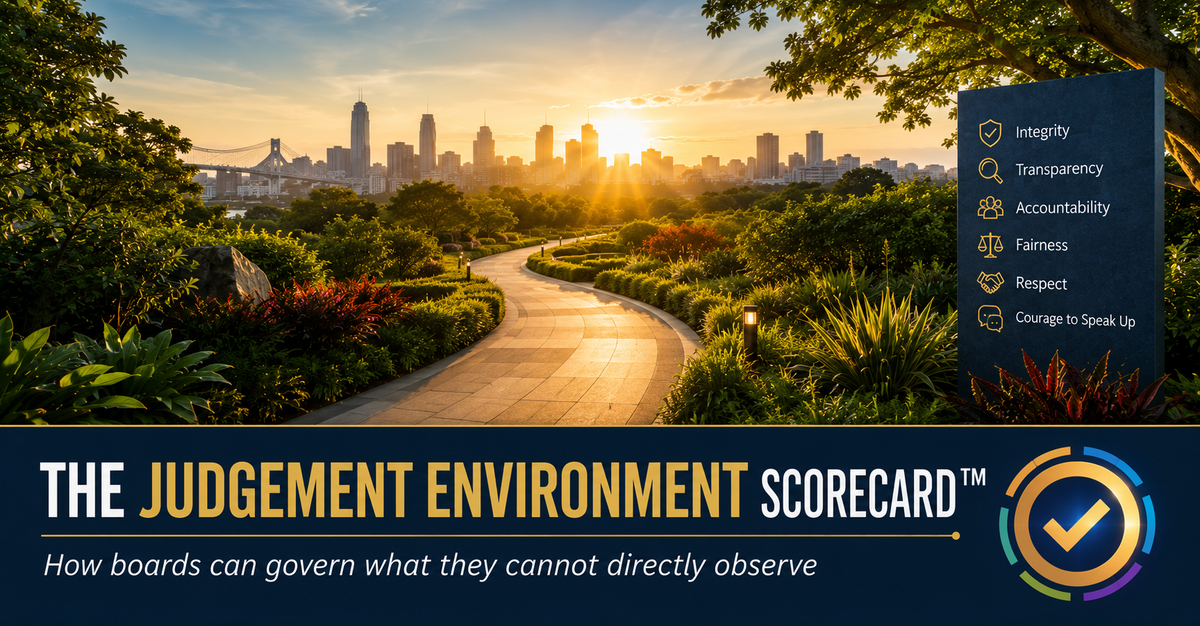
THE JUDGEMENT ENVIRONMENT SCORECARD™ How boards can govern what they cannot directly observe
Boards cannot directly observe clinical judgement, but they can govern the organisational conditions that shape it. Introducing the Judgement Environment Scorecard™—a governance framework for strengthening professional judgement, psychological safety and patient safety.
Dr Alwin Tan, GAICD, MBBS, FRACS, EMBA (Melbourne Business School)
Senior Surgeon | Governance Leader | HealthTech Co-founder | Founder of Institute for Systems Integrity (ISI) |Harvard Medical School — AI in Healthcare| University of Oxford — Sustainable Enterprise | Bastas Academy for Healthcare Leadership - Triple Scholar
Boards cannot watch every clinical interaction.
They cannot attend every escalation.
They cannot see every moment in which a practitioner hesitates, resists pressure, suppresses concern or decides that speaking is no longer worth the risk.
But boards can govern the conditions that make those moments more or less likely.
That requires moving beyond traditional assurance.
Incident rates, complaints, workforce turnover and financial performance remain important.
But they are lagging indicators.
They tell the board what entered the formal system.
They do not reveal:
- concerns that were never raised;
- decisions changed under pressure;
- dissent reframed as misconduct;
- clinicians who quietly withdrew;
- risks normalised by repetition;
- complaints entangled with workplace conflict;
- environments in which silence has become rational.
The absence of reported concern is not evidence of a healthy judgement environment.
It may simply mean the organisation has become highly effective at preventing uncomfortable information from travelling upwards.
ISI therefore proposes the Judgement Environment Scorecard™ as a board-level assurance framework.
It is not intended to rank individual practitioners.
It is designed to test whether the organisation is preserving the conditions required for sound, independent and accountable professional judgement.
1. REALITY INTEGRITY
Board question
Does accurate clinical and operational reality reach decision-makers without distortion, delay or suppression?
Possible indicators
- Time between frontline identification of a risk and executive escalation
- Frequency of material discrepancies between frontline accounts and formal reports
- Number of incidents materially reclassified during review
- Evidence of repeated concerns being downgraded or administratively closed
- Board access to unfiltered frontline safety intelligence
- Quality of triangulation across incident reports, complaints, workforce data and patient outcomes
- Proportion of significant risks first identified outside formal reporting systems
Warning signs
- Repeated surprises at board level
- Serious events described as isolated despite pattern evidence
- Consistently positive culture reports alongside high turnover or absenteeism
- Senior leaders receiving substantially different accounts from frontline staff
- Important concerns appearing only after external review, litigation or media attention
A board cannot govern reality that has been professionally edited before it arrives.
2. COGNITIVE CAPACITY
Board question
Does the organisation preserve enough time, staffing and attention for complex judgement?
Possible indicators
- Fatigue-related incidents and near misses
- Excessive overtime and unplanned roster extension
- Clinician-to-patient workload measures
- Frequency of interruptions during high-risk tasks
- Administrative time as a proportion of clinical time
- Use of agency or temporary staff in critical settings
- Missed breaks, delayed reviews and uncompleted documentation
- Staff perceptions of whether they have enough time to think before acting
Warning signs
- Productivity gains occurring alongside deteriorating safety indicators
- Persistent understaffing treated as normal operations
- Escalation pathways bypassed because of time pressure
- Increasing dependence on individual resilience
- High-performing staff routinely carrying unsafe cognitive loads
When every minute is optimised, the organisation may eliminate the time required for judgement.
3. RESPONSIBLE PROFESSIONAL AUTONOMY
Board question
Can practitioners act according to evidence, patient need and professional standards without improper organisational influence?
Possible indicators
- Number and type of clinical decisions overridden by non-clinical leaders
- Reasons for refusal, delay or modification of recommended care
- Variations in care associated with commercial or throughput targets
- Complaints regarding pressure to admit, discharge, investigate or operate
- Contractual or credentialling consequences following professional disagreement
- Transparency of incentive structures affecting clinical activity
- Frequency of ethical or clinical concerns linked to resource allocation
Warning signs
- Clinicians carrying accountability without corresponding authority
- Informal pressure that is absent from formal policy
- High-value or high-volume activity dominating professional recognition
- Practitioners reporting that saying no affects access or opportunity
- Operational targets overriding unresolved clinical concerns
Professional autonomy becomes performative when the practitioner remains responsible for decisions they were never truly free to make.
4. VOICE SAFETY
Board question
What happens to people after they raise concerns?
Possible indicators
- Time taken to acknowledge, assess and resolve concerns
- Career, rostering, credentialling or employment outcomes for people who speak up
- Rates of repeat reporting by the same individual
- Staff confidence that concerns can be raised without disadvantage
- Number of substantiated retaliation or victimisation allegations
- Whether reporters receive feedback and support
- Whether concerns lead to visible organisational change
- Differences between formal speak-up data and anonymous workforce feedback
Warning signs
- Reporters becoming labelled as disruptive, difficult or “not aligned”
- High use of confidential channels but low use of normal escalation pathways
- Staff believing anonymity is the only safe option
- Leaders focusing on the manner of escalation rather than the substance
- Concerns disappearing into review processes without visible resolution
- Those who raise concerns leaving the organisation disproportionately
The true measure of psychological safety is not whether people are invited to speak. It is what happens after they do.
5. PROCEDURAL INTEGRITY
Board question
Are complaints, investigations and regulatory escalations fair, proportionate, timely and protected from organisational misuse?
Possible indicators
- Duration of internal investigations
- Proportion of complaints substantiated, partially substantiated or unsubstantiated
- Complaints arising during employment, credentialling or professional disputes
- Number of matters escalated externally before local fact-finding was completed
- Access to procedural support for all parties
- Consistency in investigative thresholds
- Reputational or employment consequences imposed before findings
- Whether corrective action occurs when allegations are not substantiated
Warning signs
- Complaint processes used as substitutes for leadership
- Allegations treated as findings
- Disproportionate escalation of contested professional disagreement
- Significant delay with no corresponding risk justification
- Selective application of conduct standards
- Regulatory referral occurring immediately after dissent or safety escalation
- No process for repairing harm caused by unsupported allegations
A process can be formally compliant and still be procedurally unsafe.
6. GOVERNANCE ACCOUNTABILITY
Board question
Does the board receive sufficient evidence to determine whether professional judgement is being protected?
Possible indicators
- Regular board reporting on the six Judgement Environment domains
- Direct access to independent clinical and workforce assurance
- Board review of patterns across complaints, incidents, turnover and regulatory matters
- Escalation of substantiated retaliation or interference with clinical judgement
- Executive accountability for voice safety and procedural integrity
- Periodic independent review of organisational culture and complaint governance
- Evidence that board decisions address system conditions, not only individual events
Warning signs
- Culture treated as a human resources issue rather than a governance control
- Complaints and incidents reviewed separately despite common patterns
- No board visibility over how dissent is managed
- Executives marking their own assurance
- Reliance on policy existence as proof of policy effectiveness
- No mechanism for identifying concerns that never entered the formal system
Boards should not govern individual clinical decisions. They must govern the architecture that makes sound decisions possible.
HOW THE SCORECARD SHOULD BE USED
The Judgement Environment Scorecard™ should not be reduced to a single number.
A composite score may create false precision and encourage organisations to optimise presentation rather than reality.
Its primary purpose is to support:
- board inquiry;
- pattern recognition;
- triangulation;
- executive accountability;
- independent assurance;
- early intervention.
Each domain should be assessed using a combination of:
- quantitative data;
- anonymous workforce feedback;
- case review;
- patient experience;
- independent clinical assurance;
- longitudinal trends;
- direct frontline engagement.
No single data source is sufficient.
A low number of reports may indicate safety.
It may also indicate fear.
High reporting may indicate dysfunction.
It may also indicate trust.
Low turnover may indicate stability.
It may also indicate professional entrapment.
Governance depends not merely on collecting indicators, but on interpreting what those indicators may conceal.
THE BOARD’S ULTIMATE TEST
The scorecard should culminate in one recurring board question:
Could a competent practitioner in this organisation tell the truth, resist inappropriate pressure and act in the patient’s interests without facing disproportionate personal or professional harm?
If the board cannot answer that question with evidence, it does not yet have assurance over the organisation’s judgement environment.
And without that assurance, it cannot know whether silence reflects safety—
or whether silence has become the system’s most successful risk-control illusion.
REFERENCE
- Australian Commission on Safety and Quality in Health Care 2021, National Safety and Quality Health Service Standards, 2nd edn, ACSQHC, Sydney.
- Edmondson, AC 1999, 'Psychological safety and learning behavior in work teams', Administrative Science Quarterly, vol. 44, no. 2, pp. 350–383.
- Edmondson, AC 2004, 'Learning from failure in health care: frequent opportunities, pervasive barriers', Quality and Safety in Health Care, vol. 13, suppl. 2, pp. ii3–ii9.
- Edmondson, AC & Lei, Z 2014, 'Psychological safety: the history, renaissance, and future of an interpersonal construct', Annual Review of Organizational Psychology and Organizational Behavior, vol. 1, pp. 23–43.
- Maben, J, Ball, J & Edmondson, AC 2023, Workplace Conditions, Cambridge University Press, Cambridge.
- Medical Board of Australia 2020, Good Medical Practice: A Code of Conduct for Doctors in Australia, Medical Board of Australia, Melbourne.
- Nembhard, IM & Edmondson, AC 2006, 'Making it safe: the effects of leader inclusiveness and professional status on psychological safety and improvement efforts in health care teams', Journal of Organizational Behavior, vol. 27, no. 7, pp. 941–966.
- O'Donovan, R & McAuliffe, E 2020, 'A systematic review exploring the content and outcomes of interventions to improve psychological safety, speaking up and voice behaviour', BMC Health Services Research, vol. 20, article 101.
- Reason, J 2000, 'Human error: models and management', BMJ, vol. 320, no. 7237, pp. 768–770.
- van Dongen, D, Guldenmund, F, Grossmann, I & Groeneweg, J 2024, 'Classification of influencing factors of speaking-up behaviour in hospitals: a systematic review', BMC Health Services Research, vol. 24.