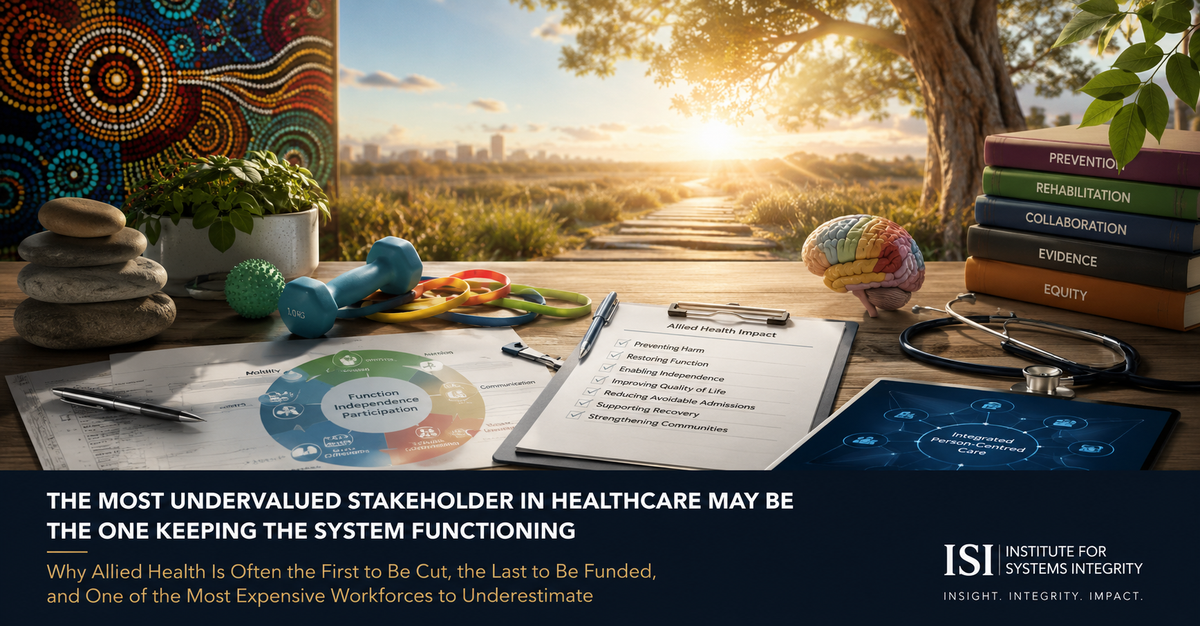
THE MOST UNDERVALUED STAKEHOLDER IN HEALTHCARE MAY BE THE ONE KEEPING THE SYSTEM FUNCTIONING : Why Allied Health Is Often the First to Be Cut, the Last to Be Funded, and One of the Most Expensive Workforces to Underestimate
Allied health prevents deterioration, preserves function and reduces future demand—yet remains underfunded and underrepresented. This paper examines the governance cost of overlooking one of healthcare’s most important workforces.
Co Authors
Assoc. Prof. Nainaben Dhana DCRT (London), HDRT( South Africa) Grad Cert EBP ( Monash) , ACA registered Counsellor
RT Education and Quality Lead, Adjunct Industry Associate Professor of RMIT, AUSCEP participant (2025-26)
Dr Alwin Tan, GAICD, MBBS, FRACS, EMBA (Melbourne Business School)
Senior Surgeon | Governance Leader | HealthTech Co-founder | Founder of Institute for Systems Integrity (ISI) |Harvard Medical School — AI in Healthcare| University of Oxford — Sustainable Enterprise | Bastas Academy for Healthcare Leadership - Triple Scholar
Healthcare has a paradox it rarely talks about.
The workforce helping prevent future demand is often the workforce most vulnerable when budgets become tight.
Every healthcare organisation can tell you:
- how many patients attended the emergency department
- how many operations were performed
- how many beds were occupied
- how long patients stayed
- how much activity occurred
But ask a different set of questions.
Who prevented the admission that never happened?
Who prevented the fall that never occurred?
Who preserved the independence that never appeared on a dashboard?
Who recognised deterioration before it became a hospital presentation?
Who helped diagnose the patient?
Who supported patients through weeks or months of rehabilitation?
Who helped patients tolerate, complete and recover from cancer treatment?
Very often, allied health is central to the answer.
Yet despite its enormous contribution to patient outcomes, system sustainability and healthcare resilience, allied health remains one of the most undervalued and least visible pillars of modern healthcare.
Not because healthcare leaders do not recognise its importance.
Not because evidence is lacking.
Not because patients do not benefit.
But because healthcare systems still struggle to value outcomes they cannot easily count.
Recovery.
Function.
Independence.
Participation.
Quality of life.
Hospital avoidance.
Long-term survival with meaningful quality of life.
These are among the outcomes patients value most.
Yet they often remain among the least visible outcomes in healthcare governance.
And that creates one of healthcare’s most dangerous contradictions.
The people helping keep patients out of hospital are often given the least influence over how healthcare systems are designed.
The First to Be Cut. The Last to Be Restored.
When healthcare organisations face financial pressure, certain services are usually protected.
Emergency departments.
Operating theatres.
Critical care.
Acute medical services.
The reasons are understandable.
The consequences of failure are immediate.
The demand is visible.
The pressure is public.
Allied health is different.
Many of its greatest successes occur when nothing happens.
A physiotherapist prevents a fall.
An occupational therapist prevents loss of independence.
A speech pathologist identifies swallowing risk before aspiration occurs.
A dietitian prevents malnutrition and treatment interruption.
A psychologist prevents escalation.
A social worker prevents crisis.
An exercise physiologist slows deterioration.
A medical imaging technologist identifies an unexpected finding and supports diagnosis.
A radiation therapist delivers treatment while supporting a patient through a demanding course of cancer care.
The problem is that prevention rarely generates headlines.
Healthcare finds it easier to count activity than to account for the absence of harm.
It finds it easier to count admissions than the admissions that never occurred.
It finds it easier to fund intervention than prevention.
When budgets tighten, allied health services can therefore appear easier to reduce because the consequences are often delayed, dispersed and less immediately visible than the closure of an emergency department or operating theatre.
The professions preventing future demand are too often among the first examined for savings and among the last considered for meaningful investment.
That is not simply a workforce issue.
It is a systems issue.
Healthcare Still Rewards Illness More Than Function
Healthcare was largely designed around acute illness.
Diagnose.
Treat.
Intervene.
Discharge.
That model transformed medicine.
But the healthcare landscape has changed.
Today’s greatest challenges increasingly include:
- chronic disease
- frailty
- disability
- ageing populations
- mental health conditions
- multimorbidity
- rehabilitation
- cancer survivorship
Healthcare is becoming less about isolated episodes and more about capability across time.
Patients increasingly care about questions such as:
Can I walk?
Can I work?
Can I remain independent?
Can I communicate?
Can I care for myself?
Can I tolerate and complete treatment?
Can I recover?
Can I stay out of hospital?
Can I return to the life that matters to me?
These are fundamentally questions of function, participation and capability.
And function is where much of allied health operates.
Yet many healthcare systems continue to recognise episodes of treatment more clearly than they recognise preserved capability across time.
Healthcare may not intentionally reward illness.
But it still measures and funds intervention more reliably than maintained function.
The system often pays most generously after failure becomes visible and far less reliably for preventing that failure from occurring.
Allied Health Is Not a Support Service
Perhaps the most damaging misconception in healthcare is embedded in the language we use.
Allied health is frequently described as a support service.
Support for hospitals.
Support for doctors.
Support for nurses.
Support for patients.
Support.
Support.
Support.
But this framing misses something fundamental.
Allied health does not merely support healthcare. Allied health delivers healthcare.
It contributes across the entire care continuum:
Prevention.
Diagnosis.
Treatment.
Rehabilitation.
Mental healthcare.
Disability support.
Cancer care.
Survivorship.
Community-based care.
Allied health professionals do not merely assist another profession to deliver the “real” intervention.
They directly assess, diagnose, treat, rehabilitate, monitor, educate and support patients.
They deliver many of the parts of healthcare that determine whether patients regain independence, maintain function, complete treatment and recover meaningful lives.
The irony is striking.
Many healthcare organisations say patients are at the centre of care.
Yet the professions most focused on what patients can actually do during and after treatment often sit furthest from strategic influence.
The Functional Value Blind Spot™
Healthcare systems are highly capable of measuring visible activity.
Admissions.
Procedures.
Bed days.
Presentations.
Appointments.
Occasions of service.
But they are often less capable of measuring preserved function, avoided deterioration and sustained participation.
This creates what the Institute for Systems Integrity describes as the Functional Value Blind Spot™.
The Functional Value Blind Spot™ occurs when healthcare systems measure episodes of treatment and visible activity more reliably than they measure preserved independence, avoided harm and capability across time.
A patient who avoids a fall may generate no incident report.
A patient who remains independent may generate no hospital admission.
A patient whose swallowing risk is identified early may never appear in aspiration statistics.
A patient whose nutrition is maintained may avoid deterioration without that success becoming visible on an executive dashboard.
A patient supported through cancer treatment may complete therapy without the organisation fully recognising the workforce contribution that made completion possible.
Absence of crisis is not absence of value.
It may be evidence that the system worked.
The Cost Does Not Disappear. It Migrates.
Reducing allied health capacity does not necessarily remove cost from the healthcare system.
It may relocate it.
A physiotherapy vacancy may reappear as delayed mobilisation, preventable falls or longer hospital stays.
Insufficient speech pathology capacity may reappear as aspiration risk, nutrition complications or delayed discharge.
Reduced occupational therapy capacity may reappear as unsafe discharge, loss of independence or greater reliance on family carers.
Inadequate dietetic support may reappear as malnutrition, treatment interruption, slower recovery or readmission.
Limited social work capacity may reappear as discharge delay, safeguarding risk, housing crisis or emergency representation.
Reduced psychological support may reappear as distress, treatment disengagement or crisis escalation.
Insufficient radiation therapy capacity may reappear as treatment delay, disrupted care pathways and greater pressure on patients and families.
The budget line may shrink while the system cost expands.
The exact consequences will vary between professions, services and patient populations.
But the governance principle is consistent.
Savings should not be declared until downstream costs, functional consequences and transferred burdens have been measured.
A healthcare organisation can reduce its own expenditure while increasing the cost carried by patients, carers, primary care, disability services, aged care, community organisations and the broader health system.
Every healthcare system eventually pays for what it chooses not to fund.
The only questions are where the cost will reappear, when it will become visible and who will carry it first.
The Missing Intelligence Layer
At the Institute for Systems Integrity, we often write about signal integrity.
Complex systems succeed when important signals reach decision-makers early.
They fail when signals are filtered, delayed, fragmented or ignored.
This is where allied health becomes critically important.
Allied health professionals frequently recognise deterioration long before the broader system acknowledges it.
They see:
- mobility decline
- caregiver fatigue
- cognitive deterioration
- nutritional risk
- social isolation
- falls risk
- communication difficulty
- swallowing risk
- rehabilitation barriers
- treatment tolerance
- loss of independence
These are not secondary observations.
They are early warning signals.
Allied health may represent one of the largest distributed risk-detection networks in healthcare.
Yet many organisations continue to treat it as though it sits outside the strategic core of the system.
The people closest to functional decline are often furthest from the decisions that determine whether their services survive.
That should concern every healthcare board.
If allied health signals do not reach senior decision-makers, the organisation may lose visibility of emerging risk before it becomes acute demand.
This is not merely underrepresentation.
It is degradation of the system’s intelligence.
The Governance Question Nobody Is Asking
Boards routinely ask:
Are we financially sustainable?
Are we compliant?
Are we meeting performance targets?
Are we managing risk?
Are we delivering activity?
Few ask:
Which workforce groups are preventing future demand?
Which professional groups see functional decline first?
Which services prevent delayed discharge, dependency and avoidable deterioration?
What capabilities become vulnerable every time budgets tighten?
Where will unmet need go if these services are reduced?
Because if the answer includes allied health, healthcare may be undermining its own future resilience.
Every healthcare system eventually pays for the capabilities it chooses not to protect.
Sometimes through longer hospital stays.
Sometimes through avoidable deterioration.
Sometimes through exhausted carers.
Sometimes through treatment disruption.
Sometimes through lost independence.
And sometimes through patients returning in crisis after the workforce that might have prevented it was treated as optional.
Five Questions Every Healthcare Board Should Ask
1. What functional outcomes do we govern?
Boards should look beyond activity, occupancy and throughput.
They should also consider:
- mobility
- independence
- communication
- nutrition
- participation
- treatment completion
- return to work
- safe community living
- patient-reported function
- quality of life
2. Which allied health signals reach the board?
Do board and executive reports include:
- unmet demand
- waiting times
- vacancy rates
- treatment delays
- missed referrals
- delayed discharge
- functional deterioration
- rural and regional access
- professional concerns
- carer capacity
- service substitution
3. What happens when allied health capacity falls?
Before reducing services, boards should ask not only:
How much will this save?
But also:
Where will the unmet need go?
4. Is allied health represented where care is designed?
Representation should extend beyond consultation after key decisions have already been made.
Allied health perspectives should inform:
- executive leadership
- clinical governance
- workforce planning
- quality and safety
- digital transformation
- capital planning
- budget development
- model-of-care redesign
5. Are we measuring avoided demand?
Boards must distinguish between:
- no demand
- unrecorded demand
- unmet demand
- demand absorbed by families and carers
- demand displaced to another service
- demand successfully prevented
Without this distinction, prevention can look like inactivity and underinvestment can masquerade as efficiency.
Healthcare’s Blind Spot
The greatest misconception surrounding allied health is that it is undervalued because it is peripheral.
The opposite may be true.
Allied health is undervalued precisely because healthcare has not yet learned how to fully value function.
Hospitals understand admissions.
Governments understand activity.
Funders understand procedures.
But increasingly, the outcomes society needs are different.
Independence.
Capability.
Participation.
Recovery.
Healthy ageing.
Community living.
Hospital avoidance.
Treatment completion.
Quality of life.
These are the outcomes that will help define healthcare sustainability over the coming decades.
And these are outcomes allied health protects every day.
What Must Change
Healthcare systems should begin measuring function alongside activity.
Boards and funders should receive functional and patient-reported outcome measures where clinically appropriate.
Material reductions in allied health services should be accompanied by downstream impact assessments examining:
- patient safety
- discharge delays
- waiting lists
- workforce consequences
- carer burden
- cost transfer
- equity
- rural and regional access
Allied health must also be represented where healthcare is designed, funded and governed.
Not through symbolic attendance.
Not through consultation after decisions have effectively been made.
But through meaningful influence over workforce planning, clinical governance, digital systems, care pathways, quality, safety and resource allocation.
Healthcare organisations should also build formal signal pathways through which recurring allied health concerns can reach executives and boards before they become visible as crises.
Because the value of allied health is not only in the care it delivers.
It is also in the deterioration it detects early enough for the system to act.
ISI Closing Reflection
The greatest healthcare governance failures rarely begin with catastrophic events.
They begin when organisations overlook the people who see risk emerging first.
Allied health professionals spend their careers identifying deterioration before it becomes crisis.
Dependency before it becomes disability.
Risk before it becomes harm.
Treatment barriers before they become treatment failure.
Yet allied health remains too often underfunded, underrepresented and insufficiently influential in the design of healthcare systems.
Perhaps allied health is not undervalued because it lacks importance.
Perhaps it is undervalued because too much of what it protects remains invisible to the systems deciding what matters.
A prevented fall leaves no dramatic incident report.
Preserved independence creates no emergency presentation.
A patient who remains nourished, communicates safely, completes treatment and returns home may generate less institutional activity, not more.
But absence of crisis is not absence of value.
It may be evidence that the system worked.
Healthcare’s most expensive mistake may be confusing what is difficult to measure with what is safe to remove.
Every healthcare system eventually pays for the capability it chooses not to protect.
Allied health does not merely support the healthcare system.
It helps prevent the system from being overwhelmed by the consequences of what it failed to see early enough.
References
Australian Digital Health Agency 2025, Expanded investment in allied health to accelerate connected care, Australian Government, Canberra.
Australian Government Department of Health and Aged Care 2025, National Allied Health Workforce Strategy, Commonwealth of Australia, Canberra.
Australian Government Department of Health and Aged Care 2025, Draft National Allied Health Workforce Strategy: Consultation Draft V2.0, Commonwealth of Australia, Canberra.
Australian Health Professions Alliance 2025, Election 2025 Allied Health Priorities, AHPA, Melbourne.
Eddison, N., Nancarrow, S., Chater, A. & McKimm, J. 2023, ‘Exploration of the representation of the allied health professions in senior leadership positions in the UK National Health Service’, BMJ Leader, vol. 8, no. 2, pp. 181–187.
Foster, A.M., Skinner, E.H., Marks, D. et al. 2025, ‘Why they come, why they stay and why they leave: drivers of recruitment, retention and attrition among allied health clinicians’, BMC Health Services Research, vol. 25.
National Rural Health Alliance 2025, Response to the Draft National Allied Health Workforce Strategy, NRHA, Canberra.
World Health Organization 2023, Rehabilitation in Health Systems: Guide for Action, WHO, Geneva.