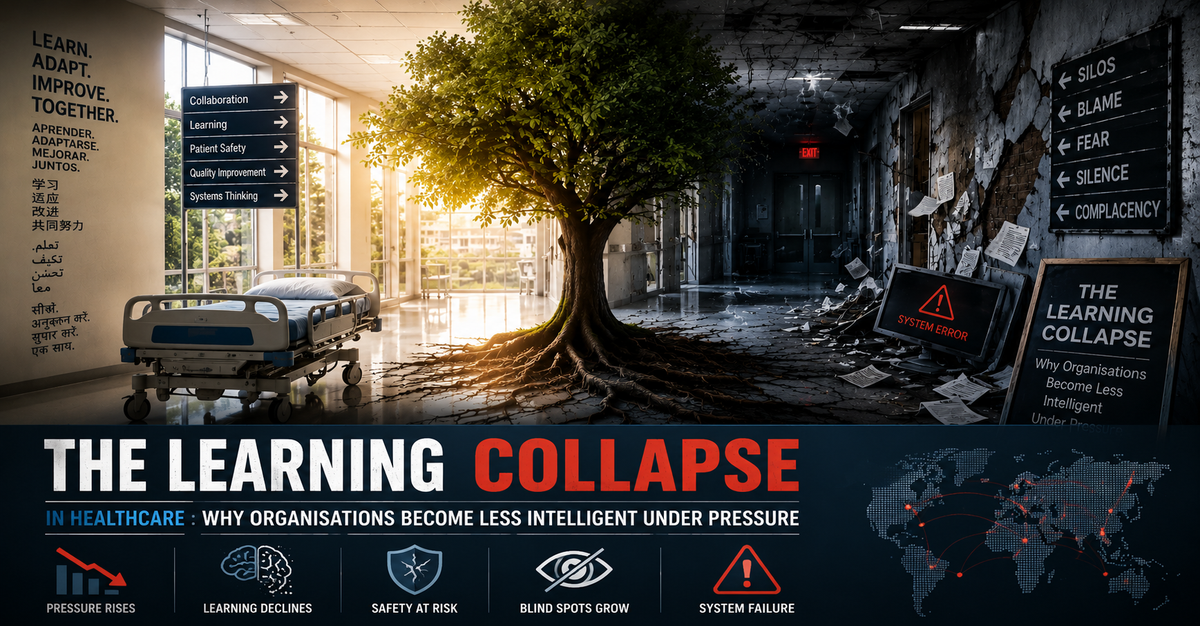
The Learning Collapse in Healthcare : Why Organisations Become Less Intelligent Under Pressure
Modern healthcare systems do not usually fail because people stop caring. They fail because organisations quietly lose their ability to learn under pressure — where escalation weakens, psychological safety erodes, and healthcare systems become less intelligent while still appearing successful.
Dr Alwin Tan, GAICD, MBBS, FRACS, EMBA (Melbourne Business School)
Senior Surgeon | Governance Leader | HealthTech Co-founder |
Harvard Medical School — AI in Healthcare |
Australian Institute of Company Directors — GAICD graduate |
University of Oxford — Sustainable Enterprise
Institute for Systems Integrity (ISI)
Modern healthcare systems do not usually fail because people stop caring.
They fail because the organisation slowly loses its ability to learn while pressure continues to rise.
And one of the most dangerous realities in healthcare today is this:
👉 A hospital can appear operationally successful while becoming progressively less intelligent underneath.
Emergency departments remain open.
Operating theatres continue running.
Dashboards stay green.
Targets are technically met.
But beneath the visible performance:
- escalation weakens
- curiosity narrows
- experimentation declines
- psychological safety erodes
- operational workarounds multiply
- frontline adaptation becomes invisible
- bad news gets softened before reaching leadership
And eventually the organisation becomes:
👉 less capable of seeing risk clearly while still appearing functional.
That is where systemic danger begins.
The Hidden Dependency Healthcare Refuses to Admit
Healthcare systems increasingly survive through human compensation rather than system capability.
Clinicians stay late.
Nurses absorb staffing gaps.
Administrators manually repair fragmented processes.
Junior staff carry escalating cognitive load.
Teams create invisible workarounds to protect patients from failing systems.
And because patients are still treated, leadership often concludes:
👉 “The system is coping.”
But this creates one of the most dangerous governance illusions in healthcare:
👉 Human sacrifice gets mistaken for organisational resilience.
A workforce compensating for dysfunction is not proof of system strength.
It is often evidence that the organisational learning system has already started deteriorating.
Pressure Does Not Automatically Create Adaptation
Healthcare romanticises pressure.
We celebrate:
- endurance
- resilience
- sacrifice
- “going above and beyond”
But chronic pressure changes how systems behave.
Under sustained overload:
- reflection time disappears
- cognitive flexibility narrows
- experimentation declines
- staff become defensive
- escalation feels unsafe
- learning loops weaken
And once learning weakens:
👉 Healthcare systems stop adapting even while complexity continues increasing.
This is the beginning of learning collapse.
The Most Dangerous Organisations Are Often the Highest Performing
One of the most uncomfortable truths in healthcare governance is this:
👉 Performance can improve temporarily while organisational intelligence deteriorates underneath.
Some of the most operationally successful healthcare organisations are also:
- highly stressed
- culturally fearful
- dependent on invisible heroics
- intolerant of bad news
- psychologically unsafe
- increasingly detached from frontline reality
Because visible activity is not the same as adaptive capability.
Throughput is not learning.
Compliance is not intelligence.
Reporting is not truth.
And yet many boards still govern primarily through lagging metrics:
- activity
- finance
- waiting times
- occupancy
- throughput
- compliance indicators
Far fewer govern:
- escalation quality
- weak-signal detection
- adaptation speed
- staff honesty
- psychological safety
- operational transparency
- learning capability under stress
Yet those are the variables that determine whether organisations can remain safe during volatility.
Psychological Safety Is Not a Wellness Initiative
Psychological safety has been dangerously misunderstood.
In healthcare, psychological safety is not about comfort.
It is not about avoiding accountability.
It is not about lowering standards.
It is something far more operationally important:
👉 It determines whether reality can safely travel upward through the organisation.
Can a junior nurse challenge a consultant?
Can a registrar escalate uncertainty?
Can staff report operational risk without retaliation?
Can clinicians say:
- “This workflow is unsafe.”
- “We are missing critical information.”
- “The system is drifting.”
- “I think patients may be harmed.”
If the answer is no:
👉 The organisation has already started losing intelligence.
Because healthcare safety depends on signal integrity.
And fear distorts signals.
Healthcare Does Not Fail Because It Lacks Data
Modern healthcare produces enormous amounts of information.
Dashboards.
KPIs.
Compliance reports.
Audits.
Accreditation frameworks.
Safety reporting systems.
But healthcare systems rarely fail because they lack metrics.
They fail because:
👉 Critical signals never reach decision-makers honestly, early enough, or intact.
As organisations become stressed:
- frontline concerns get filtered
- escalation becomes politically risky
- uncomfortable truths are softened
- reporting becomes performative
- leadership becomes insulated from operational reality
Eventually executives begin governing:
not the healthcare system itself,
but a curated representation of it.
That is governance blindness.
Burnout Is Often a Learning Failure
Burnout is frequently framed as an individual resilience problem.
But many burnout crises are actually manifestations of organisational learning failure.
Because when systems stop learning:
- inefficiencies accumulate
- operational friction rises
- workarounds multiply
- unresolved defects persist
- emotional burden shifts onto staff
And eventually healthcare workers become the shock absorbers for organisational dysfunction.
Over time:
👉 The workforce carries the cost of the system’s inability to adapt.
That is not resilience.
That is risk transfer.
AI Will Magnify the Learning Problem
Artificial intelligence will not merely test technical capability in healthcare.
It will test organisational learning capability.
Because the greatest AI risk may not be algorithmic failure alone.
It may be:
👉 Rigid healthcare organisations deploying rapidly evolving technology while losing the ability to adapt safely.
If organisations cannot:
- escalate concerns rapidly
- surface weak signals honestly
- adapt workflows safely
- tolerate uncertainty
- detect drift early
- learn continuously under pressure
then AI may amplify hidden risk accumulation rather than improve care.
The real governance question is therefore not simply:
“Can the AI perform?”
But:
👉 Can the organisation continue learning fast enough to govern the technology safely?
The Governance Question Boards Must Start Asking
Most healthcare boards ask:
“Are we performing?”
Far fewer ask:
👉 “Is our ability to learn improving or deteriorating under pressure?”
That may now be one of the defining governance questions of modern healthcare.
Because resilience is not built through:
- harder work
- endless sacrifice
- perpetual throughput
- heroic compensation
It is built by protecting the organisation’s ability to:
- surface truth
- detect weak signals
- escalate honestly
- adapt rapidly
- learn continuously
- remain operationally self-aware under stress
Final Thought
The greatest threat to healthcare may not simply be workforce shortage, rising demand, or financial pressure.
It may be this:
👉 Healthcare systems becoming less intelligent while still appearing operationally successful.
Because by the time failure becomes visible publicly:
- learning has already slowed
- escalation has already weakened
- burnout has already accumulated
- adaptation has already narrowed
- leadership has already become insulated
- risk has already normalised
And the learning system has often been deteriorating for years.
👉 The moment a healthcare organisation can no longer safely learn, it begins accumulating invisible risk.
That is the true learning collapse.
References
Amy Edmondson Edmondson, A.C. (1999) ‘Psychological Safety and Learning Behavior in Work Teams’, Administrative Science Quarterly, 44(2), pp. 350–383.
Argyris, C. and Schön, D. (1978) Organizational Learning: A Theory of Action Perspective. Reading, MA: Addison-Wesley.
The Fifth Discipline Senge, P. (1990) The Fifth Discipline: The Art and Practice of the Learning Organization. New York: Doubleday.
Weick, K.E. and Sutcliffe, K.M. (2007) Managing the Unexpected: Resilient Performance in an Age of Uncertainty. 2nd edn. San Francisco: Jossey-Bass.
Google Rozovsky, J. (2015) The Five Keys to a Successful Google Team. Google re:Work Project Aristotle.
Thinking, Fast and Slow Kahneman, D. (2011) Thinking, Fast and Slow. New York: Farrar, Straus and Giroux.
Reason, J. (2000) ‘Human Error: Models and Management’, BMJ, 320(7237), pp. 768–770.
Hollnagel, E., Wears, R.L. and Braithwaite, J. (2015) From Safety-I to Safety-II: A White Paper. University of Southern Denmark, University of Florida, and Macquarie University.