The Hourglass Organisation Why AI Will Not Flatten Healthcare — It Will Hollow It Out
AI may not flatten healthcare organisations. It may hollow out the middle layer that translates frontline reality into executive understanding — creating a dangerous new risk: organisational blindness.
Dr Alwin Tan, GAICD, MBBS, FRACS, EMBA (Melbourne Business School)
Senior Surgeon | Governance Leader | HealthTech Co-founder |
Harvard Medical School — AI in Healthcare |
Australian Institute of Company Directors — GAICD graduate |
University of Oxford — Sustainable Enterprise
By the Institute for Systems Integrity (ISI)
For years, the dominant story about artificial intelligence and work has sounded remarkably simple.
AI will flatten organisations.
Reduce middle management.
Automate knowledge work.
Increase efficiency.
Make institutions leaner, faster, and smarter.
The image is seductive:
fewer layers
more automation
faster decisions
lower costs
cleaner operations
And in some industries, that may be true.
But healthcare is not one of them.
Because most AI discussions are still being written through the lens of industries where work is already digital:
software
consulting
finance
professional services
Industries where:
information is the product
documents are the workflow
and most labour occurs through screens.
Healthcare operates differently.
Healthcare is physical.
Relational.
Ethical.
Unpredictable.
Human-dependent.
Trust-intensive.
And that difference changes everything.
The future of healthcare organisations may not resemble a flatter pyramid.
It may resemble something far more dangerous:
the hollowed-out hourglass.
The Great Misunderstanding About AI and Work
Much public discussion still frames AI as replacing “jobs.”
But historically, technological disruption rarely eliminates entire professions immediately.
It transforms:
tasks
coordination structures
information handling
administrative routines
decision pathways
The International Labour Organization (ILO) notes that AI’s impact depends not simply on occupations themselves, but on the degree to which specific tasks inside occupations can be automated or augmented.
This distinction matters enormously in healthcare.
Because while AI may automate:
documentation
rostering
workflow routing
administrative processing
triage support
compliance handling
it struggles far more with:
ethical judgement
clinical ambiguity
human reassurance
physical intervention
situational adaptation
trust formation
care relationships
The OECD similarly observes that while AI may significantly transform healthcare work, medical associations overwhelmingly believe physicians and frontline clinicians will remain central to care delivery.
That should force organisations to confront an uncomfortable reality:
AI may compress the administrative middle far faster than it reduces frontline human complexity.
The Shape of Healthcare Is About to Change
Traditional healthcare organisations still resemble pyramids.
At the top:
small executive and governance layers.
In the middle:
large operational management and coordination layers.
At the bottom:
vast frontline clinical workforces.
But AI is beginning to target something highly specific:
the administrative and coordination middle.
Not necessarily leadership itself.
And not necessarily frontline care.
But the operational infrastructure between them.
The layers responsible for:
reporting
workflow coordination
compliance management
documentation oversight
resource scheduling
performance monitoring
information routing
administrative escalation
This is where algorithmic management is rapidly expanding.
The OECD now reports that algorithmic management tools — systems that automate or partially automate managerial tasks — are already widely used across industries, including healthcare.
These systems increasingly:
allocate tasks
monitor workflows
evaluate productivity
track performance
assign priorities
manage escalation pathways
And that creates a new organisational geometry.
Not flatter.
Hollowed.
The Rise of the Hourglass Organisation
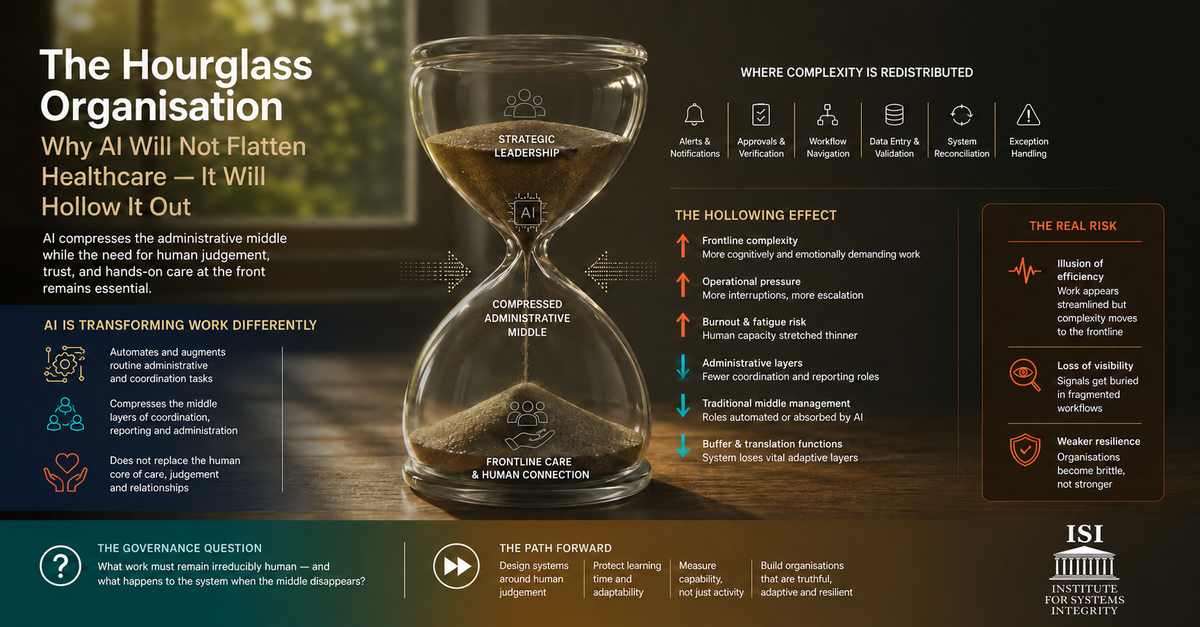
The emerging healthcare structure may increasingly resemble an hourglass:
A small strategic leadership layer
focused on:
governance
capital allocation
risk oversight
strategy
system coordination
A compressed operational middle
where many coordination and administrative functions become AI-supported or automated
A very large frontline workforce
still responsible for:
human interaction
physical care
clinical judgement
ethical interpretation
situational escalation
relationship management
This is the organisational consequence many leaders are failing to anticipate.
Because administrative work rarely disappears.
It moves.
The Most Dangerous Illusion in AI Transformation
Healthcare organisations often believe automation reduces workload.
But many digital transformations merely redistribute it.
Tasks once handled centrally become fragmented across frontline workers through:
alerts
approvals
verification steps
workflow navigation
system reconciliation
data validation
digital coordination
The organisation appears leaner.
But operational burden silently shifts downward.
Clinicians increasingly become:
system navigators
workflow managers
documentation processors
digital coordinators
exception handlers
And because the work is fragmented, it often becomes invisible.
The result is one of the most dangerous illusions in modern healthcare:
the illusion of efficiency without reduction in complexity.
AI Does Not Remove Complexity
It Redistributes It
This is one of the great governance blind spots emerging in healthcare AI.
Boards frequently ask:
“How many roles can AI eliminate?”
But the more important question is:
“Where does the complexity go?”
Because complexity never disappears.
It relocates.
And in healthcare, relocated complexity usually ends up:
at the bedside
inside clinical workflows
inside escalation pathways
inside already exhausted frontline teams
That is where burnout accelerates.
That is where adaptation slows.
That is where systems drift begins.
The Frontline Paradox
Ironically, the more AI enters healthcare, the more valuable human capability may become.
Not less.
Because as automation expands:
exceptions increase
edge-case complexity increases
ethical ambiguity increases
trust dependency increases
cross-system coordination increases
Meaning the remaining human work becomes:
more cognitively demanding
more emotionally demanding
more operationally intense
Not simpler.
The OECD warns that healthcare AI deployment introduces risks not only to patients, but also to providers through workforce disruption, liability uncertainty, and increasing coordination complexity.
This creates a paradox many organisations are not prepared for:
AI may reduce some forms of labour while intensifying the human labour that remains.
The Administrative Middle Was Never Just “Overhead”
One of the biggest strategic mistakes organisations may make is treating all middle layers as inefficiency.
Because much of the operational middle exists to absorb:
coordination friction
ambiguity
translation work
escalation handling
context interpretation
social negotiation
human adaptation
These functions are often poorly visible on balance sheets.
But highly visible during failure.
When organisations remove coordination layers without redesigning operational architecture, frontline systems become increasingly fragile.
And because performance may initially improve:
boards often mistake early acceleration for successful transformation.
But speed is not the same as resilience.
The Governance Danger: Algorithmic Management Without Organisational Redesign
The ILO defines algorithmic management as the use of software and AI systems to organise, assign, monitor, supervise, and evaluate work.
In healthcare, this increasingly includes:
workflow allocation
rostering optimisation
clinical prioritisation
performance monitoring
productivity tracking
fatigue monitoring
task assignment
This creates a major governance challenge.
Because organisations can become:
more measured
more monitored
more data-rich
while simultaneously becoming:
less adaptive
less truthful
less resilient
The danger is not simply automation.
It is organisational redesign driven by metrics rather than operational reality.
The Real Risk Is Not Job Loss
It is organisational misdesign.
The future danger is not merely that AI removes workers.
It is that leaders redesign healthcare systems based on assumptions imported from industries with fundamentally different task architectures.
Healthcare is not software.
Patients are not workflow units.
Care is not throughput.
And systems built around digital efficiency alone may become:
operationally brittle
clinically exhausting
psychologically corrosive
governance-blind
The Future Will Not Be Uniform
There will not be one AI organisational model.
Some industries may become:
highly automated
digitally coordinated
algorithmically managed
Others may become:
frontline-heavy
trust-dependent
human-centred
operationally complex
The future structure of organisations will depend less on AI itself and more on:
task architecture
risk tolerance
human interaction requirements
safety criticality
regulatory burden
trust dependency
operational ambiguity
That is the real story of AI and work.
Not universal replacement.
But uneven organisational transformation.
The Real Governance Question
The question is no longer:
“How do we deploy AI?”
It is:
“What work must remain irreducibly human — and what happens to the system when the middle disappears?”
Because the future may not belong to the flattest organisations.
It may belong to the organisations that integrate AI without losing:
operational reality
truth transmission
human judgement
adaptive capacity
frontline trust
And the organisations that fail may not fail because AI was weak.
They may fail because they misunderstood the shape of human work itself.
Harvard References
Acemoglu, D. and Restrepo, P. (2019) ‘Automation and new tasks: How technology displaces and reinstates labor’, Journal of Economic Perspectives, 33(2), pp. 3–30.
Almyranti, M., Sutherland, E., Ash, N. and Eiszele, S. (2024) Artificial Intelligence and the Health Workforce: Perspectives from Medical Associations on AI in Health. Paris: OECD Publishing.
Autor, D.H., Levy, F. and Murnane, R.J. (2003) ‘The skill content of recent technological change: An empirical exploration’, Quarterly Journal of Economics, 118(4), pp. 1279–1333.
Brynjolfsson, E., Li, D. and Raymond, L.R. (2025) ‘Generative AI at work’, Quarterly Journal of Economics, 140(2), pp. 889–942.
International Labour Organization (2025) Generative AI and Jobs: A Refined Global Index of Occupational Exposure. Geneva: ILO.
International Labour Organization (2025) Algorithmic Management in the Workplace. Geneva: ILO.
OECD (2025) How Widespread is Algorithmic Management in Workplaces? Paris: OECD Publishing.
Ricciardi, W., Di Pumpo, M., Causio, F.A. and Boccia, S. (2026) ‘The double-edged sword of automation and the risks of AI’s uneven impact on healthcare professions’, Annali dell'Istituto Superiore di Sanità, 62(1).