Social Purpose Is a Governance Test — Not a Statement : Why Boards That ‘Believe in Purpose’ Still Fail to Deliver It
Purpose is no longer a branding exercise. It is becoming a governance test. The Institute for Systems Integrity examines why boards must stop treating social purpose as narrative — and start governing the systems that produce real-world consequences.
Dr Alwin Tan, GAICD, MBBS, FRACS, EMBA (Melbourne Business School)
Senior Surgeon | Governance Leader | HealthTech Co-founder |
Harvard Medical School — AI in Healthcare |
Australian Institute of Company Directors — GAICD Graduate|
University of Oxford — Sustainable Enterprise
Most organisations now speak the language of purpose.
They publish values.
They promote ESG commitments.
They release sustainability reports.
They speak about stakeholders, communities, trust, and responsibility.
And yet — across industries — the lived experience inside many systems tells a different story.
Workers burn out inside organisations claiming to put people first.
Communities absorb harm from organisations promoting responsibility.
Customers lose trust in companies speaking constantly about values.
Hospitals claim patient-centred care while rewarding throughput over humanity.
Technology companies publish ethical principles while deploying systems faster than governance can understand them.
This is the uncomfortable truth modern governance still struggles to confront:
Purpose is not what organisations say.
Purpose is what their systems repeatedly produce.
And increasingly, society can see the difference.
The Great Governance Misunderstanding
For decades, social purpose was treated as an extension of reputation.
A communications layer.
Something added after:
- profitability
- operational performance
- strategic growth
Purpose was often positioned as:
- branding
- culture language
- corporate citizenship
- philanthropy
- ESG disclosure
But modern governance conditions have changed.
Boards no longer operate in environments where organisational narratives remain protected from scrutiny.
Today:
- employees publicly expose hypocrisy
- consumers rapidly mobilise
- operational failures become visible in real time
- investors increasingly interrogate governance integrity
- regulators examine conduct, not merely disclosure
- AI and digital systems magnify organisational consequences at scale
Under these conditions, purpose stops being symbolic.
It becomes operational.
And once operational, it becomes a governance issue.
The Shift from Narrative to System
The central governance mistake is this:
Most organisations still govern purpose as language rather than system behaviour.
Boards approve:
- purpose statements
- ESG frameworks
- strategic narratives
- culture slogans
But systems do not respond to statements.
Systems respond to:
- incentives
- accountability
- information flow
- operational pressure
- resource allocation
- performance structures
- leadership behaviour
This distinction matters enormously.
Because under pressure, systems will always prioritise what they are truly designed to optimise.
Not what leadership claims to value.
If an organisation rewards:
- speed over safety
- output over people
- silence over escalation
- growth over integrity
Then those outcomes become the organisation’s operational purpose — regardless of the official narrative.
Purpose Drift
At the Institute for Systems Integrity (ISI), we describe this phenomenon as:
👉 Purpose Drift
Purpose drift occurs when:
the stated purpose of an organisation gradually separates from the outcomes its systems actually produce.
Importantly, this rarely happens through deliberate corruption.
It happens through:
- accumulated incentives
- filtered reporting
- operational pressure
- governance distance
- leadership insulation
- performance obsession
- institutional normalisation
And because this drift occurs gradually, boards often fail to recognise it while it is developing.
The dashboard still appears positive.
Metrics still look acceptable.
Reports remain reassuring.
The narrative remains intact.
But frontline reality begins changing long before governance notices.
This is why many institutional failures appear “sudden” externally while feeling predictable internally.
The system has usually been drifting for years.
The New Visibility Problem
Historically, organisations could sustain gaps between stated values and lived experience for long periods.
That is becoming increasingly difficult.
Modern systems now generate continuous feedback loops:
- social media
- workforce transparency
- whistleblower visibility
- stakeholder activism
- digital reporting ecosystems
- public accountability movements
The consequence is profound:
The gap between declared purpose and operational reality is becoming visible faster than governance systems can adapt.
This creates a new form of governance risk:
👉 legitimacy instability.
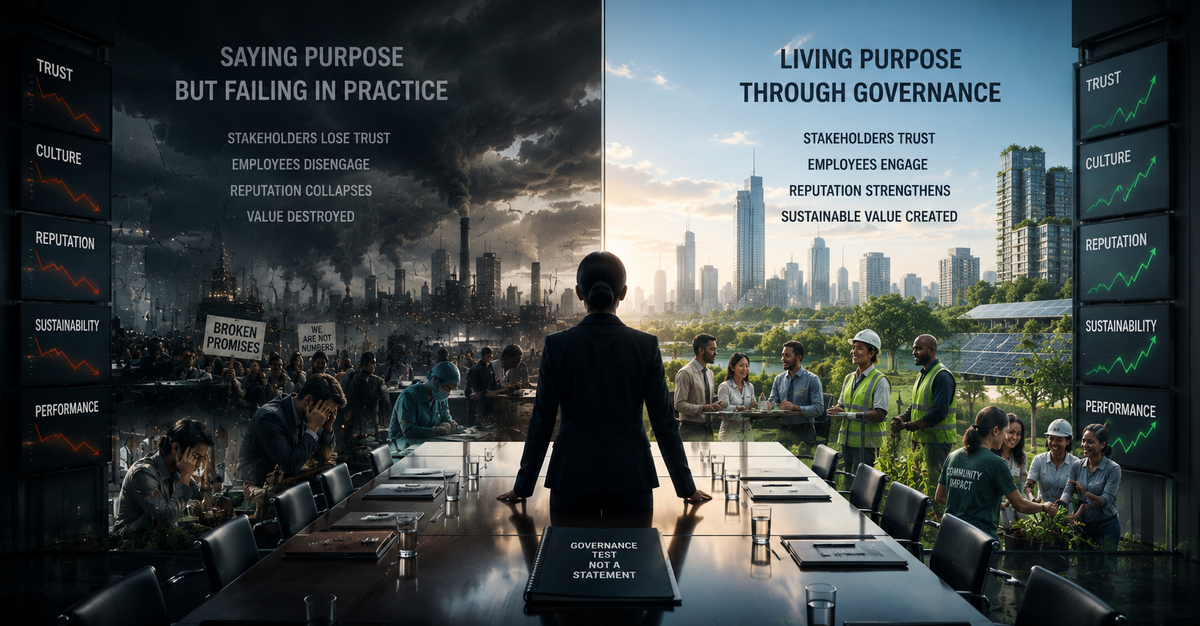
Once stakeholders lose trust that an organisation genuinely operates according to its stated purpose:
- workforce disengagement rises
- reputational resilience weakens
- regulatory pressure increases
- public scrutiny intensifies
- strategic credibility deteriorates
Purpose therefore becomes directly linked to organisational sustainability.
Not morally alone.
Operationally.
The Failure of Symbolic Governance
Many boards believe they are governing purpose because:
- committees exist
- disclosures are published
- ESG metrics are reported
- stakeholder language appears in strategy documents
But governance artefacts are not governance outcomes.
A purpose statement is not proof of purpose integrity.
In many organisations, purpose governance becomes:
- symbolic reassurance
- institutional theatre
- narrative management
- reputational insulation
Meanwhile, operational incentives continue driving contradictory behaviour.
This creates one of the most dangerous governance conditions possible:
convincing moral language combined with structurally misaligned systems.
Because the stronger the narrative becomes, the easier it is for boards to mistake communication for alignment.
The ISI Position
The Institute for Systems Integrity takes a different view.
We argue that:
👉 Purpose is not intent.
Purpose is system output integrity.
The governance question is therefore not:
“Does the organisation believe in purpose?”
It is:
“Can the organisation’s systems reliably produce outcomes consistent with its stated purpose — especially under pressure?”
Pressure is the real governance test.
Not:
- the annual report
- the strategy presentation
- the values campaign
- the leadership summit
But:
- financial stress
- operational overload
- workforce shortages
- crisis escalation
- political pressure
- public scrutiny
- AI deployment
- conflicting incentives
Because pressure reveals what the system truly protects.
The Purpose Integrity Framework
ISI proposes that boards govern purpose through five interconnected dimensions:
1. Declared Purpose
What the organisation publicly claims to value.
2. Governed Purpose
How purpose is embedded into:
- strategy
- risk appetite
- capital allocation
- executive incentives
- accountability structures
3. Operational Purpose
How purpose appears in:
- workflow design
- staffing decisions
- technology implementation
- escalation pathways
- stakeholder treatment
4. Observed Purpose
What employees, customers, patients, regulators, and communities actually experience.
5. Purpose Drift
The measurable gap between:
- declared purpose
and - operational outcomes.
Why This Matters Now
The shift toward stakeholder governance is accelerating globally. Research increasingly suggests that organisations are being evaluated not only on shareholder return, but also on their ability to manage long-term stakeholder relationships, legitimacy, and systemic impact.
Emerging governance scholarship also argues that boards are now expected to navigate competing stakeholder priorities, technological disruption, and broader societal expectations simultaneously.
At the same time, research into stakeholder governance suggests that purpose only becomes meaningful when embedded into governance structures, operational processes, and decision-making systems rather than remaining discretionary or symbolic.
This is why the era of optional purpose is ending.
Not because organisations are becoming charities.
But because:
- trust now affects performance
- legitimacy now affects resilience
- stakeholder confidence now affects sustainability
- governance quality now affects organisational survival
What Boards Must Ask Themselves
Boards serious about governing purpose should ask:
- What behaviours does our system truly reward?
- What trade-offs quietly undermine our stated purpose?
- Where is frontline reality filtered before reaching governance?
- What happens to our values under operational pressure?
- Which stakeholder harms are systematically normalised?
- Are our incentives aligned with our stated purpose?
- Who can safely challenge organisational drift?
- Are we measuring outcomes — or managing narratives?
Most importantly:
What does our organisation consistently produce when no one is watching?
Because that is the organisation’s real purpose.
Not the statement.
The system.
Final Position
The future of governance will not belong to organisations with the most convincing purpose language.
It will belong to organisations whose systems can withstand the pressure of living their purpose.
Because in the modern era:
- purpose affects trust
- trust affects legitimacy
- legitimacy affects resilience
- resilience affects survival
And none of these can be governed through branding alone.
👉 Purpose is no longer a statement to approve.
It is a system to govern.
Boards that fail to recognise this are not merely behind the curve.
They are governing a version of reality that no longer exists.
References
Australian Institute of Company Directors (AICD) 2022, Best interests duty, AICD, Sydney, viewed 16 May 2026, https://www.aicd.com.au.
Australian Institute of Company Directors (AICD) 2024, Not-for-Profit Governance Principles, AICD, Sydney.
Born, DH & Correa, M 2025, ‘5 ways organizations can pivot with purpose’, Harvard Business Review, 3 December.
Business Roundtable 2019, Statement on the Purpose of a Corporation, Business Roundtable, Washington DC.
Clegg, S, Courpasson, D & Phillips, N 2021, Power and Organizations, Sage, London.
Eccles, RG, Ioannou, I & Serafeim, G 2020, ‘The impact of corporate sustainability on organizational processes and performance’, Management Science, vol. 60, no. 11.
Freeman, RE 1984, Strategic Management: A Stakeholder Approach, Pitman, Boston.
Harvey, W, Newman, A & Ward-Christie, L (eds) 2026, The Oxford Handbook of Social Purpose, Oxford University Press, Oxford.
Klettner, A, Cetindamar, D & Sainty, R 2025, ‘Stakeholder governance and corporate purpose in certified B Corps: Minimizing conflict and fostering collaboration’, Business & Society.
Mayer, C 2021, Prosperity: Better Business Makes the Greater Good, Oxford University Press, Oxford.
Paine, LS 2023, ‘The value of corporate purpose’, Harvard Business Review, November.
Rowley, TJ & Capron, L 2025, ‘How the best boards engage with management’, Harvard Business Review, January–February.
Youmans, T & Mackey, J 2020, ‘3 ways to put your corporate purpose into action’, Harvard Business Review, 13 May.