Dual-Culture Organisations : How protected executive cultures distort governance, escalation, and organisational truth
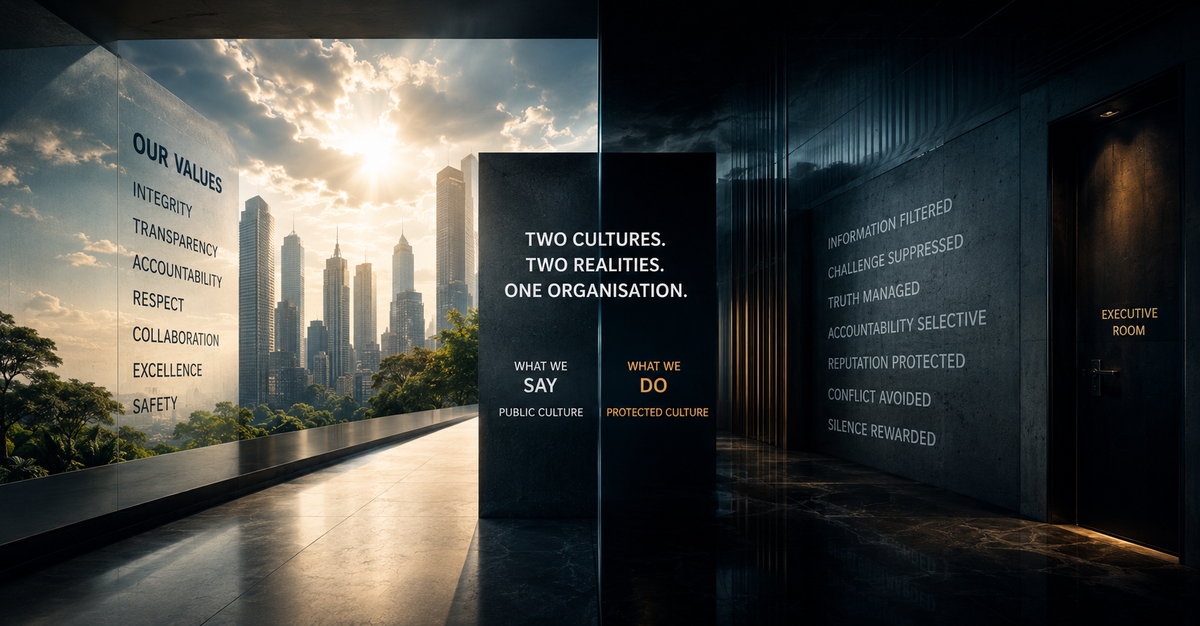
Some organisations do not have one culture. They have a public culture of values, transparency and accountability — and a protected executive culture where truth is filtered, escalation becomes political and boards inherit a curated version of reality.
Dr Alwin Tan, GAICD, MBBS, FRACS, EMBA (Melbourne Business School)
Senior Surgeon | Governance Leader | HealthTech Co-founder |
Harvard Medical School — AI in Healthcare |
Australian Institute of Company Directors — GAICD Graduate |
University of Oxford — Sustainable Enterprise
By Institute for Systems Integrity (ISI)
Executive summary
Many organisational failures are analysed through the lens of:
- compliance,
- strategy,
- leadership,
- or operational execution.
But beneath many of these failures sits a deeper structural issue:
the existence of two simultaneous organisational cultures.
One culture is publicly presented:
- values-driven,
- transparent,
- accountable,
- psychologically safe.
The other culture operates privately within protected leadership and executive environments:
- politically filtered,
- selectively accountable,
- reputation-sensitive,
- and resistant to internal challenge.
At ISI, we describe this phenomenon as:
a dual-culture system.
This matters because dual cultures distort:
- escalation,
- signal integrity,
- governance visibility,
- and organisational learning.
The result is not simply hypocrisy.
It is governance degradation.
Culture is not what organisations say
Organisations often define culture through:
- mission statements,
- leadership principles,
- codes of conduct,
- and formal values frameworks.
However, decades of organisational research demonstrate that operational culture is not determined by stated values alone.
It is determined by:
- incentive structures,
- informal power,
- behavioural reinforcement,
- and executive response under pressure.
This distinction is critical.
Because the culture visible externally may differ substantially from the culture practised internally among decision-makers.
The architecture of dual-culture systems
Dual-culture systems emerge when:
- executive behaviour diverges from stated organisational values,
- challenge becomes politically risky,
- accountability becomes selective,
- and truth becomes conditional.
Over time, two separate behavioural systems develop.
1. The public culture
The organisation’s declared identity:
- transparency,
- integrity,
- speaking up,
- accountability,
- inclusion,
- safety.
This culture is:
- communicated publicly,
- reinforced through policy,
- and often genuinely believed by leadership.
2. The protected culture
The executive operating culture under reputational pressure.
This culture is revealed through:
- what is protected,
- what is suppressed,
- who can be challenged,
- and how uncomfortable truths are handled.
Observable features include:
- selective escalation,
- over-collegiality,
- informal immunity for high performers,
- politically managed investigations,
- and reputational containment behaviour.
Why dual cultures become dangerous
Dual-culture systems create a progressive distortion of organisational truth.
Importantly, truth does not disappear.
It becomes:
- filtered,
- delayed,
- softened,
- or strategically reframed.
This creates four escalating governance risks.
1. Signal degradation
Critical information no longer moves upward accurately.
Staff adapt reporting behaviour based on:
- perceived political safety,
- historical consequences,
- and observed executive reactions.
As a result:
- near misses may not escalate,
- behavioural concerns become muted,
- and operational risk becomes underreported.
The board experiences:
- smoother reporting,
- fewer visible problems,
- and increasing confidence.
This confidence may be false.
2. Psychological safety fragmentation
In dual-culture systems, psychological safety becomes unevenly distributed.
Certain groups may feel:
- heard,
- protected,
- and trusted.
Others may experience:
- silence,
- retaliation risk,
- exclusion,
- or reduced credibility.
This fragmentation commonly follows:
- hierarchy,
- professional identity,
- tribal alignment,
- or cultural power structures.
The organisation may publicly promote “speaking up” while privately rewarding silence.
3. Governance blindness
Boards govern through signals.
If signals become distorted:
- oversight quality deteriorates,
- risk visibility declines,
- and decision-making becomes disconnected from operational reality.
This is particularly dangerous because boards may sincerely believe:
- escalation systems are functioning,
- culture is healthy,
- and transparency exists.
In reality:
- the organisation may already have adapted around leadership sensitivities.
At that point, governance becomes:
management of perception rather than management of reality.
4. Institutional hypocrisy
The wider the gap between:
- declared values
and - observed executive behaviour,
the more unstable the organisation becomes.
Staff eventually stop trusting:
- statements,
- town halls,
- leadership messaging,
- and formal culture programs.
Instead, they learn culture through:
- observation,
- consequences,
- and informal survival behaviour.
This creates:
- disengagement,
- cynicism,
- reduced escalation,
- and institutional distrust.
Why healthcare is especially vulnerable
Healthcare systems contain:
- strong hierarchy,
- professional tribalism,
- operational pressure,
- reputational sensitivity,
- and asymmetric power structures.
This creates ideal conditions for dual-culture dynamics.
Healthcare organisations may publicly state:
- patient safety is paramount,
- speaking up is encouraged,
- escalation is protected.
Yet privately:
- certain clinicians may become institutionally protected,
- complaints may be politically managed,
- junior staff may fear career consequences,
- and operational concerns may be reframed as interpersonal conflict.
This creates a profound systems risk.
Because:
the people closest to patient harm often possess the least organisational power.
When this occurs, the system loses signal before it loses safety.
APRA and the danger of “chronic ease”
The APRA Prudential Inquiry into CBA identified:
- complacency,
- insularity,
- over-collegiality,
- and insufficient challenge.
Its most important conceptual contribution was distinguishing between:
- chronic ease
and - chronic unease.
Dual-culture systems frequently exhibit chronic ease at leadership level:
- high trust within executive groups,
- reduced challenge,
- avoidance of destabilising conversations,
- and increasing reliance on reputational management.
Externally, these organisations may appear:
- high-performing,
- polished,
- and stable.
Internally, signal integrity may already be collapsing.
How boards should test for dual cultures
Boards should stop asking:
“Do we have good culture?”
And instead ask:
Signal integrity
- What information consistently reaches us late?
- What are frontline staff afraid to escalate?
Accountability consistency
- Are consequences applied equally across hierarchy and influence?
Executive behaviour
- Do leadership behaviours align with stated values under pressure?
Reporting distortion
- Are we seeing polished reporting without operational tension?
Protected groups
- Who appears institutionally untouchable?
These questions are uncomfortable.
That discomfort is healthy.
Because governance failure rarely begins with visible collapse.
It begins when organisations become too psychologically comfortable with themselves.
ISI position
At ISI, we believe culture should be governed as:
a behavioural control system governing truth movement inside institutions.
Dual-culture systems represent:
- signal distortion,
- governance fragmentation,
- and institutional risk accumulation.
The danger is not merely reputational.
It is operational.
Because once truth becomes conditional inside leadership structures:
- escalation weakens,
- learning deteriorates,
- and organisational blindness emerges.
Conclusion
The most dangerous organisations are often not openly dysfunctional.
They are:
- polished,
- successful,
- admired,
- and publicly values-driven.
Because externally, they perform one culture.
But internally, behind executive and boardroom doors, they practise another.
And once organisations begin protecting internal comfort more than organisational truth…
References:
APRA (Australian Prudential Regulation Authority) 2018, Prudential Inquiry into the Commonwealth Bank of Australia: Final Report, APRA, Sydney.
ASIC (Australian Securities and Investments Commission) 2016, The Importance of Corporate Culture in Improving Conduct and Compliance, speech by G Medcraft, ASIC, Sydney.
ASX Corporate Governance Council 2019, Corporate Governance Principles and Recommendations, 4th edn, ASX Corporate Governance Council, Sydney.
Bromley, P & Powell, WW 2012, ‘From decoupling to recoupling: institutional contradictions and organizational responses to internal complexity’, Academy of Management Annals, vol. 6, no. 1, pp. 483–530.
Commonwealth of Australia 2019, Royal Commission into Misconduct in the Banking, Superannuation and Financial Services Industry: Final Report, Commonwealth of Australia, Canberra.
Edmondson, AC 2018, The Fearless Organization: Creating Psychological Safety in the Workplace for Learning, Innovation, and Growth, John Wiley & Sons, Hoboken.
Kahn, WA 1990, ‘Psychological conditions of personal engagement and disengagement at work’, Academy of Management Journal, vol. 33, no. 4, pp. 692–724.
Morrison, EW & Milliken, FJ 2000, ‘Organizational silence: a barrier to change and development in a pluralistic world’, Academy of Management Review, vol. 25, no. 4, pp. 706–725.
O’Donovan, R & McAuliffe, E 2020, ‘A systematic review of factors that enable psychological safety in healthcare teams’, International Journal for Quality in Health Care, vol. 32, no. 4, pp. 240–250.
Reason, J 2000, Human Error: Models and Management, BMJ, vol. 320, no. 7237, pp. 768–770.
Schein, EH 2010, Organizational Culture and Leadership, 4th edn, Jossey-Bass, San Francisco.
Tourish, D 2020, The Triumph of Nonsense in Public Corporations: How New Age Dogma Is Destroying Modern Management, Routledge, London.
Vaughan, D 1996, The Challenger Launch Decision: Risky Technology, Culture, and Deviance at NASA, University of Chicago Press, Chicago.
Weick, KE & Sutcliffe, KM 2015, Managing the Unexpected: Sustained Performance in a Complex World, 3rd edn, John Wiley & Sons, Hoboken.
World Health Organization 2021, Global Patient Safety Action Plan 2021–2030: Towards Eliminating Avoidable Harm in Health Care, WHO, Geneva.